Haitian Sun, Haitian Moon
By
Leo de Natale
As she peered through her airplane window, Elizabeth Ann Murphy thought the island nation of Haiti resembled paradise. There were mountainous regions, verdant forests and beachfronts with gentle waves lapping along pristine beaches. Looks can be deceiving, especially after the plane landed. She knew firsthand.
A former Dominican novice and a registered nurse, Elizabeth was traveling with a team of volunteers for their twice-yearly pilgrimage. It was a mission of mercy. She administered health care; the remainder were involved with construction projects. Elizabeth was a tall, attractive woman of 45 who’d left the novitiate life 15 years ago, met a man, married and bore two children. She had piercing blue eyes and soft brown hair flecked with gray. Her heart and spirit were unchanged from her convent days. She remained committed to helping unfortunate souls, whether it was the mean streets of her native New Jersey or the abject poverty and suffering that existed in this godforsaken Caribbean island.
The plane landed in Port-au-Prince. She and her colleagues were greeted with a blast of hot, humid air and the sounds, sights and smells of an overcrowded airport. Some Haitians were dressed as if they were headed for Carnival. They wore brightly colored shirts, hats and footwear. Many wore overpowering colognes and perfumes. These strong aromas were mixed with the commoners. Most wore plain peasant clothing that hadn’t been cleaned for weeks or perhaps months. Some walked barefooted. Indigent men and women with toothless faces pleaded for alms. Scantily clad women slinked through the airport lobby and hoped to snare an American who might rescue them from their hellish existence.
Elizabeth recognized the face of a young black male who was holding a sign, “Ecole de Notre Dame de Fatima”. His name was Jean-Claude and his dilapidated Kia minivan was waiting outside to whisk her and her team away from the crowds to the school that was her headquarters.
The Haitian sun was blinding but after ten years of missionary work, she had become accustomed to the physical assault of an equatorial climate. She learned that blood thins after several days of heat and humidity.
She was perspiring profusely as she entered the car. Her blouse and linen slacks were drenched with sweat. The car lacked air conditioning – a luxury few cars had. Jean-Claude weaved his way through the bustling, noisy crowds. Street beggars pleading for money thrust their hands through the grimy windows. The van increased speed and eventually gained road clearance. The school’s headquarters was about 70 miles outside the city.
Everywhere she looked, Elizabeth observed armed militia bearing stern faces and semi-automatic rifles. Tension between citizens and repressive political regimes was always palpable in Port-au-Prince. For 400 years, Haiti’s history has been marked with violence, oppression and suffering. Haitians continue to be a faith-based people. It’s an admixture of African Voodoo and Roman Catholicism.
As the human and automobile traffic thinned out, Jean-Claude, speaking in Creole French, updated Elizabeth on developments at the two elementary schools under her mission’s care. There were more than 700 students attending the schools.
“Les enfants besoin de plus nourriture,” he said. “The children, they still need more food.”
She presumed as much. Food and potable water were a continual problem, especially at the school she’d be visiting that was farther inland. The school in a remote mountainous place called Riviere Froide (Cold River) was usually the most needy. Her job was to assess the improvements the mission was implementing.
About two hours after driving, Elizabeth and her group arrived at the school district’s headquarters. They were greeted by the priest and nuns who taught at both schools. She was also gleefully welcomed by children who whooped and yelled at her. She was known as “Ste. Elizabeth” among the children, many of whom exhibited heartbreaking malnutrition. Distended stomachs and starvation stemming from parasitic infestation were always evident among the “pauvre enfants”.
She and the volunteers would surround themselves with these waifs and hand out candy that had been stuffed into suitcases. A handful of mints was treated like gold. One young Haitian girl, Sylvette Mimieux, was ecstatic when she saw Elizabeth. Five years prior, Sylvette, then age six, was afflicted with diphtheria. Her parents were weeping. Sylvette was near death. Fortunately, Elizabeth had brought numerous antibiotics. She administered the drugs and stayed with the child for 48 hours. The medicine worked and a special bond was created with the family. “Toujors Ste. Elizabeth!”. Elizabeth always sought out the family during each visit. Sylvette, now eleven, was a bubbly young girl with a beautiful smile. Her parents told her Sylvette became a good student with straight A’s in class. They were very happy and proud.
After a quick sponge bath and change of clothes, Elizabeth met with her Haitian partners in a meeting room. Ceiling fans helped move the stolid air and she was updated two vital and ongoing issues: food and water. Brother Julien, the school’s principal, said thanks to the aid from American Catholic organizations, the school was now providing a nutritious lunch for four days per week. Many children, he said, eat only every other day. This, she thought, is a poverty few in the Western World have experienced. The Haitians have a Creole phrase, “vant ki vid pa tande” –“An Empty Stomach Has No Ears” that best describes starvation among children.
Elizabeth told the officials her group’s goal in 2021 was to raise enough money to attain a goal of five daily meals per week. Under paid security details, her organization in the United States was now shipping thousands of food packets for the faculty and students. Though some shipments were stolen most foodstuffs and supplies reached school headquarters.
Potable water is the second issue. About 75 percent of Haitian villages lack running water. When not attending school, the children are charged with carrying water to their homes. Brother Julien reported that, again, Americans had contributed sufficient funds to begin the first phase of the Laval Water Project.
With the help of the Elizabeth’s group, the villagers have begun construction of a cistern that filters water. The children will still be carrying water but it will be clean, and safe to drink. When purified, the water from Riviere Froide is reflective in its name: cold and good.
After a long, hot exhausting day, the group ate a modest meal- mostly vegetables and tea. Elizabeth and crew were ushered into a curtained area that was designated sleeping quarters. The school provided canvas cots and sheets. Before retiring Elizabeth walked outside and looked around her. She was sweating. Crickets and buzzing insects could be seen, heard and felt.
She disregarded the annoyances and closed her eyes. She quickly opened them and stared upwards. With no ambient light pollution, the sky was magnificent. There were star clusters and the Milky Way shone. The sight of these heavens was awe inspiring. You never see a sky like this back in New Jersey, she mused. It was a learning moment. Surrounded by the misery on this small island, one could extract beauty that transcends the human condition. The inhabitants lead hellish lives where mere survival is a constant, daily challenge.
There is hope, however, when the Haitians meet people from a different country and culture who arrive to help them lead an improved life. During her two week stay, Elizabeth conducted health clinics for children and adults. Drugs needed to combat infections and parasites were administered. She would then switch to school visitation and determine which books and supplies were needed. Her organization had contacts with French publishing houses. She listed the necessary materials and would place an orders after returning to the United States.
The day before she left, Elizabeth hosted a party for the children. She opened a large box containing Frisbees. The school placed food and candy in the discs. Brother Julien told Elizabeth the children were ecstatic with the Frisbees. He said they took them home where they’d be used as dinner plates. Simple pleasures. Amazing grace.
On the day of the team’s departure, a villager named Toussaint approached Elizabeth with a paper bag. He was a self-taught artist and created illustrated greeting cards. Using thin slices of coconut bark he crafted scenes of village life. He told her they were a gift to her. She could keep them or sell them. Any monies collected could be used for food or clothing. The cards were beautiful and manifested innate talent.
“These will sell very easily, Toussaint,” she said, thinking of the scripture, blessed are the poor, for they shall inherit the earth.
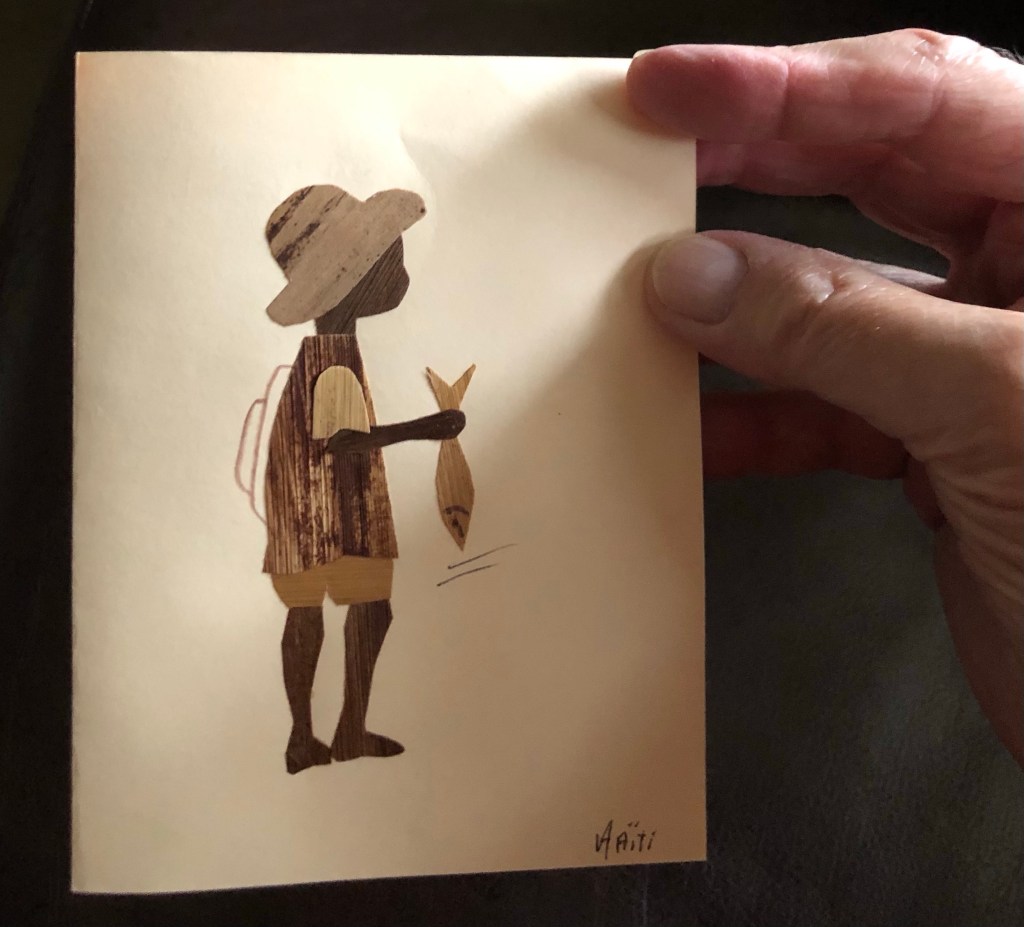
Later that day, the group arrived at the airport. Stepping from Jean-Claude’s van, Elizabeth basked in the steamy heat. In a few short hours she’d be returning to a world of bountiful food, creature comforts, computers, cell phones and WiFi. This had been a good visit, she thought. In six months she’d again return to her mission under the Haitian sun.
This is based on a true story. The organization is a non-profit charity. helpinghaitianchildren.com
 leodenatale.com
Oh, Leo, the piece about Haiti is so vivid,the poverty and hunger so visceral. I’ve never been there, have you?What a cruel world it is to have such poverty so near to our usa’s wealth.
Ever read Mountains Beyond Mountains? It’s a GREAT, about Partners in Health in
Haiti.
Hug,
Judy
LikeLike