Broca’s Area 10: Return of the Eloi
By
Leo de Natale
Illustrations by Vince Giovannucci
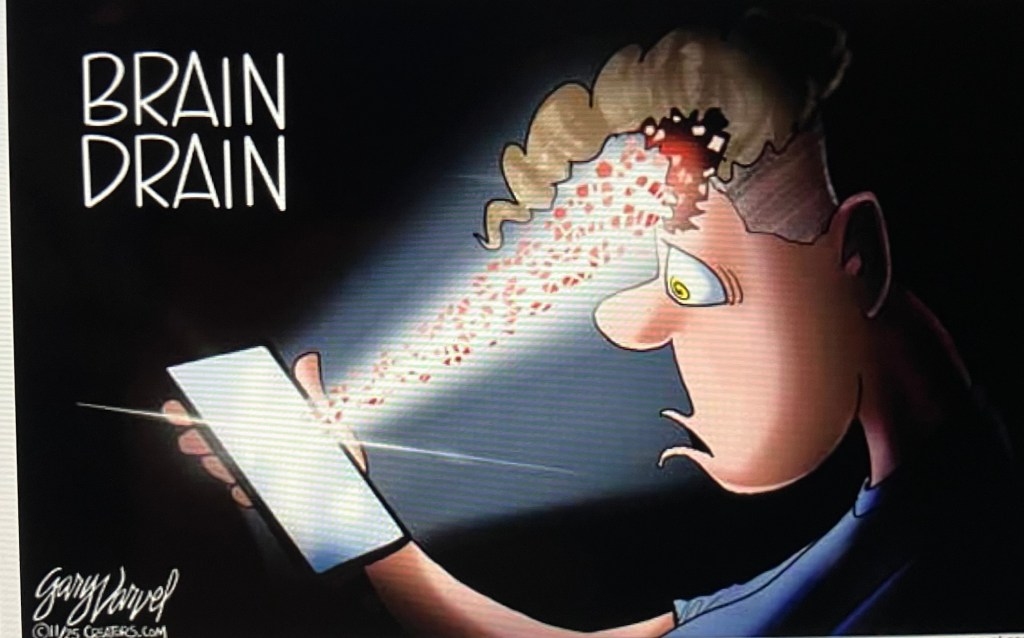
There is a new term that describes Americans under the age of 30: generational aphasia. Slowly, almost insidiously, boys and girls, men and women who have grown up under the specter of cell phones, laptops and social media have lost the ability to speak.
Charles Younger, an English teacher in a Boston Metro West suburb, has observed that among school children, the cell phone is no longer used for talking. He has witnessed students sitting three feet away from each other texting rather than turning their heads to converse. Children and young adults won’t call their parents. They text or use SnapChat, Twitter, etc.
Younger said this has translated into a strange phenomenon he’s noticed in his classroom. Students may do well on tests or school projects but fail in public speaking. He said they have an inability to talk in front of a class. They have difficulty privately discussing assignments with Younger and constantly use such verbal crutches as “like” and “you know”. He yearns for students to utter a simple declarative sentence.
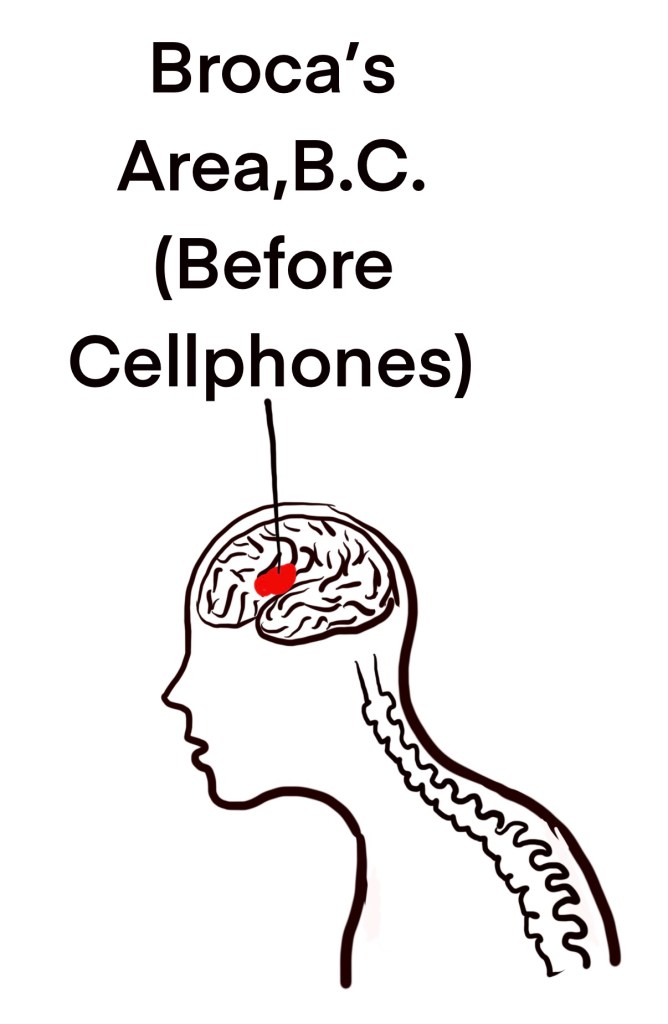
Aphasia is medically defined as the inability to comprehend or formulate language because of damage to a specific brain area known as Broca’s Area 10. It is usually associated with head trauma or brain tumors.
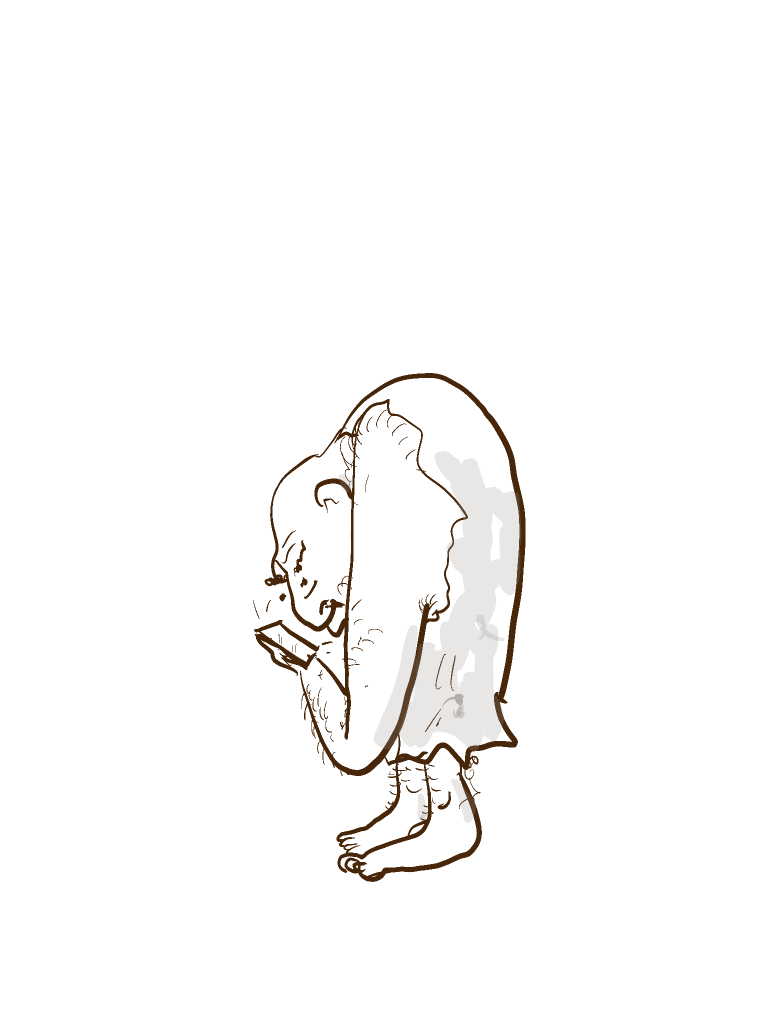
Anyone over 50 has difficulty reconciling this lifestyle change. This includes people who remember dial, touch tone telephones and phone booths. Telephone books, too. Physical posture has changed. Instead of walking as a homo erectus, humans are slouching, their necks bent. Neanderthal anatomy is returning.
During the past 30 years, our society has been seduced by the exciting flashy lights of technology. New devices were introduced at a dizzying pace. Thinner and faster PCs begot portable laptop computers, tablets, and, of course, the handheld cell phone. Concurrent with the mechanical devices was the Internet, a revolutionary network of cybernetic research and communication. The world was transformed.

We were so distracted and didn’t realize an imperceptible lulling effect engulfing us. We were literally and figuratively losing our voices. The new toys of technology stole our ability or inclincation to talk.
It is depressing to realize how these modern devices that promised to make life easier, efficient and time saving have, like Covid 19 virus, spawned a generation that’s actually dumbed down. We are creating automatons unable to function in the real world where problems cannot be solved by asking Siri.
For example, before the 2020 pandemic, restaurant customers were rapidly manifesting the loss of etiquette. It wasn’t unusual to observe groups of young diners sitting at their tables, staring at their phones. No scintillating conversations going on there. What’s wrong with you folks? Have you no manners or sophistication?
The novelist H. G. Wells was a visionary British author whose life straddled two centuries. He was born in 1866 and died in 1946. He was a prolific writer and is best known for his futuristic books, especially War of The Worlds and The Time Machine. In his lifetime he witnessed how technology would affect mankind.
Wells would find current society ironically similar to the characters in The Time Machine. In his novel, a London scientist known only as “The Time Traveler” invents a machine allowing travel forward or backwards in time. Being adventuresome, the character pushes a lever into the future and the machine hurls him through time and space. Three times during the 20th Century he stops and discovers England is at war. The last war produces nuclear annihilation.
Leaving quickly before the bombs are dropped, he pushes the lever further and arrives at the year 802,701 A.D. He discovers a different planet where England is transformed into a tropical paradise and is inhabited by two species: subterranean ghouls called Morlocks and effete, passive inhabitants living above ground and known as the Eloi.
Physically, the Eloi are cookie cutter humanoids. They are blonde, blue-eyed, and wander about and behave as a nation of lobotomized airheads. As one critic said, the Eloi “lost the spirit, intelligence and physical fitness of humanity at its peak.”
The Traveler befriends a female named Weena who takes him to a decaying building called “The Palace of Green Porcelain”. It’s a museum full of books that disintegrate into dust if touched. Nearby is a table of rings. The rings, when spun, elicit an historical narration of the world. He learns the nuclear wars changed the planet’s geology. The disfigured, Morlocks live in darkened tunnels. They are cannibals who breed the Eloi for consumption. Periodically a siren blares and the Eloi passively enter a cave and are slaughtered by clever but genocidal mutants who survived obliteration but assumed a bestial mantle.
The Time Machine is, of course, fiction but Wells was a prescient writer and somewhat clairvoyant. His other famous book, War of the Worlds, was a story about alien space ships invading Planet Earth.
The 21st Century appears to be assuming a schizoid character. The world has become technologically advanced. The Internet and the various electronics have revolutionized how businesses perform. It has changed the landscape of interpersonal communications and lifestyle behavior. Yet these advancements are creating deleterious sociological effects.
Society is becoming coarser and ill-mannered. The question remains if these dehumanizing changes will create generations of new Eloi who speak little and live in a world of catatonia. Will Broca’s Area 10 become anatomically vestigial? Time will tell.
Will this be our back to the future?
 leodenatale.com