Out of the Inkwell
By
Leo de Natale
Illustration by Vince Giovannucci
Daniel Butler Elementary School, Belmont MA
“Good morning class,” Teacher Mildred Gale said to her freshly scrubbed fourth graders. “Today we start our penmanship exercises. We’ll be using the Rinehart method.”
Miss Gale was dour and a character from Central Casting. She wore rimless eyeglasses; her triangular face possessed a priggish mouth that rarely smiled. She wore no makeup and her hands were unadorned with jewelry or nail polish. Her dresses were matronly – the style you see in Vermont Country Store catalogs and, of course, there were the obligatory sensible shoes. She was, shall we say, not warm and fuzzy. Miss Gale was the quintessential old maid.
“All right class, let’s take out our pens and begin writing,” she said.
Miss Mildred Gale
Public schools had universal hierarchy. Grammar school was kindergarten through grade 6. Miss Gale taught at the Daniel Butler school in Belmont, Massachusetts , a Boston suburb. Junior High, an age group where male and female hormones exploded was grades 7 through 9. High school included grades 10-12. Then it was off to college, the military, or the trades.
An accompanying inkwell:
“I detest sloppiness when it comes to writing,” she’d sneer. “There is no excuse for writing too fast or too slow. Both extremes will cause messiness. An even pace is the best way to write. Do you hear me, people?”
Of course most students did smudge after leaving an ink puddle after a cursive letter. With the Rinehart Handwriting System, the T’s, F’s and S’s were the usual culprits. Once the smudge occurred, kids would grasp the blotter and try to absorb as much ink as possible. The botched writing assignment would incur Miss Gale’s wrath. Many kids would earn only a middling C grade in penmanship. The writing courses were taught in all grammar school grades. Most students would arrive home with black ink stains on their fingers – or, worse, their clothes.
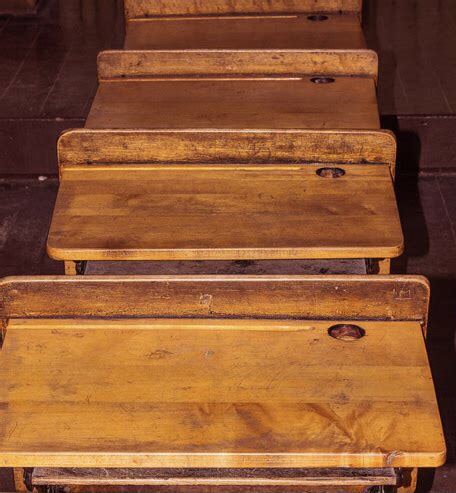
Fast forward to today. Miss Gale would be shocked at the classroom curricula. She’d discover a completely alien environment. Slate blackboards and chalk have been replaced with whiteboards and erasable Sharpie ink pens. There’d be no desks with inkwell holes or ink and stick pens. Introduced in the 1950’s, ball point pens increased in popularity and eventually replaced fountain pens. Penmanship would be abandoned from school curricula. Students today no longer write in cursive hand writing. Everybody prints. For anyone under age 40, written signatures are extinct.
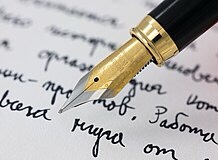
And yet there are people who cling to yesteryear. Fahrney’s, a Maryland –based company, has survived and specializes in fountain pens. The pens vary considerably in price. A Parker or Cross pen can be purchased for less than $100. Mont Blanc, a German pen company, manufactures fountain pens that are considered the Rolls Royce of writing instruments; many many Mont Blanc pens cost more than $1,000. Prices increase when 18k gold nibs are used.
Boston has several stationery stores that still sell medium to high-end fountain pens.
“Yeah, the fountain pens are a niche market,” said Buster McGee, owner of With Pen In Hand stationers. “We have some customers who’ll purchase five or six pens at a time. Penners can sometime border on being fetishists. They want different nib widths and different colored inks. Peacock blue, for example has made a comeback. It was really popular in the 50’s but black and blue inks are still the main colors.”
McGee is a classic stationer. Tall and lanky, his face is adorned with a waxed handlebar mustache. He wears three piece suits. The necktie is highlighted by a diamond stick pin and his vest has a chain attached to a gold pocket watch. His shoes are polished. He’s a dandy and if it were 1910, he’d probably be wearing spats. His persona fits perfectly with someone who uses and sells fountain pens. In fact, he writes with a Mont Blanc DeLuxe fountain pen with a rhodium nib. The pen costs $985.
He said fountain pen popularity during the past 40 years has neither increased nor decreased. The demographics are tilted towards older men and women. Most people under 40 are oblivious to such an alien device.
“Kids today see a fountain pen and think of their parents talking about rotary telephones and Rolodex file cards,” he said while shaking his head. “They don’t have a clue.”
According to McGee, the pens have gained increased popularity in the Middle East and Asia. He’s sold many German Mont Blanc and Pelikan pens to Chinese students who attend area colleges and universities.
McGee said there are many famous names still associated with the American fountain pen industry: Parker, Esterbrook, Schaefer, Cross and Waterman. These companies continue to manufacture pens. Most pens are made from acrylic plastic; the more expensive use alternate materials ranging from wood, brass, silver or gold. Many also manufacture the water-based ink.
Fountain pen devotees consider them “instruments” rather than pens. There is a ritualistic component when one decides to write with fountain pens.
The ink bottle is opened and the pen’s rubber sac is squeezed. The ink is sucked in and the pen is ready for use. There is an atavistic pleasure in writing with pen and ink. Nib widths vary with the writer’s style. Some prefer the tight clean lines of a fine nib; others use the middle-of-the-road medium nib. Still others love the bold, broad cursive lines on the blunt nib that blend on paper with a flourish. Of course, there’s the extreme art form of calligraphy.
In an era where we are surrounded by tools of the computer age—cells phones, lap top computers and Bic ball point pens, it’s nice to know there’s an oasis of a different age that survives with purists and afficianados. Men and women who cling to the old ways will still enjoy the feeling of a nib gliding across smooth Clairefontaine writing paper. This is a form of communication that transcends centuries. Pen and ink. Pen and ink.
N.B.
The title of this essay, Out Of The Inkwell, is homage to an eponymous 20th Century cartoon series spanning the years 1918 to the 1930’s. Using a stick pen, illustrator Max Fleischer created many black and white cartoon characters. His most famous characters, Betty Boop and Popeye, still remain pop culture icons.
 leodenatale.com
Another great essay…I was taught I think the Palmer method. Now I sign electronically, a signature I could never duplicate. God I love the 21st century. TN10670
LikeLike