Shine My Shoes
By
Leo de Natale

Attached to a basement wall lies a family heirloom. It is not fine china, a framed portrait or a family coat-of-arms. The inheritance is a homely, rickety cast iron shoe shine rack that has served three generations. It is approximately 100 years old and is still used to polish my shoes as it was it for my late father’s and Grandpa Joe’s. The beauty of this family keepsake is its durability. Even today, the metal device slides along a track and stretches shoes. A large wing nut locks the device and the ritual of polishing shoes begins. Ten decades of service and, to my delight, this device still functions.
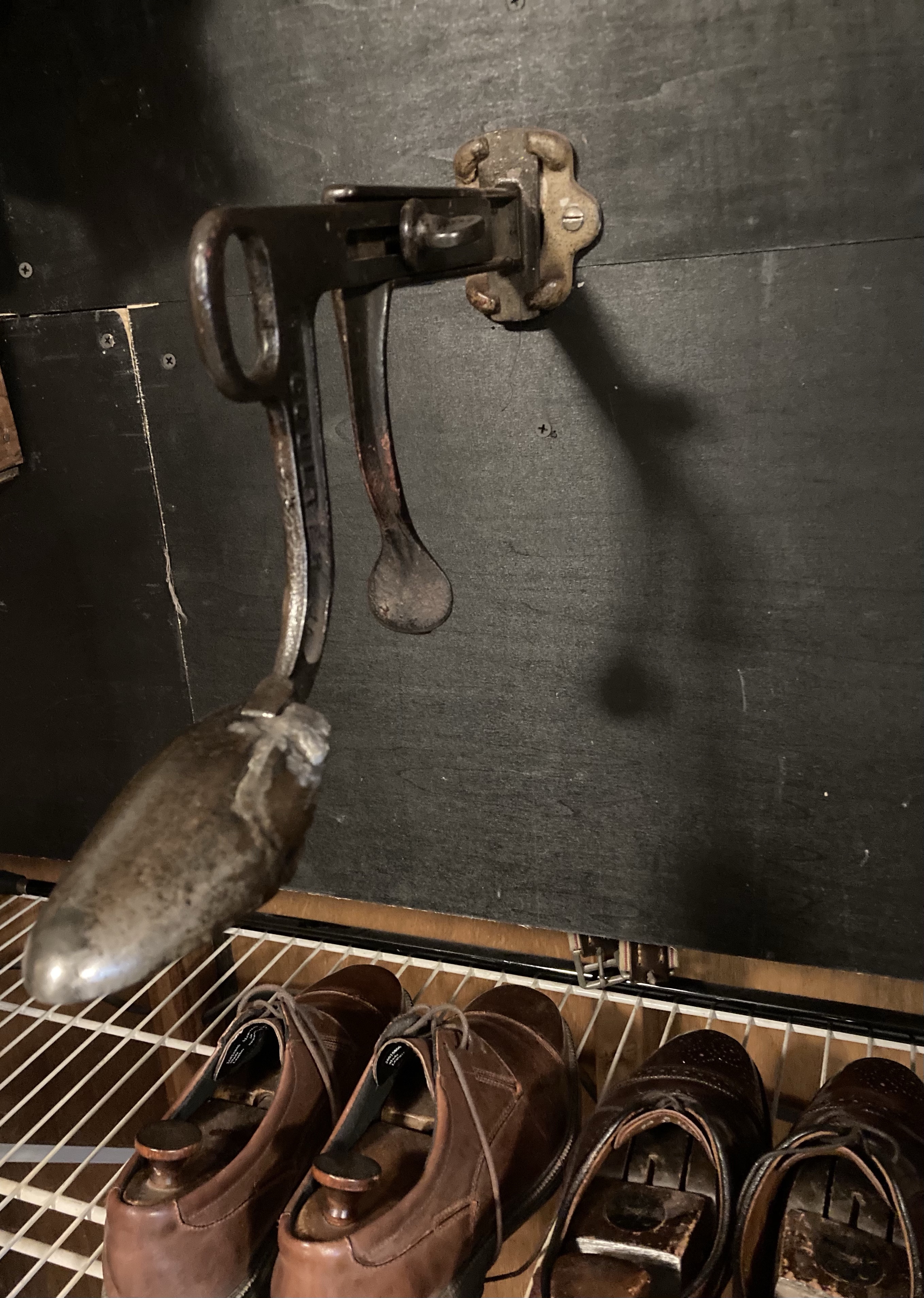
The author’s Coulter Manufacturing, Inc. shoe rack, patented 1904
I’m a sentimentalist and derive much pleasure from using something old that pertains to an activity, shining shoes. Caring for footwear draws little attention in the year 2021. Everything, including wardrobe, has become casual. Many associate shined shoes with several dubious groups: politicians, bankers, lawyers and Wall Street denizens.
As with so many aspects of life today, the pandemic has affected the simple act of shoe shining. I haven’t worked since March 2, 2020 and was forced into indefinite retirement. My elegant Allen Edmonds shoes lie dormant on shelves with, as music legend Chuck Berry would say, no particular place to go. They merely collect dust. I must confess that during the past year, I occasionally polished the shoes for a simple reason: nostalgia. It is a rite that has followed me my entire life.
My grandfather was a Sicilian immigrant. He was a barber who spoke no English when he arrived in America. I barely remember him but I do know he was a proud man who had an innate sense of style and physical appearance. There’s a family photograph of Grandpa wearing a bowler hat, a vest with pocket watch, a carefully groomed mustache and highly polished shoes.
How a person presented himself was very important in Italian culture. Both grandparents were proud of their five children and despite living through the Great Depression, they maintained a sense of style and decorum with the family. The shoe shine rack was always present and used during those years.
Within my family, using the rack became second nature. Although I never considered the routine demeaning, within society shoe shining sometimes had a negative connotation. Some would refer pejoratively to shoe shiners as “bootblacks”. The inference was their job lay with social inferiors. Throughout major cities, immigrant kids gathered at railway stations prepared to shine shoes on city streets, in subways and at hotels.
In a famous scene from the movie Goodfellas, a Mafioso insults actor Joe Pesce’s character, gangster Tommy “Spitshine” DeVito. The “made man” ridicules Pesce for being a shoe shine boy in his youth.
He yells, “Now go home and get your fuckin’ shoeshine box!” Pesce is livid, hurls expletives and with the help of fellow actor Robert De Niro, the Mafioso is beaten to death. Poor optics for shoe shiners.
The above scene was fiction and had nothing to do with the simple act of improving one’s physical appearance. For me, shining shoes was simply an integral activity instilled by my father. As a child, I watched Dad as he rubbed his shoes with a liquid cleaner. Using the shoe shine rack he would then apply aromatic shoe polish, brush the shoes and then buff them with a cotton nap cloth.
Shoe polish has a clean scent. It is composed of shea butter, and carnauba and bee’s wax. Turpentine is also included and gives the polish its distinctive aroma. Dad would often apply saliva that would provide a mirror-like sheen to the shoes. Hence the “spit shine”. Even today, shining shoes provides a pleasant and olfactory memory.
Two Australian brothers developed the modern shoe polish named Kiwi (one of the brother’s wives was a New Zealander). The product was introduced prior to World War I. The British and American soldiers were expected to complement their uniforms with polished shoes. Kiwi became the unofficial military polish. As part of the industrial revolution, mass produced footwear became affordable. I occasionally sift through fading family photographs taken during the big four Italian holidays: Thanksgiving, Christmas, St. Joseph’s Day and Easter. The photos become interchangeable. The adults were dressed in their finery, the many cousins were wearing a shirt, tie and, of course, shined shoes. The family uniform. Patriarchy ruled.
As I grew into adulthood, proper grooming also included wearing clean starched shirts, tasteful neckties and subtle after shave colognes.
We are, however, living in an era of relaxed mores. Covid 19 has increased style changes. “Working remotely” has lowered sartorial standards. Warmup suits and Uggs slippers have supplanted jeans and L.L. Bean flannel shirts. Men don’t shave and women are less concerned about hairdos and makeup. Why bother with blush and lipstick if a mask is covering your face. And there’s certainly no need for polished cordovan wingtips in the family den.
When this national nightmare is over, employees will eventually return to office buildings. Normalcy will hopefully return. Finally seeing each other’s faces will be a welcome sight. Commuter traffic jams will resume and the office environment will reappear. Slippers and flip flops will be left at home.
Dress codes vary by company standards. Many high tech firms haven’t objected to men’s rumpled shirts and trousers or women’s sweatshirts and spandex pants.
Regardless of this dumbing down in the workplace an employee’s physical appearance eventually makes a difference. According to a New York University psychologist, it takes only seven seconds for employers to assess their first impressions of job applicants. And in that time an interviewer can also make up to eleven initial judgments. Interestingly, the researchers found job candidates’ footwear is the first item noticed. Does a man wear polished Salvatore Ferragamo shoes or well-worn Nike Airs? Do women wear Manolo Blahniks or black low-cut canvas Chuck Taylors?
The research shows scanning a person’s physical appearance paradoxically starts from toe to head. In today’s world, wardrobe probably has less significance than 20 or 30 years ago. There’s a famous line in playwright Arthur Miller’s Death of a Salesman. Referring to salesman Willy Loman, the character Charley states: “He’s a man way out there in the blue, riding on a smile and a shoeshine.”
I have often thought of that passage as I descend into the basement and place my shoes into the rack and continue the ritual started long ago. Enjoying the redolence of the shoe polish, I hope Dad and Grandpa enjoy my homage to them and what they taught me about shoes and life.
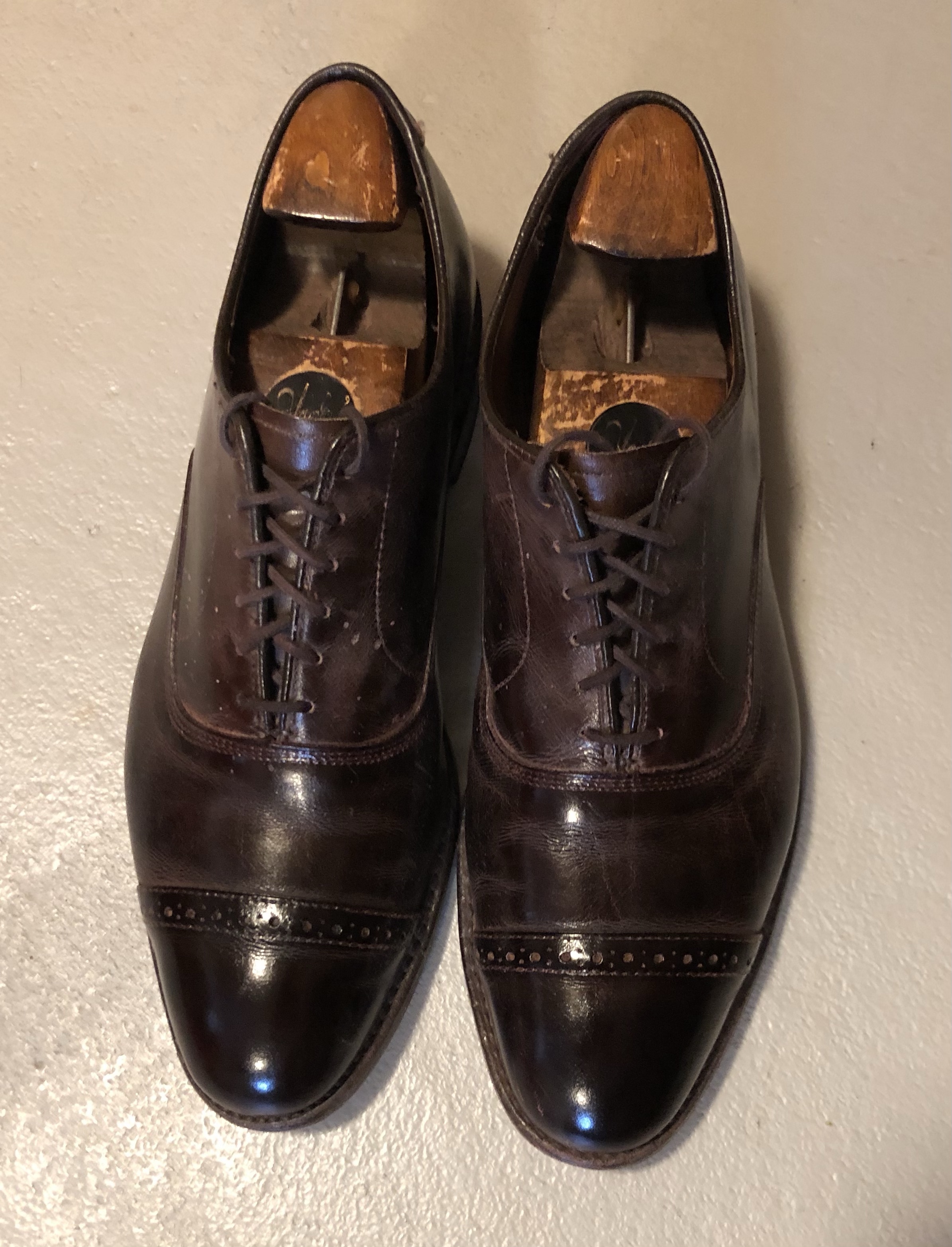
The author’s “Fifth Ave.” Allen Edmonds shoes.
 leodenatale.com
Very nice. I used to love watching my father shine shoes, but never got the knack myself.
You might be amused by this. I was at Logan one day and had enough time to get my shoes shined. When he was done he said to me, “Now, Mr. Siegel, I want you to be very careful walking through the airport.” I thought he was going to say that the shoes were slippery, but he continued, “The way your shoes look, every woman in the airport will be chasing you.”
>
LikeLike
Ed: Ha! Great story. Thanks for the feedback. Hard to believe but this is blog essay No. 32. Writing has kept my sanity. Kathy fortunately is still busy training. Hope all is well with you and Carol.
Leo
LikeLike
Keep meaning to write you on this: Excellent! No one shines their shoes today. As kids growing up, we had to clean and shine our shoes every Friday afternoon. My mother’s Dad owned and operated a leather company, Gordon, Lowe, and Godfrey, that made the softer inner leather lining for dress shoes. He sold to mills all over New England and took me on a number of sales trips when I was young. Got to see the insides of these mills and one was named the Bates Mill. Guess it was destiny that I would go to Bates College ten years later. All that said, almost to the day Grampa died, his shoes were emaculate and shined every day!
Dr. Keith E. Taylor, Optometrist 166 Atlantic Ave. Marblehead, MA 01945-2911 Work:(781)-631-2182 Fax: (781)-631-2142 ________________________________
LikeLike