Brownie
By
Leo de Natale
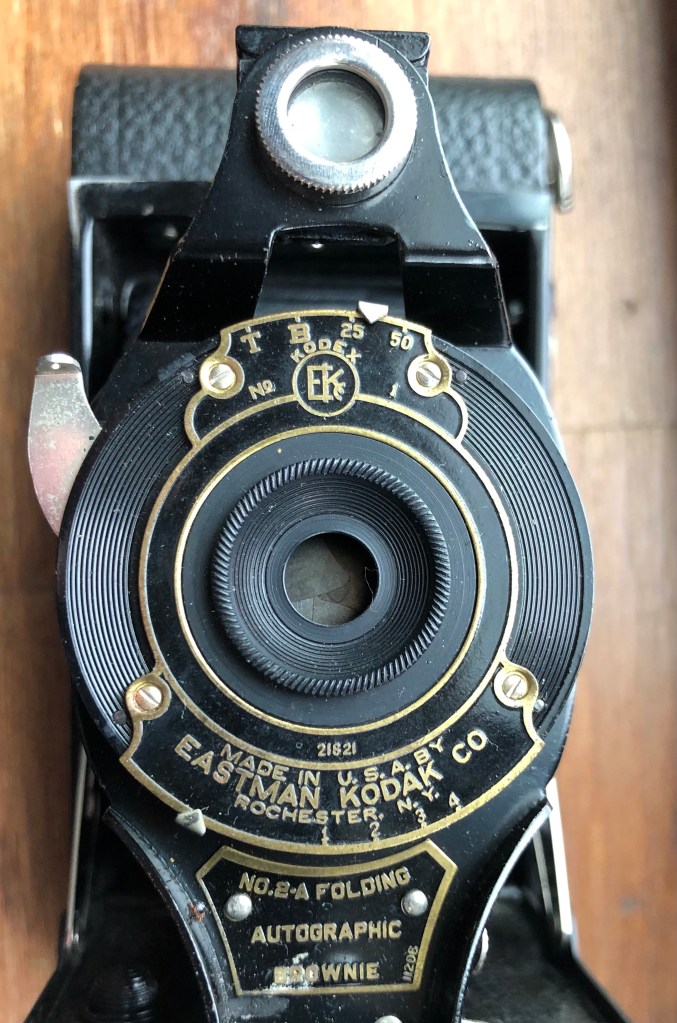
I was rummaging through some cardboard boxes in my attic last week. They’d been stored away after my wife and I sold our property in Belmont, Massachusetts three years ago.
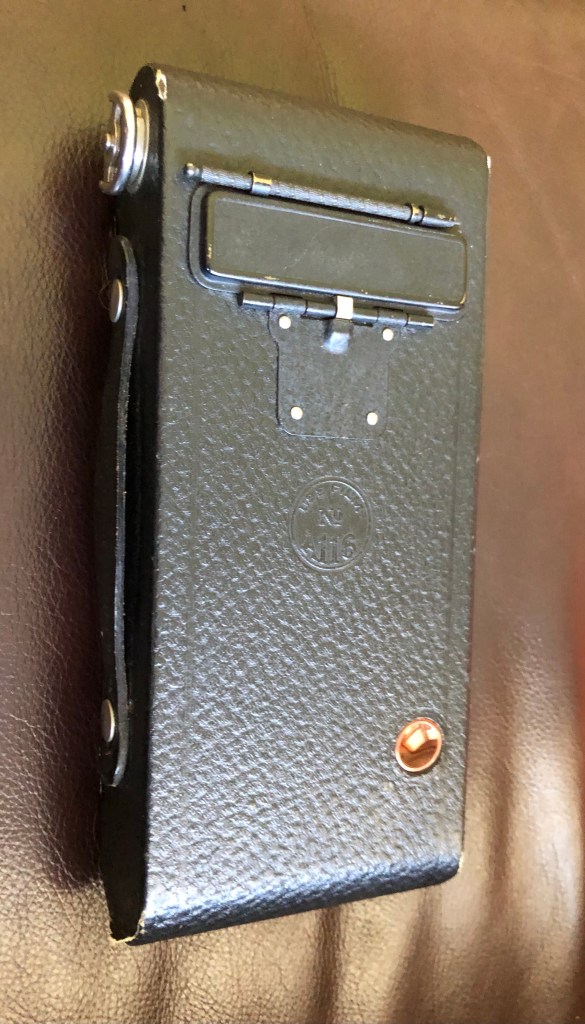
Near the bottom of one of the boxes lay a black, rectangular device with rounded edges. I smiled and reacted as if I’d discovered gold. The “device” was my mother’s “No. 2A Folding Autographic Brownie” camera. I was overcome with a wave of nostalgia. So many family paper photographs were taken with this camera. Photos of my parents’ wedding, my brother’s First Holy Communion and me with dressed up for Easter and missing my two front teeth.
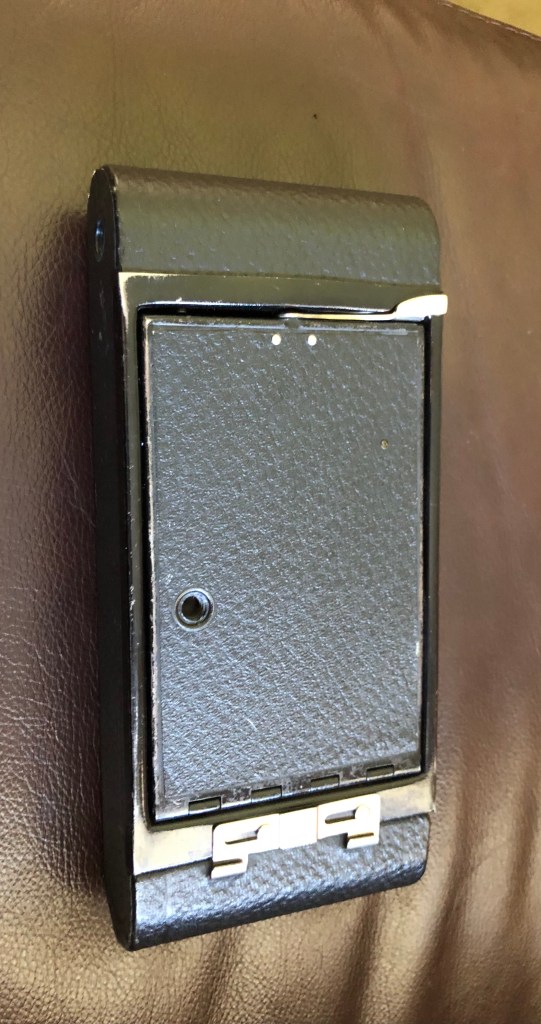
My grandmother had given Mom the camera as a gift for her 16th birthday. It was 1930. Eastman Kodak’s Brownie camera was the photographic equivalent of the Ford Model T – Kodak made owning a well built camera that middle class Americans could afford. When first introduced in 1915, it sold for a whopping $6! The Folding Brownie was the early prototype of hand held cameras that would evolve into smaller, lighter, more compact cameras. Kodak Brownie cameras became similar to such eponymous products as Kleenex tissues, Thermos bottles and Mack Trucks. The Brownie was the precursor and to modern devices: Polaroid, Leica, Hasselblad and Nikon cameras.
Physically, my Brownie is heavy and weighs about one pound. It is a strange looking device. A sliding lever opens and the camera’s lens stares at you. A locking device is squeezed and the photographer pulls the lens and its accordion housing made of fabric upward into locked position. The lens has a view finder and another lever is clicked. Aim and shoot developed a new meaning. The photographic image flashes on to the underlying film. Unfortunately photograph film is no longer available so the Brownie sits there, a desiccated antique of another era.
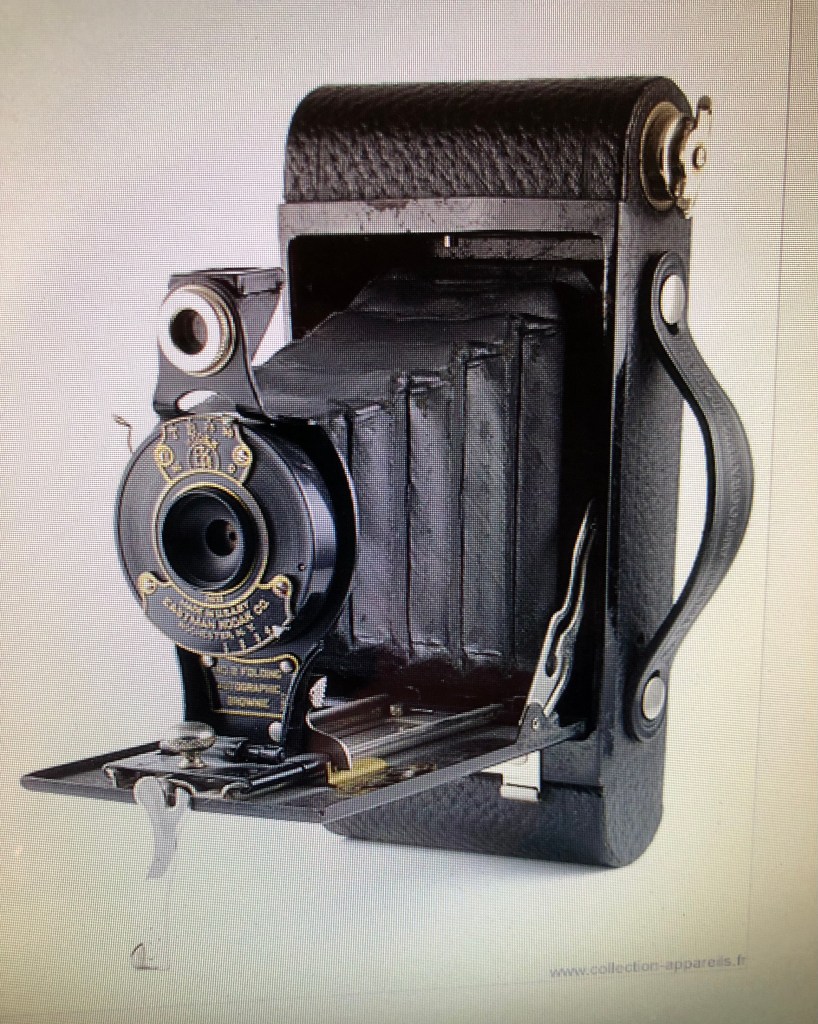
When you pick up this camera, you are holding a piece of American history that signifies a different era, one where American entrepreneurialism was at its zenith. Kodak was created in 1888 by George Eastman and Henry A. Strong. The company, Eastman Kodak, originally manufactured photograph plates for the old-fashioned 19th Century cameras. Civil War photographer Matthew Brady used such devices. The company was headquartered in Rochester, New York. Eastman was clever and tinkered with creating a handheld camera that would utilize photosensitive “film”. The Kodak empire was created when the company devised a dual marketing strategy: manufacture the camera and the film. Laboratories were created across the United States and capturing life’s images on a piece of shiny paper was integrated into American life. Camera shops were created. People could purchase film and the stores, pharmacies and department stores.
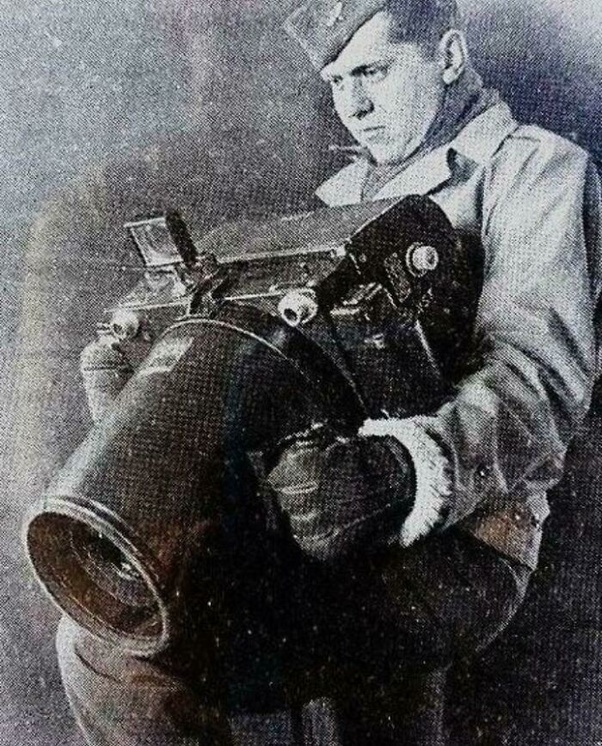
Of course the Hollywood film industry was a highly important client, especially with the introduction of color movie films that burst upon the scene during the 1950’s. The “Kodak moment” was born and survived for 100 years. Paul Simon’s famous song “Kodachrome” was a tribute to a product that many thought would never cease to exist. There’s a famous photograph of Kodak’s Monster Brownie. It was a huge camera developed for the U.S. Army’s Air Corps during World War II. The camera was a Brownie on steroids. It was used for aerial reconnaissance and manifested how Kodak was such an integral part of American history.
Near the end of the 20th Century photography transitioned from analogue film to digital. All cameras were digitized which eventually led to the amazing iPhone where clear, pixelated photographs that are literally within hand’s reach.
Unfortunately, with so many famous corporations the so-called Peter’s Principle again proved true. During the last part of the 20th Century, Kodak executives, unlike Apple and Microsoft, lacked foresight. They were reluctant to embrace the new kid on the block, digital photography. They could not accept this new innovation. Delving into the digital market would affect the highly profitable film business.
They dilly-dallied and were too late. Analogue cameras suffered a quick death as did manufacturing film for products that were being abandoned. There would be no more film processing at Seattle Film, the local drug store or photography shop. Kodak did introduce digital devices but the products weren’t popular and the camera industry eventually was ceded to the Japanese Nikons and Canons.
Eastman Kodak filed for bankruptcy in 2012. It survived but is a shell of itself. The company has switched to digital imaging and photographic equipment, materials and services. Kodak has also quizzically delved into the pharmaceutical industry. It is still headquartered in Rochester but tens of thousands of Kodak employees lost their jobs and careers.
As with much in life, for every change and advancement in our lives, there’s always something lost. Anyone under age 40 will never experience the fun of using boxy, clunky hand-held cameras that were omnipresent at family gatherings. Or will they ever experience the blinding light of camera flash bulbs. They’ll probably won’t understand the artistic skill of photographer/environmentalist Ansel Adams whose famous black-and-white masterpieces were created with techniques no longer existing. Such is the detritus of modern evolution.
After I was finished with my nostalgia trip, I rubbed my hands over the camera’s textured surface. I sniffed the camera’s bellows – it always had a distinctive and pleasant odor. The camera was solid and well made. It is a tribute to mankind’s ingenuity. It introduced the world to a medium where memories were made and preserved for future generations. It is a touchstone to the past, present and future.
For one last time, I caressed the No. 2A Folding Autographic Brownie, lovingly placed it into the box and returned to it to my attic. Au revoir, ciao, auf wiedersehen, goodbye. Click.
 leodenatale.com