Skeeve
By
Leo de Natale
Illustrations by Vince Giovannucci
Skeeve is an Anglicized version of the derogatory Italian adjective, schivo . The word is defined as someone or something that is disgusting. Filthy–dirty. It can mean the condition of someone’s house or a person who is unhygienic and smells. It can be used for a rundown restaurant or a movie house where the theater seats are 30 years old, never have been cleaned or replaced and have chewing gum glued to the fabric.
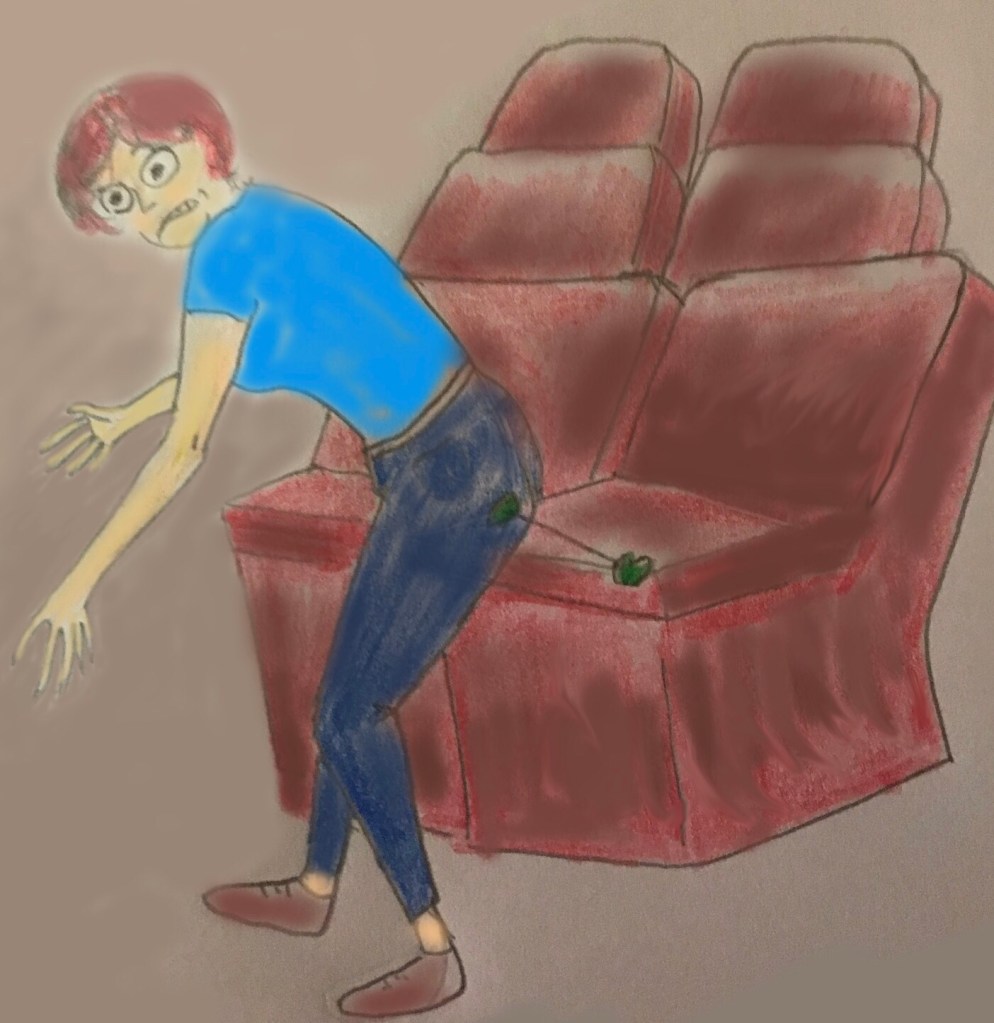
Skeeve is a versatile word because it can be used to describe just about anything that is personally offensive. It has gained popularity in America. Some don’t realize its origin. It also can be used in various forms—adjective, noun or verb — “This place is skeevy”; “Don’t go to that place, it’s full of skeeve”; “I skeeved when I saw that woman’s kitchen!”
Little did Vincent Di Merda realize he would encounter the word his late Sicilian grandfather would use. “Meengia, che schivo!!!!”
Vincent “Vinny” Di Merda was a medical technician who suffered through the 2020 Covid pandemic and would soon be exposed to a jaw dropping example of skeeve. He worked at a prestigious Boston hospital and was on the frontline during the crisis. Strict hygiene, universal mask wearing and hospital protocol became the norm. Like most health care personnel, he was subjected to the psychological stress of the killer virus.
In his early forties, Vinny had maintained a regular fitness regimen. He and his wife Judy belonged to a nearby health club. They tried going to the gym about three times per week. During the pandemic, however, the fitness center closed for four months. Because he worked at a hospital, Vinny was acutely aware of the potential risks of exposing oneself to Covid 19. He decided it was too soon to return after the club reopened in fall, 2020. The couple did “work out” at home but it couldn’t replace the aerobic exercises obtained at a gymnasium.
The result was an increase in sedentary lifestyle. It happened to many Americans. And like so many others, Vinny gained weight. He was over his normal 160 lbs and ballooned to 175 lbs.. He altered his diet but it had no discernible effect. Things started an upturn when Vinny became eligible for the first wave of Covid vaccines. Judy, a registered nurse, also received her vaccinations. They both felt fortunate to have the inoculations. By April 2021, the universal panic began to subside.
In late spring of 2021 they enthusiastically resumed their gym activities. That’s when the trouble began. During his 40-minute commute to work, Vinny began experiencing a sharp pain in his right upper leg. It felt as if someone was sticking a cattle prod in his thigh. The pain was position-sensitive – he experienced it only while driving.
After one week of enduring this piercing new pain, he was examined by a hospital neurologist (it helps to be an employee—less waiting). X-rays were taken. Diagnosis: sciatica, a condition where the sciatic nerve is compressed by surrounding vertebrae causing considerable pain.
He was referred to the orthopedics department and had an appointment with Elizabeth “Legs” Callahan, M.D. An attractive woman in her 40’s with long, straight brown hair and light blue eyes, she received the sobriquet with her reputation of flaunting an incredibly beautiful set of shapely legs. Male patients especially noticed her gams.
“I’ve reviewed your Xrays, Vincent, and there’s good news and bad news,” she said. “You don’t have a ruptured vertebral disc and that’s the good news. However, you do have bone narrowing in the spine where the sciatic nerve exits. It’s a physical irritation that’s causing the pain and probably stems from months of decreased physical activity.”
She told Vinny no surgery was necessary and steroid injections would probably be overkill. Callahan is a physiatrist, an orthopedic specialist who attempts to treat back pain with the avoidance of surgery. She ordered six-week regimen of physical therapy (PT) that would stretch the nerves through various and specific exercises.
Vinny went to the hospital’s PT facility and met with a physical therapist who provided him with a list of various exercises specifically used for sciatica. The Covid restrictions had been lifted but the building, like all hospital locations, maintained strict mask and hygiene protocol. For example, the therapist, a pleasant and competent woman, sprayed chairs and equipment with disinfectant before and after use. The therapist instructed Vinny to do two sets of exercises daily and return for an evaluation in one week.
Vinny religiously performed the exercises but was discouraged. The sciatica didn’t seem to be abating and the pain continued to occur only while driving. The PT sessions continued for one month. No significant improvement. He was scheduled for a follow-up appointment with Dr. Callahan in two weeks.
He decided to seek alternatives, specifically chiropractic. In the past, Vinny saw a chiropractor, Dr. Carol Hildebrand, who helped improve such conditions as back spasms and twisted vertebrae. She unfortunately had retired. Chiropractic is an allied health profession that often successfully relieves back, neck and shoulder pain. Many back problems are due to twisted vertebrae that pinch spinal nerves. Twenty years prior, an orthopedic surgeon had misdiagnosed Vinny’s shoulder pain as a bone spur and had scheduled surgery.
He had misgivings about the surgery that was usually painful and left significant shoulder scarring. A friend suggested obtaining a second opinion and recommended Dr. Hildebrand who examined Vinny. There was some skepticism on Vinny’s part. After assessing his spinal alignment and performing tests along the spine, she diagnosed the problem. He was suffering from a pinched nerve. Her branch of chiropractic uses the “activator”, a ballpoint pen-shaped device that is pressed along the spine. She used no bone cracking. Activators are non-invasive.
After two weeks of therapy, the shoulder pain dissipated. No surgery, no scarring. This was an example of an often maligned profession proving its legitimacy. Physicians often accuse chiropractors of quackery.
He and Judy were Hildebrand’s patients until she closed her office and returned to her native England. No one purchased her practice. A close friend who had intermittent back issues recommended Dr. Hubert Jones whose office was located nearby. He called for an appointment and fortunately the office had an opening in two days. Vinny gladly scheduled the meeting. He was about to enter Skeeveville.
Jones’s office was located on the main street of a suburban town south of Boston. The building was a strip mall that also housed a pizza parlor, nail salon, massage parlor and used sporting goods store. He entered the reception area and completed the usual paperwork that listed patient medical history, chief complaints and medications. He gazed around the room and said to himself, hmm, this office needs some love. A fresh coat of paint would be a good start. The first hint of what was to come occurred when Vinny used the office rest room.
The room was dingy and needed a new roll of toilet paper. The paper towel roll was placed in a box on the floor and not in its rack attached to the wall. He returned to the waiting room and soon Dr.Jones appeared.
“You must be Vinny,” he said with a voice muffled by the obligatory mask. “I’m Dr.Jones. Please come this way.”
Jones gestured towards an examination room. He was in his 50’s, average height, and had closed cropped hair. Many health care workers often wear scrubs and clogs – it’s the unofficial hospital wardrobe. Jones wore a dress shirt, denim pants and scuffed, unpolished shoes. He was polite and ushered Vinny into the room. This is where it started to fall apart.
In the middle of the room was a chiropractic table. Vinny was accustomed to vinyl covered treatment benches with clean sheets that were replaced between patients. Jones’s bench was blue hopsack cloth. It was dirty and had grease stains. The stitches were threadbare and frayed. So much for cleanliness next to godliness. While sitting in a nearby chair, Jones proceeded to take a case history – when, where, how long since onset, etc. Vinny gazed around the room in search of a sink and there was none. He wondered if Jones had washed his hands somewhere before the examination.
“Well, Vinny, this is a classic case of sciatica and it’s pretty straightforward in terms of healing,” he said as he nonchalantly placed his dirty shoe directly on the on the table.
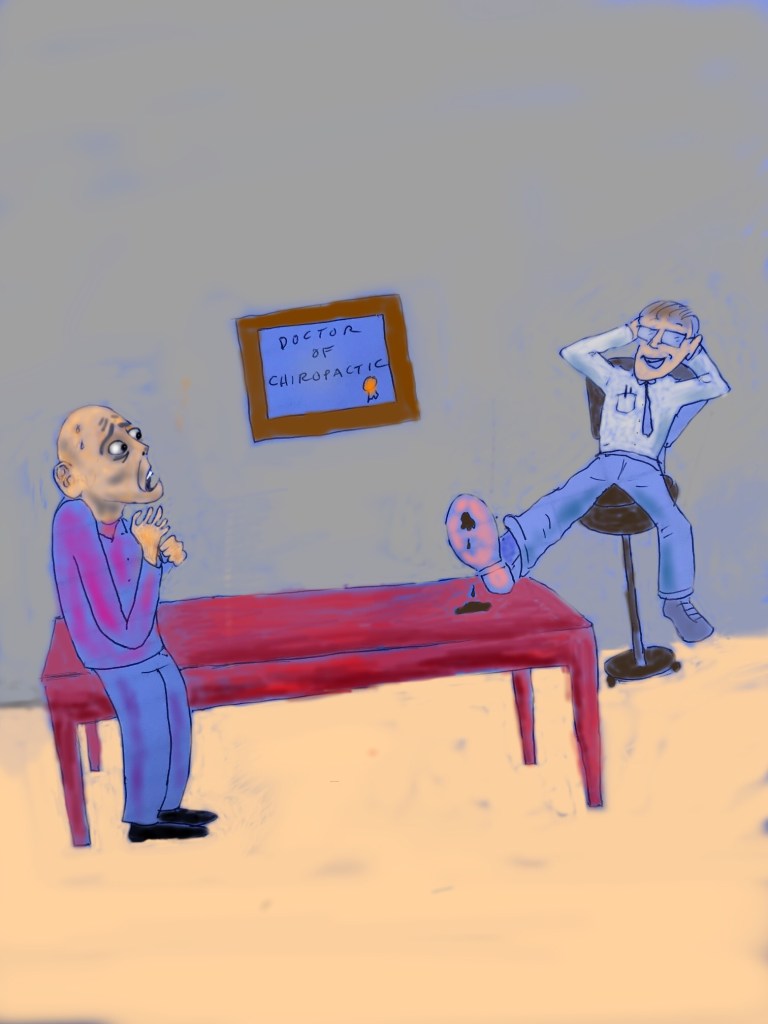
I can’t believe what I just saw thought Vinny, his eyes bugging out of his head. With a filthy shoe, this guy just stepped on to a place where I’ll be laying down for treatment! Jones then circled the table while talking and again the dirty shoe was resting where Vinny would be placing his head. This was world-class skeeve. He tuned out most of what this “healthcare professional” was saying. Reluctantly, he consented to having his bones cracked. I’m going to burn these clothes when I get home he was yelling internally.
While doing the manipulations, Jones wrapped his arms around Vinny’s torso and began the cracking. Vinny said to himself, “This guy’s clothing is in contact with mine. How many customers had a similar procedure today? I’m sure he doesn’t change shirts between patients.
Jones ended the appointment with ten minutes of heated electovibration therapy. Three pads are placed directly on the back. Are these suckers cleaned and disinfected between patients?, Vinny pondered.
Jones told Vinny he was confident the sciatica could be resolved after four weeks of chiropractic adjustments. Of course, the visits were out-of-pocket. Health insurance would not cover the appointments.
“Dr. Jones, I want to think about this,” Vinny said as he handed his credit card to the receptionist for payment. “I’m not used to the spinal manipulation technique. I’ll get back to you.”
With that, he left the office and yelled, “Please anybody, hose me down right here. I can’t stand the skeeve!”
Vinny phoned Judy before leaving the parking lot and described the entire experience. She was incredulous. Upon arriving at home, he disrobed in the garage and tossed his clothing into an awaiting washing machine. He then dashed up the stairs and immediately showered for 20 minutes. He was de-skeeved.
He decided he’d stick with traditional therapy and glad that day’s nightmare was behind him. He made a judicious choice. With diligence and religiously adhering to the therapy and gym work, the sciatica finally abated. Guess what? He was pain free in four weeks. What do you think about that, Dr. Jones?
 leodenatale.com