A Park Bench
By
Leo de Natale
Illustrations by Vince Giovannucci
“Anna, I’ve been in full sloth mode this morning,” Josef Hraček says to his wife in a muted Eastern European accent. “I need to go to the Garden for some work.”
It is a warm, beautiful day in mid-May. Josef grabs his 18”x24” Blick White Sulphite drawing paper, charcoal stick and green no.1 graphite pencil and saunters across Boylston Street to Boston’s Public Garden. He lives in the exclusive Four Seasons Hotel condominiums. The Garden is his favorite place to people watch. He chooses his usual bench that’s near the famous Swan Boats. The northern light is best there. A jovial sort, Hracek has wry humor and has manifested it through countless drawings and cartoons. Like most talented artists, he can in seconds produce caricatures that are often an exaggeration of a person’s physical appearance.
Hraček is tall and gangly at 6’2”. He has a shock of unruly brown hair that is slowly turning grey. His eyes are an unusual blue-green color. He has just turned age 60 and is remarkably fit. When he was working in New York, Josef always dressed in a shirt and tie. His bespoke suits were tailored by Paul Stuart. His Slovak parents had always taught him and his siblings the importance of refined physical appearance.
Nowadays the suits collect dust in his closets. It is strictly casual with Wrangler jeans and Carharrt work shirts. He’s typically sockless and wears Dockers boat shoes year ‘round.
Hraček loves drawing passersby as they walk through the Garden. And he knows how to draw. An eminently famous and successful commercial artist from Manhattan, Hraček is semi-retired and now lives in Boston. He has no regrets about escaping from New York City. He also has a country studio in Woodstock, Vermont where he spends summers with his wife and paints in oils and acrylics.
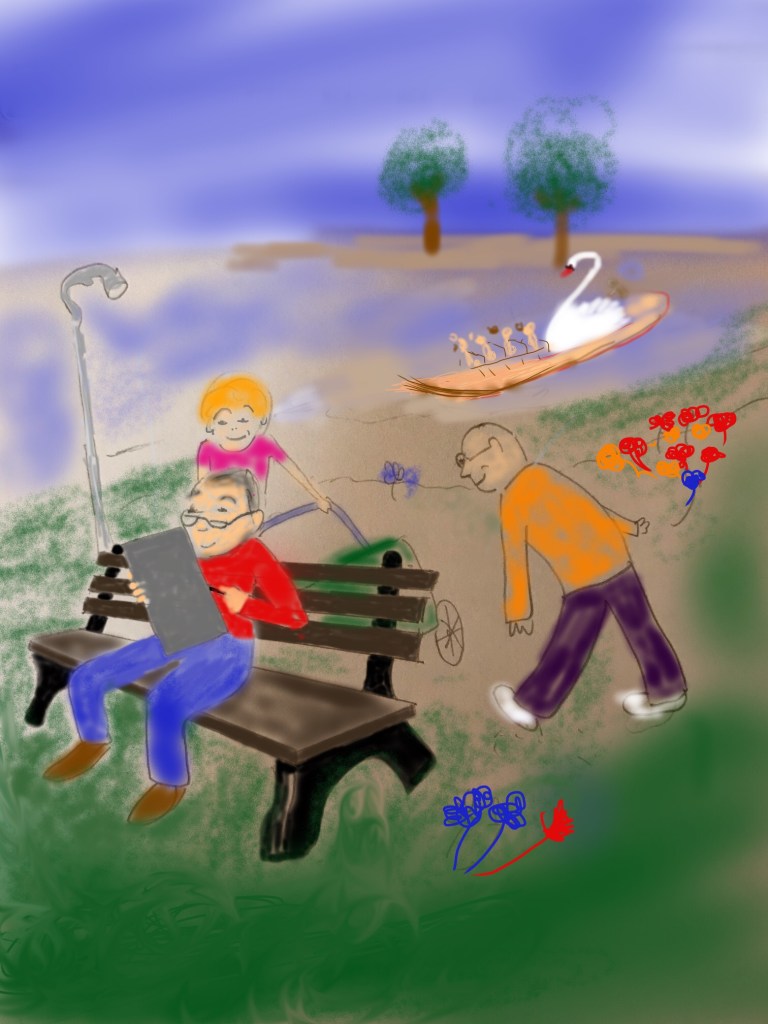
He is fully settled on the bench. It is mid-day and the light is perfect for his work. Hraček starts off with a rolly-polly older gentleman whose girth is enormous. The man – Josef calls him Oliver- has a duck-waddle gait and resembles a human bowling ball with legs. Given his belly, he cannot see his tan wing tipped shoes that are highly polished. He is about 5’ 5” and weighs perhaps 300 lbs, an obese dandy.
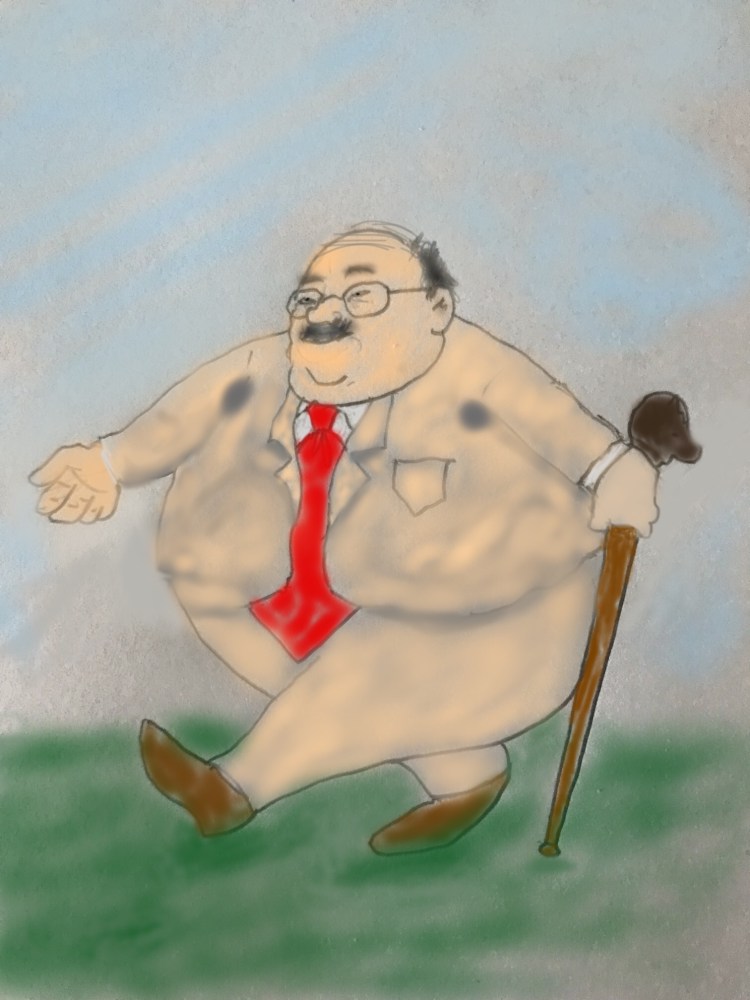
Because of his protruding stomach, nothing is visible below the water line and he hasn’t seen his feet for 30 years. In the warming temperatures of spring , his bald head is sweating profusely. Given Oliver’s unusual size his suits are custom made. Today he is wearing a pale linen suit that reveals lumberjack underarm stains. He has the physical appearance of British actor Sidney Greenstreet of Casablanca and Maltese Falcon fame. He’s probably in his mid-60’s.
Oliver’s silk necktie is unfashionably wide. It resembles a bib, because he still manages to dribble vichyssoise on his Brooks Brothers shirt. Oliver fancies himself a flaneur. He walks with a cane having a sterling silver horsehead handle. His small chubby hands have been manicured. Clear polish has been applied to his nails). He also wears on his pinky finger a sparkling 18k gold signet ring bearing the crest of his English predecessors.
As he walks, he’s constantly patting his sweaty forehead with an Irish linen handkerchief. Oliver is nearsighted and wears spectacles situated upon his bulbous pug nose. An effete, scraggly mustache is perched on his upper lid. Hracek captures this physical specimen in less than one minute.
As Oliver passes, a beautiful young woman is walking in the opposite direction. Josef scans her and begins drawing. She is probably in her late 20’s and fashionably dressed.
Tall, zaftig with a model’s body, the lady is wearing a stunning scarlet Anne Klein dress and matching Blahnik spike heels that make a distinctive clicking sound- an attention getter. As with most women under 30, she wears no nylons but her legs are tan and shapely. She’s carrying a Donna Karan clutch purse.

Josef notices her thick blonde hair is styled with the classic blunt cut bob . Her lipstick matches her dress color. He also observes professional stage makeup has been applied, an attempt to disguise her scarred face.
Alas, the young lady experienced disfiguring acne as a teenager; her cheeks and forehead have pockmarks resembling a Moonscape. Even the best plastic surgeon can’t reverse the permanent effects of acne vulgaris.
Her facial expression is pouty and Josef imagines this stunning but physically flawed young lady is insecure and her straightaway gaze meant to keep everyone at arm’s length. She passes Josef who deftly sketches the lady in red. An elegantly wafting French perfume follows in her wake.
He glances upwards to rest his eyes. The Boston sky is a brilliant blue with an errant cumulous cloud scudding by. The white sketch paper occasionally dazzles him and sometimes he thinks sunglasses would reduce glare. He learned long ago, however, the most accurate images are obtained by the naked eye. He’s never filtered his images through a tinted lens.
The beautiful weather has an unanticipated effect. Josef time travels to Prague, 1968. He was eight and was walking in the sunlight with his father through Stromovka Parkand, a park similar to the Public Garden. He didn’t comprehend the social upheaval occurring in his country. Czech President Alexander Dubček had defiantly introduced measures that lifted the oppression of the Soviet Union. Lasting only eight months, the “Prague Spring” was a evanescent breath of freedom.

The Russians brutally squashed the peaceful uprising. Josef and his family escaped and fled to the United States. His artistic talents flourished and he became a success story. He is suddenly jostled from the daydream and focuses on his next subject.
Running rapidly towards him is a jogger who weaves through the pedestrian traffic. The man is on a mission. With this day’s temperature, he is, like portly Oliver, sweating. Running man wears the de rigueur garb. This particular fellow is sporting everything Under Armour sells: running shirt and shorts with reflective logos. Josef is amused with the notion that runners become moving billboard signs for such apparel.
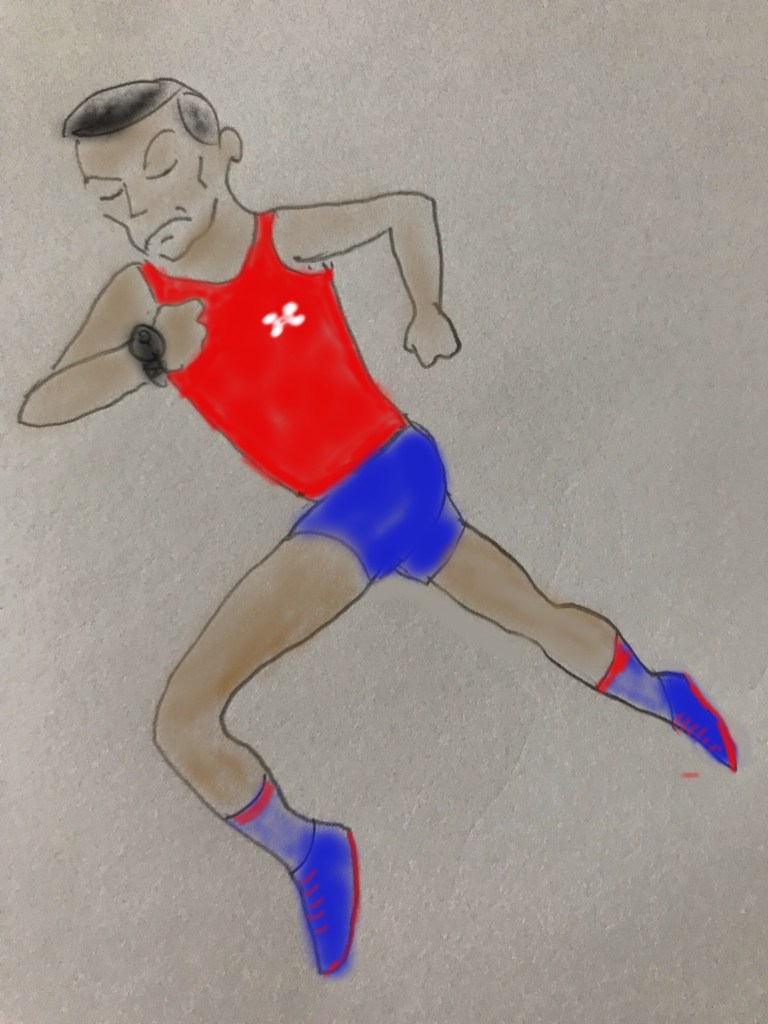
The jogger also is wearing accompanying socks and shoes. The man is perhaps 45 or 50. He has the typical lean sinewy look of a runner. His graying black hair is completely soaked, likewise the red and blue shirt. His face has that chiseled look. He is constantly monitoring his black, bulky G-Force wrist watch. Josef captures the runner in mid-stride. The man has that typical runner’s face that manifests pain. Why do so many look as if they’re not enjoying physical exercise that apparently causes pain and anguish?, he asks himself. Josef records that expression as the runner whizzes by.
During the hour he’s been drawing, intermittent curiosity seekers notice him and walk behind him on a grassy embankment. Many are curious to watch an older man sketching strangers traveling through the Public Garden. It’s similar to watching sidewalk artists using colored chalks to create clever scenes that are soon erased by rainfall. Evanescent art.
While some eavesdroppers engage in conversation, others remain respectfully quiet. One particular gentleman stops and is clearly impressed.
“That’s quite a charcoal drawing, maestro,” he says, smiling.
“Why, thank you, sir” replies Josef, turning his head. “I’m glad you like it.”
“I’ve always loved chiaroscuro. It’s so stark,” the man says with a slight New York City accent. “I’m Dr. Arthur Di Nobili and drawing and painting are my favorite avocation. And I know you. You’re Josef Hraček, am I right?”
Josef laughs, says yes, as he notices the man’s physical appearance. Imposing with piercing dark brown eyes that bulge while he’s speaking, There is an intensity to the man both in speech and body language. Di Nobili possesses black caterpillar eye brows and a matching mustache that is the same size, color and width. His hair is jet black. He is a walking chiaroscuro. Dr. DiNobili is wearing a white shirt and tailored black suit. His shoes are spit-shined black plain toes; only a Royal Stewart plaid necktie disrupts his monochromatic apparel.
“Well, I can see why you like charcoal on white sketch paper,” Josef says with an impish grin.
“Why do you say that?” Di Nobili utters with a fierce look made to perhaps intimidate.
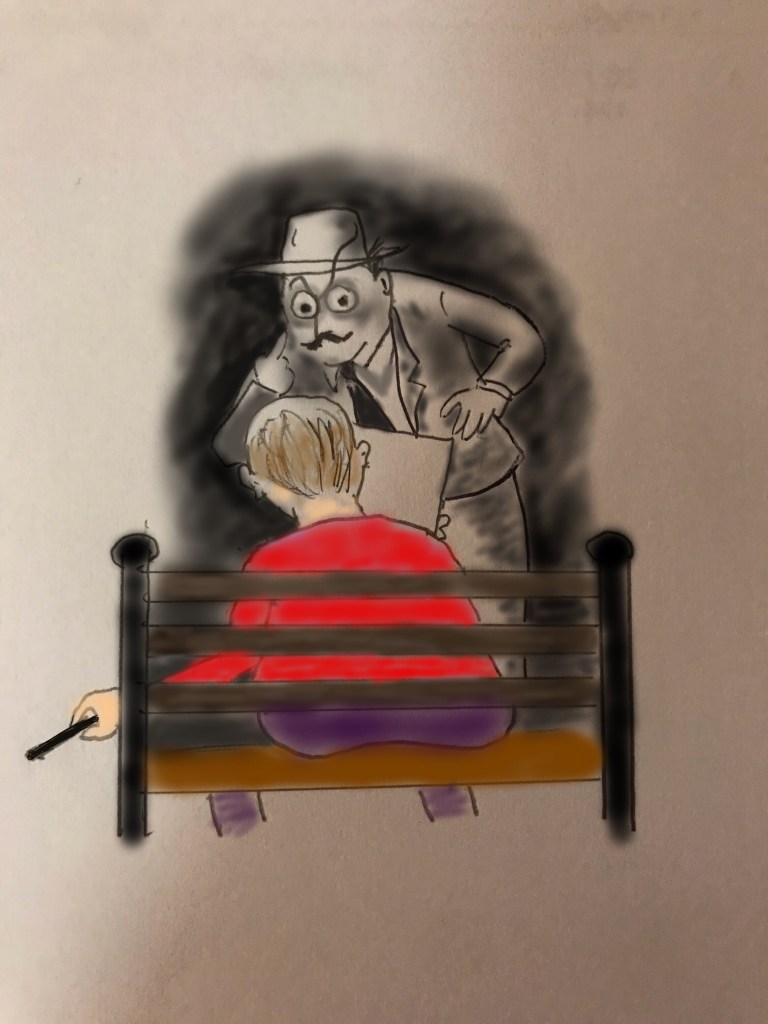
Suddenly he bursts out laughing.
“Maestro Hraček, people have been teasing me about my garb since college,” he says. “I’ve been stared at because some think I resemble a Mafia don, especially when I’m carrying my black valise and wearing a Borsalino hat. Yeah, straight out of central casting. I’m actually a professor of Baroque art history at Boston University. Caravaggio’s one of my favorites.”
The two men chat for fifteen minutes and discuss fine art, especially paintings by the masters. Josef reveals he studied at Columbia University. In fact, he doesn’t disclose he was a child prodigy (Di Nobili probably already knows that) and yearned to study art at the Sorbonne. Living in the Soviet Union prohibited him from a European education.
They exchange pleasantries and Di Nobili gives him a carte de visite, then departs. He’s scheduled to deliver several lectures at the Museum of Fine Art.
One last sketch for today, Josef says to himself, and then home for lunch with Anna.
A young couple in their early 20’s are walking past him. The man is dressed in grunge: Converse canvas sneakers, baggy blue jeans and a Jimi Hendrix T-shirt. His greasy hair is tousled and he hasn’t shaved for two days.

The woman, who’s taller than he, is Harvard Square: broom skirt, Doc Martins clunky shoes, and a diaphanous blue blouse. She is braless. At least her hair is clean, Josef muses. Two large tattoos adorn her bare arms; another tattoo is located behind her right ear.
What binds these two Gen Xers is a common denominator: their eyes are completely focused on their cell phones. No conversation between them. Of course, they are passing with others in their age group who are behaving similarly. They are walking slowly and Josef deftly captures their detachment from reality. He decides he’ll finish this sketch at home because he’ll include the numerous others surrounding the pair who are also WiFi zombies.
He packs his paper, pens and charcoal and pauses to relish the beauty of the Garden and the humans who are fodder for his skills. In a desultory manner, Josef Hraček returns to his apartment and his beautiful wife. They converse in their native Slovak tongue. She prepares his favorite lunch, plum dumplings and kasha with sour cream and butter. Afterwards, Josef returns to his studio and applies finishing touches to today’s drawings. He chuckles over his meeting with Dr. Di Nobili. It had been time to leave the bench for today. His sloth has temporarily returned. Tomorrow will provide a new batch of characters. There’s a never ending supply he muses while dosing off. Sládké sny.
 leodenatale.com