Presbycusis
By
Leo de Natale
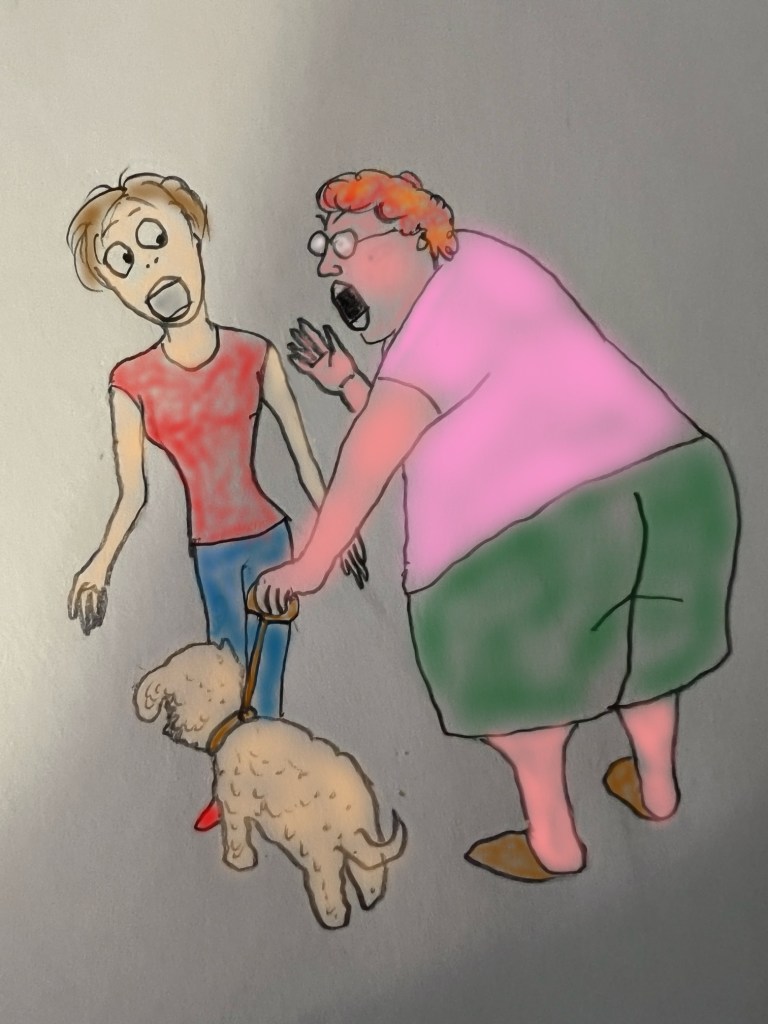
Illustration by Vince Giovannucci

“What didya say?” yelled Margaret O’Brien to dog trainer Kit Hayes as she approached the front door of a modest single family home. “I don’t have my hearing aids in. Just a sec.”
Margaret was referred to Kit, a trainer with 30 years experience, and hoped she could solve her problems with an irascible five-month-old male Labradoodle Seamus who was constantly nipping and biting his owner. He also was not housebroken as evidenced by doggy pee pads scattered throughout the disheveled living room, dining room and kitchen. Kit was gagging from the stench of canine urine and feces. I should have brought a mask she thought. Margaret was not a woman of means.
Kit had seen it all and this particular situation did not loom well for Margaret, a deaf septuagenarian and a poorly controlled diabetic. She was a large woman, gray-haired, overweight and wore thick eyeglasses from which she squinted.
Due to Margaret’s hearing loss, the conversation started by the two women yelling at each other. Margaret’s sentences were punctuated with a barrage of “What?”, “I can’t hear you” and can you speak loudah?!” She also spoke with an incredibly thick Boston accent.
Kit was familiar with presbycusis, age-related hearing loss. Her husband, age 65, had hearing deficit – it ran in his family- and reluctantly with her urging was fitted to hearing aids. He admitted it was a wise decision because he no longer asked her to repeat herself.
Regarding Margaret and Seamus, Kit’s preliminary assessment was one she’d seen with so many dogs and their owners. Margaret didn’t have a clue on the fundamentals of housebreaking. And the nipping and biting, common for dogs Seamus’ age, were problems needing fixing. Margaret would begin explaining what was going wrong but suddenly switch to an unrelated subject.
“I almost died two years ago – passed out in the living room,” she bellowed while veering from the her problems with Seamus. “My blood sugar was 1,000 and my neighbor found me. Saved my life.”
“I’m sorry to hear that,” Kit replied with her voice level approaching 90 decibels. “But let’s talk about the biting. Puppies are still teething before six months of age and they nip. Biting is an entirely different behavior problem.”
“That Seamus is a little devil,” Margaret yelled. “My children bought him for me as a companion. Of course he barks but that’s one of the few benefits of deafness. I can’t hear him a’tall!”
The one hour consultation dragged, mostly due to Kit’s frustration of having to repeat information. Seamus unfortunately wasn’t provided with the usual rubrics of today’s puppy training.
Kit started her career more than 30 years ago.
Her clientele were mostly from cities and towns in Boston’s Metrowest. In 1989 she popularized the concept of “puppy kindergarten” where puppies from ages two-to- six months learn to socialize. Puppies go through a “critical period” where learned behavior can be absorbed. The kindergarten was the brainchild of Dr. Ian Dunbar, a British veterinarian and psychologist living in California. At that time, kindergarten was a relatively new technique in dog training.
The sessions were useful in creating bite inhibition and proper interaction with their fellow canines. Supervised socialization tended to eliminate dog aggression, a problem that frequently occurs among dogs who grow up isolated from other their canine brethren.
Kit told Margaret Seamus was on the cusp but there was still time for him to learn not to bite her, other humans and dogs. There was a sadness in this situation. Well intentioned family members buy a puppy for an older relative whose age or physical limitations create a daunting, nay impossible task.
The puppy gets no training, no direction and becomes pest or biting machine. He doesn’t receive housebreaking rules and a dirty dog, an uncontrollable monster can be created. In the end a now older puppy is untrained and is transferred to a dog shelter.
The damage is done. No one wants the dog and he is eventually euthanized. During her long career, Kit had repeatedly witnessed this scenario. The unhappy ending was usually inevitable. Kit gave her Margaret her final instructions.
“Get Seamus into a group class,” Kit yelled as the session thankfully ended.
“What?” she responded. “I couldn’t hear you, honey.”
As a last resort, Kit wrote her recommendations on two sheets of legal paper.
“Call me if you have any questions, Margaret,” she screamed while leaving the home. Her mouth was parched from the 60-minute ordeal. I’ll probably have laryngitis tomorrow she mused.
On her way home she felt emotionally spent. Working with a person whose age and medical deficits was exhausting. She deeply cared about her clients – human and canine- and over the years the sadness takes its toll.
Several weeks later, Kit received a telephone call from Margaret’s daughter.
“I know you tried to help Mom, Ms. Hayes, and the family appreciated your time,” she said. “But Mom unfortunately tripped over Seamus and broke her hip. She’s in a rehab facility for an extended period. The family decided to return Seamus to the breeder. It was best for him and my mom. We are all heartbroken.”
“Oh, I’m sorry to hear that,” Kit replied. “I know your Mom was having problems. It was the right thing to do for everyone, Seamus included.”
Kit could sense relief in the daughter’s voice. It was a predictable ending, one she had witnessed too many times.
As she hung up the telephone, she was overcome by a touch of melancholy. During her career she’s witnessed many dog situations where, despite good intentions, the owners don’t listen or follow training instructions. Some choose to keep ill-behaved dogs for many years. Owners alter their lifestyles to accommodate a four-legged bête noire who eventually rules the roost.
Of course the alternate scenario is surrendering the dog who will probably be bounced from several succeeding families, none of whom can cope with an untrained canine. Eventually the dog meets a predictable death by lethal injection.
For Kit, foreseeing that scenario was always an incredibly depressing aspect of dog training.
 leodenatale.com