Made In China
By
Leo de Natale
Illustration by Vince Giovannucci

September, 2023
CPA Joe Di Nobili was in a foul mood. There was discord at his accounting office. Personality clashes had erupted and his job as Chief Executive Officer was to put out fires. There had been growing tension between two of his employees. It was a turf battle and he’d seen these tempests many times during his 30-year career. As in most offices, intramural friction created a lot of agita.
In his late forties, he was an attractive man. He was tall and fair skinned. His eyes were an unusual light green. His hair was brown and he had a slight cleft chin. He did not fit the description of a stereotypical Italian. He and his Irish Catholic wife Karen had two children, both of them were in college. Joe and Karen were presently empty nesters. They’d come to enjoy the quiet and solitude. They met at Tufts University. Joe received his MBA and CPA from the venerable business school, Babson College.
After the day’s squabbles at the office, he was glad to be in his suburban home in Arlington, Massachusetts where he could relax and have supper with his wife. After their meal the two sat in the living room. As a means of escaping the day’s hassles, Joe was reading another Scandinavian noir murder mystery. He rested his feet on a leather footstool and paused to admire the new tan opera slippers he’d purchased earlier that week.
Good footwear was important to him but ever since childhood he dreaded buying new shoes, boots, sandals or slippers. His feet were oddly shaped and sometimes difficult to fit.
He had bought the slippers – the traditional brand L. J. Stoutfoot’s- at his favorite, longtime, old-fashioned shoe store in nearby Cambridge. The footwear sold there were expensive but the salespeople were longtime employees who knew how to fit shoes. Slippers and moccasins were an integral part of the inventory. Customers knew they’d be paying top dollar but the service and customer relations were incomparable. The slippers cost $90 and Joe didn’t mind the price although he discovered Amazon.com was selling the same shoes for $50. No matter. He preferred buying something the old-fashion way.
After dinner Joe removed one slipper and admired his purchase. These slippers were incredibly comfortable and they looked good, too. But hold on, he saw something was wrong. The stitching inside the left slipper was unraveling and he discovered the lining wasn’t leather. It was vinyl-covered fabric. Fake leather. Curiously, he looked inside the slipper and suddenly it all made sense.
Underneath the manufacturer’s label was a second piece of fabric stating the country of origin. It bore all-too-familiar words: “Made In China”.

“God, everything is made in China, honey,” he bemoaned to Karen. “Look at this. I pay top dollar for a Stoutfoot slipper and it isn’t well made. It’s vinyl, not leather and is crap. That’s what it is!”
On Saturday, Joe traveled to the store and showed the defect to a salesman.
“I’m terribly sorry about this, Mr. Di Nobili,” he said. “I’ll just exchange this for a new pair.”
A new pair was inspected. There was no stitching defect. He left the shop followed by a storeful of apologies.
He returned home and went his usual weekend chores. Fall was fast approaching and he busied himself with grabbing some rakes that would be used after the leaves turned color and fell, leaving a carpet of red, yellow and orange.
He visited a local garden center and began purchasing the tulip bulbs that would be planted by mid-November. The days were still warm, the nights cool. Good planting weather, good sleeping weather.
That night, Joe opened the box containing his new slippers. He put them on but, wait a second, something felt funny in the left slipper. Removing it he was in disbelief. The insole pad covering the slipper bottom was loose and flapped open near the heel area. What is going on here? Yet another example of shoddy workmanship.
“Can you believe this, Karen?” he yelled. “These shoes are so damned comfortable but they’re merda!”
He’d been searching for good looking slippers that also provided comfort. He decided he’d give these suckers another chance and instead of returning yet another pair, he drove Monday to his cobbler John Gillooly who applied glue to the insert.
“Boy, the footwear they’re selling to us Americans is shitty,” John said. “Like they say, things ain’t the way they used to be. Don’t use the slippers until nighttime. Glue should be dry by then.”
Three months passed and Joe was indeed enjoying his slippers. They were very comfortable and he laughed because the style was very similar to the slippers old Italian men, his father included, wore around the house or working in their gardens. He remembered his paternal grandfather Joseph, “Nonnu” who’d emigrated from Messina, Sicily in the early 20th Century. Joe always joked about Nonnus being from central casting. A proud man, the father was short in stature but retained the Sicilian preoccupation with “respect”. That also accompanied the legendary Sicilian temper. Joe possessed a diluted version of Nonnu’s quick trigger. Things such as the office imbroglio would quickly summon the family trait.
Vinny De Vito, Joe’s best friend and college classmate, was a first generation American whose parents were born in Italy’s Abruzzo region. Vinny jokingly referred to the slipper style as “Scampies”, a name used by Italian men from Abruzzi. Vinny described the stereotypical appearance.
“You’d have these old Italian guys wearing their uniforms,” Vinny said. “The wife-beater t-shirts, the pot belly, the Italian cigars, and the Scampies. They’d shuffle around looking for that last glass of red wine before supper.”
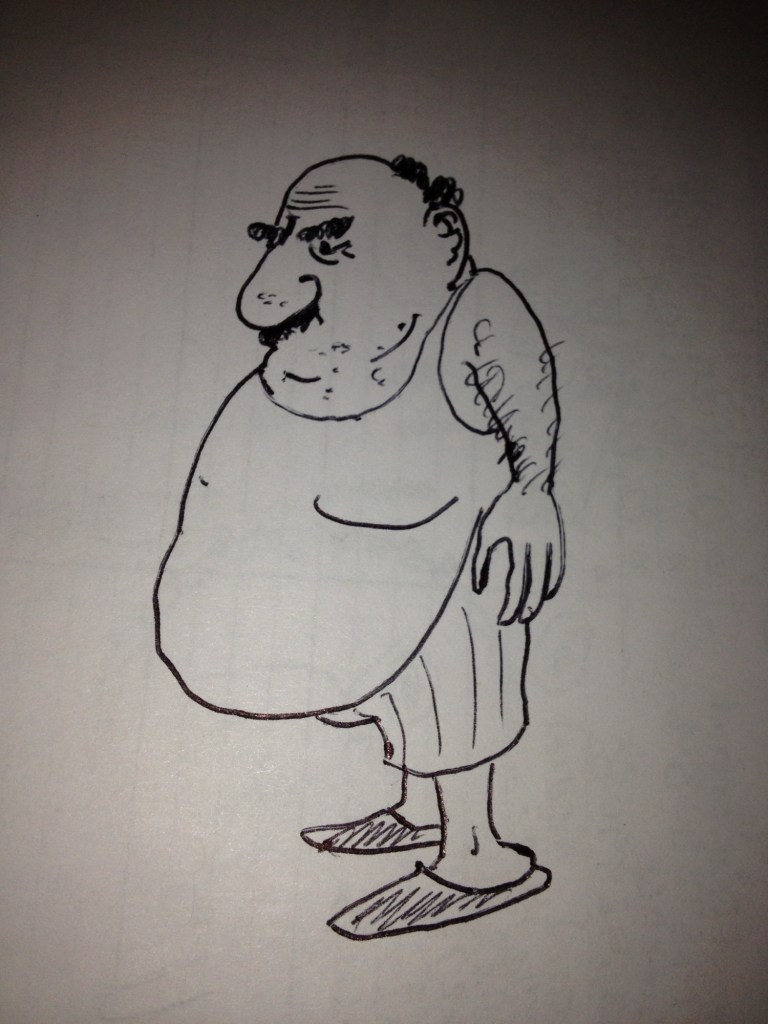
Vinny spoke the truth. He recalled Grampa Joe sitting in the living room and the image was a photocopy of what Vinny had just described. Of course the sofa was typical Italian: clear plastic covers and arm rests draped with white doily antimacassars. During the winter, his grandparent’s house reeked of moth balls, a common scent in immigrant homes.
The nostalgic daydream had wafted over him on a fall weekend. One day in October, Joe was noodling around the house. He was wearing the slippers and suddenly his left ankle buckled. No pain, no injury but the incident was odd. Until he inspected the slipper and gasped.
“I don’t goddamn believe this!” he bellowed.
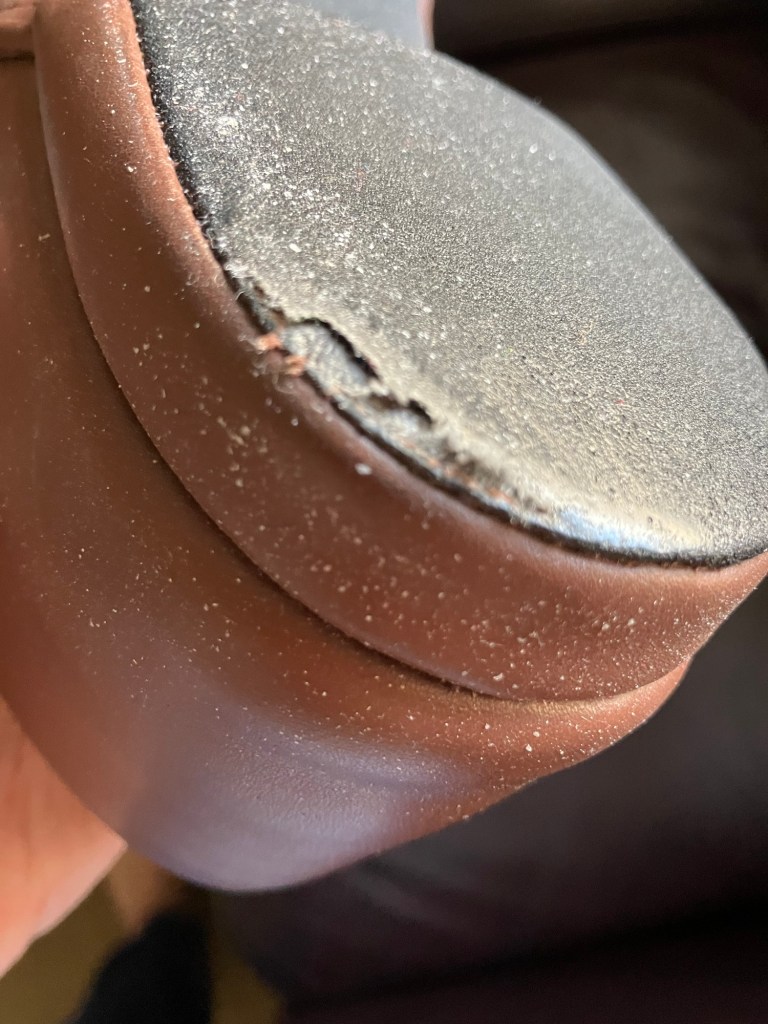
What Joe had observed was the left heel. After three months it was worn down and the cheap fabric was exposed. The heel and sole were completely worn away. Joe was livid. After a mere three months, the slippers were coming apart. Jeez, you pay good money for products that used to be made in the United States and the companies now manufacture them in some hellhole factory in China or other Asian countries.
The following day Joe made a beeline to the shoe store and once again approached the manager.
“I’ve had these slippers for three months and look at them,” he said while suppressing his volatile Sicilian anger. “Selling a product that is substandard and poorly made is not a good look for the business.”
The manager sheepishly looked at the disintegrating left heel and was embarrassed. His facial expression was a Jackie Gleason hamana, hamana, hamana.
“Gee I apologize again, Mr. Di Nobili,” he said. “I can give you a new pair. Is that okay?”
“No, it’s not,” De Nobili replied. “Because you know what’s going to happen? I’ll be back in another three months with the same problem. I tell you what I’ll do. I’m going back to my cobbler and, I’ll have them re-heel this poor excuse for ‘well-made’ slippers. If the work is too expensive, I’ll ask for my money back.
“Well, I got to be honest with you,” the manager replied. “All of our slippers, regardless of the company, are Chinese manufactured. My boss says there’s nothing we can do. The ones made in Europe, for example, are too expensive. Retailers are between a rock and a hard place.”
Once again, Joe returned to John the cobbler who assured he could replace the heels with rubber and the cost would be minimal. Five days and $35 later the slippers had been repaired. John was a craftsman. Hopefully, they would now last. Joe was angry. A $90 product had now cost him more than $130. What a rip off he said to himself.
That evening, he started searching the internet regarding the China/United States trade deficit. Many people talked about it but it was an exercise in frustration. The statistics were frightening. He traced the trade patterns from 1985 to 2022. In 1985 China exported goods – electronics, cell phones and clothing – totaled $3.86 billion. In 2022, the total exports were $535 billion while the United States exports to China was a measly $110 billion – a three-to-one drag on American economy. Joe’s slippers were part of that.
He grew up during the death throes of the 20th Century’s Cold War. Russia’s Soviet Union had imploded and the Western World sighed with relief. Through his education and experiences running a business, Joe realized one monster was replaced with another. From 1990 to 2000 the world had experienced a brief respite from turmoil. Then came 9/11, an event that continued to fester.
Concurrent with that event was a different Cold War and the new bogeyman, Red China. Joe long realized this. He worried over his children. What type of world will they lived through? It was a depressing question.
February, 2024
Joe and Karen decided they would approach life with the eat, drink and be merry attitude. The Serenity Prayer’s, One Day At A Time, became their mantra. Joe’s Sicilian blood made that decision easy. Italians usually find a glass half full.
As for the disintegrating Scampies, the soles began to split. He unceremoniously tossed them in the trash can. The same day he drove into Boston’s financial district and purchased a pair $400 genuine leather Bally slippers made in Switzerland. There’d be no more ersatz footwear. He smiled while driving home. Salut!
 leodenatale.com
So True! That about says it all! Read deep under the sole 😉 for where it is made.
LikeLike