Taming A Smart TV

Taming A Smart TV

By

Leo de Natale

Illustrations by Vince Giovannucci
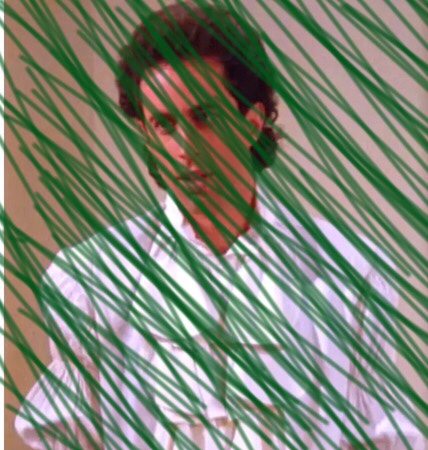
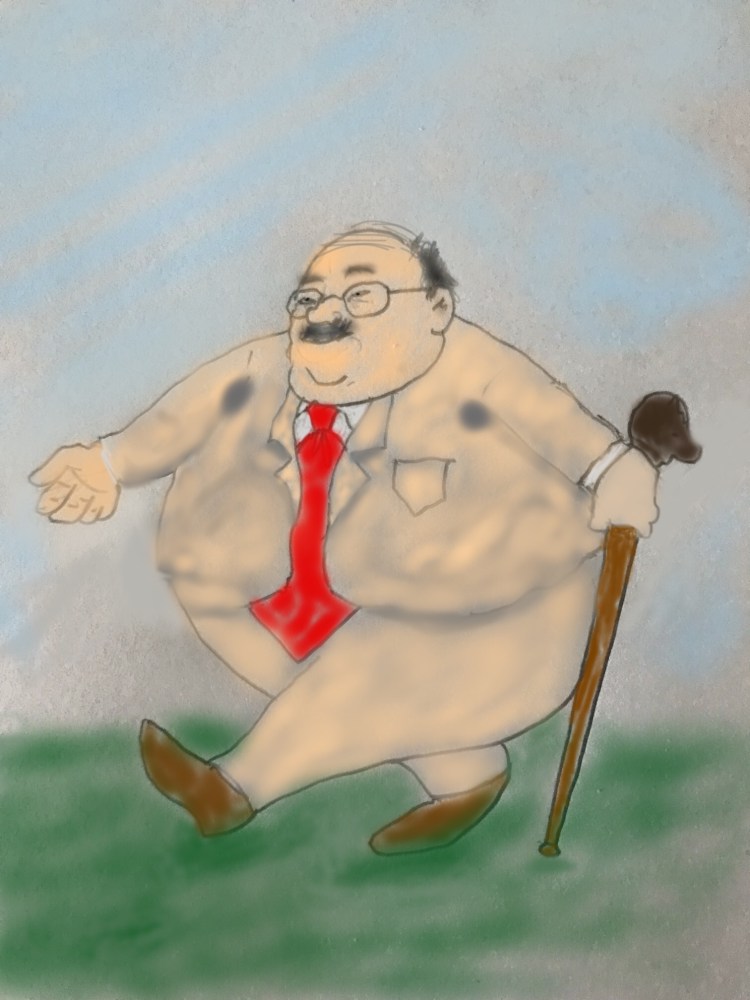
Jerry’s Puffy Shirt is camouflaged

Last week our twelve-year-old flat screen television suddenly went into its death throes. Jerry Seinfeld’s face had vertical rows of moving green lines. So didn’t Kramer’s, Elaine’s and George’s. It added a bit of immediate humor but then got old. Pretending you’re stoned can last only so long. My wife and I looked at each other and said “Uh oh, I think it’s time.”

Our TV was one of the “dumb” generation products. Pretty good picture but couldn’t compare with the images on the latest generation of televisions that have truly incredible fidelity and access to movie channels. Friends kept telling us about the wonders of streaming. Any movie, any time with the punch of a remote button. Ok, I’ll admit we were Luddites and from a generation with the no-new-TV-until-the- one-you-own-dies protocol.

We don’t watch a lot of television but the devil box has become an intrinsic, universal part of every day life. Jumping online to obtain useful research and information, I was catapulted into a brave new world of pixels, 4K ultra-high definition, vibrant QLED colors and other terms that are integral parts of the technology explosion. I called my 30-year-old nephew David who’s a computer jock at a software development company in Cambridge, Massachusetts. He became Moses leading us to the Promised Land.

“It all depends how sophisticated you want to be, Uncle,” he said. “The TVs come in all different sizes – 32”, 45”, 55”, 65”s and the ‘big guy’, an 85-incher!”

“Dave, your aunt and I won’t be traveling on the Starship Enterprise,” I replied. “We just want a television for our bedroom. That’s all”.
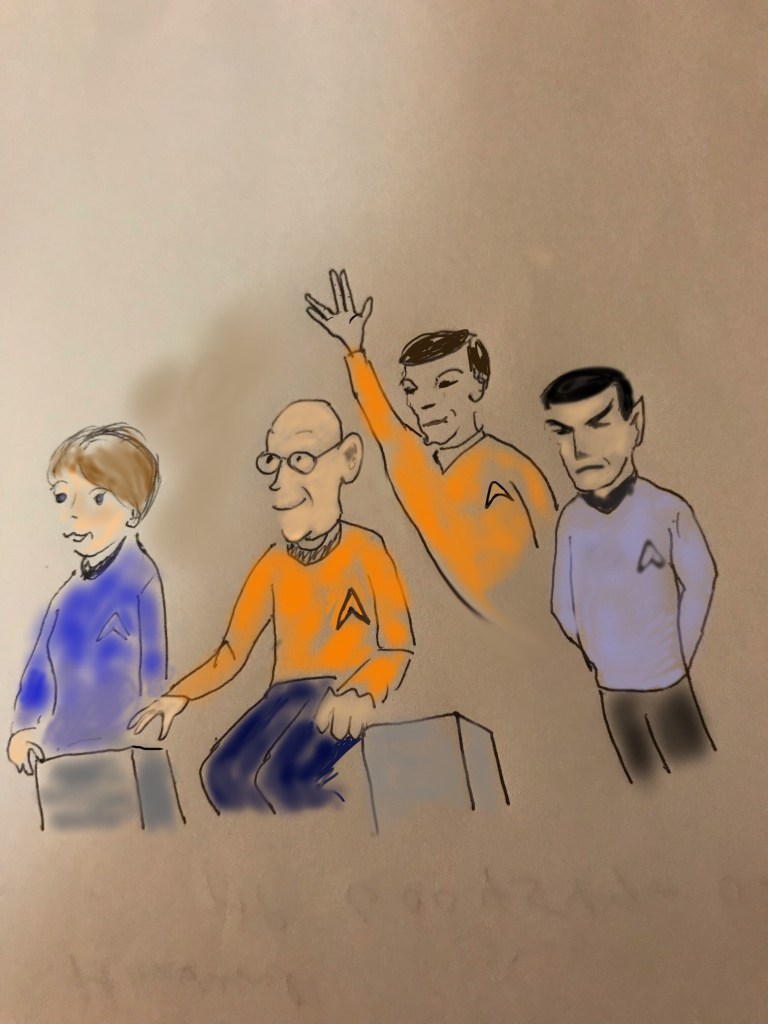
No thanks, Mr. Sulu

          He recommended researching brands and sizes on Amazon.  That would give us an idea of what was out there.  Then shop at the big box stores and try to find the best deal, he said.

We followed his advice and headed to the nearest Best Buy store. The available products were overwhelming. The stores divide products between home entertainment centers – huge screens, separate sound systems, integrated computer games – and home televisions. We were in the latter category. We had trouble finding a store associate for assistance. That seems to be a problem in this post-Covid world. Ever try to hunt down a Macy’s employee? Department store employees have become an endangered species.

We finally found Earl, a blue-shirted member of the Geek Squad. In another era, he’d be wearing a plastic pocket protector or a slide rule holster attached to his belt. Earl was sporting an ear device resembling Apple AirPods he used to communicate with other employees. He was tall and gangly, had a huge Adam’s Apple, slouched shoulders and unkempt mop of hair. His teeth were crooked and had a brownish/greenish hue and that reminded me of our dead television.
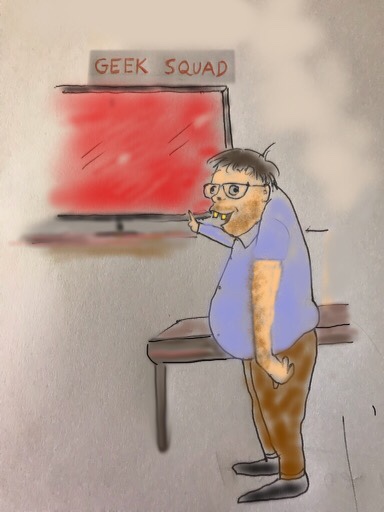
This is Earl

“So tell me Earl, what are the features we should be looking for?” I asked. ”We’re nighttime TV watchers who don’t need too many bells and whistles.”

          “Well, like, you don’t want to buy one with the 1080p HDTV, man” he replied. “That is sooo old. They’re phasing those ones out.  Like,  the 4K, it gives you 8 million pixels.  That will give maximum image resolution.”

He proceeded to numb us with techno-geek information. Our eyes starting glazing over. We were suffering from information overload. He asked us about our dying TV -It was a “32-incher”- and recommended a 45” model. He then bombarded us with jargon. He babbled on about contrast ratio, refresh rates, mini and micro LEDs and my favorite, “Quantum Dots”. Huh? When asking about a specific manufacturer he replied, “Like, it doesn’t make much difference. All TVs are made in China, man.”

Despite deciphering Millennial argot, we had sufficient information to narrow our choices. Armed with such knowledge we gleaned at Best Buy, it was on to another big box store closer to home. At BJ’s we found the exact model that would suit our needs. The difference was there were no employees in the TV/computer department. Earl would not be magically appearing. We were on our own. It was a Samsung Model 70 S, 45”, the highly desired 4K designation. Most important, it was relatively cheap and under $350. We were relieved and delighted with the new unit.

My wife and I loaded the new television- it was surprisingly lightweight- into our Subaru Forester and drove home. After disconnecting and removing the soon-to-be-trashed dead TV, we removed the Styrofoam and cardboard packing and there it was. Sleek and bigger, it was accompanied by two power and cable cords and the magic remote. There was a paucity of paperwork and to our surprise no written owner’s manual. We learned nothing purchased today has detailed paper instructions. Stick-figure drawings made the TV appear simple and easy to set up and operate. Just plug in the power cord and the cable connection wire and you’re done. Wrong.

After pressing remote buttons with no response, I had a premonition this was going to be a bit more challenging. My wife solved the first piece of the puzzle. In fine print, the assembly sheet indicated the power light should be activated. I searched to no avail. My wife finally felt a little nib of a button underneath the television’s base. She touched it and a faint red light appeared. I once again pressed the remote and voila! the screen came to life. There was a menu of options that made no sense to us.

It’s very frustrating to have technical impotency. We just continued pushing buttons to no avail. Curse words were flying.

“Godammit, nothing’s easy anymore,” I yelled. “We’re having a string of bad luck here, honey. First our PC and now this!”

We had a similarly maddening experience two months earlier when our desktop computer operating more slowly and then crapped out. After purchasing a new computer and printer at Staples we spent several hours with technical assistance. Our old computer was easy to navigate. We knew which keys to punch to complete various functions – backup, attaching documents to a task bar, accessing Word, etc. The technology had changed. Via the computer screen the printer would warn me when the ink cartridge was low.

Replacements would automatically be shipped. We now live in a world where there are smart TVs and computers and anyone over age 40 is suddenly lost in a new techno-world.

The computer had finally been tamed and were now dealing with an intimidating television. We were faced with a daunting task and the only technical help was going online to the manufacturer’s website. Searching for answers via a chat line wasn’t my idea of having fun. We needed human help but who to call, where do you go?

My wife suddenly had an epiphany. Our 30-something neighbor Brian was a local firefighter. He’d walk his doodle-cross puppy past our house. In several conversations with my wife, Brian mentioned he was reprogramming the various electronic devices – computer, television, timed house lights and thermostat control – all done through his cell phone. Now that sounded like someone who could help us. We texted him and he quickly telephoned.

“Hi Brian,” I said. “ Can you help technically challenged neighbors with our new TV?”

“No problem.  Just got home from work. I’ll be right over!” he responded.

He arrived ten minutes later. We ushered into the room and he grabbed the new remote.

“Well, part of the problem is the cable is connected to the wrong outlet,” he said. “Don’t worry, this happens a lot.  My folks had the same  problem.”

I expected him to rib me about this stuff being a generational thing but he was kind and respectful. He placed the Verizon cable into the correct outlet, pressed a few remote buttons and bing! bang! boom!, the TV came to life. The entire process occurred in about five minutes. Wow, it was that easy? I felt like a Neanderthal.

“It was easy. Glad to help,” he said.

“Please let me pay you for helping us out, Brian,” I said, handing him a $50 bill.

“No thanks, it was my pleasure to help a neighbor,” he replied.

“Well, I tell you what,” I said. “Why don’t you and your fiancée come over this weekend for steaks that are grilled over charcoal briquettes. I may not know how to install a TV but I’m a real caveman on the Weber.”

Later that night, my wife and I retired to the bedroom to watch a greenless Seinfeld. Love that Puffy Shirt, Jerry.
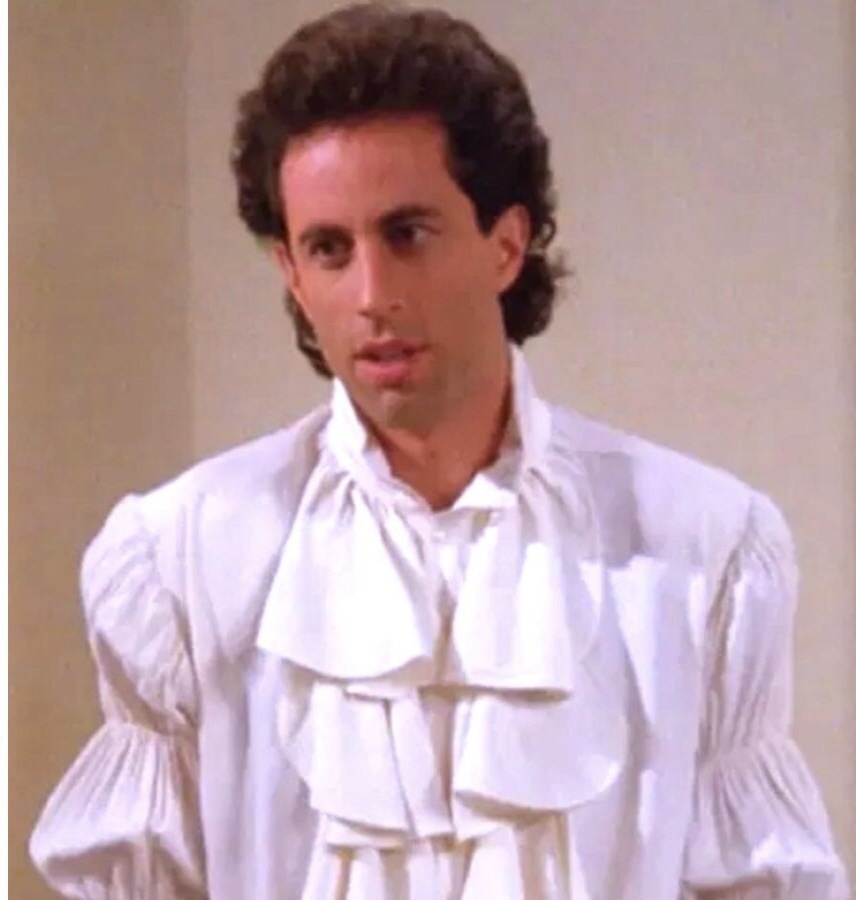
There! That’s better.

A Park Bench

A Park Bench

By
Leo de Natale

Illustrations by Vince Giovannucci

“Anna, I’ve been in full sloth mode this morning,” Josef Hraček says to his wife in a muted Eastern European accent. “I need to go to the Garden for some work.”

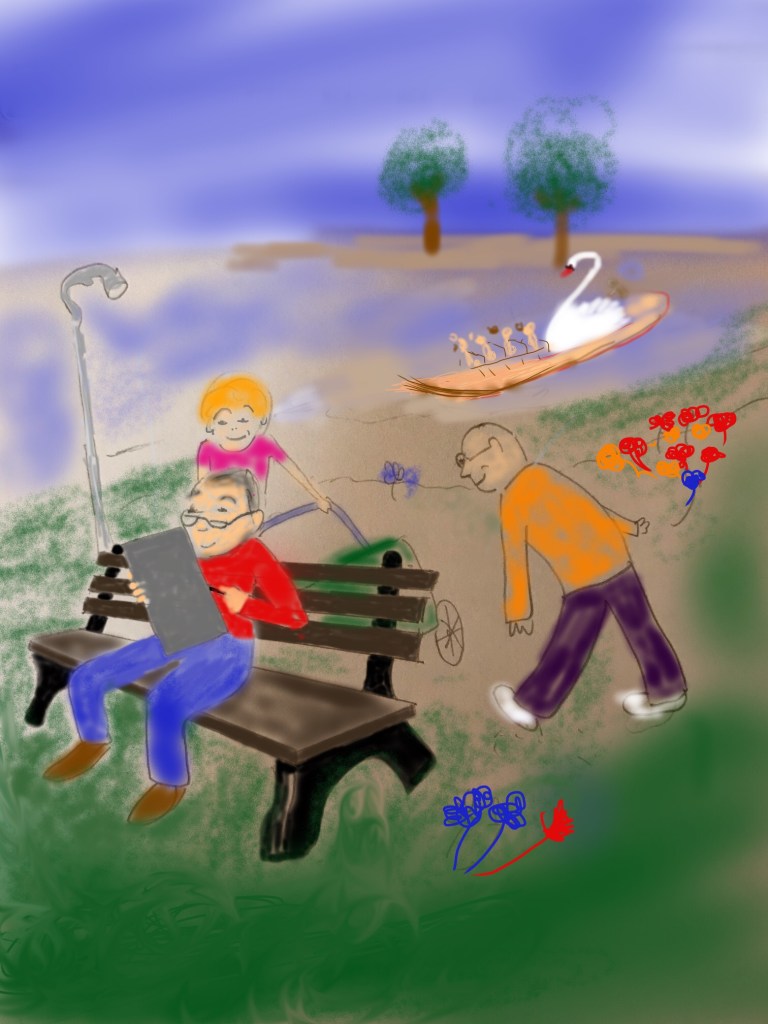
It is a warm, beautiful day in mid-May. Josef grabs his 18”x24” Blick White Sulphite drawing paper, charcoal stick and green no.1 graphite pencil and saunters across Boylston Street to Boston’s Public Garden. He lives in the exclusive Four Seasons Hotel condominiums. The Garden is his favorite place to people watch. He chooses his usual bench that’s near the famous Swan Boats. The northern light is best there. A jovial sort, Hracek has wry humor and has manifested it through countless drawings and cartoons. Like most talented artists, he can in seconds produce caricatures that are often an exaggeration of a person’s physical appearance.

Hraček is tall and gangly at 6’2”. He has a shock of unruly brown hair that is slowly turning grey. His eyes are an unusual blue-green color. He has just turned age 60 and is remarkably fit. When he was working in New York, Josef always dressed in a shirt and tie. His bespoke suits were tailored by Paul Stuart. His Slovak parents had always taught him and his siblings the importance of refined physical appearance.

Nowadays the suits collect dust in his closets. It is strictly casual with Wrangler jeans and Carharrt work shirts. He’s typically sockless and wears Dockers boat shoes year ‘round.

Hraček loves drawing passersby as they walk through the Garden. And he knows how to draw. An eminently famous and successful commercial artist from Manhattan, Hraček is semi-retired and now lives in Boston. He has no regrets about escaping from New York City. He also has a country studio in Woodstock, Vermont where he spends summers with his wife and paints in oils and acrylics.

Josef Hraček at the Boston Public Garden

He is fully settled on the bench. It is mid-day and the light is perfect for his work. Hraček starts off with a rolly-polly older gentleman whose girth is enormous. The man – Josef calls him Oliver- has a duck-waddle gait and resembles a human bowling ball with legs. Given his belly, he cannot see his tan wing tipped shoes that are highly polished. He is about 5’ 5” and weighs perhaps 300 lbs, an obese dandy.

Oliver

Because of his protruding stomach, nothing is visible below the water line and he  hasn’t seen his feet  for 30 years.  In the warming temperatures of spring , his bald head is sweating profusely.  Given Oliver’s unusual size his suits are custom made.   Today he is wearing a  pale linen suit that reveals lumberjack underarm stains. He has the physical appearance of British actor Sidney Greenstreet of Casablanca and Maltese Falcon fame.  He’s probably in his mid-60’s.

Oliver’s silk necktie is unfashionably wide.  It resembles a bib,  because he still manages to dribble vichyssoise  on his Brooks Brothers  shirt.  Oliver fancies himself a flaneur.  He walks with a cane having a sterling silver horsehead handle.  His small chubby hands have been manicured. Clear polish has been applied to his nails).  He also wears on his pinky finger a sparkling 18k gold signet ring bearing the crest of his English predecessors.

As he walks, he’s constantly patting his sweaty forehead with an Irish linen handkerchief.  Oliver is nearsighted and wears spectacles situated upon his bulbous pug nose.  An effete, scraggly mustache  is perched on his upper lid.  Hracek  captures this physical specimen in less than one minute.

As Oliver passes, a beautiful young woman is walking in the opposite direction.  Josef scans her and begins drawing.  She is probably in her late 20’s and fashionably dressed.

 Tall, zaftig  with a model’s body, the lady is wearing a stunning scarlet Anne Klein dress and matching Blahnik spike heels that make a distinctive clicking sound- an attention getter.  As with most women under 30, she wears no nylons but her legs are tan and shapely. She’s carrying a Donna Karan clutch purse.

The Lady In Red

Josef notices her thick blonde hair is styled with the classic blunt cut bob .  Her lipstick matches her dress color.  He also observes professional  stage makeup has been applied, an attempt to disguise her scarred face.

Alas, the young lady experienced disfiguring acne as a teenager; her cheeks and forehead have pockmarks resembling a Moonscape. Even the best plastic surgeon can’t reverse the permanent effects of acne vulgaris.

Her facial expression is pouty and Josef imagines  this stunning but physically flawed young lady is insecure and her straightaway gaze meant to  keep everyone at arm’s length.  She passes Josef who deftly sketches the lady in red.  An elegantly wafting French perfume follows in her wake.

        He glances upwards to rest his eyes.  The Boston sky is a brilliant blue with an errant cumulous cloud scudding by.  The white sketch paper occasionally dazzles him and sometimes he thinks sunglasses would reduce glare.  He learned long ago, however,  the most accurate images are obtained by the naked eye.  He’s never filtered his images through a tinted lens.  

The beautiful weather has an unanticipated effect. Josef time travels to Prague, 1968. He was eight and was walking in the sunlight with his father through Stromovka Parkand, a park similar to the Public Garden. He didn’t comprehend the social upheaval occurring in his country. Czech President Alexander Dubček had defiantly introduced measures that lifted the oppression of the Soviet Union. Lasting only eight months, the “Prague Spring” was a evanescent breath of freedom.

Alexander Dubček, architect of the “Prague Spring”, 1968

The Russians brutally squashed the peaceful uprising.  Josef and his family escaped and fled to the United States.  His artistic talents flourished and he became a success story.  He is suddenly jostled from the daydream and focuses on his next subject.

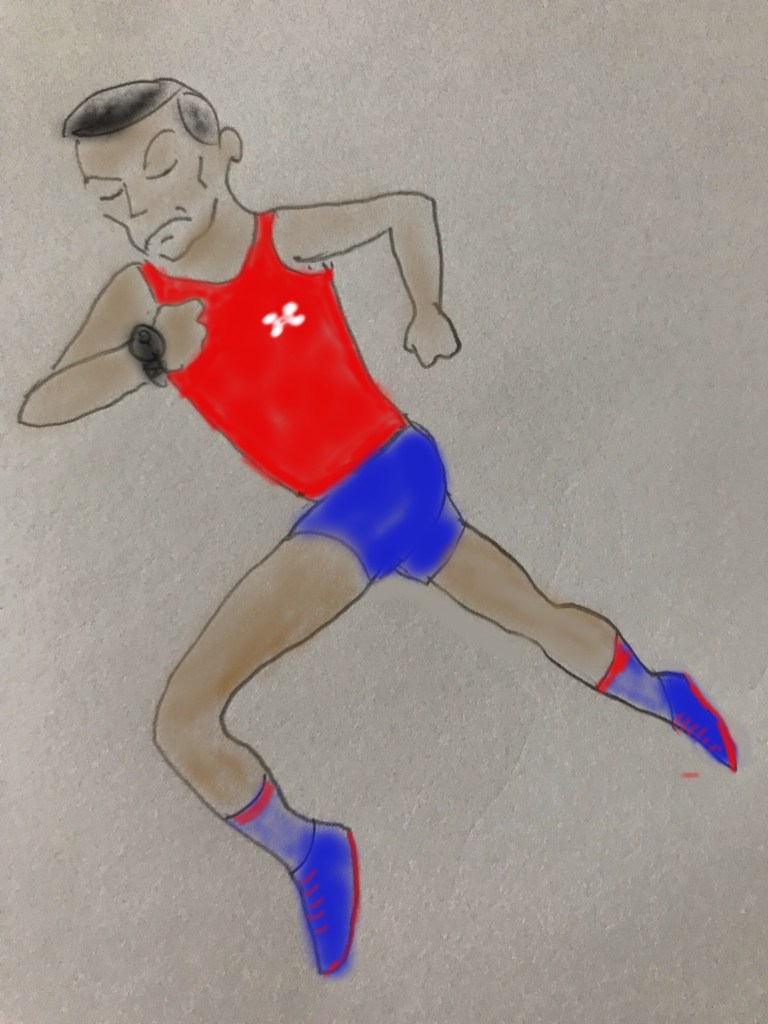
Running rapidly towards him is a jogger who weaves through the pedestrian traffic.  The man is on a mission.  With this day’s temperature,  he is, like portly Oliver, sweating.   Running man wears the de rigueur garb. This particular fellow is sporting everything Under Armour sells: running shirt and shorts with reflective logos.  Josef is amused with the notion that runners become moving billboard signs for such apparel. 

Mr. Under Armor

The jogger also is wearing accompanying socks and shoes.  The man is perhaps 45 or 50.  He has the typical lean sinewy look of a runner.  His  graying black hair is completely soaked, likewise the red and blue shirt.  His face has that chiseled look.  He is constantly monitoring his black, bulky G-Force wrist watch.  Josef captures the runner in mid-stride.  The man has that typical runner’s face that manifests pain.  Why do so many look as if they’re not enjoying physical exercise that apparently causes pain and anguish?, he asks himself.  Josef records that expression as the runner whizzes by.

During the hour he’s been drawing, intermittent curiosity seekers notice him and walk behind him on a grassy embankment.   Many are curious to watch an older man sketching strangers traveling through the Public Garden.  It’s similar to watching sidewalk artists using colored chalks to create clever scenes that are soon erased by rainfall.  Evanescent art.

While some eavesdroppers engage in conversation, others remain respectfully quiet. One particular gentleman stops and is clearly impressed.

        “That’s quite a charcoal  drawing, maestro,” he says, smiling.

        “Why, thank you, sir” replies Josef, turning his head.  “I’m glad you like it.”

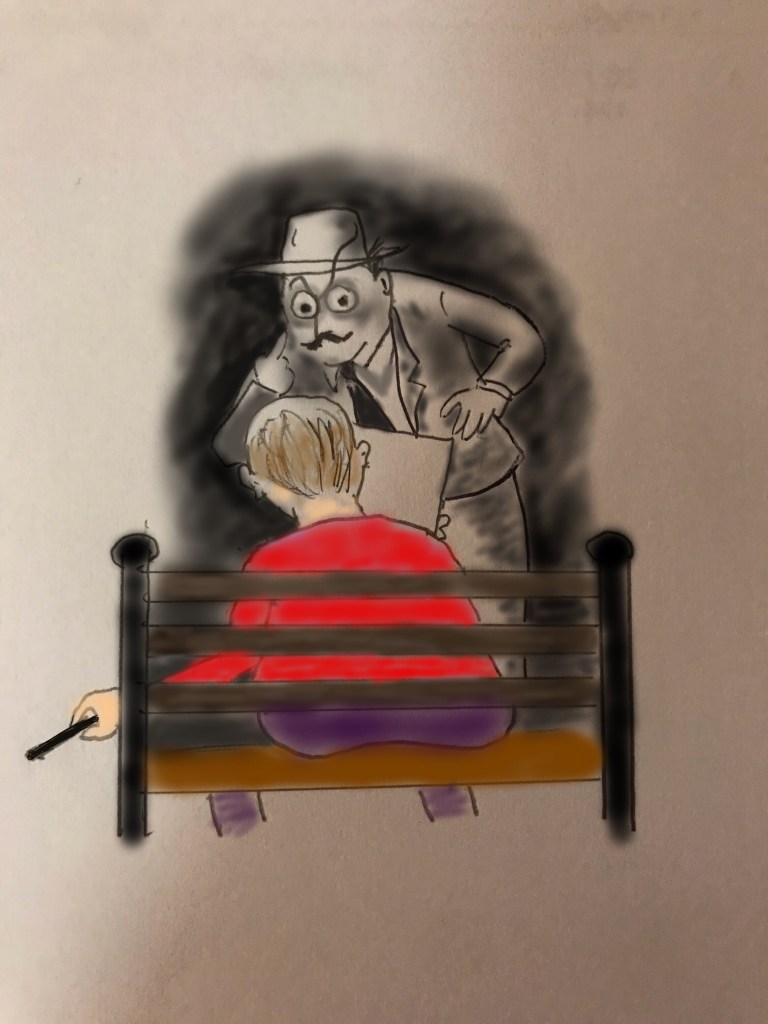
“I’ve always loved chiaroscuro. It’s so stark,” the man says with a slight New York City accent. “I’m Dr. Arthur Di Nobili and drawing and painting are my favorite avocation. And I know you. You’re Josef Hraček, am I right?”

Josef laughs, says yes, as he notices the man’s physical appearance. Imposing with piercing dark brown eyes that bulge while he’s speaking, There is an intensity to the man both in speech and body language. Di Nobili possesses black caterpillar eye brows and a matching mustache that is the same size, color and width. His hair is jet black. He is a walking chiaroscuro. Dr. DiNobili is wearing a white shirt and tailored black suit. His shoes are spit-shined black plain toes; only a Royal Stewart plaid necktie disrupts his monochromatic apparel.

        “Well, I can see why you like charcoal on white sketch paper,” Josef says with an impish grin. 

        “Why do you say that?” Di Nobili utters with a fierce look made to perhaps intimidate.

Dr. Arthur Di Nobili

        Suddenly he bursts out laughing. 

“Maestro Hraček, people have been teasing me about my garb since college,” he says. “I’ve been stared at because some think I resemble a Mafia don, especially when I’m carrying my black valise and wearing a Borsalino hat. Yeah, straight out of central casting. I’m actually a professor of Baroque art history at Boston University. Caravaggio’s one of my favorites.”

The two men chat for fifteen minutes and discuss fine art, especially paintings by the masters.   Josef reveals he studied at Columbia University.  In fact, he doesn’t disclose he was a child prodigy (Di Nobili probably already knows that)  and yearned to study art at the Sorbonne.  Living in the Soviet Union prohibited him from a European education.

They exchange pleasantries and Di Nobili gives him a carte de visite, then departs.  He’s scheduled to deliver several lectures at the Museum of Fine Art.

One last sketch for today, Josef says to himself, and then home for lunch with Anna.

A young couple in their early 20’s are walking past him.  The man is dressed in grunge: Converse canvas sneakers, baggy blue jeans and a Jimi Hendrix T-shirt.  His greasy hair is tousled and he hasn’t shaved for two days.

Gen Xer’s

The woman, who’s taller than he, is Harvard Square: broom skirt, Doc Martins clunky shoes, and a diaphanous blue blouse. She is braless. At least her hair is clean, Josef muses. Two large tattoos adorn her bare arms; another tattoo is located behind her right ear.

What binds these two Gen Xers is a common denominator:  their eyes are completely focused on their cell phones.  No conversation between them.  Of course, they are passing with others in their age group who are behaving similarly.  They are walking slowly and Josef deftly captures their detachment from reality.  He decides he’ll finish this sketch at home because he’ll include the numerous others surrounding the pair who are  also WiFi zombies.

He packs his paper, pens and charcoal and pauses to relish the beauty of the Garden and the humans who are fodder for his skills. In a desultory manner, Josef Hraček returns to his apartment and his beautiful wife. They converse in their native Slovak tongue. She prepares his favorite lunch, plum dumplings and kasha with sour cream and butter. Afterwards, Josef returns to his studio and applies finishing touches to today’s drawings. He chuckles over his meeting with Dr. Di Nobili. It had been time to leave the bench for today. His sloth has temporarily returned. Tomorrow will provide a new batch of characters. There’s a never ending supply he muses while dosing off. Sládké sny.

These Are Not Your Hawaiian Islands

These Are Not Your Hawaiian Islands

By

Leo de Natale

Ask most people over age 70 about their health and you’ll receive a laundry list of ailments: high blood pressure, elevated cholesterol, diabetes mellitus (The Big Three), arthritis, joint replacements and cataract surgery. Most folks in this group will fall victim to at least one, if not more, of these ailments that burst the bubble of the bogus phrase “The Golden Years”.

I’m in that category and know from experience how difficult aging is. It is something we Baby Boomers are forced to accept as time exponentially accelerates. You can cry or laugh. I prefer the latter. There are the physical ailments requiring a daily dose of blue pills, pinks pills, white pills.

Another category is memory or lack thereof.  “What was I going to say?  I just thought of it two minutes ago.”  At first, memory loss is frightening- the fear of Alzheimers Disease steps up front and center.  But then you talk to aged friends and family members.  You discover you’re not alone.  It’s happening to them, too. 

          And then we arrive at the physical and visual shortcomings.  Most of us geezers deal with weight gain – “Gee, I can’t fit into the suit anymore”.  The weight scale disappears as the stomach grows.  You almost hear the scale saying “Oh, God, I don’t think I can take anymore of this.  I need new batteries!”.

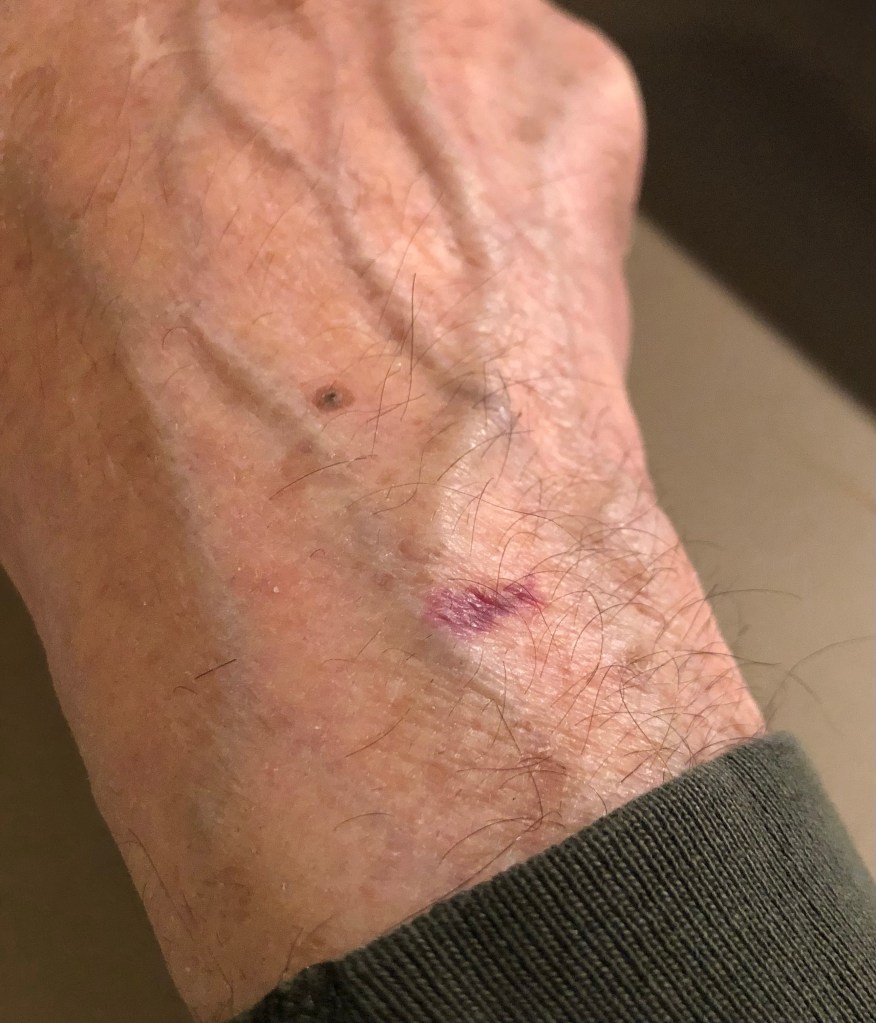
          Somewhere around 70, the body physically changes.  Skin begins to sag.  The blue veins in my hands bulge and resemble highways on a paper road map.  My once taut skin is becoming flaccid and has the appearance of crepe paper enveloping my body – a new concept in body wrapping.

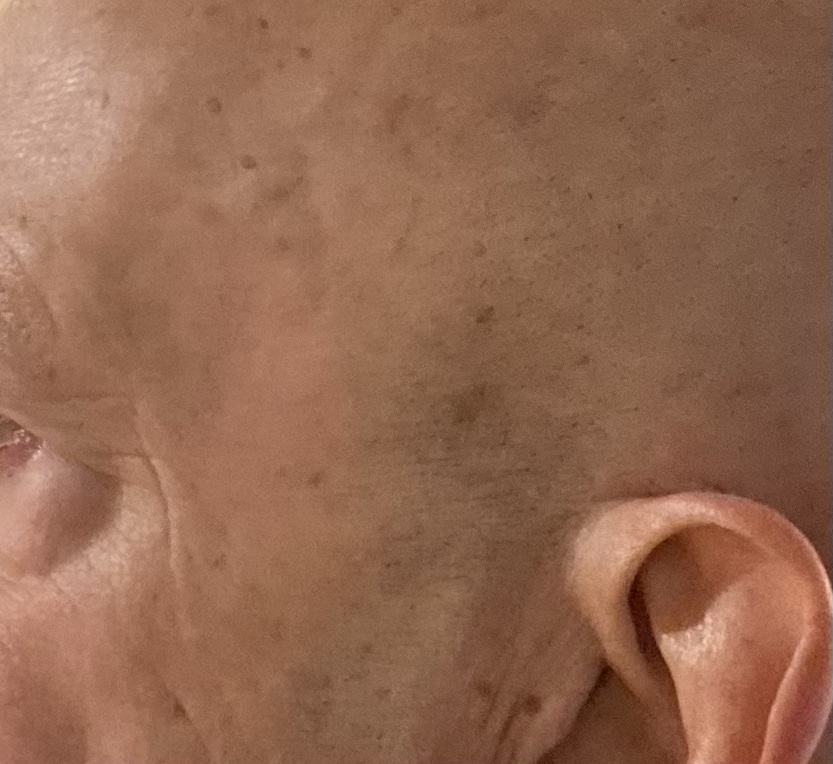
The one change that constantly amuses me is the rapid appearance of Seborrheic Keratosis (SKs), aka age spots. Yes, those brown spots of varying size that poof! litter your body overnight. While shaving I’ll say, damn, there’s another spot on my throat. SKs sprout up faster than a new Starbucks coffee shop.

          During my annual trip to Dr. Debby,  the dermatologist,  I’ll map out the latest batch of brown things that need to be inspected.  SKs are benign but they sometimes need to be differentiated from basal cell or squamous carcinomas.

There’s a certain rapport I have with Dr. D.  During my last visit I discussed a new crop of SKs that had recently popped up on my left temple.

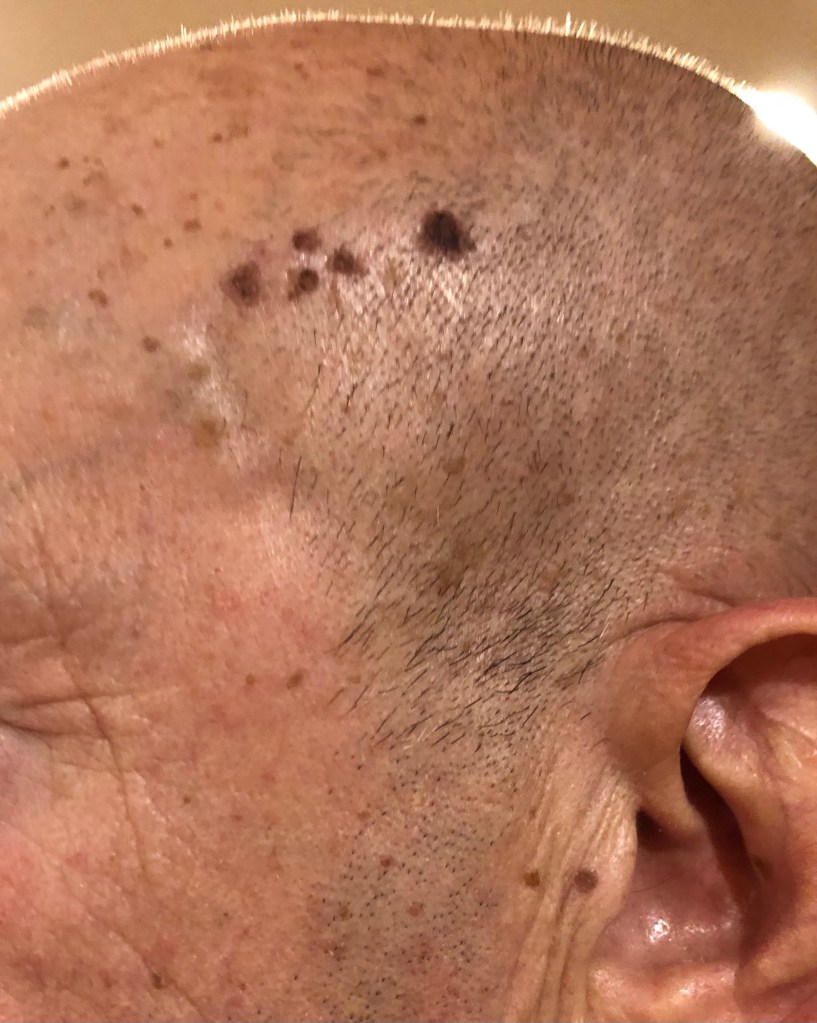
“It seems the Hawaiian Islands have suddenly shifted from the Pacific Ocean to my head,” I said pointing to the spots. “It’s a real archipelago- a perfect replica don’t you think?”

          “Well, well, well, I think you’re right,” she laughingly replied as she inspected them with her magnification loupe. “Yes I definitely see Maui and the Big Island. Oahu, too!  I think it’s time to send them back to the Pacific.”

The Archipelago

          Dr. Debby grabbed her hand-held liquid nitrogen device that resembles a thermos jug.   The device has a trigger and zip-zip-zap the islands are frozen.  Some discomfort but the SKs eventually become  scabs and disappear.

          I wasn’t finished.

          “Debby, while you’re at it, there’s another one here on my throat that just arrived,” I said. “Could you throw in that one?  It’s only going to get bigger and browner.”

          “No problem,” she said as she froze yet another annoying blemish. “This is your Early Bird Special!”

There! That’s better.

          I also mentioned  recurrent purple lesions on my left arm.

“What about this personal Rorschach test on my hand?, I asked, holding up my left hand with a fresh subcutaneous bleed.

“Oh,” those are ‘senile purpura’. “ she laughed again.  “They’re known as blood spots or skin hemorrhages.  Unsightly but benign.”

Senile is a horrible word. It’s a time marker.

          “Gee, Dr. Debby, just think,” I responded. “These inkblot tests weekly pop up on my hands and forearms,” I could rent myself out to clinical psychologists as an itinerant screening test. What do you see on this elderly gentleman’s hand the shrinks will ask.

          “Lots of wrinkles, a blood blister, and a bunch of gnarled, arthritic fingers – that’s what I see!”  I imagine a 30-year-old man suffering from a bipolar disorder would say after staring at the blob on my hand.

          At least the guy is honest. Rorschach interpretations many times are false positives.

A mini-Rorschach.

Clint Eastwood’s last good movie, The Mule, was a portrait of an octogenarian fighting against the onslaught of aging. In an interview, country singer Toby Keith, who wrote the film’s finale song, said he played golf with Eastwood before filming began. During the conversation, Keith asked him what was his secret of staying young at heart.

“Clint looked at me and said ‘It’s easy. Don’t let the old man in’”, Keith replied. That’s a good way of looking at the fate that awaits us all. Of course, Keith wrote a beautiful eponymous country song, Don’t let the Old Man in. Pretty good recording.

The youth of each generation never have a clue. They’re too busy going to college, getting married, having children and working hard. Many parents will say they can’t believe that rapidity of time occurring while child rearing. They have some inkling of what’s happening as their family grows, attends school and college and repeat the cycle. Folk singer Tom Rush recorded a very successful album in the 1960’s. One song written by Joni Mitchell was the source of the album’s title: The Circle Game.

“And the seasons they go round and round

          And the painted ponies go up and down

          We’re captive on a carousel of time

          We can’t return, we can only look

          Behind, from where we came

          And go round and round and round in the circle game

          And go round and round and round in the circle game.”

Bully On The Branch

Bully On The Branch

By

Leo de Natale

Illustration by Vince Giovannucci

Screw!!!!”

        We used to feed birds during winter. The red metal  feeder was one of those spring-loaded jobs that prevented larger birds and squirrels from hogging the sunflower seeds.  Alas, we had a mouse infestation several years ago and discontinued the daily activity.

        Winter is a brutal time of year for all these backyard creatures.  My wife and I would fret over their fate.  How do they survive sub zero temperatures and such harsh weather?

Something happened last year that created a mice-be-damned attitude about feeding these innocents. During last summer we had a new visitor to our bird bath: a black squirrel. Didn’t know the gender – he turned out to be a she- but the squirrel was predictable in its visit to the watering hole.

Our Miss Blackie

“Blackie”, as we came to call it, was cute as a button and a battle-scarred veteran of the backyard gang wars. Its body had numerous patches of missing fur on the back and behind the ear (Gray squirrels routinely attacked her). The black coat was unusual and the more frequently it visited, the more we enjoyed her gracing our backyard deck. As the summer progressed, the squirrel became fatter. Soon you could see protruding teats on her underbelly. There was now no question about the gender. Blackie was a going to be a mommy.

Suddenly she disappeared for several weeks. What happened to our cute little friend? We were concerned. Was she killed crossing a road or was she a lunchtime snack for a circling hawk or a wily coyote? Each day we’d scan the deck and hoped she’d reappear. We had switched from birdseed to oyster crackers. Blackie really enjoyed the treats and it was hilarious to watch her eat. Squirrels take a cracker and chew the treats by rotating clockwise like a human eating corn-on-the-cob. It was simple entertainment. We loved it.

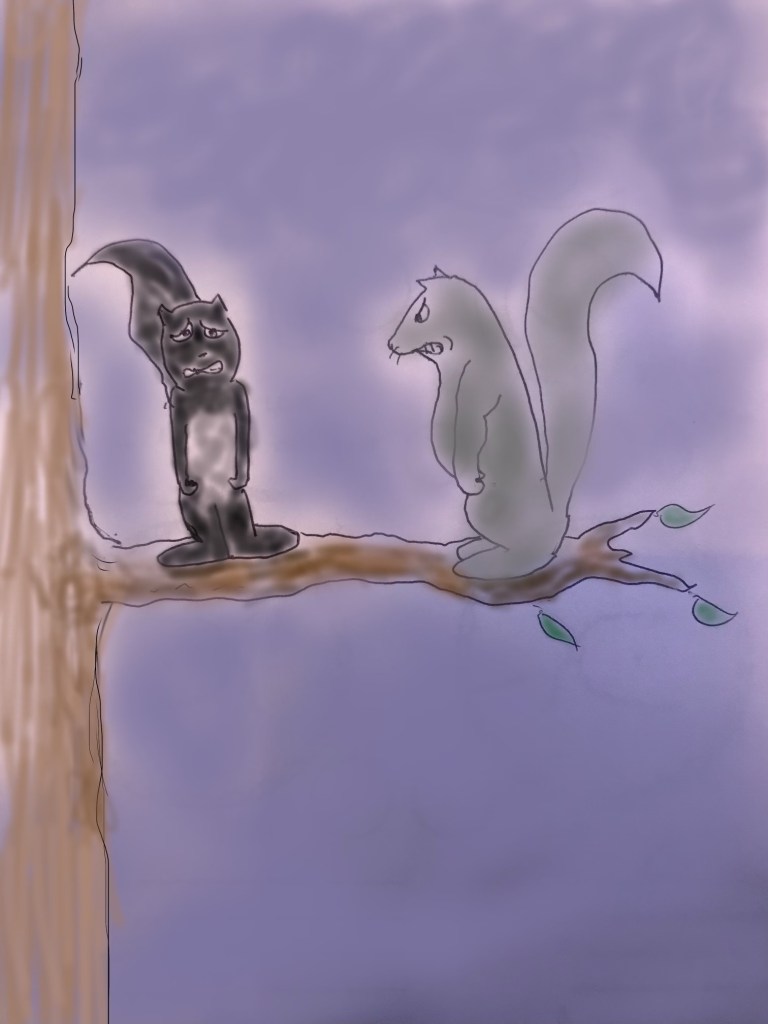
One morning in early fall, my wife Kitty called, “Come here! You’re not going to believe this!” I rushed to the dining room window and was incredulous. It was the sudden appearance of three scrawny baby Blackies. They were so small, especially compared to the gray squirrels who turned out to be the bullies of the tree branches. They’d hassle the new arrivals and their truculence didn’t stop as the black squirrels began to grow.

Per usual, we had been feeding the creatures crackers, a staple that all seemed to enjoy. Besides the squirrels, the sparrows, blue jays and big black Ravens began hanging around the chuck wagon. My wife and I, however, were concerned with the little Blackies. We started chanting “Black Squirrels Matter”!

Later in autumn, the Covid-related “supply chain” debacle created a curious shift in our feedings. The oyster crackers were suddenly disappearing from super market shelves. Like so many products, the popular treat was out of stock. Hmmm. What to do.

My wife checked our cupboards and discovered we had an ample supply of Ritz Crackers, a favorite of multi generations.

“Let’s give them a try, Kitty,” I said.  “I’ve seen the Ritz in just about every store.  The Blackies need to be fed.”

And so it began. Three times daily we’d toss about ten crackers on to the deck floor. And then we’d wait for the show. You had to be quick because within moments the squirrels would appear. The Ritz were too big for them to eat on the deck. Squirrels and most birds worried about predators. The gray squirrels chased away the Blackies and would even hassle their own breed. It was difficult to determine the hierarchy but one bull squirrel would lift his furry gray tail and dominate. His fellow grays would scatter.

Soon all squirrels, black and gray, began grabbing one whole cracker in their mouths and would scurry away to gorge themselves. Despite the harassment, the Blackies throughout the day would scoot with their daily haul. We were delighted with their success.

We began to see a pattern in these rodents’ behavior.  Regardless of color, squirrels are crepuscular – they’re active usually in early morning and late afternoon.  Deer and many other woodland denizens have similar biorhythms.  The squirrels would queue up along a six foot stockade fence separating the backyard from a side allee.  They’d slip through the deck railings, give a quick lookabout, grab a Ritz  and then scoot to a fence post and devour their snacks.  Of course, we had the loud mouths – blue jays- who’d dive bomb on the deck floor and leave with a whole cracker in their mouths.  Occasionally the true school yard bully, a big black Raven, would arrive and snatch two, perhaps three crackers in his huge beak. 

“Screw you little ones,” the Raven seem to say as he cawed and flew away.  Ravens are huge compared to the other birds.  Even the gray squirrels were frightened by the Big Boy.  You don’t mess with Edgar Allen Poe’s Raven.

I became intrigued by the appearance of Blackie and her brood. Black squirrels have a mutated pigmented melanin gene. They have existed in North America since the 17th Century. They inhabit much of central Canada and the northern United States. Biologists have no explanation of how or why this mutated gene appeared but they do have several theories.

Some researchers suggest the black fur helps retain body heat during harsh winters.  Black coated animals were found to have 18 % less heat loss in temperatures below 14 degrees.  The researchers refer to the phenomenon as “thermal advantage”.  It has also been suggested their fur is better camouflage in deeply forested areas.  Gray squirrels stand out and are an easier target for predators.

Regardless of the how and why of their sudden appearance, we feel a certain joy with each day the Blackies appear.  They seem to have more personality and we are thrilled with their presence.  Black is beautiful, Baby.

A Trip Through The Abattoir

A Trip Through The Abattoir

By

Leo de Natale

Illustrations by Vince Giovannucci

Is it a Chicago stockyard or a Boston airport?

It was fall, 2021.

Flashback two years ago. In May, 2019 Julie and Kyle Reston had flown first class for a dude ranch horseback riding vacation in sunny Arizona. What an experience. There’s a perceived pretentiousness with many who fly first class but not the Restons. The recently retired couple had worked hard during their lifetime and felt it was time to splurge on luxury. They’d made the right decision.

It turned out 2019 was the last year air travel would be normal. After takeoff, the well manicured, obsequious female flight attendants in first class pampered their guests. First, there were the hot towels handled with tongs, a luxurious way to clean one’s hands. Next followed a complementary glass of champagne. The flight left at noon, late enough to splurge on booze.

During the five hour flight, the Restons were given a gourmet lunch served on china plates, premium silverware and linen napkins. White and red wines accompanied the meals. Alcohol flowed freely. The meal was completed with a hot fudge sundae served in an old-fashioned glass goblet and topped with nuts, marshmallow and, of course, a cherry on top. The attendants did everything with alacrity and supplied warm, complementary blankets – it gets cold at 30,000 feet.

Back in the cheap seats, travelers received a sandwich, pretzels and soft beverages in plastic cups.   Alcoholic  drinks had to be purchased.  It was class distinction before one’s eyes. The Restons learned afterwards  that attendants receive financial bonuses when first class passengers give high marks in an  online feedback survey.  Kyle admitted the service to and from Arizona was spectacular.

They had planned for another Pheonix getaway in  2020 but the curse called Covid 19 derailed that trip.  Airline tickets were cancelled and a sidetrip to the Tucson dude ranch was  placed on hold.  The ranch’s non-refundable deposit would be held in escrow for two years.   Most important, the Restons missed visiting their longtime friends who lived in Scottsdale.

Like so many Americans, their life’s activity had been completely altered by an invisible enemy. Fortunately, anti-Covid vaccines were developed in record-breaking time. Think Operation Warp Speed. By March, 2021, Kyle and Julie had been vaccinated. Life was slowly returning to a new normal.

At least the dreaded blue masks were disappearing from many aspects of life but not at airports or during in-flight travel.   One could sense a proverbial light at the end of the tunnel.  Their delayed vacation would be a reality.

In May they purchased tickets from American Airlines. The Restons again selected five-hour nonstop flights between Boston and Pheonix. Kyle contacted the ranch and reserved a four-day stay for both their friends and themselves.

Everything was in place and they antipicated their October vacation. Little did they know they’d be hurled into a good case of You Can’t Go Home Again. And it started with their flight schedule. In mid-July, the airline company notified the Restons’ their direct to Phoenix flight had been cancelled. The new flight included a one-hour stopover in Charlotte, North Carolina. Total flight time would now be eight hours.

Kyle was outraged and learned the airline industry had radically changed during the Covid crisis. He called the airlines’ toll free number and, due to apparent lack of personnel, was given a choice: he could choose to wait on hold approximately four hours or opt for a call back.  He chose the latter.   He called nine separate times and never received a return call.   He and Julie faced a brick wall.  There were no alternate telephone numbers and there was no corporate email addresses listed where a complaint could be registered.   All commercial airlines were behaving in a similar fashion.  Nobody could contact anyone.

“I know someone who works for American Airlines,” a friend of Julie’s explained. “They’re just starting to rehire people.  The airline apparently has antiquated software.  That’s why you can’t reach them. My friend told me the best time to call is at 5 am.  Any later in the day, forget about it.”

Julie followed the advice and called at 5:00.  Two hours later an agent finally responded.  Julie had read many travelers were downright hostile and verbally abusive to employees.  Julie by nature was polite.  In an even-tempered voice she asked for help.

“My husband and I really want a non-stop,” she said. “Is there anything you can do?”

“Well Mrs. Reston, I just scanned the flights and we actually have one nonstop flight on the same day,” the agent responded.  “But takeoff is at 9:45 am which means you’ll have to arrive at 6:30 for security and boarding.”

“Good, we’ll take it.”  So be it, she thought.

This meant the Restons had to rise at 4:30 am.  They contacted a local taxi company who would drive them to the airport with a pickup of 6.  Traffic flow was unpredictable on Monday mornings.

The reservation hassles were the first hint of the vagaries of today’s air travel.

The bleary-eyed Restons arrived at the airport.  What a difference two years make.

          “My God, can you believe this?”  said Julie to Kyle as they entered  Boston’s Logan Airport departure gate. “This looks like a cattle pen at a stockyard!”

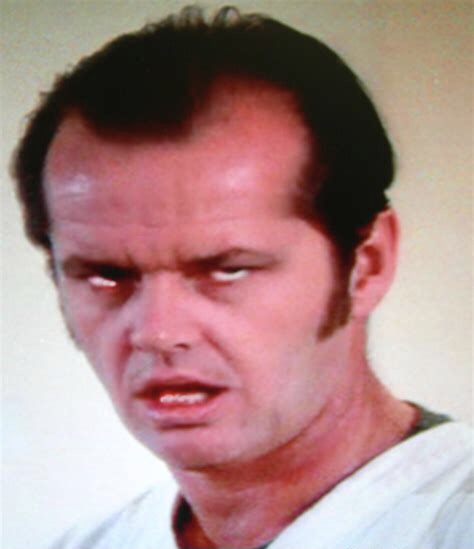
Julie was referring to the scene at the terminal on an early Monday morning. They had just entered the check-in area. There were hundreds of travelers shuffling through a serpentine line awaiting initial security inspection. The line moved slowly through the retractable belt barriers. Bored travelers were wheeling their carry-ons. By 6:30 am, everyone resembled a lobotomized Jack Nicholson in One Flew Over The Cuckoo’s Nest.

Logan Airport, Monday, 6 am

          “I feel as if I’m at a Kansas City abattoir and viewing blue-masked Angus steers awaiting the stun gun,” Kyle said.  “All you need is the mooing of cattle.  How inhumane.”

There was a potpourri of travelers. Some wore warmup suits; portly men and women were devouring cheeseburgers and burritos, the grease dripping down their double chins and staining the masks. Young women were sipping Starbucks coffee while wearing tight fitting ripped jeans that expose various amounts of flesh and tattoos. Older women and men wore them, too.

The overarching observation was this:  flying apparel was immaterial and irrelevant; everyone’s eyes were glued to  cell phones or laptops.  Few were conversing; texting was far more important method of communication. The entire world has aphasia.

          The Restons were spared most of the experience.  First Class airline ticket holders and were guided through a separate queue.  Like everyone, they had to place their belongings, belts, shoes and anything metallic into the now all too familiar plastic bins.  They walked through an arch-shaped screening device.  Julie passed the screening.  Kyle, however was delayed because his titanium knee replacement had sounded an alarm.  He was moved to a special arch that detected the metal knee.  He also underwent the pat down to prove he wasn’t a terrorist.

The Restons boarded the airplane and sat at seats 2 C and D. Leg room was abundant. The seats were wide but Julie noted differences.

          “These seats don’t seem to be as roomy,” she said through her blue mask.  “I remember their being wider.”

          Once aloft the 2019-2021 difference became readily apparent. One flight attendant was male; the other was female.  Neither were warm and fuzzy.   No hot towels were served. No champagne either.

          “Will breakfast be served?” Kyle asked the man. “We got up too early this morning.”

          “We’ll be serving you soon,” he flatly responded.

Within moments, the attendant walked down the aisle carrying flimsy clear plastic glasses containing water, Coca-Cola and lemonade. The Restons asked for coffee and soon were drinking coffee out of paper cups. So much for the chinaware. Finally, their “breakfast” arrived. Stale croissants with turkey, lettuce and tomato sat on paper plates. Included in the meal were trail mix and a fruit cup. That was it. There would be no hot fudge sundae served on this trip.

“Gee, things are a lot different now,” Kyle said to the attendant. “I’m sure it’s been tough on you.”

The attendant explained the changes in section designation.  American Airlines had downgraded first class to “business class”.  The niceties had been eliminated, including those cozy blankets. Also missing were the cheesy inflight American Airlines magazines crossword puzzles that had already solved and advertisements for expensive products and gadgets no one ever purchased. Now, the only advantage was seat size and leg room.  The poor bastards in coach were squeezed into narrow sardine seats and received pretzels and a drink.  No booze, no blanket, no nothing.

Even the first class passengers’ physical appearance had changed. Seated directly in front of the Restons was a middle-aged married couple. The wife was wearing the aforementioned ripped jeans. She continuously played with her pony-tailed hair. Periodically, she flipped the hair over the head rest. Kyle was staring at a glob of semi-washed hair containing a touch of gray.

Tattoo you?

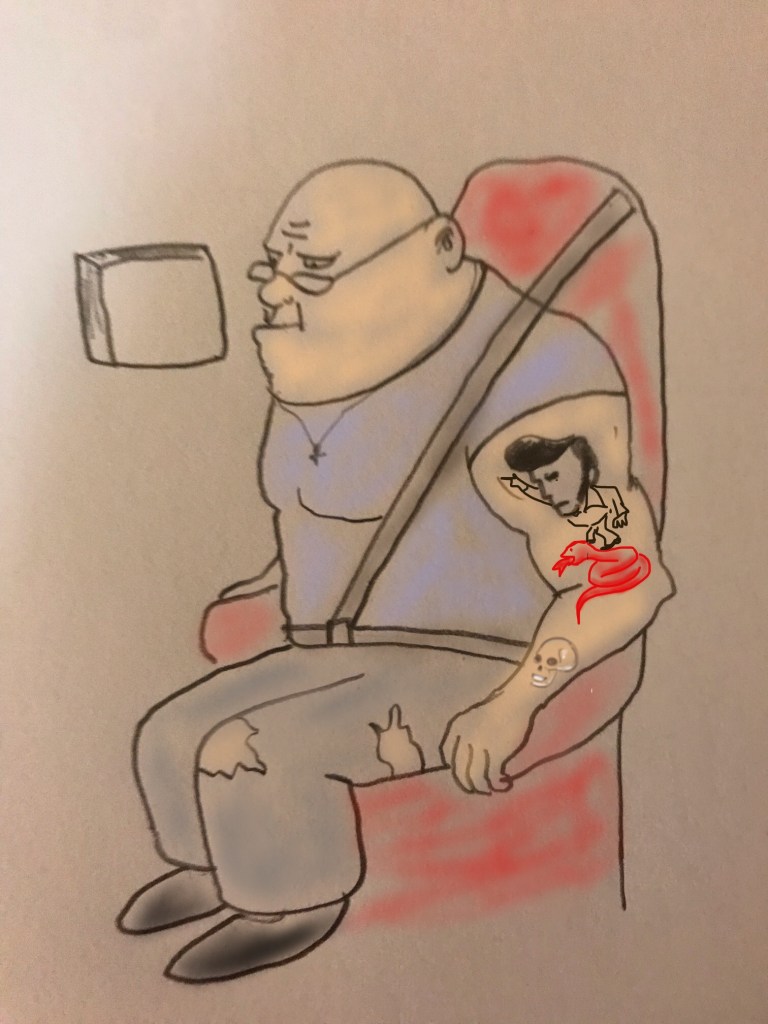
The well-muscled husband also wore the same jeans style. His bald head was clean shaven and gleaming. The kicker was this man was apparently suffering from a bad case of male menopause. The cabin was cold but that didn’t stop him from wearing a tightly fitting tee shirt that exposed newly inked sleeve tattoos on both arms. It was a classic example of exhibitionism. Passengers were supposed to be impressed with a huge Elvis-head tattoo on his right arm.

Across the aisle, a nerdy guy with eyeglasses and paunch was very thirsty. Just after a 9:45 takeoff, he ordered the first of four Bloody Marys. The attendants didn’t serve drinks; they merely handed him tomato juice and vodka nips. Having had several tastes of the Beast, he weaved to the rest room located near the pilot’s cockpit.

“The hair of the dog that bit me”

Julie walked toward the rest room. Mr. V-8 was exiting. She discovered he’d deposited plastic cups and nips into the sink. At least he’d had the decency to not vomit, she thought.

To stretch his legs, Kyle walked through coach en route to the rear rest rooms.    The seating is barbaric, he said to himself.  They were tight enough to cut off one’s blood circulation.  And yet, some travelers were sleeping.  Kyle had always envied these people.  How do they do it, he mused.  In fact, seeing these people reminded him of the war galley scenes in the movie  Ben Hur.  The galley slaves were chained to their aisles and rowed constantly.   Those who collapsed were whipped by the galley master.  Kyle imagined hearing that crack as he returned to the first class cabin.

The Restons were engrossed in reading- a tedious task while wearing masks. Their eyeglasses continually fogged up. What a pain they said to each other. Some passengers would remove the mask while they were eating or drinking and were slow to mask up. The attendants walked by and, sometimes sternly, told the passengers to reposition their masks. Obdurate mask scofflaws could find their names on a do not fly list ban on American Airlines.

Despite the Boeing 737’s droning engines Kyle dozed off. The Restons could suddenly feel the plane’s descent. Kyle gazed out the window and in the late morning sun he saw the grey/brown mountain ranges east of Phoenix. The sun was bright and shone on the vast metropolis, Hundreds of subdevelopments appeared, each home with the obligatory in-ground swimming pool. In this part of the country, pools were de rigueur. The plane swiftly descended and, with the bounce and with a screech of its tires, safely landed.

As they walked through the gangway the welcoming heat and light shone.  It was sunny and 90 degrees and the forecast for the week was hot, dry and no rain; when they left Boston that morning it was raining and 45 degrees.

“Enjoy this, honey,” Julie said. “In a short ten days, this will quickly become a memory. In the meantime, let’s cowboy up.”

The Restons headed for the Uber station. They knew there’d be another another trip through the abattoir upon their return. For now they were living one day at a time and enjoying one moment at a time. Arizona makes that easy.

The Emperor’s Clothes, 2021

The Emperor’s Clothes, 2021

By

Leo de Natale

Illustrations by Vince Giovannucci

A purebred standard French Poodle
A purebred Golden Retriever

The Emperor’s Clothes is an old fairy tale whose moral is people can be hoodwinked into believing there’s something there when there isn’t. Combine that myth with P. T. Barnum’s quip there’s a sucker born every minute and you have the Goldendoodle.

The concept of mating a Golden Retriever with a standard-sized Poodle was this: mix the temperament of a Retriever with the hypoallergenic properties of a Poodle and you have an ideal dog.

During the 1990’s the Goldendoodle “breed” was first popularized in Australia where breeders got the brilliant idea for creating a pet for persons who loved dogs but had canine allergies. Dander in a Retriever’s coat was the source of allergic reactions. Poodles are one of several breeds such as Bichon Frises having wiry, non-shedding coats. Anyone who’s ever owned a Golden Retriever or any long-haired dog knows about the daily shedding that leaves tumbleweeds of hair throughout a home.

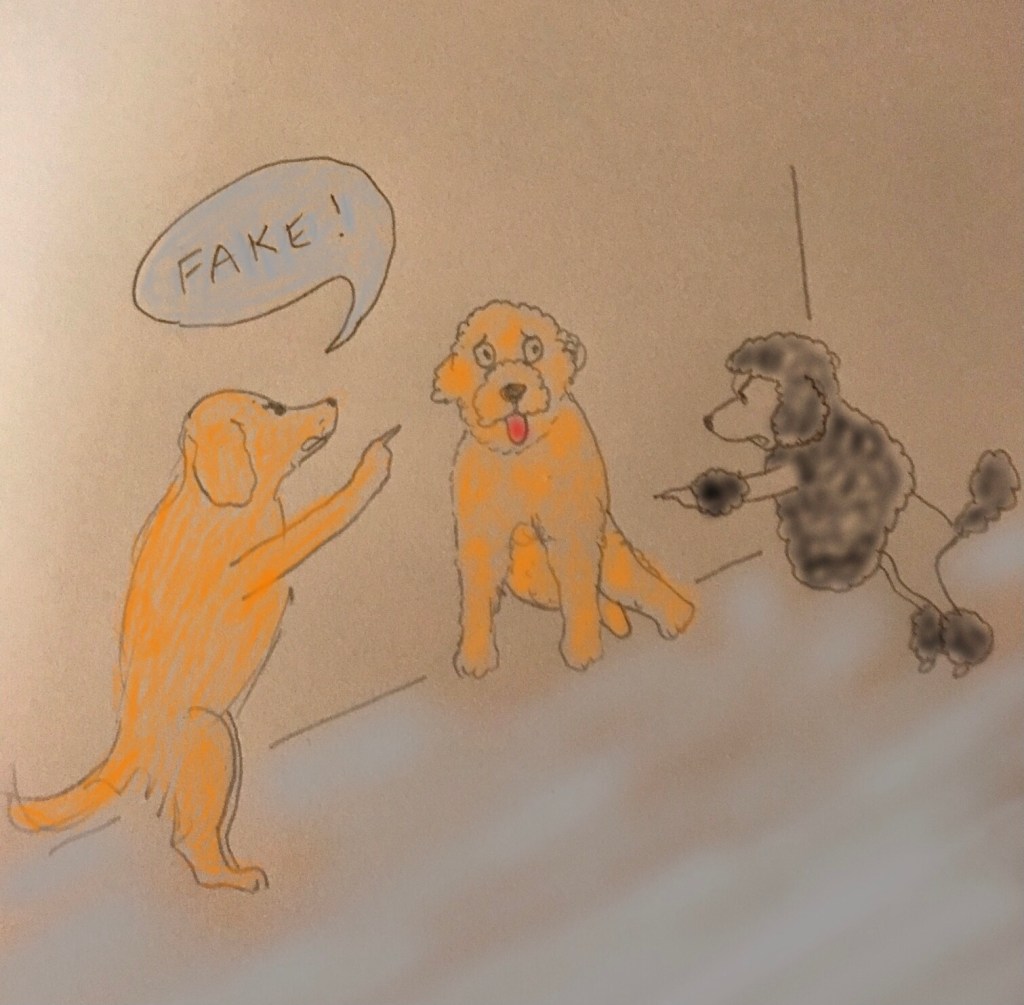
Australians refer to Goldendoodles as “Groodles” and are considered mongrels, i.e., mixed breed dogs. The notion of creating a dog that would be compatible with persons with allergies gained traction. The dog owners and breeders were buzzing over this “new breed”. Soon Americans were breeding Doodle dogs and today they’ve achieved a strong presence in the United States. Labrador Retrievers are the most popular AKC breed. Today, Labradoodles are flooding the Doodle market. The Doodles’ sizes vary with the poodle types: standard, miniature and toy. They also vary in coat color and length.

Fake!!!

In the dog world, however, various purebred dogs experience ephemeral popularity. Breeds become trendy and have their fifteen minutes of fame. For example, in the 1990’s, the film 101 Dalmatians was released and, predictably, Dalmations became the dog du jour. Breeders couldn’t keep up with the demand. Their popularity was short lived when owners discovered the breed was difficult to train. They were high energy dogs who were bred to run, run, run. Hyperactivity was the Dalmation’s calling card. They also have a genetic predisposition to deafness.

Then it was on to the wooly Bernese Mountain Dogs. “Berners” have adorable faces, especially as puppies. They are a large, obscure Swiss breed and the total number of dogs worldwide is small in comparison to others. This meant there is a diminished gene pool. What emerged is an AKA-approved breed that is inbred and has various genetic defects. Many Bernese have short life spans or manifest poor temperament.

The American Kennel Club’s (AKC) top three breeds – Labrador Retrievers, German Shepherd Dogs and Golden Retrievers- have been the most popular dogs for decades. The remaining breeds (there are a total of 202 recognized) travel up and down the popularity scale. Movies can have an influence, e.g., think Pugs after the Men In Black movies or television’s Eddie, the Jack Russell Terrier, who was a favorite on the Frasier show.

There has been a decrease in purebred dog sales due to the increased cost. A prospective dog owner is shocked by the sticker price. Most purebreds cost between $1,000-$5,000. The specific breed doesn’t matter. They’re expensive. Many Americans have opted for shelter dogs who have been abandoned. Often the adoptees are from Southern states and cost $300-$500.

The success of Doodle crossbreeding, however, has swept the breeding landscape. Therein lies a paradox and that’s where Mr. Barnum’s influence appears. Today, an entire subspecies has appeared and the cost rivals purebreds. “Breeders” have invented new Doodles that are bred with toy breeds. Chia-poos (Chihuahua/Poodle), Maltipoos (Maltese/Poodle), Cavipoo (Cavalier King Charles/Poodle), etc. There are about 22 distinct crossbreeds. Our friend the Bernese Mountain Dog has also been bred to create the Bernadoodle.

This is where the insanity is manifested. Unscrupulous people have created a cottage industry by breeding two purebreds and creating mongrels, regardless of size. Doodle dogs will never be recognized as an official breed.

          “It’s rare for me to train purebred dogs,” said Kitty Hayes, a professional trainer with 30 years’ experience. “The Doodle crosses have been dominating the dog breeding industry for quite some time. They come in all different sizes, shapes, and colors.  Some I train are sweet while I’ve trained many that have  attitudes; others have been unstable. Hybrid vigor varies.”

          Hayes said Standard Poodles can be large (they often weight up to 70lbs.) with dominant personalities.  

The AKC has specific rules and regulations that govern such physical attributes of size, weight, color and temperament. For example, pure White German Shepherd Dogs  are bred but not officially recognized because of their coat color.  Dachsunds have three coats, smooth, wire-haired and long  but must conform to size, weight and physical appearance.  The same applies to fox terriers, smooth and wire; Collies can be smooth or rough coated.

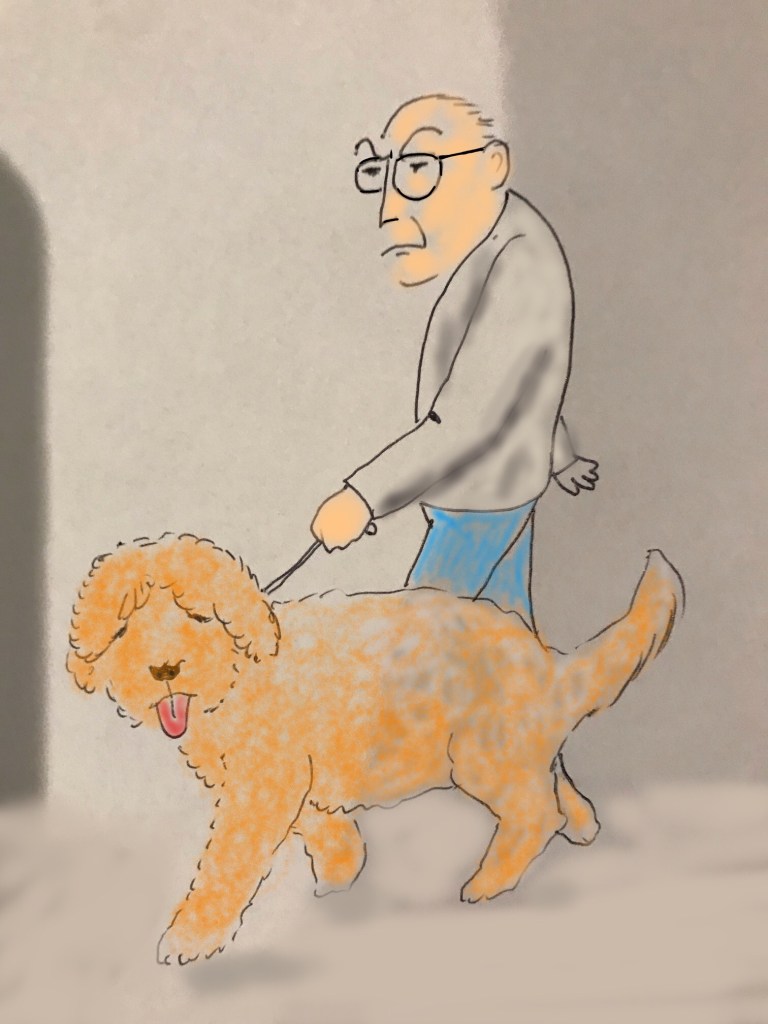
But guess what? Doodle dogs are outselling purebreds. Search the internet and you’ll find a Bernadoodle puppy with a $4,500 price tag. These mixed breed dogs with their cachet are fetching as much as the AKC breeds. Owners of these mongrels are quite proud and happy with their selections. In many from affluent communities residents parade around with their en vogue Doodle puppies unaware they’ve been played. There are many emperors who strut with dogs that are fool’s gold. A mongrel is a mongrel is a mongrel. Isn’t that right, Mr. Barnum?

“My Doodle is soooo chic, n’est pas?”

          Meanwhile there are thousands of animal shelters across the country where kind-hearted volunteers tend to stray dogs who, if not adopted, face a said end to their sorry beginnings.  The euthanizing  hypodermic needle awaits them.  Such is a dog’s life.

Invisible Man

Invisible Man

By

Leo de Natale

A grain of sand through the hourglass how quickly it falls

A metaphor for those whose time rapidly accelerates

Oh we were warned how one’s age becomes a freight train

Out of control. Blink of an eye 40, the blink of an eye 50, the blink of an eye and it’s 70;

You gaze into a mirror and a face stares back

Changing so imperceptibly at first then an avalanche of sagging skin baggy eyes Forehead lines. What is happening to myself you say…

I am a soul with external and internal wrinkles. Some bemoan, some Accept. Humor And laughter and family are the salve and succor.

The aged dwell in the past when they Were somebody and not

Some invisible person Ignored, unnoticed at the grocery store, The Restaurant, invisible to younger passersby

On the street those addicted to cell Phones are oblivious to Everyone.

Societal Detachment; illness, disease, immobility Become the battle Lines between Young and Old we’ve seen it kids and it will happen to

You, believe us.  The invisible men and women have seen it

It’s true

If Franz Kafka Were An Optometrist

If Franz Kafka Were An Optometrist

By

Leo de Natale

Illustrations by Vince Giovannucci

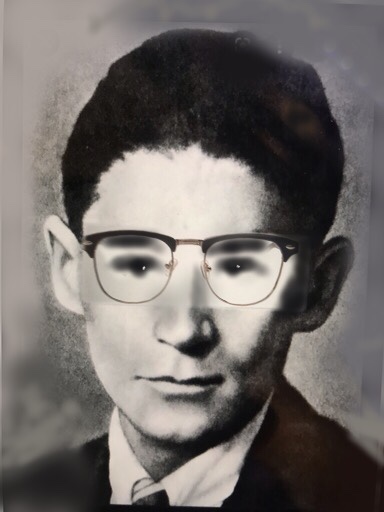
Kafkaesque: Czech-born German language writer Franz Kafka whose surreal fiction vividly expressed anxiety, alienation and powerlessness of the individual in the 20th century. The word Kafkaesque is often applied to bizarre and impersonal administrative situations where the individual feels powerless to understand or control what is happening. Source:Mirriam-Webster

Franz Kafka
A bespectacled Franz Kafka

          In Massachusetts, there is a bureaucratic haven called the Department of Licensure.  It is an office that controls, monitors and issues professional licenses.   Many occupations require a license.  Hairdressers, plumbers, physicians and numerous and varied occupations can’t escape the long arm of Those Who Control Our Lives.  In the eyes of state hacks, a neurosurgeon is no different from a barber.  Many occupations affecting the functioning of society require monitoring.  For a fee, of course.  Over the years more and more people are affected by the dictates of organized government.  And why would you say this exists?  Very simple.  Professional licensure has become a cash cow.  It’s all about the money.

Anyone in an occupation requiring a license pays an annual registration fee.  Statistically, the cost has increased.  Most license fees have doubled or tripled.  The following is such an example.

Dr. Stuart Paul is a semi-retired optometrist who in the year 2021 would be sucked into the vortex of a Kafkaesque bureaucracy. It all began early the previous year. When the public health crisis was at its zenith in 2020, he pondered hanging up his ophthalmoscope and permanently retiring. He wouldn’t renew his professional licenses and would call it a career. Like all Americans, the short and long term effects of Covid 19 affected him. He worked at an optical chain located inside a Boston mall. The office was busy with a steady patient flow. By early March, 2020 the mall pulled the plug and the entire facility was indefinitely closed.

After 40 years examining patients’ eyes, he could not work.  In his early 60’s, Paul was unemployed. He consulted with his primary care physician, Miriam St. Claire.

“Stuart, you’re 65  now,” she stated.  “The CDC is advising persons in your age group are at greater risk for Covid infection.  I would prefer you suspend work.   You optometrists are in close contact with patients.  I know you regularly exercise. I’d also suspend any gym activities, too.”

And so arrived the routine: mandatory masks, social distancing and isolation became the watch words. After he’d closed his private practice nearly ten years ago, he’d settled nicely into a series of part time positions. He was free lancer, a “hired gun”, and never wanted for work. Like most Americans, Dr. Paul and his wife Katrina plummeted into forced isolation. Their children were grown and lived out-of-state. It was just them and their two Cairn Terriers, Hoot and Lassie.

They lived during the “Curse of the Mask” where everyone was obliged to wear the dreaded blue disposable masks. Life became claustrophobic. Everyone yearned for the “good old days” which weren’t that old. My, how everyone took normalcy for granted. The country endured a period where citizens were forced into a national psychological depression. Inability to interact socially or travel to work and sheer boredom consumed the nation. Hello, Herr Kafka.

Fortunately government leadership in record-breaking time developed vaccines in late 2020. The cure was near. After the usual Food and Drug Administration (FDA) hurdles vaccines became increasingly available. On a hunch he’d be working again, Stuart Paul had wisely renewed his professional license (for a $150 fee – it once was $25) for 2021-22. As a licensed health care worker, he was eligible for vaccination. He was vaccinated by March, 2021.

April arrived.  Stuart still felt nudgy.  He reversed his retirement decision and began looking for work.  He contacted various colleagues but there weren’t any available part time positions.  His main physical activity had been two hour walks, sometimes with Katrina, sometimes with his neighbor Joe.  At various times during the day, he’d ride a stationary recumbent bicycle he’d purchased the previous December.  He was reading books and telephoning friends.  It was a time when old friendships were re-ignited – that was a positive aspect of living through a pandemic.

Out of the blue, the phone rang.  It was an optometrist who had hired him part time after he’d closed his office.  She’d moved out of state five years ago but returned to Boston and reassumed her shopping mall practice.

“Hi Stuart, this is Suzy calling,” Suzy Wadsworth said. “I’m back and have signed a new contract with the mall.  I’m looking for some part time coverage.  I know you’ve retired, but are you interested in coming back?”

“It’s so good to hear your voice, Suzy,” he replied. “Yes, I’ve been dying to resume working and ditch retirement. Let’s have lunch.”

They arranged to meet later that week. It initially was awkward because of the mask requirement but they talked. Stuart had always enjoyed his interaction with Suzy. He liked her. She was an extremely competent optometrist and there was good chemistry between them. She wanted coverage two times per week and increased Stuart’s per diem salary. He was giddy. But then he had to explain the glitch.

The licensure for writing prescriptions drugs had lapsed. He was required to renew the drug license. He could not work in an office with the inability to treat eye infections.

“Suzy, I’ve renewed my general license but the drug license has lapsed,” he confessed. “I can examine eyes and write eyeglass prescriptions but obviously not prescribe medications.”

“Well, I tell you what, Stuart,” she said. “You can start working but exclude any patients needing medication.  I can call in  prescriptions.  That’ll cover us.  But you have to apply for license reinstatement.”

“I’ll do that first thing tomorrow,” he eagerly replied. “I’m so happy you contacted me.”

This is where he would experience Kafka’s labyrinth. Stuart Paul’s descent into this parallel universe began when he telephoned the Department of Licensure’s main number. As with most companies, governmental agencies or utility companies, he heard the predictable computerized voice.

“You have reached the Massachusetts Department of Licensure.” an android voice said. “ For new applications, press 1, for inquiries on pending applications press 2. All other inquiries press 3 or remain on the line.”

Stuart pressed 1 and, you guessed it, the recorded message said “Due to the high volume of calls and the Covid 19 restrictions, we are unable to answer this call. Please leave your name and telephone number. Your call will be answered within the next 24 hours.”

The message added the option of using the  department’s website.   So many businesses are basically forcing the public to use online services.  This reduces the number and cost of humanoids manning  telephones.  With state government what difference did it make?

Stuart left a message and waited. And waited. And waited. Three days later, it was obvious no one would be returning his inquiry. Dammit, he said to himself, you can’t get anyone to respond. All these government workers who are receiving a full salary and working from home. My taxpayer dollars are paying these salaries and the service gets worse! He gave up and went online and navigated through the bureaucratic maze of options. He decided to utilized the optometry license website and, amazingly, found the dropdown option for renewal forms. He downloaded the printed application form. Now we’re getting somewhere.

He filled the necessary checkoff information including whether he not he’d been convicted of malpractice, insurance fraud, selling a cheap pair of eyeglasses, used contact lenses, or other inane categories. He signed the document, included the $165 fee and mailed the application. Hopefully, he’d receive the license within two weeks. Or so he thought.

After three weeks, the envelope was returned with the message, “Letter undeliverable to this address.” What the fuck is going on? he said to himself. He double-checked the address. Yup, it was correctly addressed.

Once again, he telephoned the department, followed the voice prompts, left a message and obtained the same failed response.

Stuart was fuming.  He decided to see if another branch of state government could help and contacted his state representative.  The same telephone call protocol – push one for Rep. X, two for Y, and three for Z. Number 3 was his guy.  Left a message with his aide who, surprisingly returned the call about three hours later.

Stuart explained his situation and the exasperation with the address glitch. He discovered he’d made the right move. An aide named Mark responded.

“Dr. Paul, this is Mark,” he said. “I’m giving you the name and telephone number in the Department of Public Health.  They oversee the Licensure Board.  Please contact Molly Graves.  She’ll put you in contact with the right person.  Call me if there are any problems.  Sorry for your inconvenience.”

He quickly called Ms. Graves and was placed on hold.  After three minutes, she answered.

“Ms. Graves, this should be a simple straightforward activity,” he said. “I mailed the envelope to the address provided and it was returned.  What is going on?”

“I’m sorry for this delay, Doctor,” she said apologetically. “There was an “administrative” error. Here’s the new address.”

She supplied the information but he wouldn’t let go of his frustration.

“I simply don’t understand how application addresses are switched and not updated on the document,” he replied. “I’ll resubmit this but I’m sending it by certified mail.  I don’t want to wait another three weeks.”

That was Round 1. He did in fact wait another three weeks. A letter finally arrived. He opened it and, to his dismay, the application was returned with a note saying “You failed to renew your license for 2019-2020. The check received covers last year’s license. You must resubmit an additional $165 fee.” Due to Covid, the license had allegedly provide a fee forgiveness for 2020. Wrong. Whether or not an optometrist was working, the fee was still required.

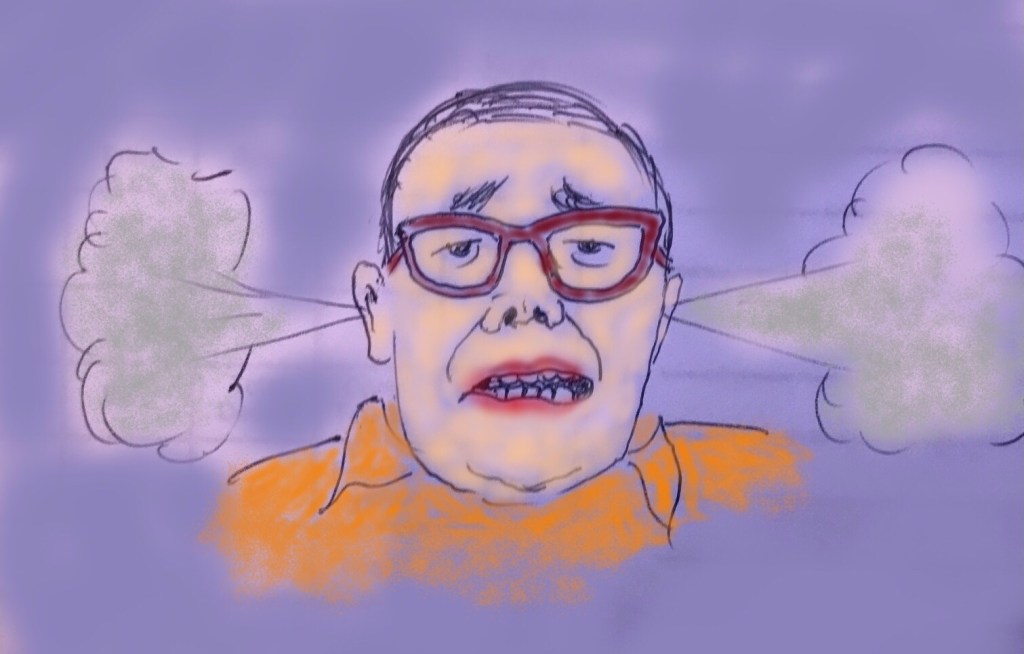
Stuart, with steam pouring from his ears, resubmitted the application and again mailed it registered mail. I don’t trust these incompetents, he mused.

An exasperated Dr. Stuart Paul

Two weeks later, an envelope arrived. He opened the letter and he fell deeper into the bureaucratic chasm. Inside the envelope was an application and it wasn’t Stuart’s. The document belonged to a female optometrist from central Massachusetts who had failed to complete her application. Right church, wrong pew.

He Googled the doctor’s office and telephoned. She answered the call and Stuart explained the ongoing fiasco. She said she’d been had been awaiting the license for five of weeks.

“Look, I’m in the same boat,” he said briefly describing his travails. “I’ll mail you the application and you can correct the missing items. Good luck.”

Furious, Stuart telephoned his new best friend Molly Graves.

“I can’t believe this incompetence, Ms. Graves,” he said. “Where is my license and when will it be delivered? I’ve been waiting nearly four months for something that should not take that long to process.”

“Dr. Paul, I apologize for these delays,” she calmly replied.  “I’m giving you the direct telephone number for Mildred Ryan.  She’s the employee who is now handling all optometric licensing.  I’ll also text her regarding this situation.”

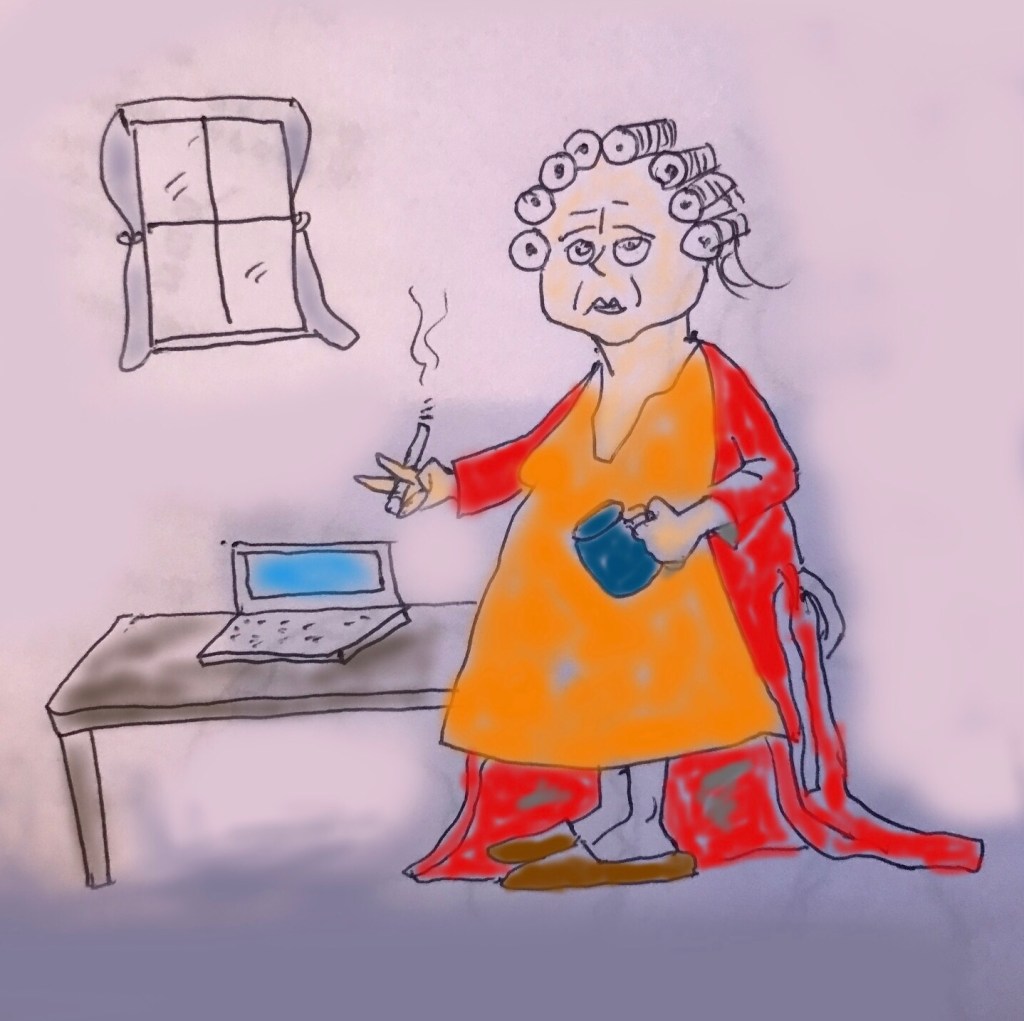
He immediately telephoned Mildred – god, what an awful name—and, predictably was transferred to a voice mail recording. “This is Mildred Ryan,” a high-pitched voice with a strong Boston accent said. “Please leave yaw telephone numba and I’ll return yaw call.” Hearing that message, he pictured an obese, middle-aged woman wearing a house coat and drinking coffee while smoking cigarettes at her dining room table.

State employee Mildred Ryan. “It’s a tough job working from home!”

          No Mildred that day.  Or the next.  Finally, on day three, Mildred responded with a phlegmatic tone.

          “I’m working remotely, Docta, and it’s hahd retrieving all my messages,” she said.  “I promise I’ll get this to ya within four days.”

          He politely thanked her but for Stuart, Mildred epitomized the inefficiency and inertia observed in so many state employees.  The taxpayers’s money hard at work.  Not.

Three days later, sunofabitch, the license finally arrived. While taking several deep breaths, he thought I can finally escape from Franz Kafka’s maelstrom.

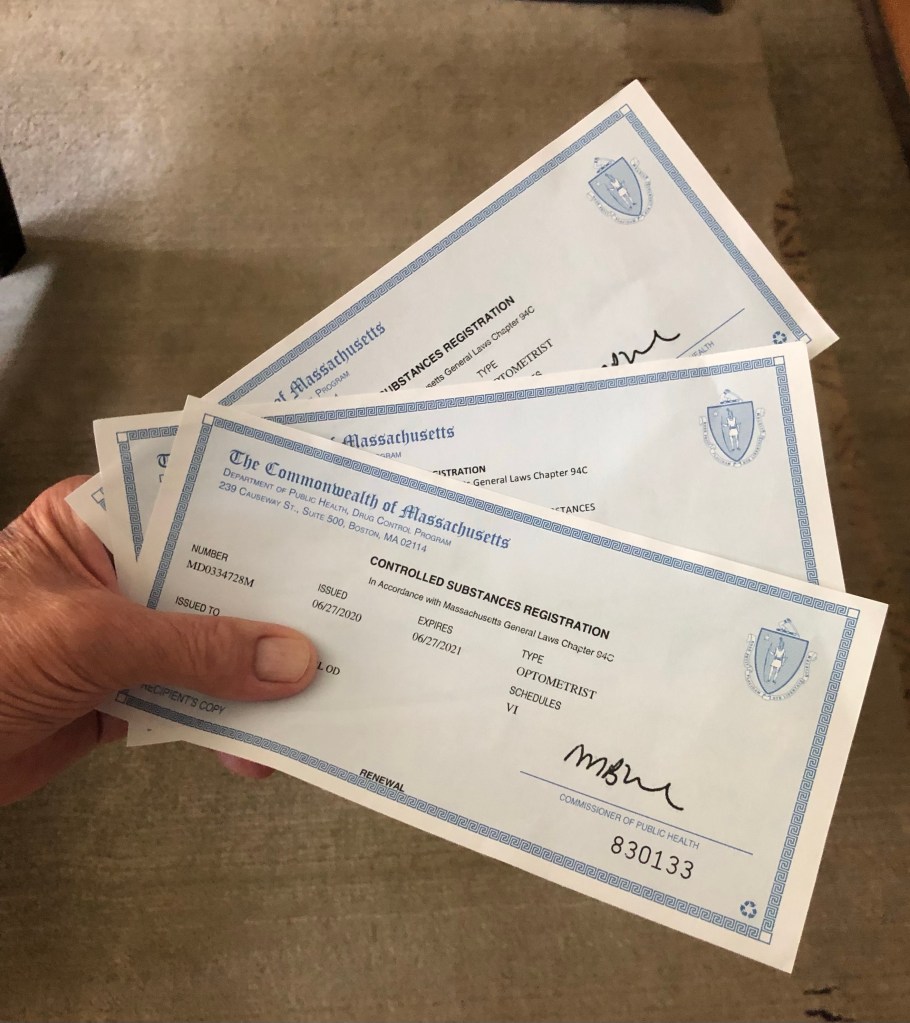
As an epilogue, Stuart, four days later, received another Dept. of Licensure envelope. With trepidation, he opened the letter and viewed its contents. His pupils dilated from incredulity as he stared at the contents: two additional licenses had been sent. Well, what do you know? Three licenses for the price of one. Government at your service, ladies and gentlemen.

Three for the price of one

Automobilus Asisninus

Automobilus  Asisninus

By

Leo de Natale

Illustrations by Vince Giovannucci

Anyone driving a car these days knows how perilous it has become. Every time motorists fasten their seat belts and enter such death zones as Rte. 128 or the Massachusetts Turnpike, there’s always potential for mayhem. All drivers face the possibility of horrific accidents.

Perhaps it’s always been this way but the peril seems to have intensified with the increased rudeness and stupidity of today’s drivers. Bad driving transcends age, gender or the number of years driving.

          Sociologists have teamed with taxonomists and developed a new, Latinized categorization of driver types.

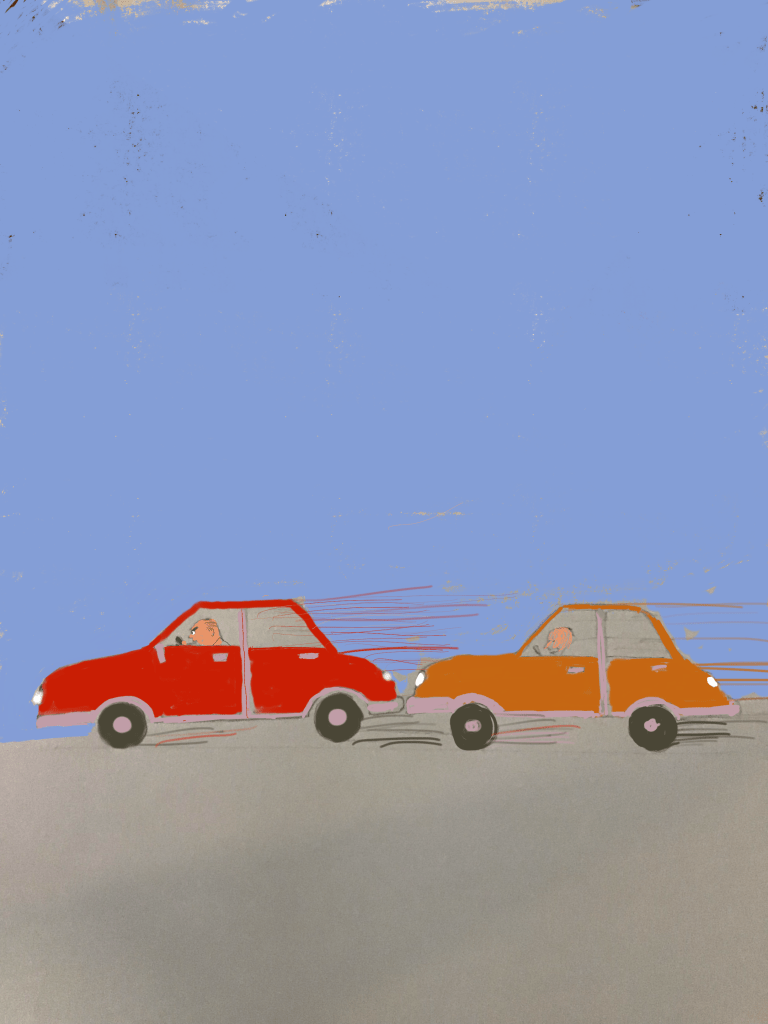
For example, there the species Hominus tailgatenous . We all know them. They’re the idiots who cruise highways and secondary road and tailgate. Hominus t. has forgotten or never knew the rule of thumb regarding distance vs. driving speed – 55 mph means 55 feet between cars should be maintained. But, no, these bozos will be driving 70 mph and be within ten feet of your rear bumper. It’s worse in the passing lane. Cars will whiz by at 85-90 mph with tailgaiters pinned to each others’ tails. Have you ever noticed most catastrophic automobile accidents usually occur in the passing lane?

Hominus taligatenous

There’ll be two or three cars twisted in steel, glass and rubber pretzels.  Often bodies are laying in the roadway; ambulances wailing their sirens and whisking  victims to nearby hospital emergency rooms.  Traffic in the opposite lanes slows due to “curiosity factor”.  Drivers say to themselves, poor bastards, there for  the grace of God…….  Yet we never learn.

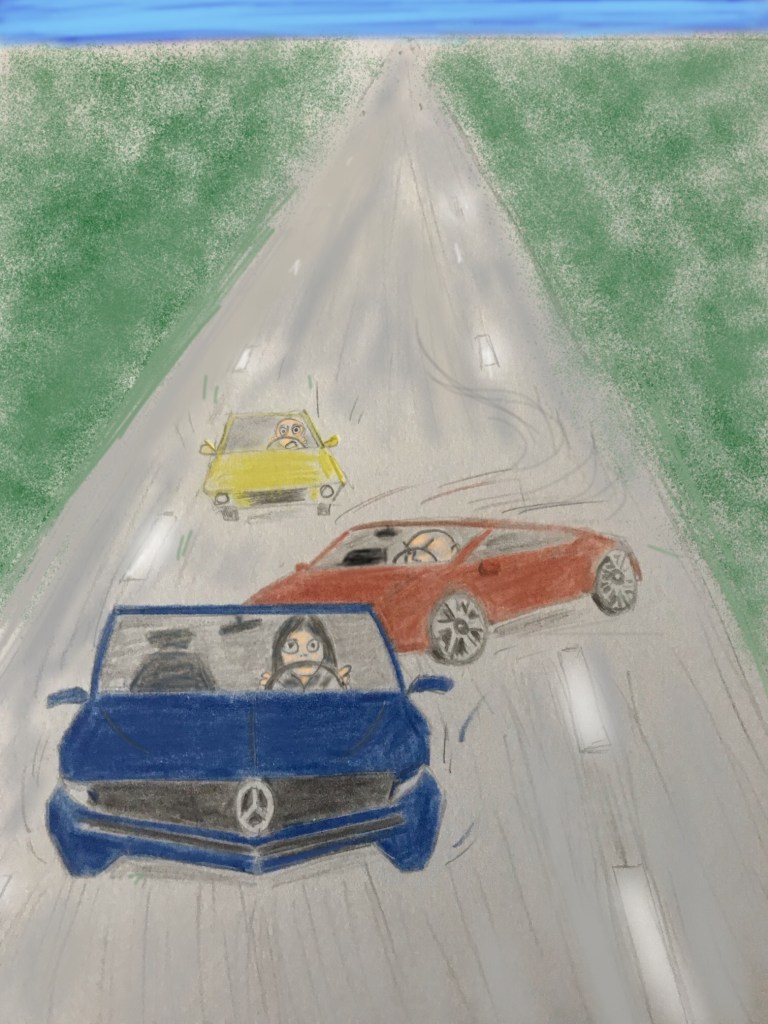
Then there’s Bmwensis serpentium. We’ve all seen these whack jobs. Members of this species feels they’re special. They usually drive the snotty prestige cars – BMWs, Audis, Mercedes, Porsches – traffic rules do not apply to these drivers. They’re once again traveling well above the speed limit. And they weave.

B. Serpentium “Get outta my f****ing way!!

First they’ll be speeding in the aforementioned passing lane. Without signaling, they suddenly swerve and pass into adjacent lanes, then to the right traveling lane. Snakelike, they weave in and out with total disregard. Suddenly they’ll say, oh, shit, I’m in the wrong lane! They once again dart in front of motorists saying, fuck you untermenchen, this is my exit! These creatures are the entitled who have contempt for fellow travelers. It’s always a matter of time before these elitists create a deadly accident when they cut the weaving too close. Their motto is “I’m better than you plebes! Out of my goddamned way!”

Then there’s rapidly growing organism, Telephonus arseholiensis. They’re the scofflaw cell phone addicts who insist on illegally using their phones on highways and secondary roads. There are many telltale behaviors with this group. On speedways, their cars will drift to and fro within their lanes and they’re usually driving below the minimum speed limit. They often can be seen texting with the phone at 12 o’clock on the steering wheel. It’s a perverse case of multitasking. At traffic light stops their necks bend downwards as they gaze at a phone resting on their groins.

Still others are brazen and can be seen conversing with the phone in full view. They are usually smiling and laughing, totally unaware of their dangerous behavior. How many drivers exclaim, “Where’s a state cop when you need one?”. People continue to thumb their noses at society. Traffic laws be damned. It’s been recently reported that cell phone scofflaws create more accidents than drunks or potheads.

As an addendum, there’s a subcategory of T. arseholium. It’s called Pedestriamus craniorectuminversionensis. This pertains to pedestrians whose eyes are affixed while gazing at their cell phones. They walk along city sidewalks, necks bent, and are oblivious to all that surrounds them. Many times they’ll bump into each other at crosswalks. They’re most dangerous while crossing streets. They make a cursory scan of the roadways, cross and are often jostled by the blaring horn of a car that’s nearly killed them. There are also joggers – and bicyclists- gazing at their cell phones and diagonally crossing streets and eschewing crosswalks. Picture P. cranion encountering a T. arseholium; the perfect storm of hubris and stupidity.

The perfect storm

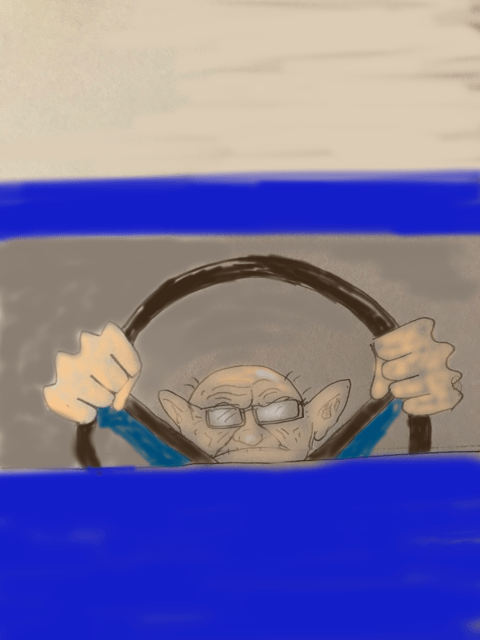
One category has existed throughout automobile history. We’re talking about Automobilus methusalum. They’ve been around a long time. In the 1950’s they drove Plymouth sedans; in the 1960’s the Chevy IIs were popular. Each decade has a car model that defined this species. In the year 2021, the Honda Civic is this group’s favorite. They are usually wizened little old men and women who can barely see above the car’s steering wheel. They rarely drive on major highways. Rather, they creep along roadways at 20-25 mph and create logjams. Motorists behind them lean on the car horns, flail the arms in frustration and cuss a blue streak.

Methusala Behind the Wheel

On single lane roads, many drivers will tempt fate and roar past these ladies and gents. They’ll scream at the duffers and make obscene hand jestures while passing. Everyone’s in a hurry except A. methesalehnealum. They’ve got all the time in the world. Or so they think. The worst thing for most Seniors is losing their driver’s license.

So there you have it. No matter where you live or what you do, bad drivers aren’t going away. The best advice is to drive defensively. It’s a jungle on the asphalt, folks, and you must drive with your head on the proverbial swivel. We must wait for the arrival of driverless automobiles. They will be coming to save us from ourselves.

Skeeve

Skeeve

By

Leo de Natale

Illustrations by Vince Giovannucci

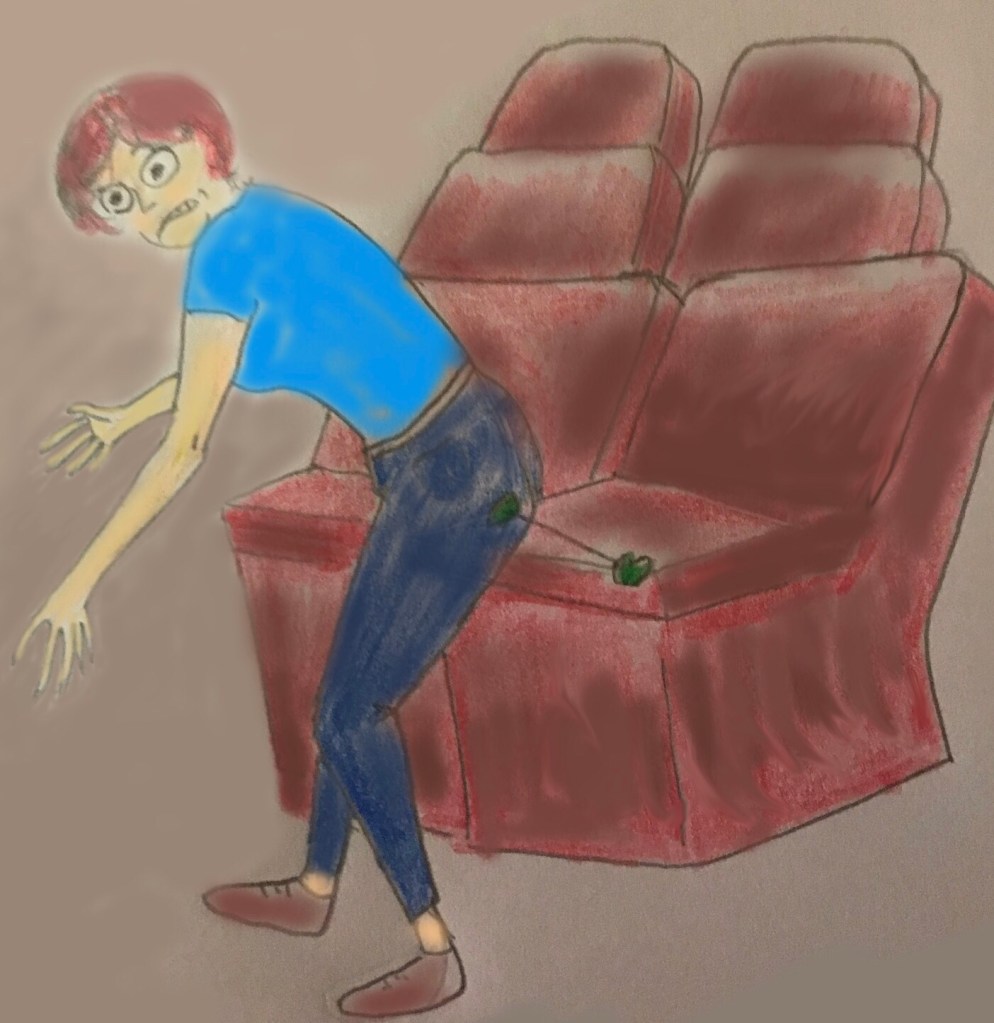
Skeeve is an Anglicized version of the derogatory Italian adjective, schivo . The word is defined as someone or something that is disgusting. Filthy–dirty. It can mean the condition of someone’s house or a person who is unhygienic and smells. It can be used for a rundown restaurant or a movie house where the theater seats are 30 years old, never have been cleaned or replaced and have chewing gum glued to the fabric.

Skeeve at the movies

Skeeve is a versatile word because it can be used to describe just about anything that is personally offensive. It has gained popularity in America. Some don’t realize its origin. It also can be used in various forms—adjective, noun or verb — “This place is skeevy”; “Don’t go to that place, it’s full of skeeve”; “I skeeved when I saw that woman’s kitchen!”

Little did Vincent Di Merda realize he would encounter the word his late Sicilian grandfather would use. “Meengia, che schivo!!!!”

Vincent “Vinny” Di Merda was a medical technician who suffered through the 2020 Covid pandemic and would soon be exposed to a jaw dropping example of skeeve. He worked at a prestigious Boston hospital and was on the frontline during the crisis. Strict hygiene, universal mask wearing and hospital protocol became the norm. Like most health care personnel, he was subjected to the psychological stress of the killer virus.

In his early forties, Vinny had maintained a regular fitness regimen. He and his wife Judy belonged to a nearby health club. They tried going to the gym about three times per week. During the pandemic, however, the fitness center closed for four months. Because he worked at a hospital, Vinny was acutely aware of the potential risks of exposing oneself to Covid 19. He decided it was too soon to return after the club reopened in fall, 2020. The couple did “work out” at home but it couldn’t replace the aerobic exercises obtained at a gymnasium.

The result was an increase in sedentary lifestyle. It happened to many Americans. And like so many others, Vinny gained weight. He was over his normal 160 lbs and ballooned to 175 lbs.. He altered his diet but it had no discernible effect. Things started an upturn when Vinny became eligible for the first wave of Covid vaccines. Judy, a registered nurse, also received her vaccinations. They both felt fortunate to have the inoculations. By April 2021, the universal panic began to subside.

In late spring of 2021 they enthusiastically resumed their gym activities. That’s when the trouble began. During his 40-minute commute to work, Vinny began experiencing a sharp pain in his right upper leg. It felt as if someone was sticking a cattle prod in his thigh. The pain was position-sensitive – he experienced it only while driving.

After one week of enduring this piercing new pain, he was examined by a hospital neurologist (it helps to be an employee—less waiting). X-rays were taken. Diagnosis: sciatica, a condition where the sciatic nerve is compressed by surrounding vertebrae causing considerable pain.

He was referred to the orthopedics department and had an appointment with Elizabeth “Legs” Callahan, M.D. An attractive woman in her 40’s with long, straight brown hair and light blue eyes, she received the sobriquet with her reputation of flaunting an incredibly beautiful set of shapely legs. Male patients especially noticed her gams.

“I’ve reviewed your Xrays, Vincent, and there’s good news and bad news,” she said. “You don’t have a ruptured vertebral disc and that’s the good news. However, you do have bone narrowing in the spine where the sciatic nerve exits. It’s a physical irritation that’s causing the pain and probably stems from months of decreased physical activity.”

She told Vinny no surgery was necessary and steroid injections would probably be overkill. Callahan is a physiatrist, an orthopedic specialist who attempts to treat back pain with the avoidance of surgery. She ordered six-week regimen of physical therapy (PT) that would stretch the nerves through various and specific exercises.

Vinny went to the hospital’s PT facility and met with a physical therapist who provided him with a list of various exercises specifically used for sciatica. The Covid restrictions had been lifted but the building, like all hospital locations, maintained strict mask and hygiene protocol. For example, the therapist, a pleasant and competent woman, sprayed chairs and equipment with disinfectant before and after use. The therapist instructed Vinny to do two sets of exercises daily and return for an evaluation in one week.

Vinny religiously performed the exercises but was discouraged. The sciatica didn’t seem to be abating and the pain continued to occur only while driving. The PT sessions continued for one month. No significant improvement. He was scheduled for a follow-up appointment with Dr. Callahan in two weeks.

He decided to seek alternatives, specifically chiropractic. In the past, Vinny saw a chiropractor, Dr. Carol Hildebrand, who helped improve such conditions as back spasms and twisted vertebrae. She unfortunately had retired. Chiropractic is an allied health profession that often successfully relieves back, neck and shoulder pain. Many back problems are due to twisted vertebrae that pinch spinal nerves. Twenty years prior, an orthopedic surgeon had misdiagnosed Vinny’s shoulder pain as a bone spur and had scheduled surgery.

He had misgivings about the surgery that was usually painful and left significant shoulder scarring. A friend suggested obtaining a second opinion and recommended Dr. Hildebrand who examined Vinny. There was some skepticism on Vinny’s part. After assessing his spinal alignment and performing tests along the spine, she diagnosed the problem. He was suffering from a pinched nerve. Her branch of chiropractic uses the “activator”, a ballpoint pen-shaped device that is pressed along the spine. She used no bone cracking. Activators are non-invasive.

After two weeks of therapy, the shoulder pain dissipated. No surgery, no scarring. This was an example of an often maligned profession proving its legitimacy. Physicians often accuse chiropractors of quackery.

He and Judy were Hildebrand’s patients until she closed her office and returned to her native England. No one purchased her practice. A close friend who had intermittent back issues recommended Dr. Hubert Jones whose office was located nearby. He called for an appointment and fortunately the office had an opening in two days. Vinny gladly scheduled the meeting. He was about to enter Skeeveville.

Jones’s office was located on the main street of a suburban town south of Boston. The building was a strip mall that also housed a pizza parlor, nail salon, massage parlor and used sporting goods store. He entered the reception area and completed the usual paperwork that listed patient medical history, chief complaints and medications. He gazed around the room and said to himself, hmm, this office needs some love. A fresh coat of paint would be a good start. The first hint of what was to come occurred when Vinny used the office rest room.

The room was dingy and needed a new roll of toilet paper. The paper towel roll was placed in a box on the floor and not in its rack attached to the wall. He returned to the waiting room and soon Dr.Jones appeared.

“You must be Vinny,” he said with a voice muffled by the obligatory mask. “I’m Dr.Jones. Please come this way.”

Jones gestured towards an examination room. He was in his 50’s, average height, and had closed cropped hair. Many health care workers often wear scrubs and clogs – it’s the unofficial hospital wardrobe. Jones wore a dress shirt, denim pants and scuffed, unpolished shoes. He was polite and ushered Vinny into the room. This is where it started to fall apart.

In the middle of the room was a chiropractic table. Vinny was accustomed to vinyl covered treatment benches with clean sheets that were replaced between patients. Jones’s bench was blue hopsack cloth. It was dirty and had grease stains. The stitches were threadbare and frayed. So much for cleanliness next to godliness. While sitting in a nearby chair, Jones proceeded to take a case history – when, where, how long since onset, etc. Vinny gazed around the room in search of a sink and there was none. He wondered if Jones had washed his hands somewhere before the examination.

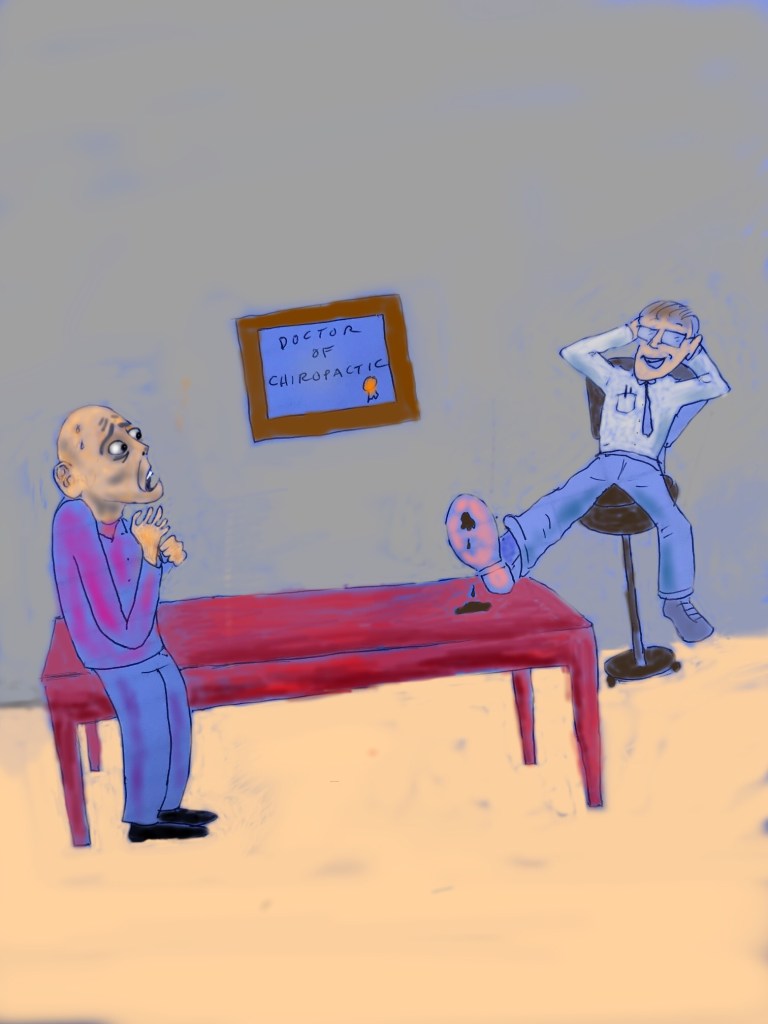
“Well, Vinny, this is a classic case of sciatica and it’s pretty straightforward in terms of healing,” he said as he nonchalantly placed his dirty shoe directly on the on the table.

Vinny meets Dr. Jones’s shoe

I can’t believe what I just saw thought Vinny, his eyes bugging out of his head. With a filthy shoe, this guy just stepped on to a place where I’ll be laying down for treatment! Jones then circled the table while talking and again the dirty shoe was resting where Vinny would be placing his head. This was world-class skeeve. He tuned out most of what this “healthcare professional” was saying. Reluctantly, he consented to having his bones cracked. I’m going to burn these clothes when I get home he was yelling internally.

While doing the manipulations, Jones wrapped his arms around Vinny’s torso and began the cracking. Vinny said to himself, “This guy’s clothing is in contact with mine. How many customers had a similar procedure today? I’m sure he doesn’t change shirts between patients.

Jones ended the appointment with ten minutes of heated electovibration therapy. Three pads are placed directly on the back. Are these suckers cleaned and disinfected between patients?, Vinny pondered.

Jones told Vinny he was confident the sciatica could be resolved after four weeks of chiropractic adjustments. Of course, the visits were out-of-pocket. Health insurance would not cover the appointments.

“Dr. Jones, I want to think about this,” Vinny said as he handed his credit card to the receptionist for payment. “I’m not used to the spinal manipulation technique. I’ll get back to you.”

With that, he left the office and yelled, “Please anybody, hose me down right here. I can’t stand the skeeve!”

Vinny phoned Judy before leaving the parking lot and described the entire experience. She was incredulous. Upon arriving at home, he disrobed in the garage and tossed his clothing into an awaiting washing machine. He then dashed up the stairs and immediately showered for 20 minutes. He was de-skeeved.

He decided he’d stick with traditional therapy and glad that day’s nightmare was behind him. He made a judicious choice. With diligence and religiously adhering to the therapy and gym work, the sciatica finally abated. Guess what? He was pain free in four weeks. What do you think about that, Dr. Jones?