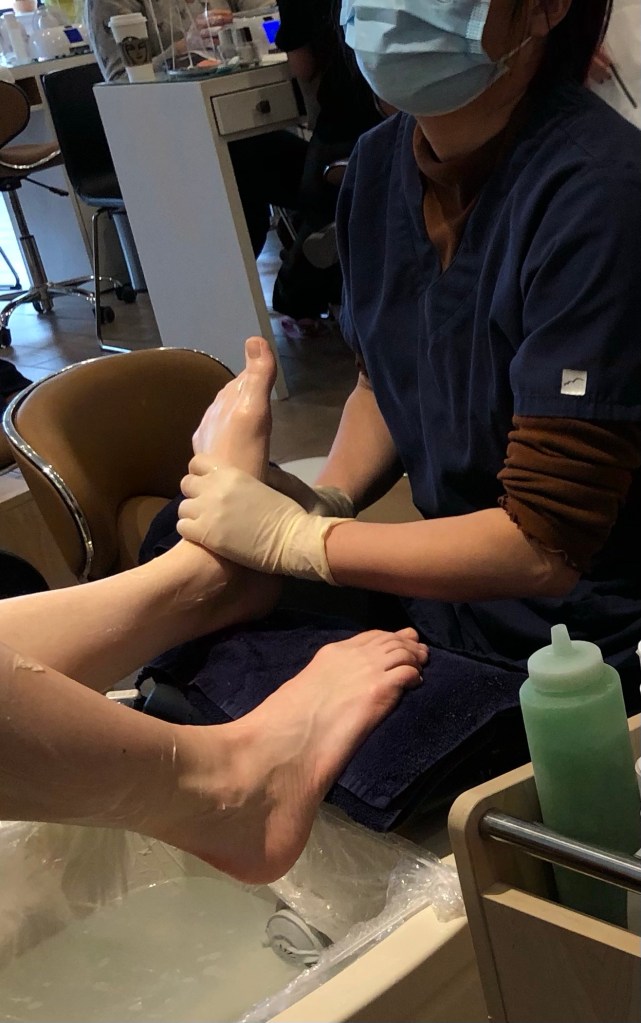
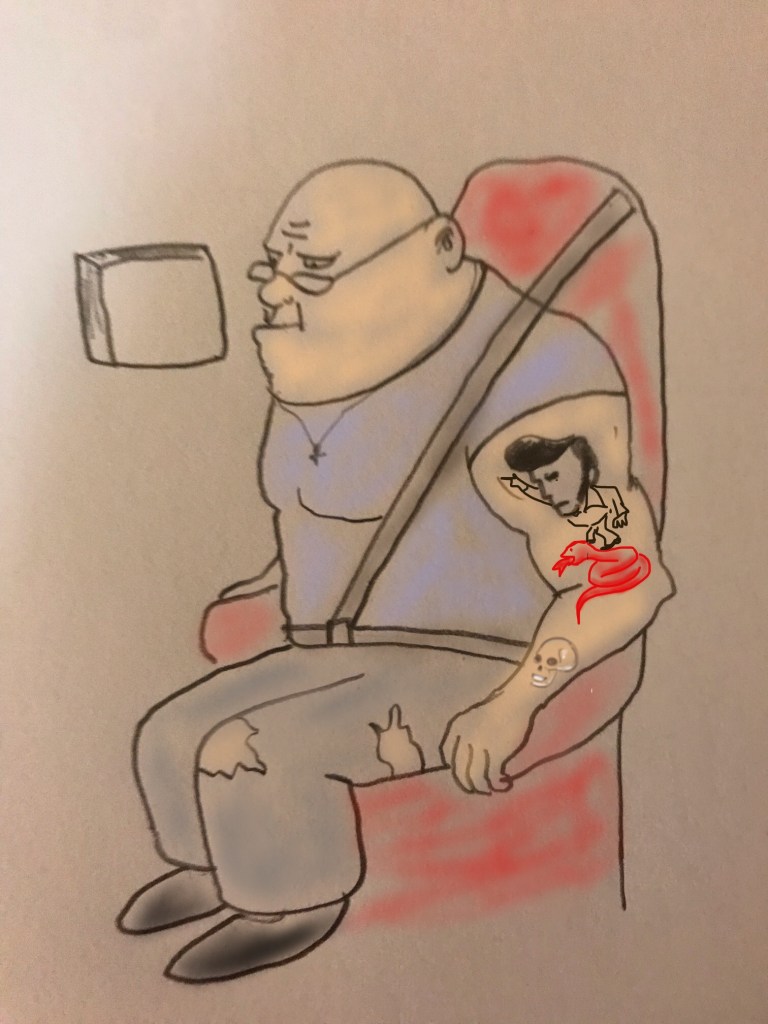
Barbara “Babs” Hayes, a 60-something financial analyst, was fuming as she left the “Happy Endings” nail salon. Like many American women, she had reached her flash point with the hand and feet emporiums that are infamous for their cultural rudeness. As she had done numerous times, she’d arrived for her 11am appointment with her favorite manicurist, “Becky”, an incredibly petite woman who spoke few words.
“Su-Su”, the tattooed salon’s owner imperiously strutted over to Babs and, in broken English, said “Becky late. You sit there” while pointing to an old, well-worn vinyl and aluminum kitchen chair. Su-Su perceived her store as an East Asian fiefdom. She had an electric smile that turned on and off as her mood shifted. Twenty Vietnamese women worked in this chrome and glass gulag. There was quiet chatter, none of it English.
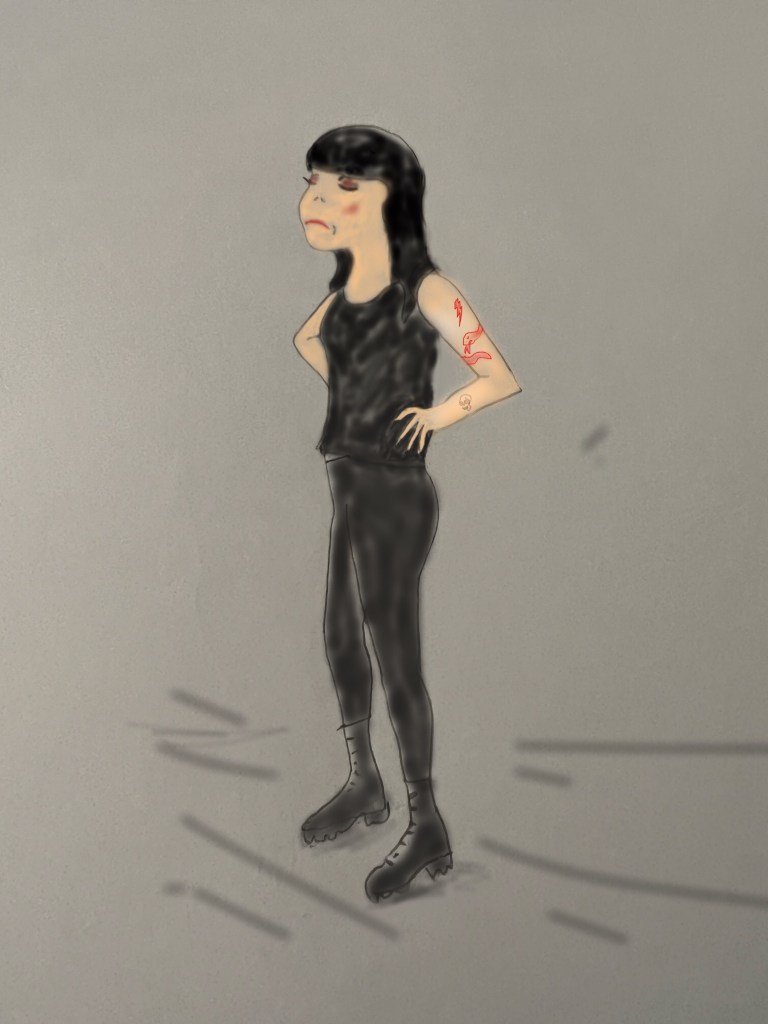
Black Clad Su-Su
The majority of customers in any nail salon are women. For some, the experience is zen. They sit back, relax and are soothed by the sensual indulgence. It is physical and emotional escapism. For others such as Babs, the mani/pedi experience is a quick fix method of improving one’s appearance, regardless of age. The appeal is looking well groomed, feeling confident and occasionally conjuring childhood memories of “playing dress up” wearing flashy colors. Painted nails were a rite of passage.
One of Babs’ best friends would be lulled by the process and actually fall asleep. Not so for Babs. And many of her friends admitted mani/pedis were a love/hate experience: they were always searching for the ideal salon. Babs had been a Happy Endings customer for more than two years, a comparatively long time. And like so many friends, she had a litany of salon horror stories. For example, she had previously gone to a salon – once -because she observed a bare-footed employee rubbing her fingers between her toes while waiting for the next customer. For Babs, that was a one and done. Ewww, that’s gross she said to herself feeling nauseous . That’s it, I’m outta here! And this incident occurred before Covid 19. Many nail salons tended to be unhygienic – and loud.
Some friends had recommended Happy Endings because of its cleanliness and quiet atmosphere. Owner Su-Su tried to be more sophisticated by pumping classical music through the spa’s sound system. She always wore black clothing and boots. Babs thought Su-Su resembled a goose stepping Nazi Stormtrooper.
Babs grew accustomed to such arrogant behavior. She was there because Becky was an experienced manicurist with incredibly skilled hands. She was also polite and quiet. Babs was always pleased with her nails and left a generous tip in cash. Lately, however, she had noticed a change. Becky had started conversing with her co-worker, Nguyên, who was massaging the gigantic feet of a tall mid-20’s woman. Babs had never seen such gunboats. They were likely a size 11.
Now these are ginormous!
Loud chatter started increasing and she immediately thought of the old Seinfeld episode where Elaine discovers the manicurists are discussing her and making snarky comments about clients “chan co’mui hoi” (smelly feet) or “con heo map” (fat pig).
During the past few visits, the conversations were becoming louder. Babs reached a flash point and looked squarely into Becky’s eyes:
“Becky, this chatter between you two is very rude and inappropriate,” she said. “You’re living in America. Start talking in English so people can understand what you’re saying. Tu dien dong nghaia tieng Anh Hoc thanh ngu Tieng Anh!!!” (an unpleasant retort)
In college, Babs had majored in East Asian languages and could speak passable Mandarin, Thai and Vietnamese. She chuckled because it helped when friends and family ordered Asian food.
Boss Lady Su-Su was incensed by Babs’ intrusion into this cultural atmosphere, especially after Becky received no tip. Babs rarely behaved that way but the entire experience had pushed her buttons. Sorry, Becky, but this customer had lost her patience.
Like most everything else in the United States, trying to find a nail salon owned and run by Americans was exceedingly difficult, but not impossible. It was Diogenes, 2023. Women regardless of age, were searching for OPI Nirvana.
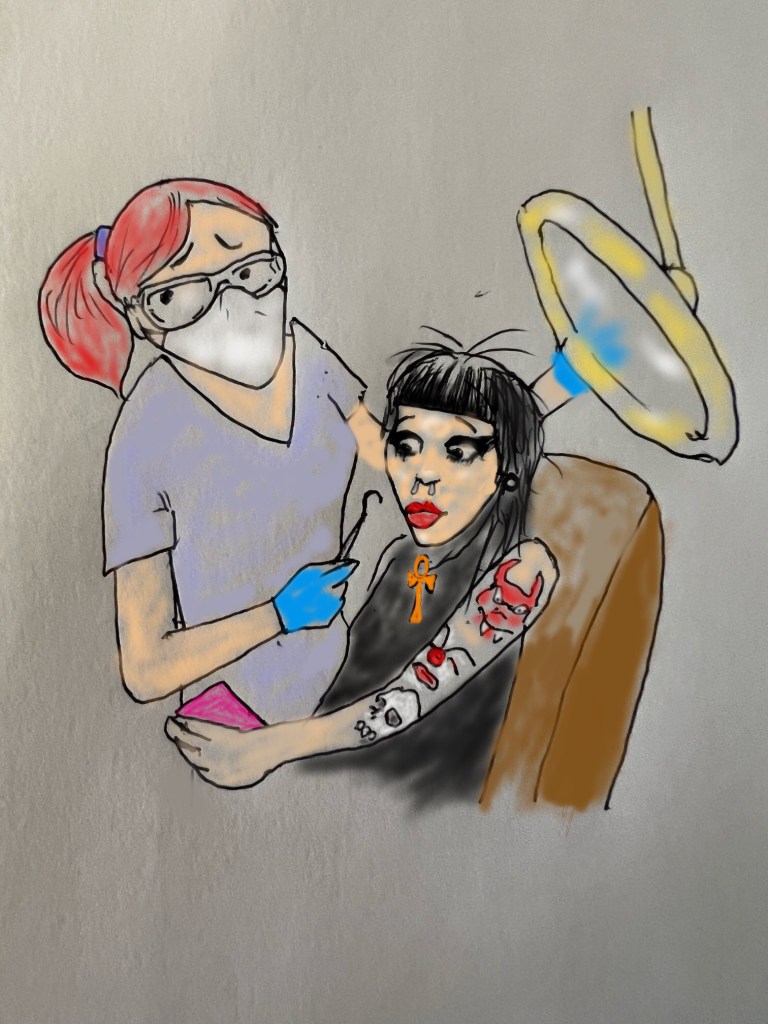
She was a twenty-year-old, acne ridden woman who had Biafrin-thin skinniness. Like so many lemmings her age, she had the obligatory nose ring pierced through her left nostril and dagger-shaped chest tattoo emanating somewhere below her sternum and ending just below the throat. She also had a sleeve tattoo and was in her Goth mode: black blouse, pants and fingernails. “Tedi” was her name and she had arrived at Dr. Finkelstein’s dental office. She was due for an annual teeth cleaning.
“Uh, Tedi, lose the phone”
As usual, she clutched her beloved cell phone. Her generation treats the phones as a body appendage. You go nowhere without the devices being in hand or within reach. It’s similar to eating at a restaurant and watching a family of four seated at a table, each member staring at a phone instead of a menu. Interpersonal communication is minimal – pass the fucking butter and don’t grease up my phone.
The dental hygienist Judy seats Tedi in an examination chair. Tedi climbs into the chair but maintains a death grip on her phone as a bib is placed around her neck.
“Please put down the cell phone , Tedi,” Judy says. “I’ll be cleaning your teeth.”
“Like, you know, can you give me a sec?” Tedi replies. “I’m expecting a wicked important text.”
She then holds her phone at arm’s length and thumbs a brief message. Judy is not pleased, especially after the phone rings. “Oh, I forgot to turn off the ringer.” No apology. Tedi sits there with her ear buds attached and listening to Goth Rock band Sex Gang Children while tartar is removed from her lower incisors.
Such devo behavior transcends all professions, all occupations. Ophthalmologists, dermatologists, gynecologists all witness Gen-Xers demonstrating generational boorishness. One gynecologist reported a patient keeping phone in hand during a pelvic examination. The coarsening of society allows poor manners to become acceptable. Lack of etiquette. Sad stuff.
The disconnection between and among us has no boundaries.
For example, Joey Angini tried contacting his new internet server, Ethernet, after his emails vanished into cyberspace. It was caused by an internet glitch. Angini, age 46, considered himself computer savvy but couldn’t retrieve his data and was forced to call the obligatory toll free number. He’d had similar experiences but never imagined how daunting this issue could be. He called the number and was greeted with a familiar recording: “Welcome to Ethernet. For English press 1,”. A voice speaking Spanish repeated the prompt – numero “dos”. He had entered a jungle known as the telephone tree.
Joey “Jo-Ay” Angini
“For account balance or to pay an outstanding bill, press 1, account information press 2, technical press 3; for any other matters press 4 or stay on the line.” The process lasted five minutes.
Joey pressed 3. A message stated “Due to the high call volume, response time may be delayed. You are currently caller number six.” Fifteen minutes later, a voice with an unmistakably thick accent. He’d heard this many times.
“Hello, my name is Chuck (yeah, sure). With whom do I have the pleasure of speaking with?” Chuck asked.
“It’s Joey Angini, Chuck,” he replied.
Joey was certain the voice had a Filipino patois. He felt like asking “How’s the weather in Manila today?” but proceeded to explain the nature of his call. Lost email. Business account. Important correspondence. Need retrieval ASAP.
“No worries, Jo-Ay,” Chuck said. “We can fix your problem, but I’m at the company’s assignment center. I’ll have to connect you to tech support.”
Thirty minutes had now transpired. He was placed on hold for another fifteen. At last, a he heard a woman’s voice. She said her name was “Cherry” – they’re usually assigned American names- and the accent was definitely Asian.
“Hello, Jo-Ay. This is Cheree,” she said. “How can I help you?”
He repeated his conversation he’d had with Chuck. Cherry listed the repetitive questions: name, email address, home address, telephone number. She then checked his account to determine if he’d paid for the monthly service contract fee. He hadn’t and was informed he’d have to purchase the service –only $15.99 per month!- and then provided her his credit card information. Another 20 minutes passed. I don’t fucking believe this he thought. I’ve been on the telephone for more than one hour!
After the transaction was completed, Cherry told Joey he was “all set”.
“Let me transfer you our tech support line, Jo-Ay,” she said. “Eet’s been a pleasure talking to you. Good bye, stay safe and have a good day.”
“Wait a second, Cherry,” Joey said. “I thought you were tech support.”
“ No, no, Jo-Ay. I here to process your payment for services. I send you to tech support now.”
So this is how it goes, Joey mused. There’s layer upon layer of foreign speaking support staff, This experience is becoming more labyrinthian. How many more trolls will I be subjected to before I retrieve my emails? He waited. Twenty minutes later, a man called Milos with an Eastern European accent spoke.
“Before we get started Milos, what country are you calling from” Charles asked.
“Romania, Jo-Eee,” he replied. “ Have you been to my country?”
“No, but Milos, can we just solve my problem?” Joey said. “I’ve been on the phone with Ethernet for about two hours.”
“No Worries, Jo-Eee, ” Milos replied.
That phrase, No Worries, had become laboriously hackneyed. It was as bad as the verbal crutches “Like” and “Ya’ know”, voice upgliding and vocal fry. Speaking skills were becoming an endangered species but at least Joey could understand Milos’ conversation.
Once again, Joey, had to repeat his email address, telephone number, etc.
Milos used a remote access program and navigated through the iPhone settings. In some cases, technology was truly amazing and helpful. He zipped through the various program files, found the error and quickly recovered his emails.
Charles thanked him, uttered several platitudes and, after 3+ hours, hung up the phone. This was my penance for today, he mused.
Meanwhile, another techno-crisis is unfolding across town.
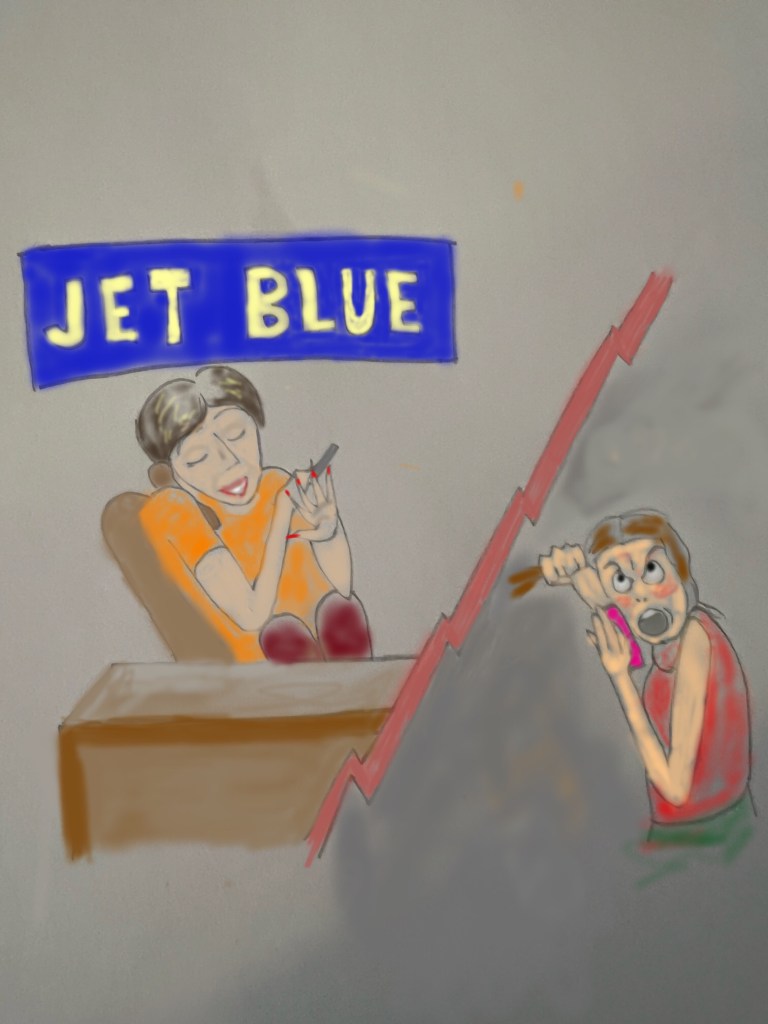
“Aarrgh! I can’t stand this,” yelled Annie Stutman. “I’ve been on the goddamned phone with Jet Blue for two hours!”
Annie was a stay-at-home mom. She had three teenage sons, a husband who was a big shot lawyer and two labradoodles, Bowie and Newmi, who many times ran the show. She was a petite, perky woman with blonde hair and gray eyes who was also a lawyer but had professionally burnt out after her children were born. She realized there was more to life than juggling a career and family.
Her particular frustration that day was the walking-through-mud experience so many people were experiencing. Her father, a centenarian living in California, was now in hospice and she desperately needed to book a flight ASAP. Like so many Americans, she was being engulfed with a techno-cyber monster that is wreaking havoc on her life.
She went online to purchase tickets, but a systems glitch was blocking her attempts. She was forced to telephone the airline company and therein lay the rub. Just like our friend Joey, the experience was as follows: a computer-generated voice answers and provided options – English press 1, Spanish press 2; she was then prompted to press buttons to reach various departments, In Annie’s case, she was trying to place a reservation. Fifteen minutes became thirty and she was benumbed by the canned, tasteless music interspersed with the message, “We apologize for the delay. Your call is important to us. An agent will be with you shortly”.
The reality appears to be there are more people – especially the Gen-Xers who don’t want to work. That’s where the shortage lies, she said to herself. Despite the long waiting time she finally obtained her ticket and would be flying to San Francisco the following day. Whew!
Several miles away from Annie, Stefan Gregson, an active 62-year- old, had returned from Wegman’s supermarket and knew something was afoot. A hard working blue collar type, he had a good job as a foreman at a long haul trucking business. It was his day off and he’d been food shopping.
He was minding his business when somewhere along the jams, jellies and coffee aisle he suddenly felt a distinct pain in his lower right abdomen. The discomfort began to escalate while passing the frozen pizza section. Uh-oh, he thought, here we go again. The telltale pain and its location provided an instant diagnosis: another bout of renal calculi, aka kidney stones. He had been told they eventually would reappear.
Gregson had sustained an attack three years ago. The pain was severe but not debilitating. He’d driven to his urologist, Dr. Franklin Quid, whose staff performed an ultrasound.
“Yup, you have a stone, Stefan,” Quid said. “It’s banging on your ureter’s door. I’m giving you a prescription for pain killers. That should tide you over. I want you to drink four glasses of water daily. Hopefully you’ll pass the stone but if the scan shows you have a veritable quarry in that right kidney. Multiple stones. If it’s any consolation, most people in your age group have them. They’re the silent enemy.”
“Gee Dr. Quid, what is the prognosis?” Stefan asked.
“Tough to say but if you pass this boulder your kidneys may be quiet,” Quid replied. “But I want to monitor you for the next six months,” Quid replied.
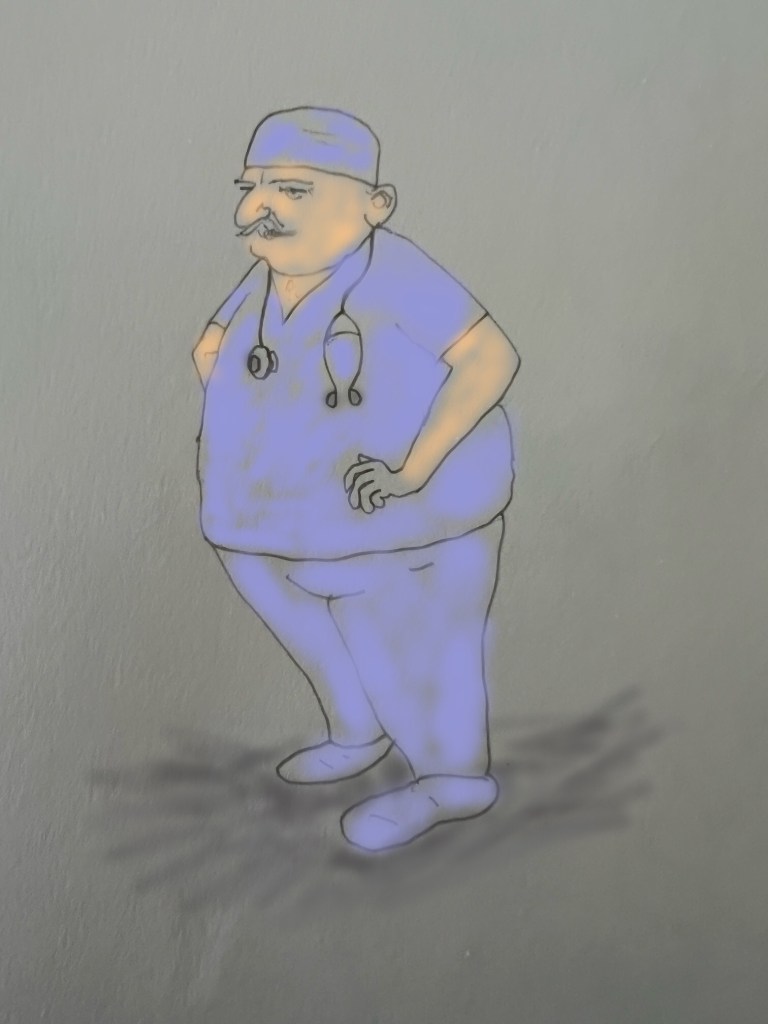
Dr. Franklin Quid
About two days later and much agony, Stefan’s stone passed. He felt immediate relief. That was then. This latest episode at the supermarket, however, was a different story. The pain had intensified. There was no mistaking his self-diagnosis.
By the time he arrived home, Stefan was nearly bowled over with the discomfort. He immediately telephoned Dr. Quid’s office and then swallowed two Tylenol Extra Strength anti-inflammatory pills. He quickly angered by the way modern medicine is parsed out. There’s a format that’s familiar with doctors’ patients, or “customers” as they’re more frequently known.
“You have reached Boston Urology Associates,” the automaton voice declared. “If this is a medical emergency, hang up and call 911. For prescription referrals, press one, to schedule an appointment, press two, for all other matters press three or stay on the line.”
Gone are the days when a human being answered the phone. Missing is the ability to speak directly with the physician. Medicine has devolved into a hierarchy where it’s impossible to reach the big cheese. After waiting five, ten, fifteen minutes a telephone receptionist answers. Stefan recited the usual check down: name, date of birth, telephone number and then explained the problem: the kidney stone from hell.
“I’m sorry, Mr. Gregson, but Dr. Quid’s physician’s assistant Julie is seeing patients right now,” the operator said. “I’ll email her and place this on a high priority. In fact Suzy, our nurse practitioner, may be calling you.”
So there’s now a hierarchy. Stefan was subjected to two strata of personnel before Quid becomes involved. The reason? Most MDs are on a gerbil wheel. Fifteen minutes max for patient encounters.
The more “customers”, the more insurance submissions. As actor Charles Grodin tells Robert De Niro in the film, Midnight Run, “It’s all about the fucking money, Jack!”
We’re all meat on the hoof thought Stefan.
Julie finally called Stefan with her sing-songy syrupy sweet voice. He found her obsequiousness annoying.
“Hi Stefan, it’s Julie,” she said. “I’m sorry you’ve had to wait. You’ve got something going on here, huh? I’d like to perform a CAT scan today. If that’s not possible, we’ll have to wait until tomorrow. Sorry.”
“Well, what am I supposed to do?” Stefan replied. “This pain is becoming intolerable.”
“Well, if it’s that bad, drive to our Emergency Room,” she said. “I can call and prioritize you and there’d be no sitting in the waiting room.”
“Fine, my wife Katey will drive me there,” he responded.
Pushing through rush hour traffic, Stefan finally arrived at the hospital. He was indeed fast-tracked but it’s the usual protocol: front desk “Your name, date of birth, address. A visit to the triage room where some twenty-something nurse asks the same questions and takes vitals: blood pressure, temperature, medication lists and case history. Stefan avoided the return to the waiting room and was ushered on to a hospital bed. He stripped naked and donned the obligatory Johnny gown. The pain in his right flank was pulsating.
Another nurse arrives. Name, date of birth, address, etc. Another case history is taken.
“Well, Mr. Gregson, Dr. Quid has emailed us your information,” she said. “We’re going to send you to radiology for a CAT scan and find out what’s going on, ok?”
“Yes, yes,” he said. “Listen, can you give me pain medication? The stone is rolling and I’m not talking about the rock group.”
Thirty minutes later, Stefan is wheeled into the radiology department. The CAT scan room door is opened and he is placed on to a bed. The scan begins and a robotic voice repeatedly drones, “Breathe in. Hold. Breathe out.” A whirling noise begins and in less than two minutes the procedure is complete.
He returns to his ER room and waits. And waits. Emergency rooms are controlled chaos. Doctors, nurses, technicians and support personnel hustle back and forth. All are in Covid protocol and masked. Most patients miss the good old days when they could see the faces of those who are tending to them. Much like the abhorrent telephone trees, the depersonalization with masks is a metaphor for the changes in health care delivery. The nurses inserting IV lines and performing various preliminary tests become faceless.
The attending physician finally arrived at Stefan’s room.
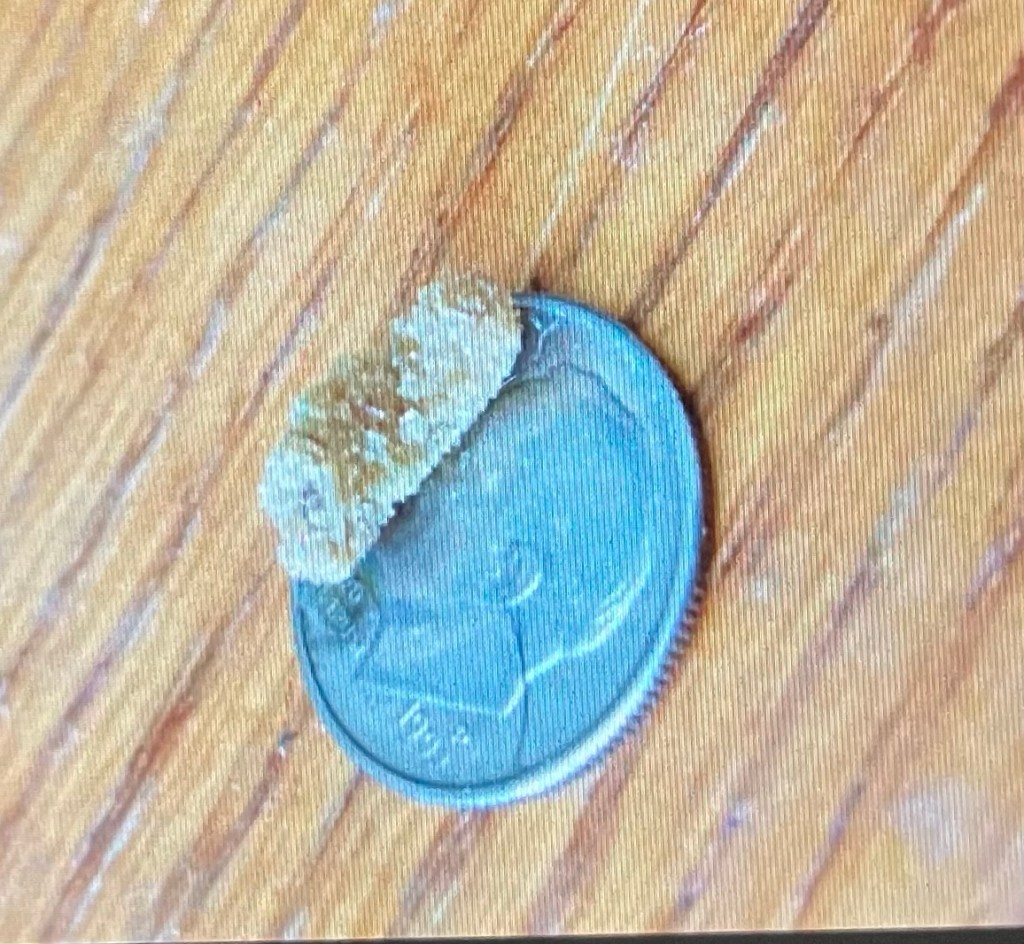
“Well, Stefan, you’ve got one big stone lodged in your right kidney,” he said. “In fact, it’s huge – 9 mm in length. You’ll never be able to pass that sucker. If it stays, it’ll eventually cause a serious infection and, of course, excruciating pain. I’ll be sending my report to Dr. Quid”.
A 9 mm kidney stone: what it looks like…
Nine millimeters. My God, that’s the size of pencil eraser thought Stefan. It’s like a Yellowstone boulder wedged inside me. I can just imagine what the pain will be like.
Dr. Quid’s staff scheduled emergency surgery for the following day. He was released and returned home and was told to call an ambulance if he sustained a severe attack during the night.
The following day, Stefan is at the hospital; surgery was scheduled for 2:15 pm. He had observed the cardinal rules of nothing to eat or drink after midnight. As usual, there’s the terminal waiting. After disrobing and again donning the johnny gown, he was wheeled into a pre-operation room. The staff asked for his name, birth date; in fact at every point during the procedure line the same two questions were repeated. Why don’t I just have that info stamped on my forehead?
Dressed in scrubs, Quid arrived, oh so cheerful over yet another stone crushing adventure. He uttered the minimal pleasantries and left saying, “I’ll see you in the OR, Stef.”
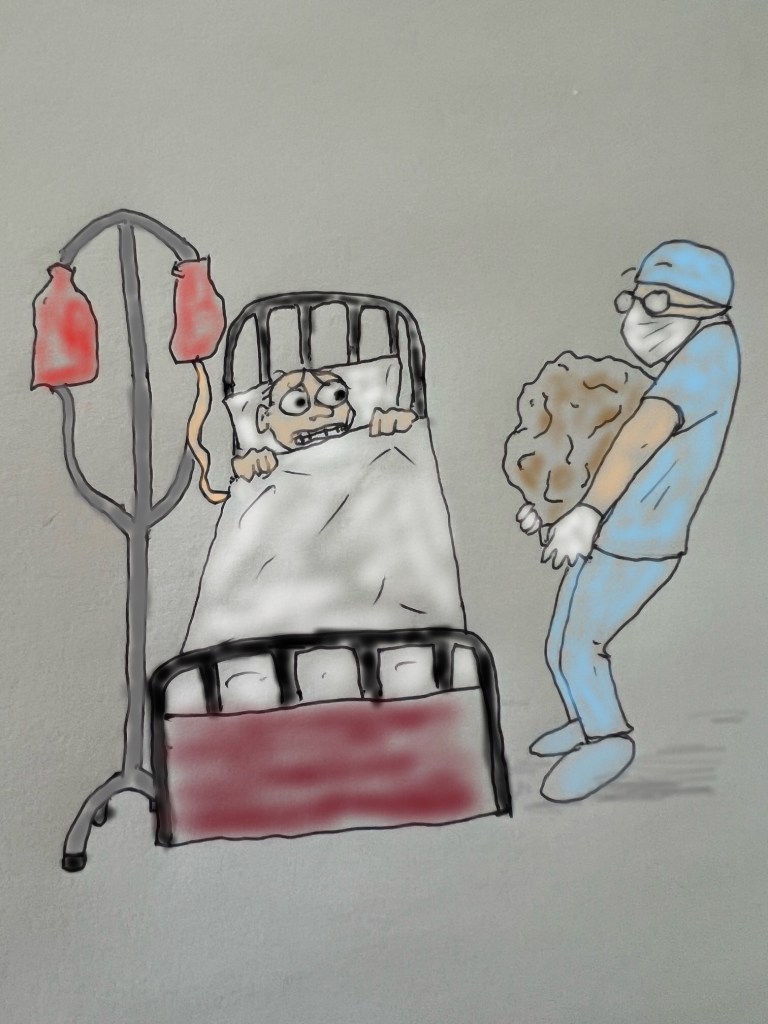
What it feels like….
Eventually, Stefan was carted on to a corridor, transported by elevator, and arrived at the brightly lighted operating room. He slid on to the table and awaited the happy juice express. Everyone has the same experience. The anesthesiologist appears and chats with staff and patient alike. Stefan remembered starting to ask how long before the drug would take effect, but, as we all do, he slipped into unconsciousness before finishing the sentence.
The next thing he slightly remembers is a nurse calling his name. He was in the recovery room and, true to form he had no memory of the first a 30 minutes post surgery. It happens to everyone. That’s why they say “don’t make any important life decisions after surgery……………….”
The flank pain continues due to a temporary plastic stent tube Quid inserted that drains urine from the kidney to the bladder. Josef is on the production line of old people with plumbing problems. Apart from making a lot of money, why do people specialize in urology?
Urologists work with geezers suffering from bum prostates, kidney stones and various diseases affecting the urinary system. They daily stare at wizened old penises and shrunken scrotums. He images Quid’s wife saying, “Hi, Honey, how was your day???”
Despite the hassles he’d experienced with today’s health system, Stefan appreciated the good care received. He, Joey and Annie can remember when communication problems weren’t complicated and realize how the rules have changed.
Tedi the Goth and her beloved cell phone unfortunately haven’t a clue. Like, it is indeed a brave new world, ya know?.
Curiously, the taxonomic nickname of the above insect is Psychodidae. We know it as the common drain fly, a nettlesome household pest that can drive humans crazy/psychotic. Ask Joel Pinter.
“Jamie, there’s more of them!”, he yelled to his wife as he exited the shower stall. “I just killed at least seven. This is grossing me out.”
“I know, Joel,” she responded while entering the bedroom. “I counted at least six when I was showering this morning. Ugh, giving me the creeps.”
Suddenly and inexplicably these tiny pests had mysteriously appeared. Drain flies are smallish insects, somewhat larger than fruit flies. Drain flies fly into people’s homes and breed in the slime that collects in drain pipes. They begin laying eggs in this detritus.
They were flying around the Pinter’s master bathroom earlier in the year. Their life cycle is short. The larvae feed on bacteria, algae fungi and microscopic animals. It is difficult to eradicate infestation. The flies are relentless. As soon as Joel killed a bunch with a thump! from a towel, the flies would return in droves. Frustrated. the Pinters contacted their plumber, Dino Rizzuto.
“Yup, those are drain flies,” Dino responded after arriving at their home. “They can be a pain in the ass. I’ll Roto-Rooter the drains but I don’t how much that’ll help. They’re real sumbitches, pardon my French.”
Dino, who didn’t speak the King’s English, snaked both the shower and sink drains and discovered thick, black sludge attached to the metal cable.
“This may do the trick but you might want to contact a pest control company,” he told the couple. “I seen a lot of these ones in this here neighborhood.”
Mr. and Mrs. Pinter lived in tony Glastonbury, Connecticut. Joel and Jamie were empty-nesters. They were in their early 70’s, their children created a diaspora, moving to points west and south. The kids continued to dote on their parents and routinely telephoned.
The Pinters led a sedate life. They both occupied their time with volunteer work in their town and Joel, a semi-retired accountant, still had longtime clients. He was usually busy during tax season.
The couple’s house was located in a development of upscale split-entrance ranch designed homes that were built in the early 1970’s. They’d maintained their home by upgrading the kitchen with contemporary cabinets and stainless steel appliances.
Unbeknownst to them, they had made a prescient decision to construct a new, larger master bathroom. Like everyone else, Joel knew this renovation was a costly and lengthy process; two months of disruption and a hefty price tag- about $70,000.They had decided to take on this big, disruptive project.
The Pinters timing was actually impeccable. Earlier in that year, Joel noticed the bathroom was insidiously being invaded by the gnat-like flies that swarmed the bathroom and particularly the shower stall. They’d never heard the term drain fly. Unlike common house fly, these new invaders didn’t move around. They were small and merely landed on tiles and stayed there, and easy to kill with either a hand or towel. Joel detested these bugs.
Joe deduced these flies were stupid and their demise was quick and easy. The problem was they’d appear in swarms. Joel became adept at duplicating the old Brother Grimms fairy tale “The Valiant Little Tailor who cried “Seven at one stroke!” and duped a giant who thought he was referring to humans, not the flies in his shop.
Smack! Smack! Smack! Like the little tailor, he began squishing them with his hands. Hygiene be damned, he said to himself. The drain flies also reminded him of the old X-Files episode “Darkness Falls” where hordes of green-glowing flies invaded the Olympia National Forest and attacked foresters.
The Greenies Surround Agent Scully
During the episode, viewers learned greedy lumber companies had felled trees hundreds of years old- a conservationist’s nightmare.- that disrupted the forest’s ecology. The nocturnal green flies were unleashed and inflicted death to various cast members. Mulder and Scully were screaming when the creatures invaded their cabin. Predictably, they survived the attack
But this was no fairy tale or sci-fi show and the Pinters were becoming increasingly frustrated.
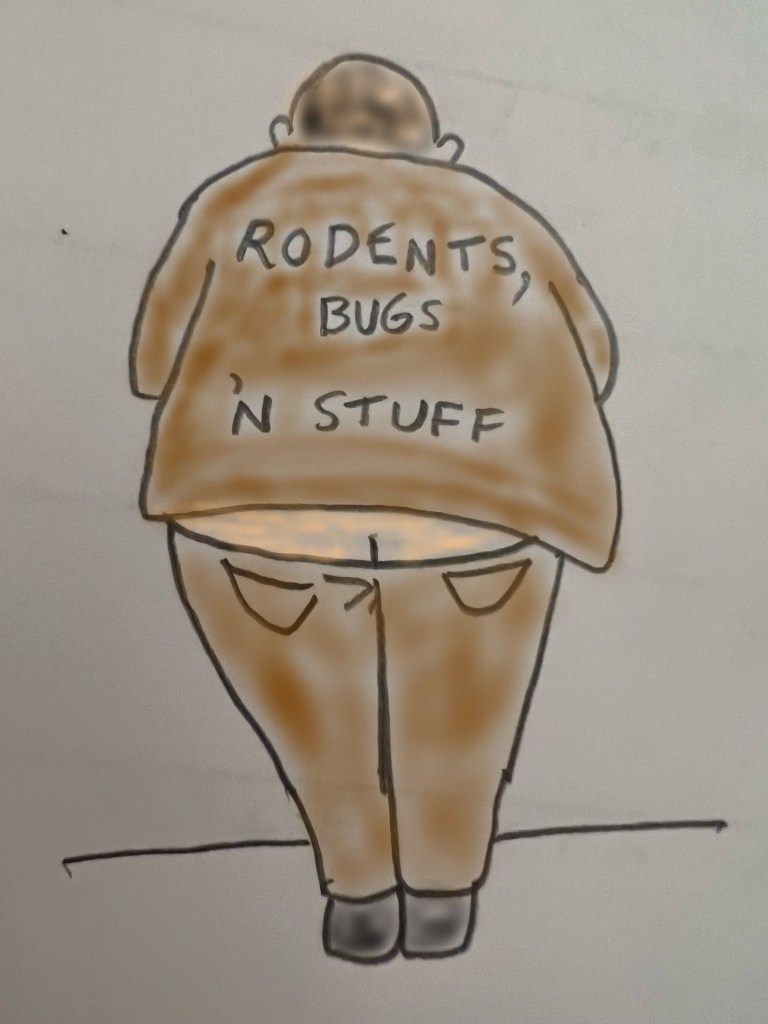
As he expected, Dino the plumber’s efforts were fruitless. Joel contacted a local exterminator, “Rodents, Bugs,’N Stuff”. Bad name but the company enjoyed a good reputation in Greater Hartford. One week later Dwight the technician arrived on time. He was a 6’2” ham-fisted lummox wearing a clean company uniform and matching baseball cap. His appearance was neat, even down to his polished size 14 work boots. Dwight was a big guy.
The Pinters ushered him into the bathroom for his initial inspection and fortunately several flies were attached to the shower stall walls.
“Yeah, those are the drain flies all right,” he said, bending over and exposing the obligatory plumber’s crack. “They can be extremely persistent. How long have they been around?”
“About six months,” Joel replied as a fly flew by his face. “Is this going to be an ongoing problem?”
Dwight, busy at work
“Well, we’ve got several approaches, Mr. Pinter,” he said. “There’s the expensive way –twice a day, you pour a cup of ‘Robo-Goop’, that’s a citronella-based gel that prevents larvae from hatching. The simple, cheap method that involves pouring vinegar, baking soda and hot water down the drain. These flies breed in the scum that coats drain pipes. They breed fast – from egg to larva to adult fly takes about two days. You can try either method.”
“I think we’d like to try the gel first,” Joel said. “We want this problem solved fast.”
“Ok, Mr. Pinter but we’re talking about a big price difference,” Dwight replied. “But please call me in a couple of weeks.
Twenty minutes and $500 later, Dwight left after leaving specific instructions. The fly potion/slop was to be poured into the shower and sink drains twice daily, and followed four hours later by two cups of boiling water. It was as if the Pointers were discarding salad dressing without the herbs and spices. They performed the task religiously. One, two, six days passed. Nothing. The drain flies were still there.
Because of that X-Files episode, Joel began having nightmares of flies swarming on to his bed and covering him and Jamie while they slept. He thought it amazing that something so small and relatively benign could have such a profound psychological impact. And then he thought about the upcoming renovation. What happens if these pests persist?
Two weeks passed and the miracle gel reduced the numbers of flies but they were still present. Joel called Ernie.
“Dwight this wonder product isn’t cutting it,” he said. “These damned bugs are persistent.”
“Well, it looks like we’ll have to go to Plan B,” Dwight said via cell phone. “Two-and-a-half cups of straight bleach and cover the drains for three hours. Flush with the boiling water. It’s a lot cheaper. Hopefully that’ll do the trick. Sorry about the Robo-Goop. I’ll see if we can get you a prorated refund ‘cause the manufacturer guarantees success. In your case it hasn’t worked.”
Thankfully the flies seemed to have diminished in volume and frequency of appearance. But they were still there. Would they ever leave?
The remedy arrived quicker than anticipated. The bathroom renovation project finally began. The contractor’s wrecking crew arrived. The first thing the workers did was remove the plumbing – toilet, sink and shower drains. Sure enough, the shower drain was still filled with sludge .
Each pipe was sawed off and sealed. New connections would be one of the last steps before completion. And the flies disappeared.
As the contractor had predicted, the project wasn’t completed for two months. The house had been in disarray. All clothing and furniture removed from the bedroom were finally returned. The Pinters hired a cleaning company that removed the dust and debris that had filtered throughout the entire house. The workers disappeared as suddenly as they had arrived. Joel and Jamie finally had their house back. They held their breath. A day, three days, a week passed. Glory be, the master bathroom had been exorcised.
“I’ll be damned, Jamie, it worked,” Joel said with jubilance. “It was worth the wait.”
He was, of course, referring to the absence of Psychodidae. The siege had ended, the noisome drain flies had been vanquished. Die, fly. And never return.
Addendum: This is my fiftieth essay. In 2020, the world was flipped upside-down with the Covid – 19 pandemic. Most citizens hunkered down, the workplace became non-existent. People worked from home; businesses and restaurants struggled and unfortunately vanished into the vapors. It was a depressing time for the United States and the Western World. I stopped working, and was forced me into a temporary retirement. If there was a silver lining for me during this time of adversity, it was a return to a vocation that had lain dormant. I returned to writing and this blog is the result. It was a method of channeling my energy, a way of maintaining my perspective – and sanity! Many of the essays are Covid-related. I always try to interject humor into my writing.
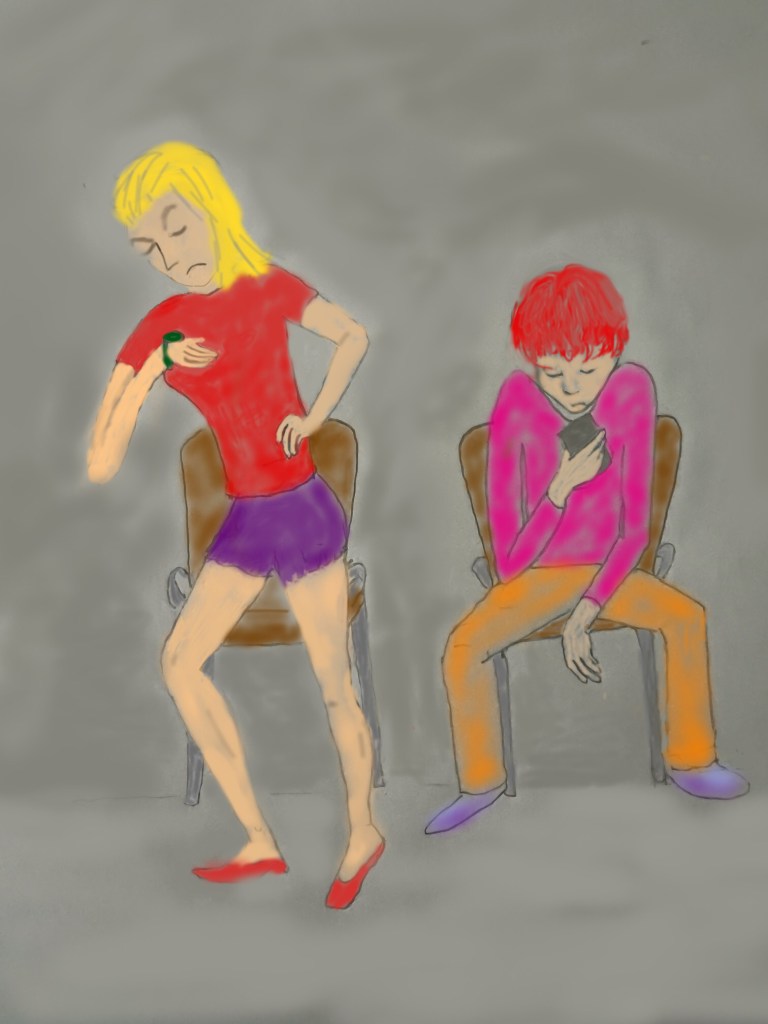
“We’ve been waiting for 30 minutes, Doctor,” said Cindy Thornton, a forty-ish mother whose teenage son Timothy “Timmy” Thornton was in tow. “I’m really pressed for time and Timmy needs to be fitted to contact lenses and I want him fitted today.”
Cindy and Timmy
These were the first words uttered to semi-retired optometrist Dr. James Devine who worked part time at SeeMore, an optical chain known for bargain eyeglass and contact lens pricing. This woman was figuratively tapping her foot with the inconvenient delay.
Oh, I can see where this is going Devine thought as he ushered mother and son into the examination room. It’s fasten your seat belts because I’ve encountered many Cindy Thorntons during my forty years in this profession.
Cindy was fit, tall, tan and wore very short, ripped jeans that exposed bare thigh. She also sported a small, newly inked rose ankle tattoo. Devine mused, oh, this is another one of those middle-aged millennials who is battling Father Time.
She had fashionably cut long dirty blond hair and fingernails with exotic, multi-color polish. Her pushed-in face was pouty and projected sternness accentuated with thin lips. Her body language suggested confrontation.
Cindy said Timmy was thirteen and wanted contact lenses for sports. He was a scrawny but tallish kid lacking a personality and Devine was sure Timmy’s enthusiasm didn’t match his mother’s. The boy’s body language reflected his diffidence.
“I’m sorry for the delay, Cindy, but the previous patient arrived late,” he said. “That always delays the schedule. I apologize.”
“Well, like I said, we were supposed to have been seen thirty minutes ago and I don’t have much time,” she repeated.
“Well, I’ll be as quick as I can,” he replied.
“Oh, no, I don’t want this to be a rush-job,” she snapped. “I want a thorough exam.”
Okay, so that’s how it’s going to be, Devine thought. Increased waiting time had transcended all health care professions. It’s not unusual for patients to cool their heels at medical offices. It’s become part of the landscape. Get used to it, Cindy.
Timmy was a new patient to the office. A thorough case history was required and various tests – color vision, depth perception, and ocular measurements were required. Devine could normally perform a routine eye examination in about twenty minutes. Timmy had become more nearsighted and required a prescription change. The medical part of the examination involved ophthalmoscopy (looking into eye and retina) and inspecting the eyelids and cornea with a microscope. He already knew there’d be a problem because Timmy was light sensitive and didn’t like Devine’s rubber-gloved fingers manipulating his eyelids. He had the phobic reaction of squeezing his eyes shut. Eye people refer to this as the “menace reflex”. It makes for tough going when trying to insert contact lenses. This did not bode well for wearing contact lenses.
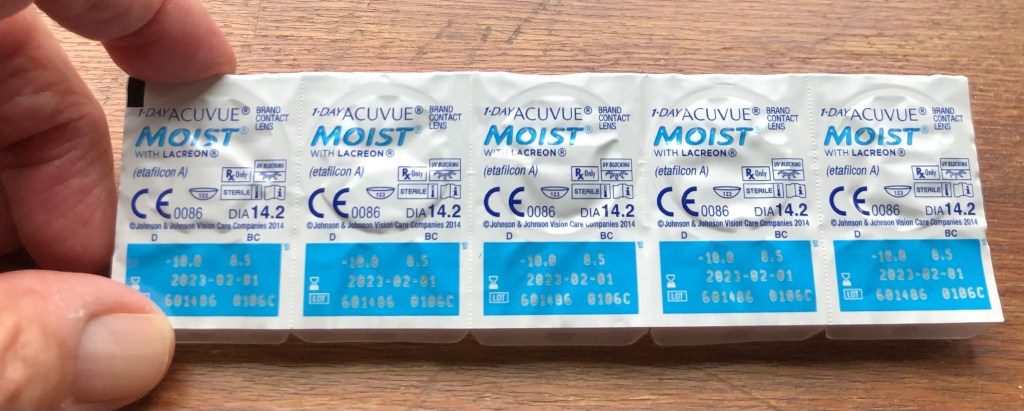
Devine explained his findings and told Cindy Timmy was nearsighted and had astigmatism in both eyes and would require a specialty soft contact lens. He suggested daily disposable lenses, commonly referred to as “dailies” that were gaining popularity. Discarding contacts every day reduced potential infections and were healthier for eyes.
“So, would you like me fitting Timmy to the dailies?” he asked?
“Yes, I wear the same thing,” she explained. “So can we start now?”
“Well you’re running behind schedule and this may take some time,” Devine responded. “We can always do this another time if it’s inconvenient now.” “Look, Doctor Devine, we made an appointment for a contact lens fitting today!”, she repeated with an aggressive tone. “I don’t want to have to come back here for a separate appointment.”
“Okay, I’ll select some trial contact lens,” he said, his Irish temper silently rising. “Just one moment.”
This woman is a problem, he said to himself. Demanding, imperious, entitled. Keep your cool, James. Don’t let this thing escalate.
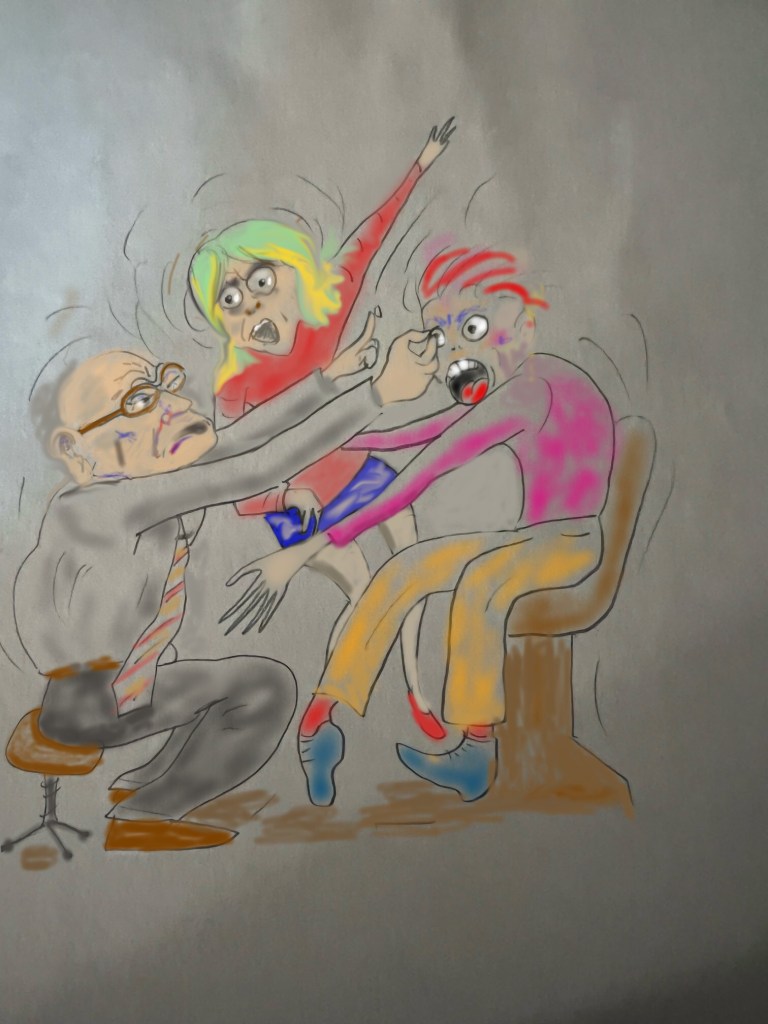
Doctor, patient and mother segued into a contact lens fitting room. Devine selected the appropriate samples. The lenses were packaged in blister packs. After washing his hands and eschewing rubber gloves, Devine attempted to insert the right eye contact lens. He’d been fitting contact lenses using the same technique throughout his career. As he anticipated, the kid was squirmy, tried closing his eyes shut despite Devine’s pulling on the upper and lower eyelids. It was like prying open a bivalve. In most offices, optometrists selected the lenses and technicians performed the instructions. This was a low budget office. The optometrist did it all. Devine was earning a generous per diem and gladly suffered the indignity.
Timmy showed incredible resistance and the Mom jumped in.
“You’re being too rough with him and you’re scaring him,” she yelled. “I’ve never seen this before.”
A tough day at the office for Dr. Devine
“Ms. Thornton, many patients behave this way,” he replied in a calm voice. “It’s important to get the lens inside the eye. I have to make sure the lens fits properly and provides good vision.”
After numerous attempts, Devine finally inserted the right lens. The last straw arrived.
“Mommy, my eye hurts, take this thing out!”, he waled. Obligingly, Devine quickly removed the lens and wanted to continue.
“Stop it! I’ve had enough,” she yelled. “ You’re far too rough with my son. I’ve had it! He’s being traumatized. I’ll have you to blame if he is so scared he’ll never be able to wear contacts! I want his new eyeglass prescription.”
Leaving mother and son in the fitting room, Devine returned to his office and handed Cindy the document.
“I’m leaving right now,” she said after grabbing the document.
Devine was aghast. In his long career as an optometrist, he’d never experienced such an antagonistic, truculent encounter. Oh, I know what’s coming, he thought. She’ll file a scathing complaint with SeeMore’s corporate consumer relations and say I was rude, uncaring and disrespectful.
He was steaming because he had been required to manifest incredible restraint. You have to remain professional. Most of the time, it was easy but the Cindy Thorntons of the world make it quite difficult.
“What’s going on, Doc?”, Penny, the store’s manager, asked after Cindy stormed out the office door. “She was some kind of mad.”
Devine began to elucidate the imbroglio but could tell Penny would probably presume the doctor was at fault. That happens in corporate health care. Devine disliked this display of Penny’s pusillanimity but had seen it many times before. He’d probably be hearing from the SeeMore’s corporate office and have his knuckles rapped. He was unfazed. Over his career he’d become the consummate professional. He enjoyed a good reputation and was always being recruited by optical chains. Competent, experienced optometrists were becoming difficult to find.
Devine returned to the examination room and saw his next patient. A lunch break followed. He entered the contact lens fitting room and was tidying the area by removing used paper towels and facial tissue. He looked at the fitting table and noticed the sample contact lens boxes were missing. He returned to the examination room and searched for the lenses. Nothing there. Returning to the fitting table, he again glanced around the room. Nothing.
Hmm, it appeared Cindy Thornton had helped herself to those lenses. Where else could they be? In her pocketbook perhaps? It also turned out she stormed from the office, displayed her anger to Penny and left without paying for the examination. Devine smiled. Cindy scammed a free examination and not only was Cindy a bitch, she was a petty thief, too. And for stolen contact lens samples that couldn’t be used. He made sure that would be reported to the corporate regional offices. He smiled again.
Joseph “Jo Jo” Bjornson decided to apply for yet another credit card—he already had several: LL Bean, Orvis, Amazon Prime, Walmart, etc. He had joined membership to a regional discount store a la Costco. The big box store, “Buy This”, had comparable prices and wider parking spaces that didn’t shoe horn him between the neighboring cars and prevented the scratches and door dings for which Costco was infamous.
Buy This had a modest membership fee and, as most shoppers knew, the lower prices quickly amortized the cost. Jo Jo had been shopping there for about one year and decided take advantage of the Master Card/Visa card that was currently offered. Like Amazon credit cards, the hook was the more you spent, the more credit points accrued that would be credited towards his purchases.
Most Americans, Jo Jo included, have ambivalence towards the credit card industry. Many cards are free; others such as Buy This have an annual membership fee. Contained within the fine print of the literature accompanying the cards is the lurking topic of interest rates. Credit card companies are legalized loansharks.
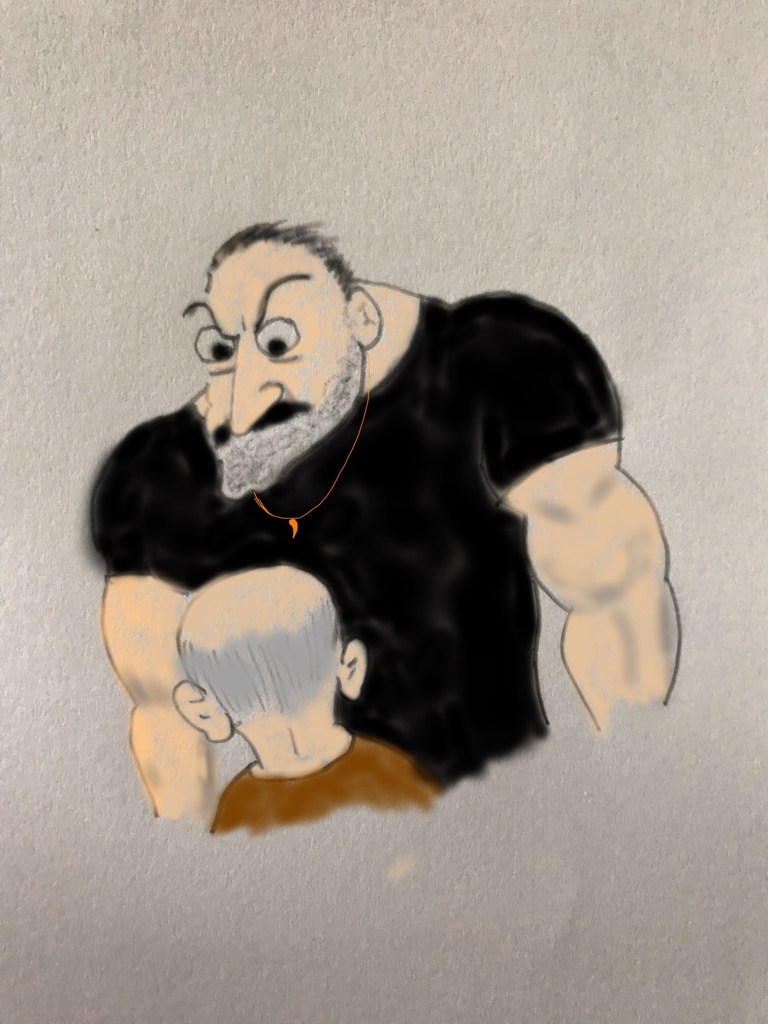
Once you fail to pay the monthly balance, the vigorish accrues. There are countless stories of credit card holders who become bankrupt and owe hundreds of thousands of dollars to the companies. They don’t play nicey-nice. Images appear of swarthy, mustachioed, black-shirted enforcers bent on breaking a few legs. The whirlpool of debt spirals out of control. Most consumers, Jo Jo included, are aware of the dark underbelly of the credit card industry.
“Youse owes us some money plus the vigorish, Pal!”
Jo Jo completed the boilerplate application and within two weeks a shiny new plastic card arrived in the mail. The usual protocol required the cardholder to call a toll free number that would activate the card.
The computerized nasal voice that’s identical among the credit industry would say “Welcome to credit card services. For English press one, por Espanol, numero dos. For card activation please enter the last four digits of your card and press four.”
After entering the information, a cheerful automated nasally voice would chirp, “Thank you, your card has been successfully activated. You now can enjoy the wonderful benefits of the Buy This card. Goodbye”.
That was the last “cheerful” encounter Jo Jo would experience. The following week, he shopped at the store and, in the self checkout aisle, inserted the card for payment. A menacing voice from deep inside the cash register said “I’m sorry, this card is not recognized. Please try again.”
Hmm, Jo Jo thought, this is odd. After paying his bill with a different credit card, he approached the customer service desk and explained what had happened.
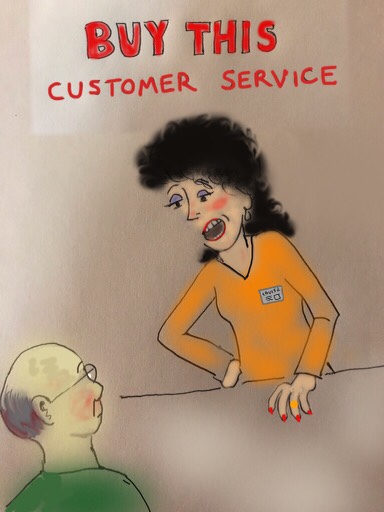
“Sorry, sir, Buy This is not involved with the credit card company,” a woman with big jet black dyed hair said flatly. “You’ll have to call them directly.”
Sorry, it’s not my job
Thanks. Thanks a lot.
And so the adventure began. During the next three days, Jo Jo called the toll free number with the same results. Another robotic voice repeated the same message: “I’m sorry, we are experiencing technical difficulties and cannot answer your call. Consult our website for further details.” Of course, a trip to the website provided no information regarding when and if customer service would be operational. A week transpired. No change into the mysteriously disappearing credit card company. Something appears fishy here, he thought.
Pursuing a different take, Jo Jo called Buy This corporate headquarters and, as usual, was subjected to the shuffle. His call was transferred to four different departments. Finally, a humanoid answered and he wasn’t an American. Most companies are farming out customer service to foreign countries, such as the Phillipines and India.
“Look, I’ve been trying to contact your credit card company and something’s quite wrong,” he said to an associate “Bruce” – wink-wink-who unsurprisingly had a discernable foreign accent. “I can’t get through. What would happen if my card were lost or stolen? I think you’ve got a serious problem on your hands.”
“I’m sorry you’re having this problem, Mr. Jo Jo,” Bruce responded. “But this matter is handled by a different department. I can pass along your comments and maybe you’ll be contacted.”
Bruce is somewhere in this “customer service” maze….
“Maybe?,” I asked incredulously. “You have a potential problem that could affect millions of customers. My patience has grown thin with the bank who’s contracted to operate the credit card business. I want someone to contact me ASAP, Bruce.”
Jo Jo felt he was experiencing a Kafkaesque journey where the walls in buildings transmogrify into an amusement park fun house. Unfortunately there wasn’t anything amusing.
Another three days transpired. No word from Buy This.
Jo Jo decided a possible solution was to make things personal. He drove to the closest store and at the customer service desk asked for the manager.
Usually the image of a store manager is some middle-aged man with a pot belly, thick eyeglasses and a disappearing hairline that’s camouflaged with a predictable comb-over. Or a woman with dyed hair, heavy makeup covering wrinkles and drug store reading glasses perched on the tip of her nose.
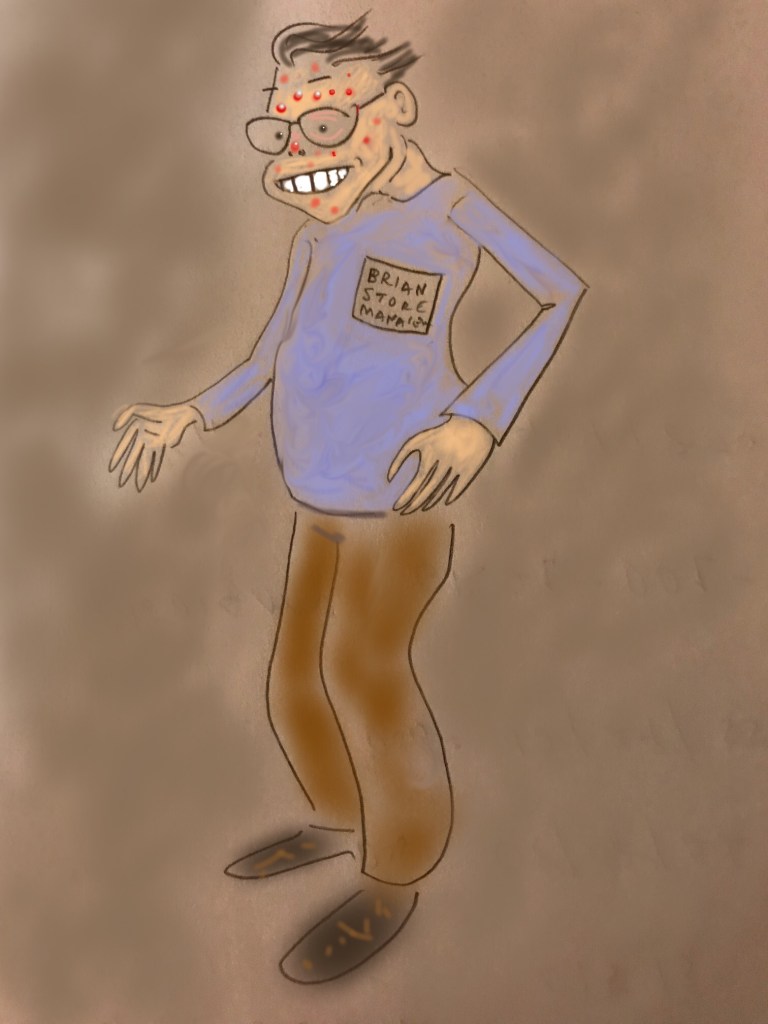
Meet Brian
Jo Jo was surprised to meet Brian, pimply-faced young man in his late 20’s who was wearing a rumpled shirt and scuffed shoes. He was pleasant and had the face of someone who was eager to please.
“Buy This has a problem with its credit cards,” Jo Jo said and explained at length the frustration he’d been experiencing.
“Gee, I’m sorry Mr. Bjornson,” Brian replied. “Unfortunately we’re well aware of this problem. You’re not the first customer who’s reported this issue.”
He explained the parent bank providing the credit card services was in a mess. The entire computer system was being changed and somehow there was a massive failure. The bank had apparently been blindsided by the catastrophic software implosion and was scrambling to resuscitate the system. Hence all those cryptic messages about delays in service. There was a suggestion that the company’s website and records had been hacked.
“Yeah, the kicker is the bank hid the entire catastrophe from corporate Buy This,” Brian confessed. “Needless to say the company is furious and will be switching to a new credit card company ASAP.”
“Well, I’ll tell you, Brian, it’s a moot point for me,” Jo Jo replied. “I’ll continue to shop here but there’s no way in hell I’d ever use the Buy This credit card, especially if the company’s been hacked.”
And with that, Jo Jo drove home and entered his office. He activated the paper shredder that also accepted credit cards. The switch was turned on and in went the Buy This card. A delightful crunching sound was heard. Ooooh, this feels good. I think maybe I’ll shred more of these goddamned cards, time to simplify, he said to himself.
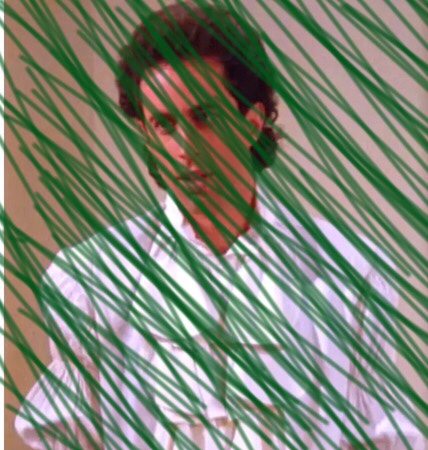
Last week our twelve-year-old flat screen television suddenly went into its death throes. Jerry Seinfeld’s face had vertical rows of moving green lines. So didn’t Kramer’s, Elaine’s and George’s. It added a bit of immediate humor but then got old. Pretending you’re stoned can last only so long. My wife and I looked at each other and said “Uh oh, I think it’s time.”
Our TV was one of the “dumb” generation products. Pretty good picture but couldn’t compare with the images on the latest generation of televisions that have truly incredible fidelity and access to movie channels. Friends kept telling us about the wonders of streaming. Any movie, any time with the punch of a remote button. Ok, I’ll admit we were Luddites and from a generation with the no-new-TV-until-the- one-you-own-dies protocol.
We don’t watch a lot of television but the devil box has become an intrinsic, universal part of every day life. Jumping online to obtain useful research and information, I was catapulted into a brave new world of pixels, 4K ultra-high definition, vibrant QLED colors and other terms that are integral parts of the technology explosion. I called my 30-year-old nephew David who’s a computer jock at a software development company in Cambridge, Massachusetts. He became Moses leading us to the Promised Land.
“It all depends how sophisticated you want to be, Uncle,” he said. “The TVs come in all different sizes – 32”, 45”, 55”, 65”s and the ‘big guy’, an 85-incher!”
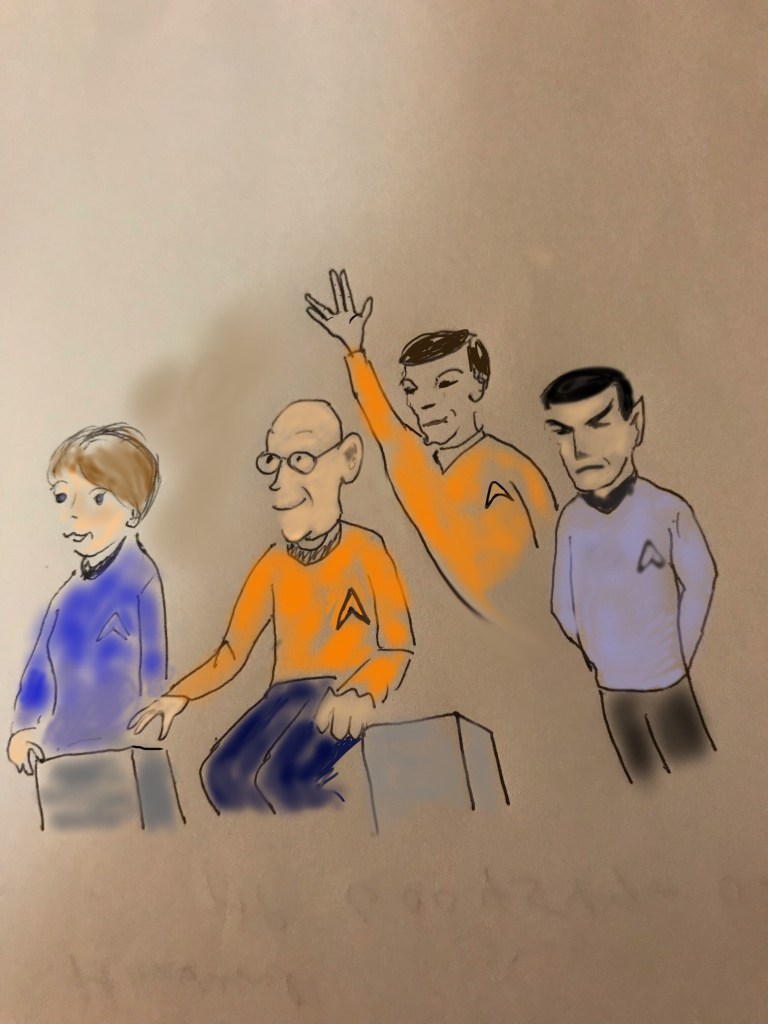
“Dave, your aunt and I won’t be traveling on the Starship Enterprise,” I replied. “We just want a television for our bedroom. That’s all”.
No thanks, Mr. Sulu
He recommended researching brands and sizes on Amazon. That would give us an idea of what was out there. Then shop at the big box stores and try to find the best deal, he said.
We followed his advice and headed to the nearest Best Buy store. The available products were overwhelming. The stores divide products between home entertainment centers – huge screens, separate sound systems, integrated computer games – and home televisions. We were in the latter category. We had trouble finding a store associate for assistance. That seems to be a problem in this post-Covid world. Ever try to hunt down a Macy’s employee? Department store employees have become an endangered species.
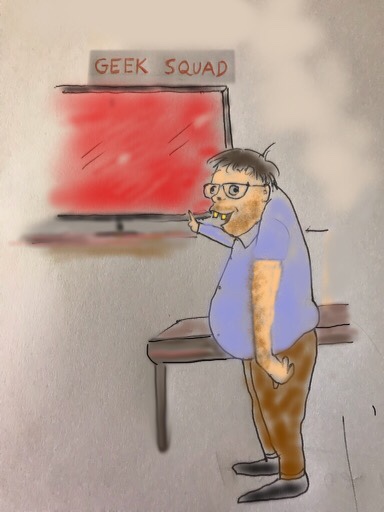
We finally found Earl, a blue-shirted member of the Geek Squad. In another era, he’d be wearing a plastic pocket protector or a slide rule holster attached to his belt. Earl was sporting an ear device resembling Apple AirPods he used to communicate with other employees. He was tall and gangly, had a huge Adam’s Apple, slouched shoulders and unkempt mop of hair. His teeth were crooked and had a brownish/greenish hue and that reminded me of our dead television.
This is Earl
“So tell me Earl, what are the features we should be looking for?” I asked. ”We’re nighttime TV watchers who don’t need too many bells and whistles.”
“Well, like, you don’t want to buy one with the 1080p HDTV, man” he replied. “That is sooo old. They’re phasing those ones out. Like, the 4K, it gives you 8 million pixels. That will give maximum image resolution.”
He proceeded to numb us with techno-geek information. Our eyes starting glazing over. We were suffering from information overload. He asked us about our dying TV -It was a “32-incher”- and recommended a 45” model. He then bombarded us with jargon. He babbled on about contrast ratio, refresh rates, mini and micro LEDs and my favorite, “Quantum Dots”. Huh? When asking about a specific manufacturer he replied, “Like, it doesn’t make much difference. All TVs are made in China, man.”
Despite deciphering Millennial argot, we had sufficient information to narrow our choices. Armed with such knowledge we gleaned at Best Buy, it was on to another big box store closer to home. At BJ’s we found the exact model that would suit our needs. The difference was there were no employees in the TV/computer department. Earl would not be magically appearing. We were on our own. It was a Samsung Model 70 S, 45”, the highly desired 4K designation. Most important, it was relatively cheap and under $350. We were relieved and delighted with the new unit.
My wife and I loaded the new television- it was surprisingly lightweight- into our Subaru Forester and drove home. After disconnecting and removing the soon-to-be-trashed dead TV, we removed the Styrofoam and cardboard packing and there it was. Sleek and bigger, it was accompanied by two power and cable cords and the magic remote. There was a paucity of paperwork and to our surprise no written owner’s manual. We learned nothing purchased today has detailed paper instructions. Stick-figure drawings made the TV appear simple and easy to set up and operate. Just plug in the power cord and the cable connection wire and you’re done. Wrong.
After pressing remote buttons with no response, I had a premonition this was going to be a bit more challenging. My wife solved the first piece of the puzzle. In fine print, the assembly sheet indicated the power light should be activated. I searched to no avail. My wife finally felt a little nib of a button underneath the television’s base. She touched it and a faint red light appeared. I once again pressed the remote and voila! the screen came to life. There was a menu of options that made no sense to us.
It’s very frustrating to have technical impotency. We just continued pushing buttons. Curse words were flying.
“Godammit, nothing’s easy anymore,” I yelled. “We’re having a string of bad luck here, honey. First our PC and now this!”
We had a similarly maddening experience two months earlier when our desktop computer operating more slowly and then crapped out. After purchasing a new computer and printer at Staples we spent several hours with technical assistance. Our old computer was easy to navigate. We knew which keys to punch to complete various functions – backup, attaching documents to a task bar, accessing Word, etc. The technology had changed. Via the computer screen the printer would warn me when the ink cartridge was low.
Replacements would automatically be shipped. We now live in a world where there are smart TVs and computers and anyone over age 40 is suddenly lost in a new techno-world.
The computer had finally been tamed and were now dealing with an intimidating television. We were faced with a daunting task and the only technical help was going online to the manufacturer’s website. Searching for answers via a chat line wasn’t my idea of having fun. We needed human help but who to call, where do you go?
My wife suddenly had an epiphany. Our 30-something neighbor Brian was a local firefighter. He’d walk his doodle-cross puppy past our house. In several conversations with my wife, Brian mentioned he was reprogramming the various electronic devices – computer, television, timed house lights and thermostat control – all done through his cell phone. Now that sounded like someone who could help us. We texted him and he quickly telephoned.
“Hi Brian,” I said. “ Can you help technically challenged neighbors with our new TV?”
“No problem. Just got home from work. I’ll be right over!” he responded.
He arrived ten minutes later. We ushered into the room and he grabbed the new remote.
“Well, part of the problem is the cable is connected to the wrong outlet,” he said. “Don’t worry, this happens a lot. My folks had the same problem.”
I expected him to rib me about this stuff being a generational thing but he was kind and respectful. He placed the Verizon cable into the correct outlet, pressed a few remote buttons and bing! bang! boom!, the TV came to life. The entire process occurred in about five minutes. Wow, it was that easy? I felt like a Neanderthal.
“It was easy. Glad to help,” he said.
“Please let me pay you for helping us out, Brian,” I said, handing him a $50 bill.
“No thanks, it was my pleasure to help a neighbor,” he replied.
“Well, I tell you what,” I said. “Why don’t you and your fiancée come over this weekend for steaks that are grilled over charcoal briquettes. I may not know how to install a TV but I’m a real caveman on the Weber.”
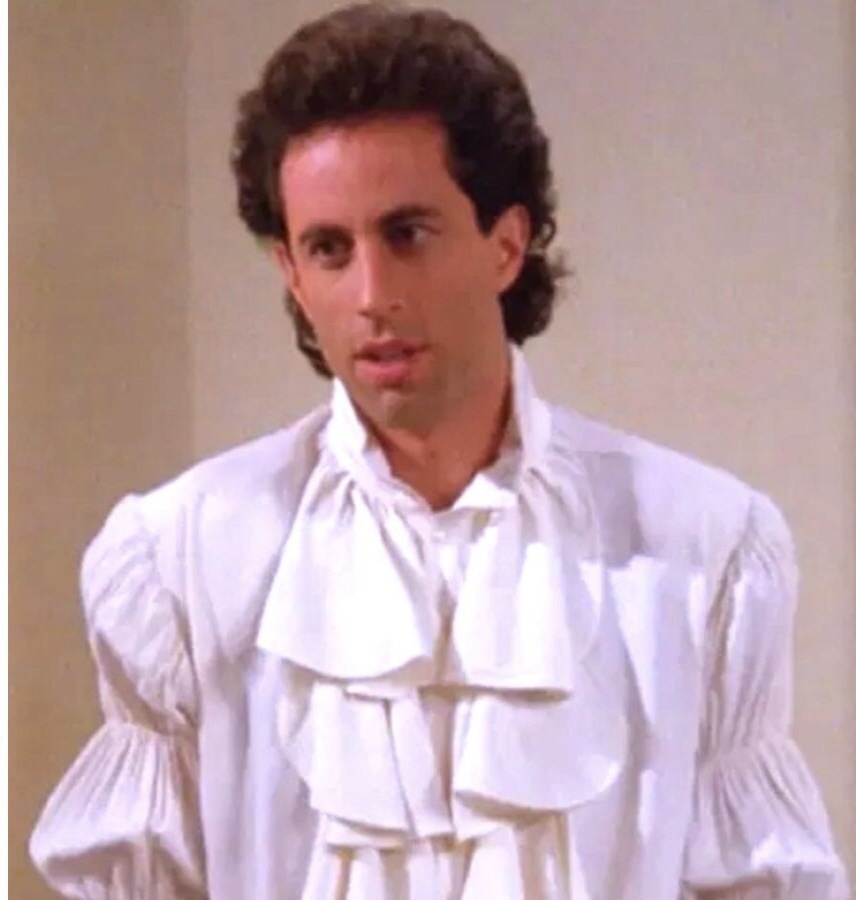
Later that night, my wife and I retired to the bedroom to watch a greenless Seinfeld. Love that Puffy Shirt, Jerry.
“Anna, I’ve been in full sloth mode this morning,” Josef Hraček says to his wife in a muted Eastern European accent. “I need to go to the Garden for some work.”
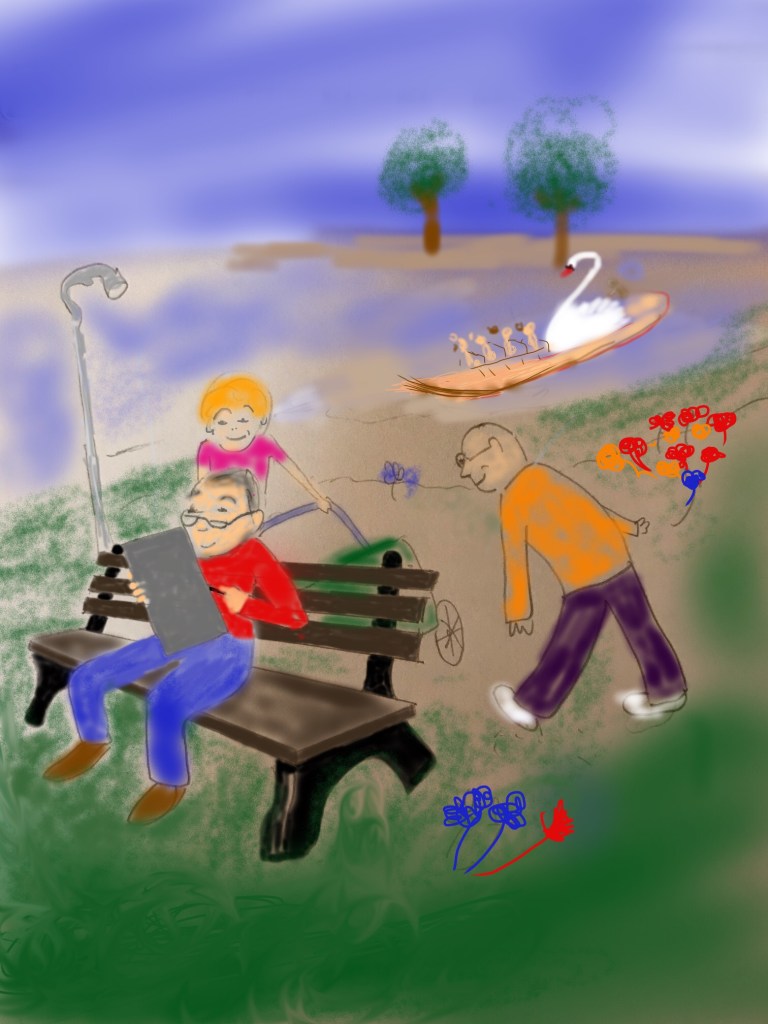
It is a warm, beautiful day in mid-May. Josef grabs his 18”x24” Blick White Sulphite drawing paper, charcoal stick and green no.1 graphite pencil and saunters across Boylston Street to Boston’s Public Garden. He lives in the exclusive Four Seasons Hotel condominiums. The Garden is his favorite place to people watch. He chooses his usual bench that’s near the famous Swan Boats. The northern light is best there. A jovial sort, Hracek has wry humor and has manifested it through countless drawings and cartoons. Like most talented artists, he can in seconds produce caricatures that are often an exaggeration of a person’s physical appearance.
Hraček is tall and gangly at 6’2”. He has a shock of unruly brown hair that is slowly turning grey. His eyes are an unusual blue-green color. He has just turned age 60 and is remarkably fit. When he was working in New York, Josef always dressed in a shirt and tie. His bespoke suits were tailored by Paul Stuart. His Slovak parents had always taught him and his siblings the importance of refined physical appearance.
Nowadays the suits collect dust in his closets. It is strictly casual with Wrangler jeans and Carharrt work shirts. He’s typically sockless and wears Dockers boat shoes year ‘round.
Hraček loves drawing passersby as they walk through the Garden. And he knows how to draw. An eminently famous and successful commercial artist from Manhattan, Hraček is semi-retired and now lives in Boston. He has no regrets about escaping from New York City. He also has a country studio in Woodstock, Vermont where he spends summers with his wife and paints in oils and acrylics.
Josef Hraček at the Boston Public Garden
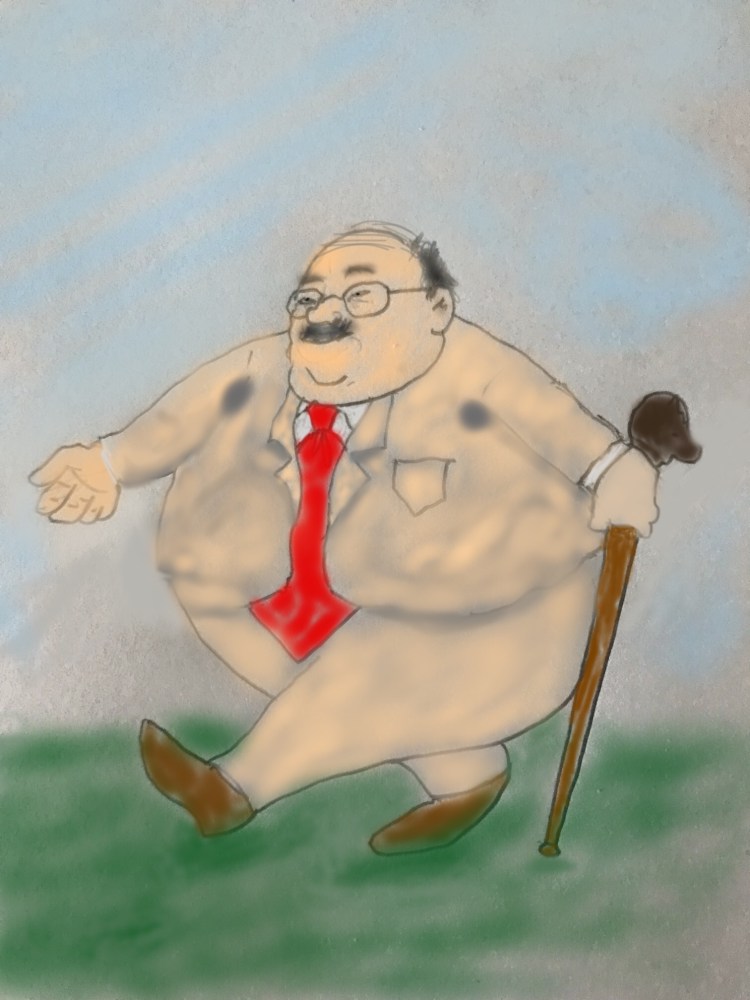
He is fully settled on the bench. It is mid-day and the light is perfect for his work. Hraček starts off with a rolly-polly older gentleman whose girth is enormous. The man – Josef calls him Oliver- has a duck-waddle gait and resembles a human bowling ball with legs. Given his belly, he cannot see his tan wing tipped shoes that are highly polished. He is about 5’ 5” and weighs perhaps 300 lbs, an obese dandy.
Oliver
Because of his protruding stomach, nothing is visible below the water line and he hasn’t seen his feet for 30 years. In the warming temperatures of spring , his bald head is sweating profusely. Given Oliver’s unusual size, his suits are custom made. Today he is wearing a pale linen suit that reveals lumberjack underarm stains. He has the physical appearance of British actor Sidney Greenstreet of Casablanca and Maltese Falcon fame. He’s probably in his mid-60’s.
Oliver’s silk necktie is unfashionably wide. It resembles a bib, because he still manages to dribble vichyssoise on his Brooks Brothers shirt. Oliver fancies himself a flaneur. He walks with a cane having a sterling silver horsehead handle. His small chubby hands have been manicured. Clear polish has been applied to his nails). He also wears on his pinky finger a sparkling 18k gold signet ring bearing the crest of his English predecessors.
As he walks, he’s constantly patting his sweaty forehead with an Irish linen handkerchief. Oliver is nearsighted and wears spectacles situated upon his bulbous pug nose. An effete, scraggly mustache is perched on his upper lid. Hracek captures this physical specimen in less than one minute.
As Oliver passes, a beautiful young woman is walking in the opposite direction. Josef scans her and begins drawing. She is probably in her late 20’s and fashionably dressed.
Tall, zaftig with a model’s body, the lady is wearing a stunning scarlet Anne Klein dress and matching Blahnik spike heels that make a distinctive clicking sound- an attention getter. As with most women under 30, she wears no nylons but her legs are tan and shapely. She’s carrying a Donna Karan clutch purse.
The Lady In Red
Josef notices her thick blonde hair is styled with the classic blunt cut bob . Her lipstick matches her dress color. He also observes professional stage makeup has been applied, an attempt to disguise her scarred face.
Alas, the young lady experienced disfiguring acne as a teenager; her cheeks and forehead have pockmarks resembling a Moonscape. Even the best plastic surgeon can’t reverse the permanent effects of acne vulgaris.
Her facial expression is pouty and Josef imagines this stunning but physically flawed young lady is insecure and her straightaway gaze meant to keep everyone at arm’s length. She passes Josef who deftly sketches the lady in red. An elegantly wafting French perfume follows in her wake.
He glances upwards to rest his eyes. The Boston sky is a brilliant blue with an errant cumulous cloud scudding by. The white sketch paper occasionally dazzles him and sometimes he thinks sunglasses would reduce glare. He learned long ago, however, the most accurate images are obtained by the naked eye. He’s never filtered his images through a tinted lens.
The beautiful weather has an unanticipated effect. Josef time travels to Prague, 1968. He was eight and was walking in the sunlight with his father through Stromovka Parkand, a park similar to the Public Garden. He didn’t comprehend the social upheaval occurring in his country. Czech President Alexander Dubček had defiantly introduced measures that lifted the oppression of the Soviet Union. Lasting only eight months, the “Prague Spring” was a evanescent breath of freedom.
Alexander Dubček, architect of the “Prague Spring”, 1968
The Russians brutally squashed the peaceful uprising. Josef and his family escaped and fled to the United States. His artistic talents flourished and he became a success story. He is suddenly jostled from the daydream and focuses on his next subject.
Running rapidly towards him is a jogger who weaves through the pedestrian traffic. The man is on a mission. With this day’s temperature, he is, like portly Oliver, sweating. Running man wears the de rigueur garb. This particular fellow is sporting everything Under Armour sells: running shirt and shorts with reflective logos. Josef is amused with the notion that runners become moving billboard signs for such apparel.
Mr. Under Armor
The jogger also is wearing accompanying socks and shoes. The man is perhaps 45 or 50. He has the typical lean sinewy look of a runner. His graying black hair is completely soaked, likewise the red and blue shirt. His face has that chiseled look. He is constantly monitoring his black, bulky G-Force wrist watch. Josef captures the runner in mid-stride. The man has that typical runner’s face that manifests pain. Why do so many look as if they’re not enjoying physical exercise that apparently causes pain and anguish?, he asks himself. Josef records that expression as the runner whizzes by.
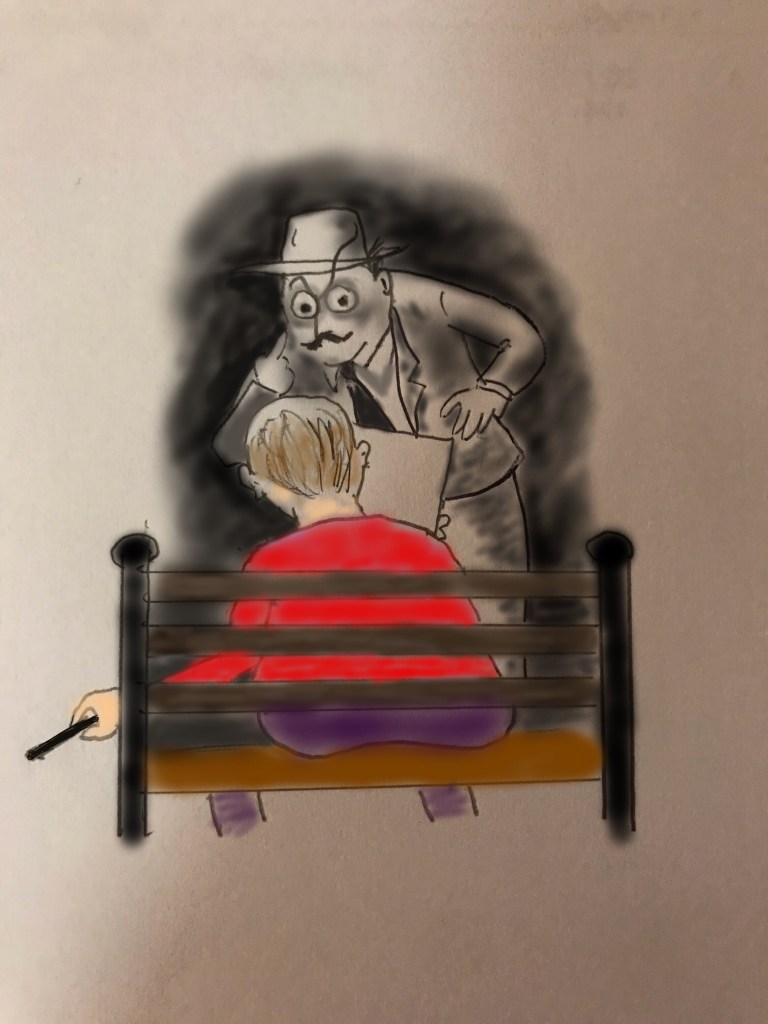
During the hour he’s been drawing, intermittent curiosity seekers notice him and walk behind him on a grassy embankment. Many are curious to watch an older man sketching strangers traveling through the Public Garden. It’s similar to watching sidewalk artists using colored chalks to create clever scenes that are soon erased by rainfall. Evanescent art.
While some eavesdroppers engage in conversation, others remain respectfully quiet. One particular gentleman stops and is clearly impressed.
“That’s quite a charcoal drawing, maestro,” he says, smiling.
“Why, thank you, sir” replies Josef, turning his head. “I’m glad you like it.”
“I’ve always loved chiaroscuro. It’s so stark,” the man says with a slight New York City accent. “I’m Dr. Arthur Di Nobili and drawing and painting are my favorite avocation. And I know you. You’re Josef Hraček, am I right?”
Josef laughs, says yes, as he notices the man’s physical appearance. Imposing with piercing dark brown eyes that bulge while he’s speaking, There is an intensity to the man both in speech and body language. Di Nobili possesses black caterpillar eye brows and a matching mustache that is the same size, color and width. His hair is jet black. He is a walking chiaroscuro. Dr. DiNobili is wearing a white shirt and tailored black suit. His shoes are spit-shined black plain toes; only a Royal Stewart plaid necktie disrupts his monochromatic apparel.
“Well, I can see why you like charcoal on white sketch paper,” Josef says with an impish grin.
“Why do you say that?” Di Nobili utters with a fierce look made to perhaps intimidate.
Dr. Arthur Di Nobili
Suddenly he bursts out laughing.
“Maestro Hraček, people have been teasing me about my garb since college,” he says. “I’ve been stared at because some think I resemble a Mafia don, especially when I’m carrying my black valise and wearing a Borsalino hat. Yeah, straight out of central casting. I’m actually a professor of Baroque art history at Boston University. Caravaggio’s one of my favorites.”
The two men chat for fifteen minutes and discuss fine art, especially paintings by the masters. Josef reveals he studied at Columbia University. In fact, he doesn’t disclose he was a child prodigy (Di Nobili probably already knows that) and yearned to study art at the Sorbonne. Living in the Soviet Union prohibited him from a European education.
They exchange pleasantries and Di Nobili gives him a carte de visite, then departs. He’s scheduled to deliver several lectures at the Museum of Fine Art.
One last sketch for today, Josef says to himself, and then home for lunch with Anna.
A young couple in their early 20’s are walking past him. The man is dressed in grunge: Converse canvas sneakers, baggy blue jeans and a Jimi Hendrix T-shirt. His greasy hair is tousled and he hasn’t shaved for two days.
Gen Xer’s
The woman, who’s taller than he, is Harvard Square: broom skirt, Doc Martins clunky shoes, and a diaphanous blue blouse. She is braless. At least her hair is clean, Josef muses. Two large tattoos adorn her bare arms; another tattoo is located behind her right ear.
What binds these two Gen Xers is a common denominator: their eyes are completely focused on their cell phones. No conversation between them. Of course, they are passing with others in their age group who are behaving similarly. They are walking slowly and Josef deftly captures their detachment from reality. He decides he’ll finish this sketch at home because he’ll include the numerous others surrounding the pair who are also WiFi zombies.
He packs his paper, pens and charcoal and pauses to relish the beauty of the Garden and the humans who are fodder for his skills. In a desultory manner, Josef Hraček returns to his apartment and his beautiful wife. They converse in their native Slovak tongue. She prepares his favorite lunch, plum dumplings and kasha with sour cream and butter. Afterwards, Josef returns to his studio and applies finishing touches to today’s drawings. He chuckles over his meeting with Dr. Di Nobili. It had been time to leave the bench for today. His sloth has temporarily returned. Tomorrow will provide a new batch of characters. There’s a never ending supply he muses while dosing off. Sládké sny.
Ask most people over age 70 about their health and you’ll receive a laundry list of ailments: high blood pressure, elevated cholesterol, diabetes mellitus (The Big Three), arthritis, joint replacements and cataract surgery. Most folks in this group will fall victim to at least one, if not more, of these ailments that burst the bubble of the bogus phrase “The Golden Years”.
I’m in that category and know from experience how difficult aging is. It is something we Baby Boomers are forced to accept as time exponentially accelerates. You can cry or laugh. I prefer the latter. There are the physical ailments requiring a daily dose of blue pills, pinks pills, white pills.
Another category is memory or lack thereof. “What was I going to say? I just thought of it two minutes ago.” At first, memory loss is frightening- the fear of Alzheimers Disease steps up front and center. But then you talk to aged friends and family members. You discover you’re not alone. It’s happening to them, too.
And then we arrive at the physical and visual shortcomings. Most of us geezers deal with weight gain – “Gee, I can’t fit into the suit anymore”. The weight scale disappears as the stomach grows. You almost hear the scale saying “Oh, God, I don’t think I can take anymore of this. I need new batteries!”.
Somewhere around 70, the body physically changes. Skin begins to sag. The blue veins in my hands bulge and resemble highways on a paper road map. My once taut skin is becoming flaccid and has the appearance of crepe paper enveloping my body – a new concept in body wrapping.
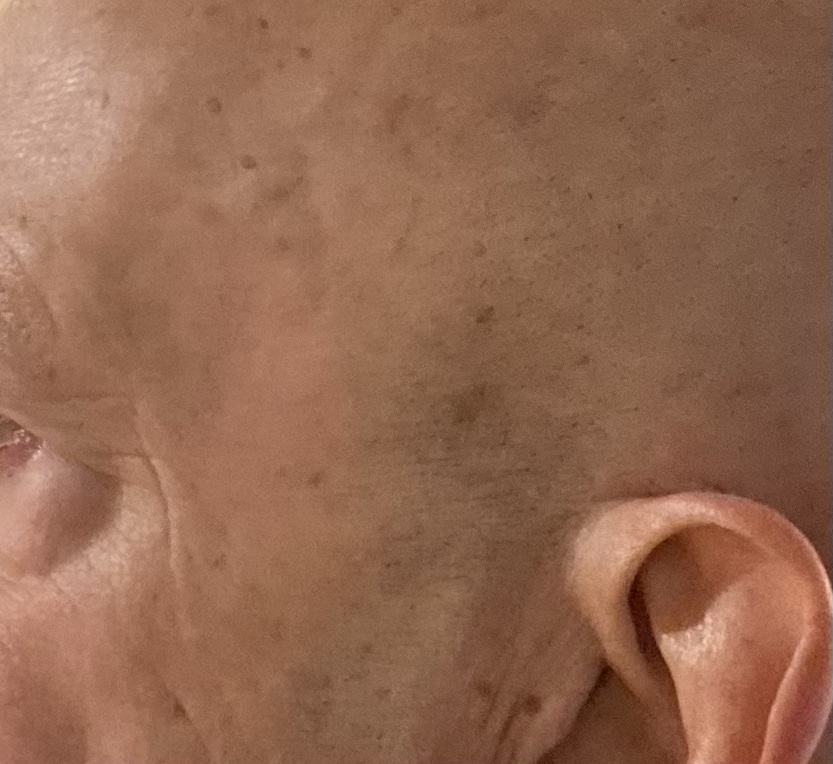
The one change that constantly amuses me is the rapid appearance of Seborrheic Keratosis (SKs), aka age spots. Yes, those brown spots of varying size that poof! litter your body overnight. While shaving I’ll say, damn, there’s another spot on my throat. SKs sprout up faster than a new Starbucks coffee shop.
During my annual trip to Dr. Debby, my dermatologist, I’ll map out the latest batch of brown things that need to be inspected. SKs are benign but they sometimes need to be differentiated from basal cell or squamous carcinomas.
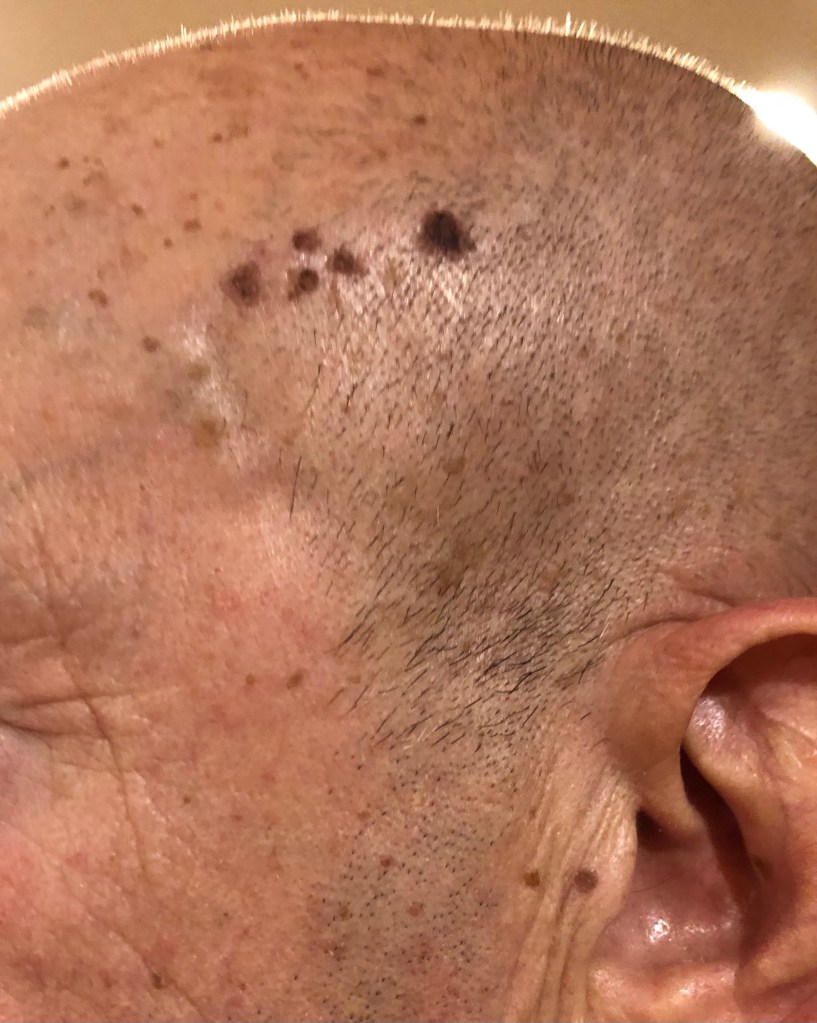
There’s a certain rapport I have with Dr. D. During my last visit I discussed a new crop of SKs that had recently popped up on my left temple.
“It seems the Hawaiian Islands have suddenly shifted from the Pacific Ocean to my head,” I said pointing to the spots. “It’s a real archipelago- a perfect replica don’t you think?”
“Well, well, well, I think you’re right,” she laughingly replied as she inspected them with her magnification loupe. “Yes I definitely see Maui and the Big Island. Oahu, too! I think it’s time to send them back to the Pacific.”
The Archipelago
Dr. Debby grabbed her hand-held liquid nitrogen device that resembles a thermos jug. The device has a trigger and zip-zip-zap the islands are frozen. Some discomfort but the SKs eventually become scabs and disappear.
I wasn’t finished.
“Debby, while you’re at it, there’s another one here on my throat that just arrived,” I said. “Could you throw in that one? It’s only going to get bigger and browner.”
“No problem,” she said as she froze yet another annoying blemish. “This is your Early Bird Special!”
There! That’s better.
I also mentioned recurrent purple lesions on my left arm.
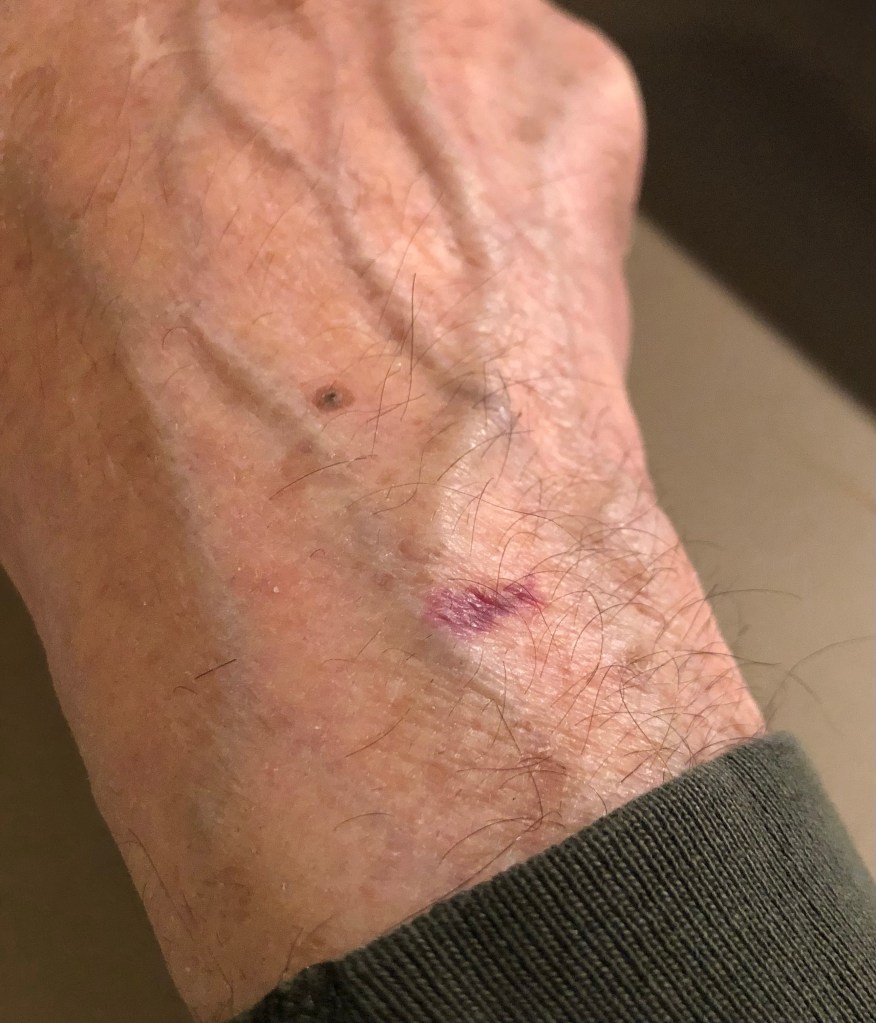
“What about this personal Rorschach test on my hand?, I asked, holding up my left hand with a fresh subcutaneous bleed.
“Oh,” those are ‘senile purpura’. “ she laughed again. “They’re known as blood spots or skin hemorrhages. Unsightly but benign.”
Senile is a horrible word. It’s a time marker.
“Gee, Dr. Debby, just think,” I responded. “These inkblot tests weekly pop up on my hands and forearms,” I could rent myself out to clinical psychologists as an itinerant screening test. What do you see on this elderly gentleman’s hand the shrinks will ask.
“Lots of wrinkles, a blood blister, and a bunch of gnarled, arthritic fingers – that’s what I see!” I imagine a 30-year-old man suffering from a bipolar disorder would say after staring at the blob on my hand.
At least the guy is honest. Rorschach interpretations many times are false positives.
A mini-Rorschach.
Clint Eastwood’s last good movie, The Mule, was a portrait of an octogenarian fighting against the onslaught of aging. In an interview, the late country singer Toby Keith, who wrote the film’s finale song, said he played golf with Eastwood before filming began. During the conversation, Keith asked him what was his secret of staying young at heart.
“Clint looked at me and said ‘It’s easy. Don’t let the old man in’”, Keith replied. That’s a good way of looking at the fate that awaits us all. Of course, Keith wrote a beautiful eponymous country song, Don’t let the Old Man in. Pretty good recording.
The youth of each generation never have a clue. They’re too busy going to college, getting married, having children and working hard. Many parents will say they can’t believe that rapidity of time occurring while child rearing. They have some inkling of what’s happening as their family grows, attends school and college and repeat the cycle. Folk singer Tom Rush recorded a very successful album in the 1960’s. One song written by Joni Mitchell was the source of the album’s title: The Circle Game.
“And the seasons they go round and round
And the painted ponies go up and down
We’re captive on a carousel of time
We can’t return, we can only look
Behind, from where we came
And go round and round and round in the circle game
And go round and round and round in the circle game.”
We used to feed birds during winter. The red metal feeder was one of those spring-loaded jobs that prevented larger birds and squirrels from hogging the sunflower seeds. Alas, we had a mouse infestation several years ago and discontinued the daily activity.
Winter is a brutal time of year for all these backyard creatures. My wife and I would fret over their fate. How do they survive sub zero temperatures and such harsh weather?
Something happened last year that created a mice-be-damned attitude about feeding these innocents. During last summer we had a new visitor to our bird bath: a black squirrel. Didn’t know the gender – he turned out to be a she- but the squirrel was predictable in its visit to the watering hole.
Our Miss Blackie
“Blackie”, as we came to call it, was cute as a button and a battle-scarred veteran of the backyard gang wars. Its body had numerous patches of missing fur on the back and behind the ear (Gray squirrels routinely attacked her). The black coat was unusual and the more frequently it visited, the more we enjoyed her gracing our backyard deck. As the summer progressed, the squirrel became fatter. Soon you could see protruding teats on her underbelly. There was now no question about the gender. Blackie was a going to be a mommy.
Suddenly she disappeared for several weeks. What happened to our cute little friend? We were concerned. Was she killed crossing a road or was she a lunchtime snack for a circling hawk or a wily coyote? Each day we’d scan the deck and hoped she’d reappear. We had switched from birdseed to oyster crackers. Blackie really enjoyed the treats and it was hilarious to watch her eat. Squirrels take a cracker and chew the treats by rotating clockwise like a human eating corn-on-the-cob. It was simple entertainment. We loved it.
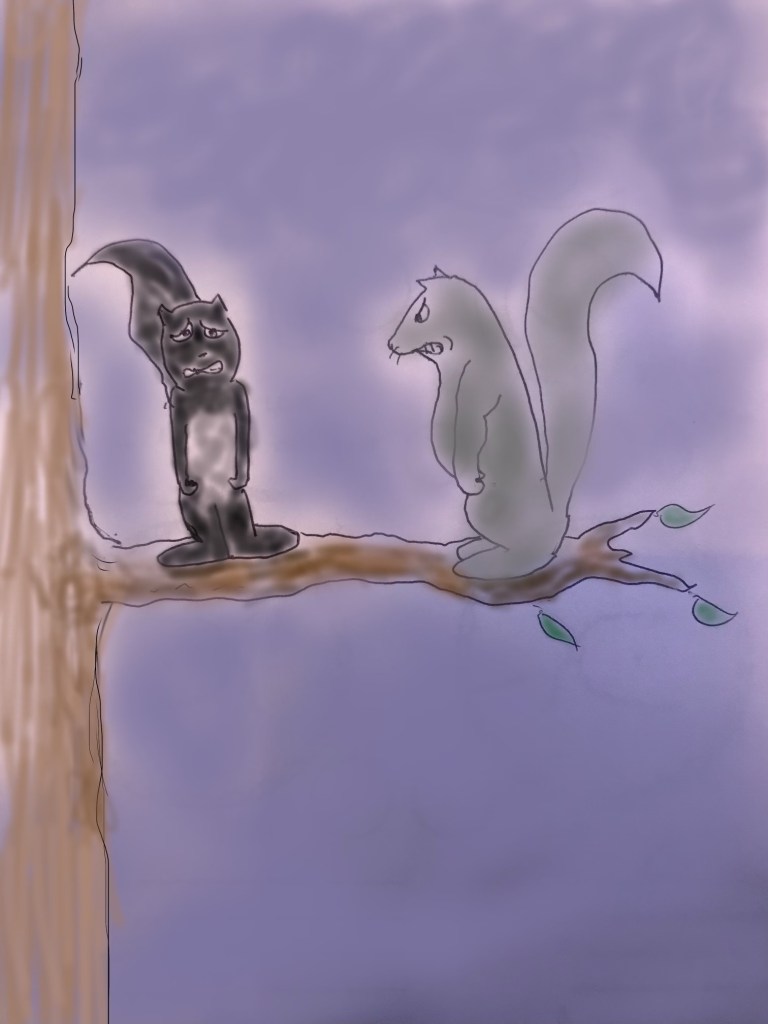
One morning in early fall, my wife Kitty called, “Come here! You’re not going to believe this!” I rushed to the dining room window and was incredulous. It was the sudden appearance of three scrawny baby Blackies. They were so small, especially compared to the gray squirrels who turned out to be the bullies of the tree branches. They’d hassle the new arrivals and their truculence didn’t stop as the black squirrels began to grow.
Per usual, we had been feeding the creatures crackers, a staple that all seemed to enjoy. Besides the squirrels, the sparrows, blue jays and big black Ravens began hanging around the chuck wagon. My wife and I, however, were concerned with the little Blackies. We started chanting “Black Squirrels Matter”!
Later in autumn, the Covid-related “supply chain” debacle created a curious shift in our feedings. The oyster crackers were suddenly disappearing from super market shelves. Like so many products, the popular treat was out of stock. Hmmm. What to do.
My wife checked our cupboards and discovered we had an ample supply of Ritz Crackers, a favorite of multi generations.
“Let’s give them a try, Kitty,” I said. “I’ve seen the Ritz in just about every store. The Blackies need to be fed.”
And so it began. Three times daily we’d toss about ten crackers on to the deck floor. And then we’d wait for the show. You had to be quick because within moments the squirrels would appear. The Ritz were too big for them to eat on the deck. Squirrels and most birds worried about predators. The gray squirrels chased away the Blackies and would even hassle their own breed. It was difficult to determine the hierarchy but one bull squirrel would lift his furry gray tail and dominate. His fellow grays would scatter.
Soon all squirrels, black and gray, began grabbing one whole cracker in their mouths and would scurry away to gorge themselves. Despite the harassment, the Blackies throughout the day would scoot with their daily haul. We were delighted with their success.
We began to see a pattern in these rodents’ behavior. Regardless of color, squirrels are crepuscular – they’re active usually in early morning and late afternoon. Deer and many other woodland denizens have similar biorhythms. The squirrels would queue up along a six foot stockade fence separating the backyard from a side allee. They’d slip through the deck railings, give a quick lookabout, grab a Ritz and then scoot to a fence post and devour their snacks. Of course, we had the loud mouths – blue jays- who’d dive bomb on the deck floor and leave with a whole cracker in their mouths. Occasionally the true school yard bully, a big black Raven, would arrive and snatch two, perhaps three crackers in his huge beak.
“Screw you little ones,” the Raven seem to say as he cawed and flew away. Ravens are huge compared to the other birds. Even the gray squirrels were frightened by the Big Boy. You don’t mess with Edgar Allen Poe’s Raven.
I became intrigued by the appearance of Blackie and her brood. Black squirrels have a mutated pigmented melanin gene. They have existed in North America since the 17th Century. They inhabit much of central Canada and the northern United States. Biologists have no explanation of how or why this mutated gene appeared but they do have several theories.
Some researchers suggest the black fur helps retain body heat during harsh winters. Black coated animals were found to have 18 % less heat loss in temperatures below 14 degrees. The researchers refer to the phenomenon as “thermal advantage”. It has also been suggested their fur is better camouflage in deeply forested areas. Gray squirrels stand out and are an easier target for predators.
Regardless of the how and why of their sudden appearance, we feel a certain joy with each day the Blackies appear. They seem to have more personality and we are thrilled with their presence. Black is beautiful, Baby.
Flashback two years ago. In May, 2019 Julie and Kyle Reston had flown first class for a dude ranch horseback riding vacation in sunny Arizona. What an experience. There’s a perceived pretentiousness with many who fly first class but not the Restons. The recently retired couple had worked hard during their lifetime and felt it was time to splurge on luxury. They’d made the right decision.
It turned out 2019 was the last year air travel would be normal. After takeoff, the well manicured, obsequious female flight attendants in first class pampered their guests. First, there were the hot towels handled with tongs, a luxurious way to clean one’s hands. Next followed a complementary glass of champagne. The flight left at noon, late enough to splurge on booze.
During the five hour flight, the Restons were given a gourmet lunch served on china plates, premium silverware and linen napkins. White and red wines accompanied the meals. Alcohol flowed freely. The meal was completed with a hot fudge sundae served in an old-fashioned glass goblet and topped with nuts, marshmallow and, of course, a cherry on top. The attendants did everything with alacrity and supplied warm, complementary blankets – it gets cold at 30,000 feet.
Back in the cheap seats, travelers received a sandwich, pretzels and soft beverages in plastic cups. Alcoholic drinks had to be purchased. It was class distinction before one’s eyes. The Restons learned afterwards that attendants receive financial bonuses when first class passengers give high marks in an online feedback survey. Kyle admitted the service to and from Arizona was spectacular.
They had planned for another Pheonix getaway in 2020 but the curse called Covid 19 derailed that trip. Airline tickets were cancelled and a sidetrip to the Tucson dude ranch was placed on hold. The ranch’s non-refundable deposit would be held in escrow for two years. Most important, the Restons missed visiting their longtime friends who lived in Scottsdale.
Like so many Americans, their life’s activity had been completely altered by an invisible enemy. Fortunately, anti-Covid vaccines were developed in record-breaking time. Think Operation Warp Speed. By March, 2021, Kyle and Julie had been vaccinated. Life was slowly returning to a new normal.
At least the dreaded blue masks were disappearing from many aspects of life but not at airports or during in-flight travel. One could sense a proverbial light at the end of the tunnel. Their delayed vacation would be a reality.
In May they purchased tickets from American Airlines. The Restons again selected five-hour nonstop flights between Boston and Pheonix. Kyle contacted the ranch and reserved a four-day stay for both their friends and themselves.
Everything was in place and they antipicated their October vacation. Little did they know they’d be hurled into a good case of You Can’t Go Home Again. And it started with their flight schedule. In mid-July, the airline company notified the Restons’ their direct to Phoenix flight had been cancelled. The new flight included a one-hour stopover in Charlotte, North Carolina. Total flight time would now be eight hours.
Kyle was outraged and learned the airline industry had radically changed during the Covid crisis. He called the airlines’ toll free number and, due to apparent lack of personnel, was given a choice: he could choose to wait on hold approximately four hours or opt for a call back. He chose the latter. He called nine separate times and never received a return call. He and Julie faced a brick wall. There were no alternate telephone numbers and there was no corporate email addresses listed where a complaint could be registered. All commercial airlines were behaving in a similar fashion. Nobody could contact anyone.
“I know someone who works for American Airlines,” a friend of Julie’s explained. “They’re just starting to rehire people. The airline apparently has antiquated software. That’s why you can’t reach them. My friend told me the best time to call is at 5 am. Any later in the day, forget about it.”
Julie followed the advice and called at 5:00. Two hours later an agent finally responded. Julie had read many travelers were downright hostile and verbally abusive to employees. Julie by nature was polite. In an even-tempered voice she asked for help.
“My husband and I really want a non-stop,” she said. “Is there anything you can do?”
“Well Mrs. Reston, I just scanned the flights and we actually have one nonstop flight on the same day,” the agent responded. “But takeoff is at 9:45 am which means you’ll have to arrive at 6:30 for security and boarding.”
“Good, we’ll take it.” So be it, she thought.
This meant the Restons had to rise at 4:30 am. They contacted a local taxi company who would drive them to the airport with a pickup of 6. Traffic flow was unpredictable on Monday mornings.
The reservation hassles were the first hint of the vagaries of today’s air travel.
The bleary-eyed Restons arrived at the airport. What a difference two years make.
“My God, can you believe this?” said Julie to Kyle as they entered Boston’s Logan Airport departure gate. “This looks like a cattle pen at a stockyard!”
Julie was referring to the scene at the terminal on an early Monday morning. They had just entered the check-in area. There were hundreds of travelers shuffling through a serpentine line awaiting initial security inspection. The line moved slowly through the retractable belt barriers. Bored travelers were wheeling their carry-ons. By 6:30 am, everyone resembled a lobotomized Jack Nicholson in One Flew Over The Cuckoo’s Nest.
Logan Airport, Monday, 6am
“I feel as if I’m at a Kansas City abattoir and viewing blue-masked Angus steers awaiting the stun gun,” Kyle said. “All you need is the mooing of cattle. How inhumane.”
There was a potpourri of travelers. Some wore warmup suits; portly men and women were devouring cheeseburgers and burritos, the grease dripping down their double chins and staining the masks. Young women were sipping Starbucks coffee while wearing tight fitting ripped jeans that expose various amounts of flesh and tattoos. Older women and men wore them, too.
The overarching observation was this: flying apparel was immaterial and irrelevant; everyone’s eyes were glued to cell phones or laptops. Few were conversing; texting was far more important method of communication. The entire world has aphasia.
The Restons were spared most of the experience. First Class airline ticket holders and were guided through a separate queue. Like everyone, they had to place their belongings, belts, shoes and anything metallic into the now all too familiar plastic bins. They walked through an arch-shaped screening device. Julie passed the screening. Kyle, however was delayed because his titanium knee replacement had sounded an alarm. He was moved to a special arch that detected the metal knee. He also underwent the pat down to prove he wasn’t a terrorist.
The Restons boarded the airplane and sat at seats 2 C and D. Leg room was abundant. The seats were wide but Julie noted differences.
“These seats don’t seem to be as roomy,” she said through her blue mask. “I remember their being wider.”
Once aloft the 2019-2021 difference became readily apparent. One flight attendant was male; the other was female. Neither were warm and fuzzy. No hot towels were served. No champagne either.
“Will breakfast be served?” Kyle asked the man. “We got up too early this morning.”
“We’ll be serving you soon,” he flatly responded.
Within moments, the attendant walked down the aisle carrying flimsy clear plastic glasses containing water, Coca-Cola and lemonade. The Restons asked for coffee and soon were drinking coffee out of paper cups. So much for the chinaware. Finally, their “breakfast” arrived. Stale croissants with turkey, lettuce and tomato sat on paper plates. Included in the meal were trail mix and a fruit cup. That was it. There would be no hot fudge sundae served on this trip.
“Gee, things are a lot different now,” Kyle said to the attendant. “I’m sure it’s been tough on you.”
The attendant explained the changes in section designation. American Airlines had downgraded first class to “business class”. The niceties had been eliminated, including those cozy blankets. Also missing were the cheesy inflight American Airlines magazines crossword puzzles that had already solved and advertisements for expensive products and gadgets no one ever purchased. Now, the only advantage was seat size and leg room. The poor bastards in coach were squeezed into narrow sardine seats and received pretzels and a drink. No booze, no blanket, no nothing.
Even the first class passengers’ physical appearance had changed. Seated directly in front of the Restons was a middle-aged married couple. The wife was wearing the aforementioned ripped jeans. She continuously played with her pony-tailed hair. Periodically, she flipped the hair over the head rest. Kyle was staring at a glob of semi-washed hair containing a touch of gray.
Tattoo you?
The well-muscled husband also wore the same jeans style. His bald head was clean shaven and gleaming. The kicker was this man was apparently suffering from a bad case of male menopause. The cabin was cold but that didn’t stop him from wearing a tightly fitting tee shirt that exposed newly inked sleeve tattoos on both arms. It was a classic example of exhibitionism. Passengers were supposed to be impressed with a huge Elvis-head tattoo on his right arm.
Across the aisle, a nerdy guy with eyeglasses and paunch was very thirsty. Just after a 9:45 takeoff, he ordered the first of four Bloody Marys. The attendants didn’t serve drinks; they merely handed him tomato juice and vodka nips. Having had several tastes of the Beast, he weaved to the rest room located near the pilot’s cockpit.
“The hair of the dog that bit me”
Julie walked toward the rest room. Mr. V-8 was exiting. She discovered he’d deposited plastic cups and nips into the sink. At least he’d had the decency to not vomit, she thought.
To stretch his legs, Kyle walked through coach en route to the rear rest rooms. The seating is barbaric, he said to himself. They were tight enough to cut off one’s blood circulation. And yet, some travelers were sleeping. Kyle had always envied these people. How do they do it, he mused. In fact, seeing these people reminded him of the war galley scenes in the movie Ben Hur. The galley slaves were chained to their aisles and rowed constantly. Those who collapsed were whipped by the galley master. Kyle imagined hearing that crack as he returned to the first class cabin.
The Restons were engrossed in reading- a tedious task while wearing masks. Their eyeglasses continually fogged up. What a pain they said to each other. Some passengers would remove the mask while they were eating or drinking and were slow to mask up. The attendants walked by and, sometimes sternly, told the passengers to reposition their masks. Obdurate mask scofflaws could find their names on a do not fly list ban on American Airlines.
Despite the Boeing 737’s droning engines Kyle dozed off. The Restons could suddenly feel the plane’s descent. Kyle gazed out the window and in the late morning sun he saw the grey/brown mountain ranges east of Phoenix. The sun was bright and shone on the vast metropolis, Hundreds of subdevelopments appeared, each home with the obligatory in-ground swimming pool. In this part of the country, pools were de rigueur. The plane swiftly descended and, with the bounce and with a screech of its tires, safely landed.
As they walked through the gangway the welcoming heat and light shone. It was sunny and 90 degrees and the forecast for the week was hot, dry and no rain; when they left Boston that morning it was raining and 45 degrees.
“Enjoy this, honey,” Julie said. “In a short ten days, this will quickly become a memory. In the meantime, let’s cowboy up.”
The Restons headed for the Uber station. They knew there’d be another another trip through the abattoir upon their return. For now they were living one day at a time and enjoying one moment at a time. Arizona makes that easy.