Vitreous Humor
By
Leo de Natale
Illustrations by Vince Giovannucci
I graduated from optometry school in 1981. It was a time when the profession’s tectonic plates were shifting. Theretofore it was a hybrid occupation: half optician/half eye doctor. It was a time where at optometric conventions the audience, mostly male, was awash in white belts and shoes, toupees, and pinky rings. At the annual New England optometric conventions, most of the exhibitors who underwrote the meeting were eyeglass frame companies, lens manufacturers and equipment salesmen. The rooms were always filled with cigarette smoke.
Historically, optometrists have had an inferiority complex. Ophthalmologists were the schoolyard bullies. They were bigger, smarter and stole patients. Many of us were smitten by the question, “But are you a real doctor?” Clinical psychologists and podiatrists and chiropractors encountered similar professional insults. Here is the world according to older optometrists:
Lens grinders were the primordial slime; opticians Cro-Magnons; optometrists Neanderthals; ophthalmologists homo erectus.
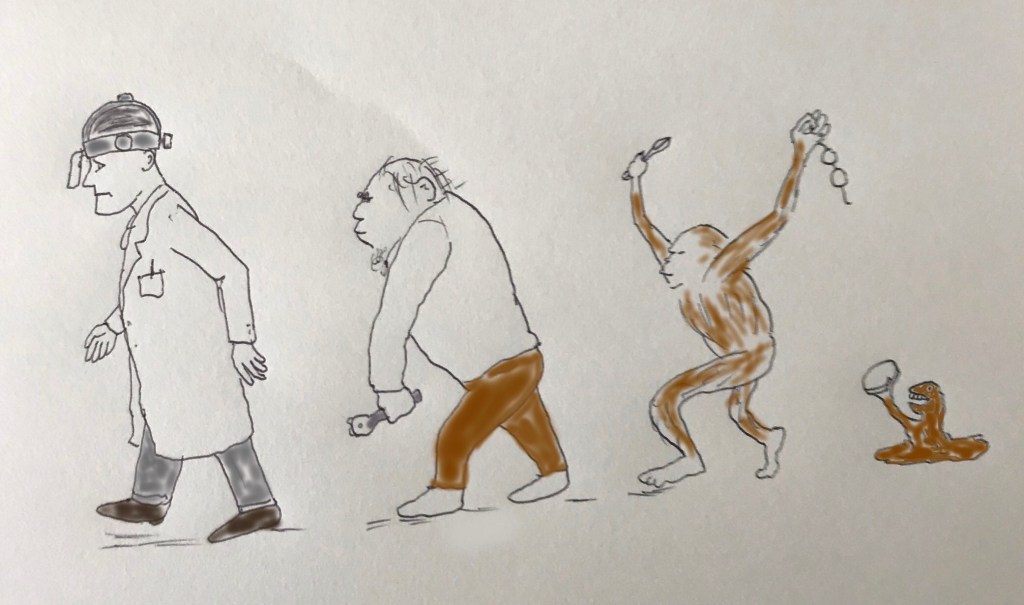
My class was the first to witness the changes directing optometry towards a medically-based profession. The academic decision makers decided optometry would begin emulating ophthalmologists and de-emphasize mercantile opticianry. It was the profession pushing the envelope and transforming us into make-believe MDs. The ‘81ers, still had one foot in the optical shop and the other in the examination room but that was made the profession challenging, especially those classmates who, like myself, worked in private practice. Optometry, however, was changing. Many were finding positions in clinics and working for ophthalmologists. It was known as sleeping with the enemy.
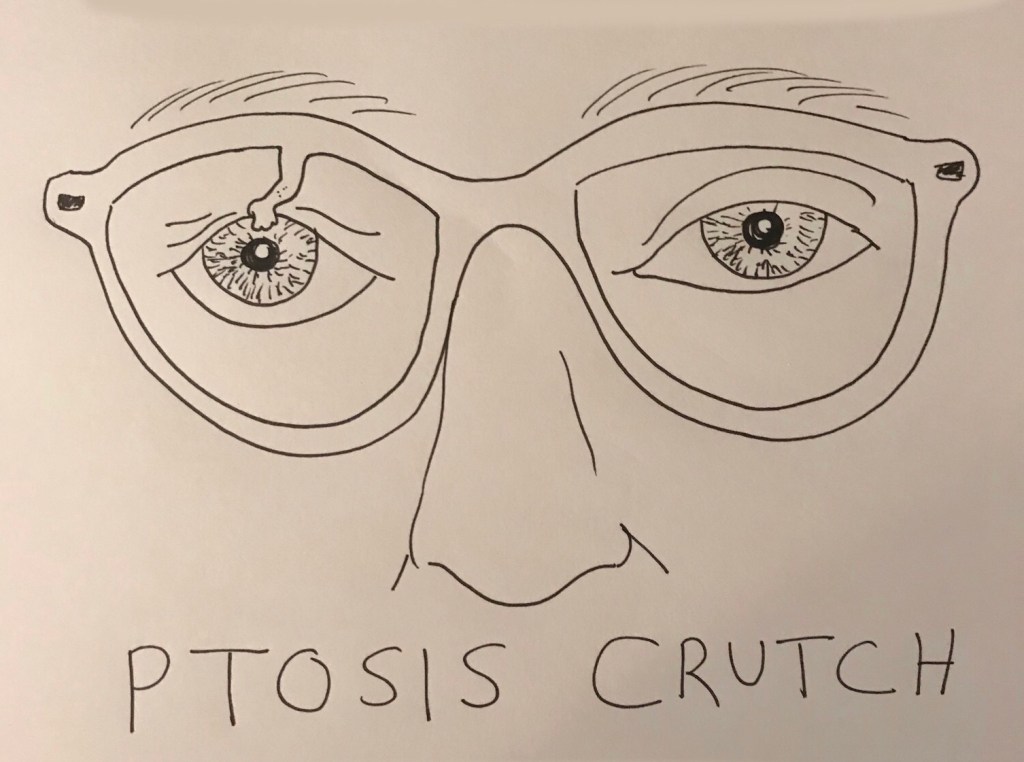
For us who wore the optician’s hat we dealt with nomenclature that pertained to making eyeglasses. Office terms were filled with double entendres. There was the “drop ball test”, a term referring to an ophthalmic lens’ breakability. Frames and lens were placed in “job trays”. We were facile with pliers used for eyeglass adjustments. We were required to construct a Medieval device called the ptosis crutch that would literally elevate a patient’s droopy eyelids.
We had the task of fitting teenage girls with the teardrop-shaped plastic frames that contained sparklies. The boys wore dull, drab plastic frames. We knew half of the kids rarely wore their glasses. Middle school peer pressure has that effect.
When switching to medical mode in the examination room there were other terms evoking internal laughter: the “muscle light” to diagnose eye turns, the phoropter – the device resembling a periscope – had a “near point rod” that assessed near vision. Examining the eye’s internal contents we evaluated the area of central vision, the fovea, that contained rods and cones.

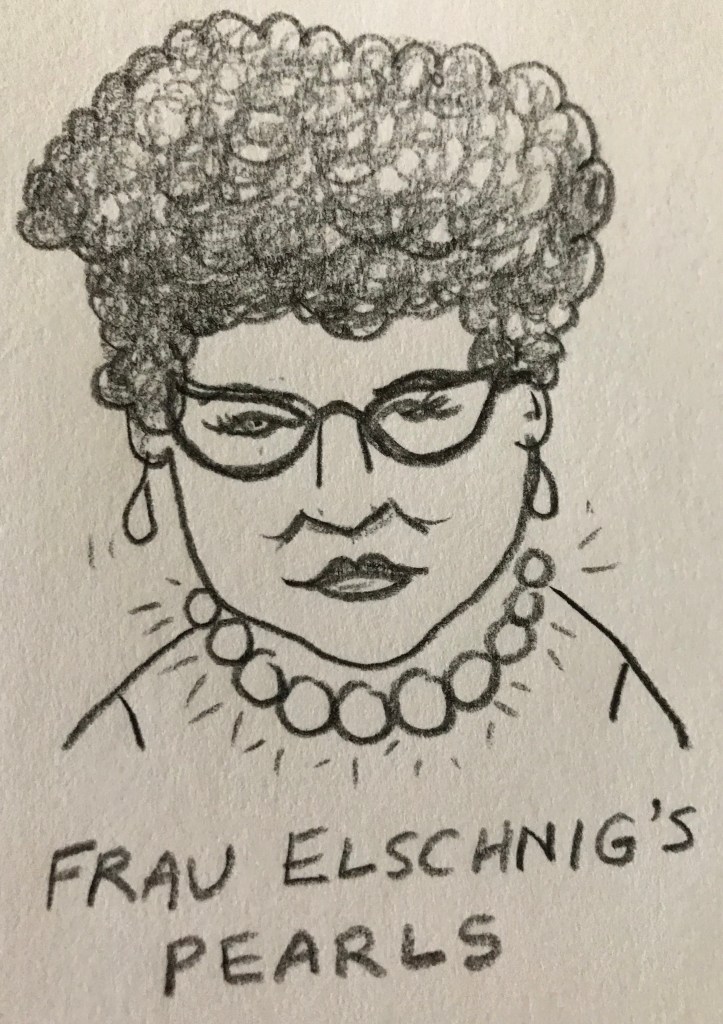
There were oddly-named medical conditions – drusen of the optic nerve head, Elschnig pearls, eyelid nodules, Hudson-Stahli lines and cutaneous horns- a dermatological condition. Iris bombe, a physical defect of the iris. I always imagined a Punjabi pronouncing the term in high falsetto. The oddly named vitreous humor was the gelatinous, clear fluid that filled and gave shape to the eye’s internal contents. It was also the source of those pesky things known as “floaters”.
During that era, ophthalmologists contended optometrists were ill-educated and undeserving of professional recognition. We were purportedly more interested in selling eyeglasses than assessing ocular health. In some cases they were right. The geezers were sometimes slipshod.
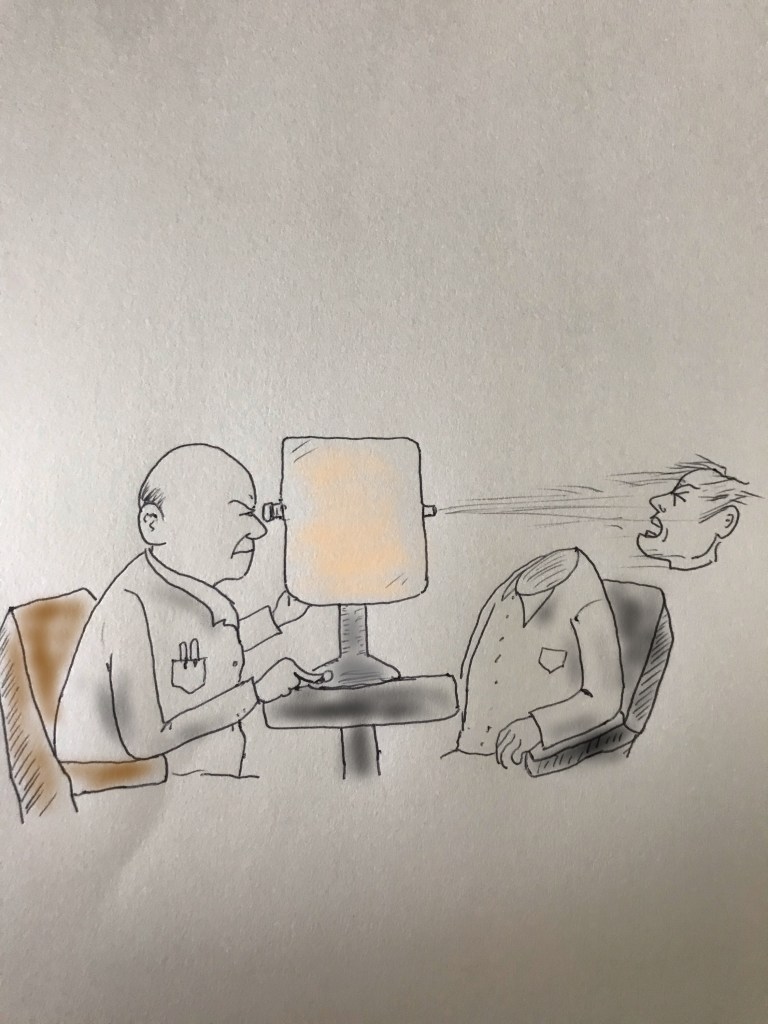
But the medical mode optometrists were busily working. One of the most essential requirements was the ability to diagnose diseases such as glaucoma. Problem was a pharmaceutical numbing drop was needed for accurate measurements. The MDs efforts had forced the optometrists to purchase the expensive and dreaded “air puff” glaucoma test. Many patients had palpitations knowing they would “get the blast.” The puff test is still used but its accuracy has always been variable.
The vanguard was led by North Carolina optometrists who successfully introduced a bill allowing them to use so-called diagnostic drugs. Included in the new law was permission to use drops that dilate the eyes. Their argument was there were fewer ophthalmologists and more optometrists in rural areas. With such drugs they could thoroughly search for pathologies within the eye.
Predictably, a domino effect was created. State-by-state similar bills were passed until 49 out of 50 states had diagnostic laws. Which state was left? Massachusetts, of course. Ophthalmologists were a powerful group and annually paid lobbyists and key legislators to squelch any drug legislation. They published a pamphlet whose motto was :“M.D., The Major Difference” that included articles where optometric incompetency supposedly had blinded patients.
It took money and pressure but in 1987, the profession had counter-lobbied and raised campaign funds for sympathetic lawmakers. The diagnostic drug had finally made law. Sardonic glee raged through optometry offices across the state. David slew Goliath.
North Carolina and other states pushed the envelope further. We have diagnostic drugs, now we want the right to use therapeutic drugs for red eyes and external and internal infections and pathologies. The rationale was, unlike Massachusetts that has a plethora of ophthalmologists, many states have fewer. Massachusetts again the last state to follow. The therapeutic bill became law in 1997. The irony was that many optometrists who worked in hospitals or M.D. offices had been using the various drugs before the laws were passed. The rest of us needed the official imprimatur.
For the private practitioners the sweeping changes were a double-edged sword. We could use the drugs but we also were required to purchase or lease incredibly expensive diagnostic equipment. Insurance companies had insinuated themselves in health care and required “standard levels of care”. Translated: if you don’t use the equipment you were subject to disciplinary action. The fearsome specter of malpractice suits was omnipresent.
On the optical front there were also winds of change. It was a Chinese wind. Slowly and methodically, American frame manufacturers were closing. New England was particularly affected. Companies such as American Optical (AO), a long-established Southbridge MA-based company, stopped making ophthalmic lenses and eventually frames. AO was famous for the geek plastic frames – think Revenge of the Nerds- and the semi-metal frames that every male high school teacher wore. It was purchased by a conglomerate and eventually disappeared.
Rhode Island was another state that was home to famous frame manufacturers. Those companies suffered a similar fate. By the 1990’s American-made frames and lenses were endangered species and finally extinct. The predictable source of this was cheap labor.
The optical industry was flooded with frames made in Hong Kong. Today, most frames, even high-end designer frames including Ralph Lauren, Ray-Ban and Tiffany, are stamped with “Made in China”. The only competition left is in Europe – Italy, France and Austria. As with everything else, the Chinese have become the Russian trawler of the optical industry. Naturally, they have monopolized manufacturing of optical lenses, too.
Compounding the problem for private practitioners are companies that are offering online eyeglass sales. Lowball outlets – Warby Parker et al have impacted optometry. They sell cheap Chinese frames and lenses for less than $100. Other online retailers sell eyeglasses for less.
And so today the predictions made in 1981 have become reality. A typical optometrist wants nothing to do with eyeglasses. Doesn’t know or care about fitting eyeglasses. Dealing with “merchandise” is odious. It’s optical leprosy. That’s left to the technicians and opticians who work “in the store”. Optometrists fit contact lenses, but, again the technicians perform the training and instructing.
The polyester leisure suits and alligator shoes are gone. Soup-stained neckties are a thing of the past although halitosis continues. In many clinics the predictable white doctors’ jackets are de rigueur. The chief distinction is we have “O.D.” after our names; the ophthalmologists still have “M.D.”. The major difference. Whatever. The medical model optometrists have achieved their goals. The profession can treat glaucoma. The underpinning of this is economics. Optometrists can bill insurance companies for glaucoma treatment and reimbursements are profitable. Again, in 49 out of 50 states optometrists can diagnose and treat glaucoma. Which state cannot? Yup, Massachusetts today is still the holdout. Some things don’t change.

