The Love Of A Horse
By
Leo de Natale

The author riding Straw’s Essie at Plymouth Beach, MA
On a crisp autumn day, riding a horse at full gallop is the greatest adrenal rush one can experience. Guiding a 1,200 lb. animal across a grassy field is exhilarating. You feel the speed, the pounding hooves, the refreshing cool of the wind in your face and the sound of staccato hoofbeats of a magnificent beast. Man and horse traverse meadows as one swiftly moving unit. The art of riding is an atavistic pleasure. When one rides, he or she is experiencing a thrill that has been occurring for millennia. We replicate what Genghis Kahn, the Greeks, Romans and all subsequent conquering nations have discovered: the bond between horses and humans is never ending . Every time a rider saddles up, the continuum is perpetuated. We are riding with Julius Ceaser, with Spanish conquistadors, Napoleon, George Custer and countless cavalry soldiers and adventurers.
Until the 20th Century, horses were indeed beasts of burden. They pulled wagons, tilled fields, changed the lives of Native Americans, transported humans in carriages and were ridden and slaughtered on such battlefields as Bull Run and Gettysburg. Most horses experienced miserable lives that ended at an abattoir. Today, horses have been primarily relegated to a pleasure activity. In certain parts of the planet they are still worked but the days of universal equine use and abuse have passed.
There is no question about the love and admiration mankind has for these noble animals. We revere them in paintings, sculptures and statues. In the era of war horses, soldiers literally looked up to cavalry officers. Horses have always instilled admiration among those on foot. No one wants to be trampled and that inherent fear remains unchanged. Many are fearful of riding them. They are big and powerful. And beautiful.
Watching horses in a pasture is pure bucolic beauty. The sight of their foraging with supple lips, racing along a fence line or resting on their sides covered with mud are simple pleasures. It is a joy to be present at feeding time and hear the rhythmic crunching as a barn full of horses consume their twice-daily ration of feed. In winter with barn doors closed, the stables are surprisingly warm from equine body heat. The accompanying aroma is a delight. When a horse whinnies and neighs under saddle, its body vibrates with equine excitement and reverie. Most riders are tickled by the sensation. They also experience the jolt when the horse – especially in springtime—bucks with gusto. Horses express their emotions in very physical terms.
In the United States, horseback riding has become a sport. For many it is a leisurely pastime where human and horse travel in primeval forests, flatlands and mountains. There still is thoroughbred racing and cowboys on horses do exist out West but the majority of horses are used for pleasure and relaxation. Owning and riding a horse does appeal to aristocrats and social climbers who engage in horse shows and competitive events. Riding became more egalitarian during the last half of the 20th Century, something middle class folk could enjoy. In the West, you often see horses in backyards. Many riders lease horses; others purchase them at prices varying from an inexpensive grade horse to jumping and eventing horses costing more than $100,000.
It is an expensive sport. Saddles and bridles from England, France and Germany sell for thousands of dollars; used or synthetic saddles are more reasonably priced. The cost of boarding a horse varies. Show barns, where horses and riders are involved in competitive events, are costly; others, where riders own or lease pleasure horses, are comparably affordable. There are also veterinary bills and horseshoeing fees.
But the magic of equine husbandry has always been there whether someone leased or owned. There’s a sensual quality of horseback riding. The sight of a grazing horse in pasture, the pungent aroma of horseflesh, the sounds horses make – whinnying, snorting, neighing and soft huzzahs—all provide delight to horsemen and women. There is the soft, velvety feel of their muzzles. In a sign of equine affection, horses will lean their shoulders against riders, especially during grooming sessions. There are the munching sounds when offered carrots or apples.
Riding can be a sociable sport with boarders discussing riding conditions or sharing barn gossip, all with the comradery that creates bonds among riders who often ride in groups. It is also can be a solitary activity where there’s only a rider, horse and nature. Many a rider suspends reality and harkens to an unspecified time and place where there’s peace and tranquility. Trailblazers, pioneers or explorers rode alone. Horses became their trusted companions. While horses don’t display the bond humans have with dogs, many a horseman will tell you his or her horse recognizes them and manifests rudimentary affection.
There are many rituals involved with riding. On a typical day, the rider strolls to a paddock or pasture where his or her horse will be grazing on field grass. The horse will be led to the barn where the clippity-clop of horseshoes on concrete is music unto itself. Riders nestle in the aromatic atmosphere barn smells of manure, hay, horse sweat and saddle leather. Then comes the husbandry that has been performed for centuries.
With horses, grooming goes from bottom to top. The riders first inspect the hooves and, with a hoof pick, remove the impacted mud and dirt. They feel the hooves and check to see if there is heat, an indicator of hoof health. They inspect the iron shoes. Is there a nail missing? Is a shoe loose? A trail ride can be canceled if any of these routine problems are discovered. From the hooves, riders glide over the four legs and make sure there is no inflammation or tenderness. They also look for deer ticks, those disgusting parasites that cause Lyme Tick Disease. Finally, the horse is ready for brushing. Most horses –especially in summer- roll in dirt or mud to protect them from ubiquitous and irritating flies. Using a variety of brushes, the dirt is removed the legs, rib cage, back and rump. The cross-tie area is awash in dust and horse hair.
Last, the mane and tail are untangled with human hair brushes. Many riders use a detangling spray that makes the job easier. The spray has a pleasant scent, too.
There are various levels of pre-ride preparations. Riders can be perfunctory and prepare for riding as quickly as possible; others are fastidious and want their horses properly turned out. It is now time for tacking up the horse. Most barns have tack rooms where saddles, bridles and reins and saddle pads are stored. Out they come and the horse is quickly saddled, bit inserted and reins attached. In summer, many riders use fly spray and douse the horse, especially on the neck, underbelly and tail.
Riders, especially those who ride with English-style saddles, usually grab gloves and a riding crop. The safety helmet is donned– there was a time when falls from a horse caused serious or fatal head injuries. Most barns require mandatory helmet use. Horse and rider walk towards a mounting block, riders swing the right leg over the saddle, boots are secure in the stirrups and the adventure begins.
The beauty of riding is the ability to ride year round. In springtime, the rider revels in verdant scenes. Trees are spreading their leaves, the grassy knolls and forest undergrowth are green. The smell of springtime is incomparable. Forging across racing streams and the sounds made walking through water is a joy. The view atop a horse is different and special. Summertime brings heat and flies. Nearly every rider uses a fly whisk, a shortened crop with horsehair attached and resembling a dust mop. Conservative riders won’t engage in too much galloping or cantering during midsummer. Heat stroke can occur if the riding period is too long or strenuous.
When rider and sweat-laden horse return there is the bathing ritual. A hosedown with cool water is followed by pleasantly scented horse shampoo. When thorough rinsing is complete, a squeegee-like device called a sweat scraper removes the excess water. After the bath, most riders will graze their horses until the coats are dry and gleaming.
This is done because the dry, bathed horse invariably returns to its paddock, lays down and again covers itself with dirt. All the cleaning and primping is for naught. Riders usually shake their heads and smile at their exercise in futility.
Autumn is a favorite season for riders. The temperature is cooling, the insects are disappearing. Horses are more frisky. It’s a time when when a four minute gallop becomes invigorating for horse and rider. Again, from atop a horse, the rider revels in the pastel colors of foliage – yellows, reds, oranges – that blend together and create an impressionist painting that lasts for a mere two-to-three weeks. It is also the fox hunting season. Hunt clubs are very popular in the Northeastern states. There’s a certain elitism to such events but most clubs allow day-trippers to enjoy the excitement of jumping over countless fences. That’s the adrenaline rush on steroids.
Fortunately, no real foxes are used. The hunt clubs conduct “drag” hunts where fox urine is applied along the appointed trail route. Foxhounds eagerly pick up the scent. A popular activity during these hunts occurs at resting “check points”, where the hunters stop and sip whiskey, schnapps or brandy before noon. The sweaty horses merely stand, cool off and smell the booze.
Fox hunting and fall pleasure riding occur before the ground is frozen. Season four begins in December. Usually the rides are limited to trots and canters. Tundra can be harmful to horses’ legs. During this period, horses are re-shod with winter shoes that possess iron studs allowing them to traverse slippery ice and snow. Many horses have their woolly coats clipped. This prevents excessive sweating but also requires horse blankets to provide warmth. Intrepid riders love this period, too. Unless there’s a severe snowstorm or blizzard, horse and rider can traverse trails.
After a snow storm, the forest and trails have a magical beauty. Tree branches are covered with snow and icicles. There are incredible vistas in meadows that glisten with virgin snow. Animal tracks – fox, rabbit, coyotes – are easy to see. The horses work harder in the snow and their noses discharge the white vapor of their breathing. Perhaps the most enjoyable part of winter riding is the quiet. Hoofbeats are muffled and, apart from an occasional snort, there is a calmness of the spirit. Riding a horse in wintry solitude has that effect.
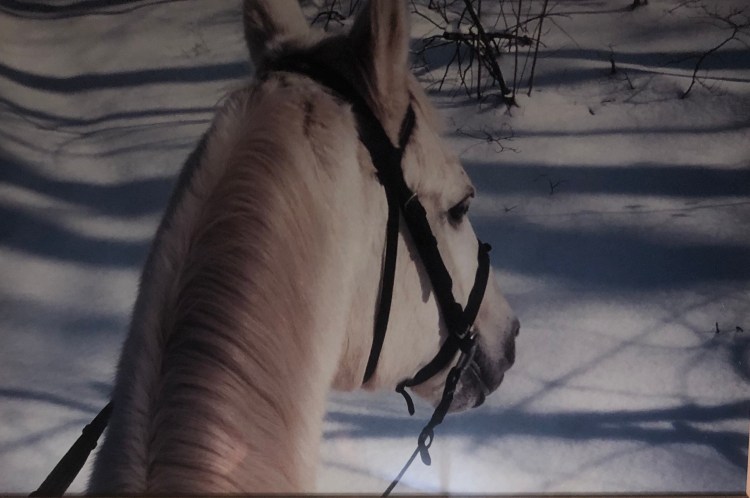
Riding “Smokey” after a Dover, MA snowfall
Unfortunately the trance is broken. After an hour, the rider’s feet and hands become so cold, it’s time to return to the barn. Thawing riders will trade stories of their specific routes. Which trails were more icy, places where the snow is too deep and difficult to traverse. Hot coffee and donuts are shared. Everyone leaves and thinks about the next ride. And the ride after that. Riding becomes an addiction. The beauty of riding horses is its longevity. With the right horse a rider can ride throughout his or her life. Some ride into their 80’s. They’re the lucky ones. They spend their leisure time with the love of nature and the love of a horse — one of God’s gift to humans.
 leodenatale.com
As your friend who enjoyed ALL of the pleasures you describe here WITH you so many years ago, it was a delight to read your blog post and relive our joyous times riding in all seasons. Thanks for the trip down memory lane!
LikeLike
Thanks. I’m glad you liked it
LikeLike
boy, this piece really opens up for me why “horse people” are so enamored of horses. I, for one, had a scary first riding experience at age 12, at stables in west medford. They gave me the gentlest horse, who proceeded to take off like a bat outa hell. Scared the shit outa me.
never have gotten on a horse since!
judy
LikeLike
Leo (small d),
Another talented cousin……………I really like your writing especially The Love of a Horse…………as well as Vitreous Humor, Gym Rat and the piece about your friend who found himself going bald at an early age.
Hope you are doing well.
John (Big D)
LikeLike
Cousin John (big D): Thanks for your compliments. I retired from Optometry in March –Covid 19 and all that– and have returned to my writing. Glad you like the essays. I just published another one yesterday, Piccalilli. It’s about Grandma Shuko. Hope all is well. Please send me your email.
LikeLike