Smell
By
Leo de Natale
Illustrations by Vince Giovannucci

My name is Andy Di Coglione and this story involves me and my battle with the first Cranial Nerve, aka the olfactory nerve. The situation occurred ten years ago, long before the Covid pandemic.
The height of hysteria occurred during the winter that followed nasal surgery. I will explain below. Frantically pacing around my house, I continuously cupped a hand underneath my nostrils. Can I really smell my after shave? Sniff. What about the coffee pot? Is it my favorite New Orleans coffee blend? Sniff. I walk the dog after a snowfall, and , like a predator “air “ its prey, I raise my nose in the air. I notice the irony. Can I smell the smoke from my neighbor’s fireplace? Sniff, sniff.
In some cases I could indeed satisfy the sensory inquiry but it was beginning to become maddening for me and my wife Kate who said I was rapidly resembling the persnickety Odd Couple character Felix Unger.
“Andy, will you please stop it!?” she would implore, referring to my breathing mask. You’ll be fine. It just takes time.”
As a daily ritual, I would conduct my smell check, yet this unrelenting anxiety of losing my sense of smell after surgery continued. I finally understood what fear really is, especially for those who become blind or deaf after a lifetime of seeing and hearing. Fortunately, a metaphysical slap across the face from one’s spouse – Thanks, I needed that!- does wonders. Time itself is an incredible balm and spousal support finally provided enough perspective to achieve some inner peace. And that is the perspective from which I write today.
Olfaction, our ability to smell, is the bastard-child of the human senses. Compared to vision, hearing or touch, smelling is often given short shrift or completely ignored. Scores of songs and poems have been written about the eye and how it is the window to the soul. The nose is, well, just the nose. After a yearlong odyssey that started with what is euphemistically referred to as “minor surgery”, I have a very different story to tell and one based on the frightening specter of losing an elemental sense.
I have always had an acute appreciation of my sensory world and something I call “sense memory”. A particular sight or sound or smell that has occurred in my past trigger a Proustian remembrance of things past. The smell of pine tree needles in the forest recalls countless memories of youthful summers at a New Hampshire Boy Scout camp spent hiking and camping. The smell of cotton candy at a country fair harkens me to the Nantasket Beach amusement park with the smell of popcorn on hot, sunny days. There is the smell of my wife’s perfume. During our courtship I purchased a bottle of aromatic Shalimar. It became her signature fragrance. There was the musty smell of the Louisiana bayous. I remember that peculiar odor traveling to New Orleans during Mardi Gras. There was the childhood memory of the ocean in summertime when I would wade into the frigid salt water of New England beaches where my feet would become entangled with icky, stinky seaweed.
During much of my adult life my sense of smell has had an historical glitch: hay fever and seasonal allergies. I had always dreaded August and September because I knew that for six weeks I would suffer the afflictions of sneezing, sinus headaches, the constantly runny nose that are the defining symptoms of the hay fever syndrome. It also affected my sense of taste. Couldn’t really savor the barbecued chicken and beer.
Each year, the symptoms and duration seemed to lengthen and 2015 was perhaps the worst. Until that time, I had accepted this seasonal affliction was my lot in life and was simply resigned to months of misery. But all that changed when I consulted my new Primary Care Physician who discovered the root cause of such exacerbation: nasal polyps. When first told of these microscopic nodules causing my problems I had images of tiny sea creatures inhabiting my nasal passages. My surname changed from Di Coglione to Andy Di Nostril, the polyp king.
Seeking to reassure me, my doctor informed me that nasal polyps were commonplace and afflicted many. He suggested having them surgically removed and referred me to several “nose men”, officially designated as otolaryngologists, or ENTs for short.
On my physician’s recommendation, I arrived at the office of Dr.Benji Stone, a tall, thin , bespectacled ENT-man who apparently was a charter member of The Hair Club for Men ( I came to realize one should never trust a physician sporting a toupee). During his examination he wore a mirror loupe that provided more light into the nostrils. I watched him as he very adeptly- and carefully – removed the loupe from his head and avoided disrupting the bargain basement polyester hairpiece.
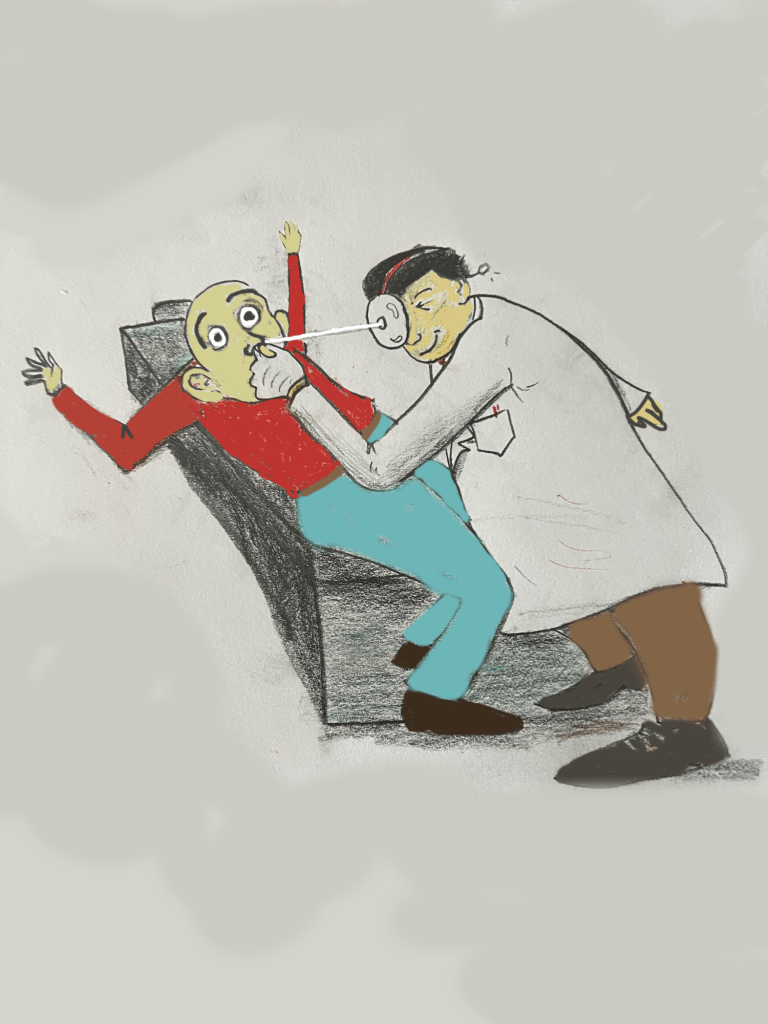
“Oh yes,” Dr. Stone decried after examining me and my polyps. “ You’ve got many, many in both nostrils.”
With off-handed bravura, Dr. Stone proceeded to tell me that endoscopic surgery – a sort of nasal Roto-Rooter- would readily remove the polyps from hell. Following the surgery, I needn’t be concerned about long term recurrences if I squirted each nostril daily with a low dosage steroid nasal spray. The procedure would be day surgery and required general anesthesia. I’d probably miss two to three days’ work, he said.
I must confess the thought of freeing myself from the ravages of hay fever season was alluring. Many persons approach surgery with trepidation. Yet I was so convinced of the straightforward nature of this procedure that I looked forward, almost embraced the concept of Dr. Stone and his hair piece sending his Ford Probe (what a terrible name for an automobile) up my nose with the self assurance I would finally have “the cure”.
Nov. 2, 2015. It is 6:30 AM and I am strapped to a gurney in the pre-surgery center at a suburban hospital. There are at least 12 of us there, each with an intravenous tube administering the Valium that leaves us smiling like idiots. I can imagine how the surgical nurses view us: there’s a nose over there, a “D and C” here, a hernia to our right, a laparoscopy to our left. So many body parts being fixed day in day out. This was my final observation before everything faded to black.
Six hours later, my consciousness pushed through the fog of anesthesia and slowly I had the groggy sense of where I was and what had happened to me. I was in the hospital recovery room, my nose encased in gauze and an oxygen mask covering my face. Theoretically, day surgery procedures are uncomplicated and recovery is quick and without incident.
I, however, seemed to be having some problems. The nurse assigned to me said I wasn’t drawing a sufficient number of breaths per minute. My situation was compounded by waves of nausea that wouldn’t stop even with administration of anti-nausea medication. By 4:30pm I still hadn’t revived enough and the decision was made to admit me for “overnight observation”. I would not be going home after day surgery.
Kate was by my side and I could detect nervousness in her voice.
“Andy, they tell me you’re not breathing enough,” she said. “Come on, try to take deep breaths. I’ll be here first thing tomorrow.”
By 7 pm I was moved to a hospital floor. The poor bastard in the bed across from me had sliced open his leg with a chain saw. My wife told me later that the family was beginning to have dinner with Mr. McCullough, when wretched sounds of my post-operative nausea caused an abrupt scattering of all familial activity. He got back at me in his own way. Chain Saw kept his television on throughout the night and any efforts at sleep on my part were null and void.
I was discharged the following morning, a rainy, cold Friday. My sole desire was to go home and begin recuperation. The nausea had fortunately abated and discomfort was minimal despite feeling as if several hundred feet of cotton tamponades had been ram-injected up each nostril. In fact, during the first day home, I drifted in and out of a sublime torpor. By Sunday I was wandering around the house but somehow felt abnormal and it was something that became increasingly obvious to me.
I was still feeling fatigued, unable to perform the simplest task before returning to bed for several hours’ sleep. Later that day I tried walking the dog. After traveling about a quarter-mile, I had to rest at a curbstone. For several moments I felt panic: what if I didn’t have the strength to return home? Fortunately I was carrying my cell phone and immediately called my wife.
“Kate, I’m freaking out here,” I said. “Don’t know if I have enough energy to walk home. Please come and get me.”
She quickly arrived and we were home in less than five minutes. I confess I was truly frightened by the notion of having that level of debilitation. Clearly, something was wrong.
My plans Monday were to return to my office for a vigorous day’s work (Kate drove me) but even the simplest functions of showering and shaving knocked the snot out of me. I arrived at the office and my secretary Pat commented on how wan I appeared – green around the gills was her exact comment.
I sat in my office chair and felt as weak as I had during the entire weekend. It was patently clear I wasn’t in shape to perform a full day’s work. In short, Dr. Stone’s 2-3 days turned into a week and my entire workload was rescheduled. I did, however, return to Stone’s office Wednesday for a scheduled post-operative appointment.
“I’ll tell you what I think, Doctor, “ I said to my nose man as he went about the filthy task of removing tamponades filled with blood, snot and tears. “I think I was given too much anesthesia. The pre-op was a circus – everyone was being medicated. I had an uneasy feeling about my anesthesiologist before she administered my happy juice.”
“Well, you know, you could be right,” Stone responded in a refreshingly frank manner. “I’ve had some problems with that anesthesia team in the past. You shouldn’t be having this much difficulty.”
Egged on by the conversation, I telephoned the hospital’s chief of anesthesia, relayed my conversation with Dr. Stone and notified him I was filing an official complaint. Guess what happened? The powers that be rapped Stone’s knuckles so hard he sent a post-dated letter reversing the position he’d assumed during our private conversation.
Oh, I see, Dr. Stone. It’s cover-your-ass time ‘cause everyone’s thinking potential lawsuit. The events over the ensuing two weeks were predictable. A hospital spokesperson sent another letter essentially apologizing for any discomfort and inconvenience and reiterated the hospital position that a review of my surgical procedure was within protocol. Lastly, I was offered a bromide.
The letter stated that in order to prevent any ill feelings, the hospital was waiving my responsibility for the anesthesia and overnight hospitalization. Two months later I discovered that what they really meant was I didn’t have to pay the health insurance co-paymnet of $86.54. The hospital still charged and received from my insurance company $1,350 for anesthesia and $722 for the overnight stay. They made a tidy profit and that, folks, is how medicine plays out in the big city.
Convalescence can be such a relative term. A person recovering from heart surgery or broken bones can require varying time to recover from the trauma of these procedures. I learned there is a physical and psychological component from the anesthesia’s side effects. The daily fatigue was abating. I could finally walk my dog without feeling debilitated. By December I began feel better physically, and there was no question I could breathe easily and freely — my nostrils felt as wide as Boston’s Sumner Tunnel, though not as grimy.
It was at this time, however, that the psychological component kick in and my fretting began. I became aware of my inability to smell things. Agnosia is the medical term. Arriving home from the office I couldn’t discern the aroma of my wife’s cooking. I couldn’t smell the particular odor that occurs after snowfall. At first I attributed the deficit to post-operative trauma and the healing process. The longer it endured, the more anxious I became. I decided it was time for another appointment with Dr. Stone.
My relationship with Nose Man had become strained after the hospital complaint flak but we were in midstream. Neither enjoyed the other’s presence, sort of a bad marriage on the worst day. I proceeded to articulate my concerns.
“I’ll tell you how bad it is, Benji,” I said. “I can’t smell my dog’s shit! For better or worse, his poop odor always snapped my head back.”
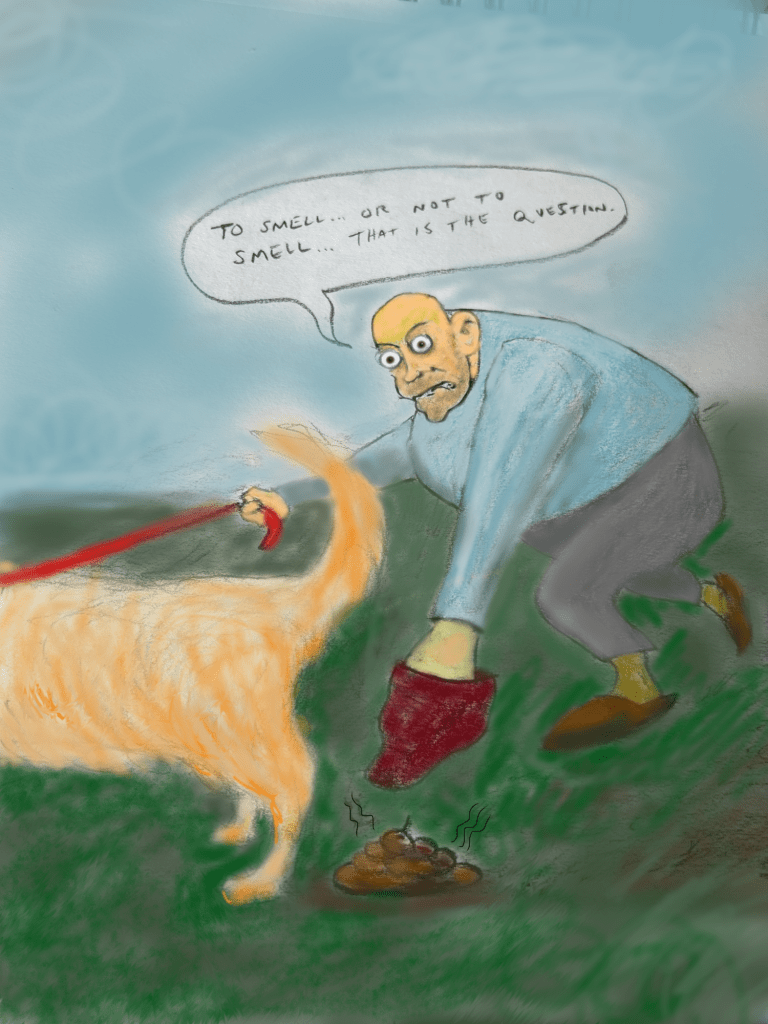
Once again, Nose Man probed and prodded my nostrils and discovered what he termed “crusting” – stuff, junk, crap up there that was contributing to blockage and my depressed sense of smell. He sought to reassure me I was experiencing a variation of the healing process. Patience, dear Andy, patience. Time is a great healer, he said using the hackneyed expression.
Several weeks passed, and I experienced a waxing and waning of smell sensitivity. The hysteria, complete with the frequent hand cupping, began and at one point I thought I was losing it. I decided a second opinion was necessary. My PCP had referred me to the office of Dr. Yale Cornell (honest! , an older Nose Man whose bullet head and pencil mustache reminded me of a character in a low-budget porn film.
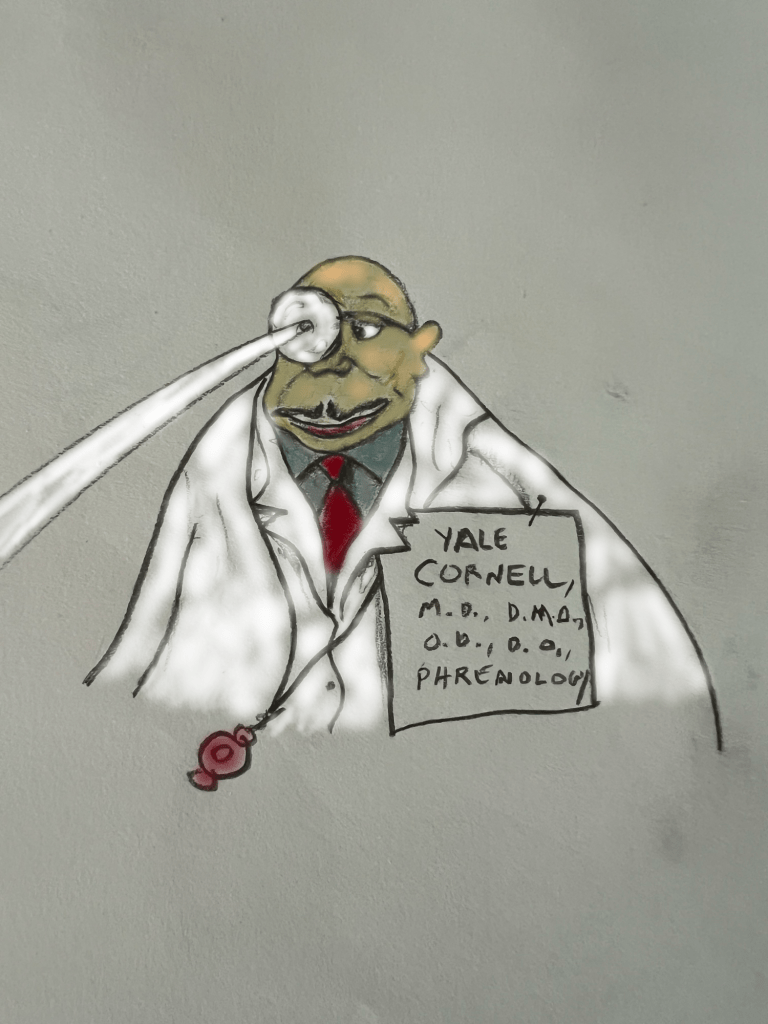
Dr. Yale gathered a detailed case history, examined me with his Ford Probe, and concluded my “crusting” was causing the problem. He parenthetically told me I was cleaning my ears too frequently –“Let the wax build up. Stop using Q-tips and don’t worry, the ear is self-cleaning.”. I was beginning to think Nose Men were odd. Must go with the territory of snot, mucous and ear wax.
By spring, I oscillated between despondency over my agnosia and acceptance tempered with the hope that the surgery would at least ameliorate the underlying problem of seasonal allergies. For my nose’s part, the sense of smell began to come and go. There were more days where I was actually aware of most smells wafting my way although my dog’s poop continued to be seen but not smelled. Thanks for tender mercies.
Spring became summer and there was nary a trace of my usual discomfort. The smell sensation remained about the same. I was still waiting for the acid test: mid-August, the days of torment. Days blended. The weather forecasters reported ever-increasing pollen levels but, sniff, no allergy attacks.
There were several days where I became sniffly but, hot damn, I seemed to be riding out my first post-operative summer without a major incident. By Labor Day I still hadn’t experienced the misery of previous years and by mid-September and the height of ragweed season, I knew I was over the hump.
I had a year to reflect upon the olfactory odyssey and in retrospect the truisms have been accurate. Time is indeed a healer. I am extremely pleased with the surgical outcome. Being freed of the torments of hayfever is truly a blessing. I have come to accept diminished sensitivity although the dog’s poop can now be detected. I also am pleased I’ll never again have to see Benji Stone and his toupee.
The steroid spray snorts continue. It’s nice to smell the roses…..well, at least some of them.

