By
Leo de Natale
The Dog That Was
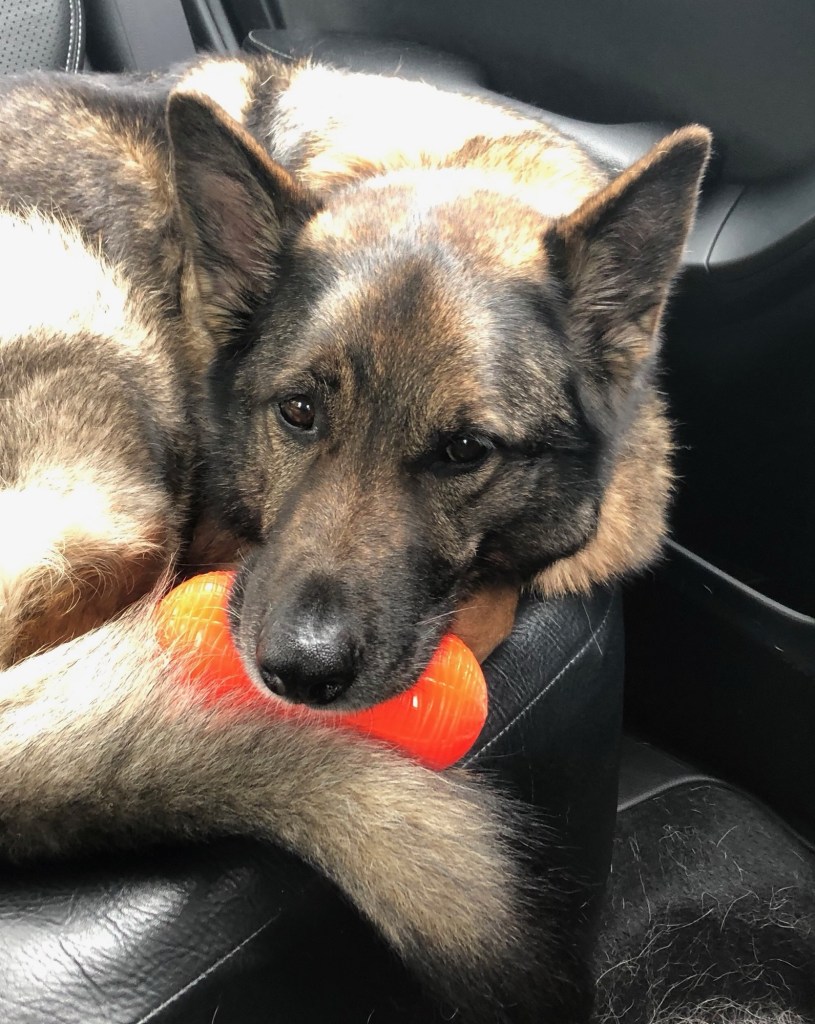
Kaiser, 2008-2021
As homage to Thomas Wolfe, it was a poignant case of you can’t go home again. Or was it? Five years ago my wife Kathy and I euthanized our beloved German Shepherd Dog, Kaiser. He was a jolly fellow who lived a good life of nearly thirteen years. That’s a ripe old age for a large breed dog. The question was would there be another?
We missed Kaiser’s soft brown eyes that had clouded over with cataracts. We missed his omnipresence and the kisses of affection he showered upon us. As he aged he became more pacific, i.e., a couch potato. He was our sentinel and made us feel safe. German Shepherds have that effect. Everyone cried after he died. Friends sent flowers and sympathy cards. Dog people are that way; non-dog people are not. The ensuing days and months were extremely emotional. Our children were grown and lived far away and they supported us with FaceTime. All these gestures gave us succor and we were soothed by such comfort.
It’s not as if we weren’t used to such upheaval – Kaiser was our seventh Shepherd and we were accustomed to the loss. “The problem with dogs is they never live long enough,” a breeder friend once told us. Dogs become significant touchstones of our lives, of where we were ten, fifteen, twenty years ago. The pain can be searing. I dare anyone to watch the film Old Yeller and not understand the emotions.
For the first time in more than forty years, our house felt empty – no cold, wet nose waking Daddy for the 6:45 am walk. The three dog beds were unused. Kaiser’s toy box containing his favorite chew toys lay abandoned. During the first few weeks following his euthanasia, we donated his dog crate and food to a local animal shelter. All the trappings of sharing a home with dogs were disappearing and the silence and solitude hit us hard. No more tail wagging, no more barking with pleasure, no more front door greetings.
This time the loss of a dog was different. We were aging and the notion of owning and handling a large dog suddenly became daunting. When people reach their seventh and eighth decade the question “Aren’t you too old to own a dog?” is often indelicately posed. Our grief process lasted several months. We were accustomed to noting Kaiser’s whereabouts, especially at night. Sometimes he was sleeping in our bedroom on his deluxe L.L. Bean bed. Other times he’d be sleeping in the hallway or in my wife’s office, otherwise known as “Kaiser’s office”. Years prior we’d purchased motion detector night-lights — neither of us wanted to trip over the big guy. After he died, we continued to absentmindedly check on him. . I was sometimes convinced he was indeed in the hallway. Such mirages often happened and continued to haunt us. We’d hear a noise and were convinced it was Kaiser. We’d talk about him as if he were still there.
We tried to put a positive spin on the loss.
“Well, Honey, for years we’ve wanted to travel,” Kathy said with pretend alacrity. “And don’t forget we do have an Arizona vacation in October.”
The thought of being unrestricted and leaving the house for more than one week was appealing. Many dog owners schedule their lives around the maximum allowable period of away time. Family dogs often stay at boarding kennels. Alternately other owners, us included, pay someone to be a live-in caretaker. One of our friends who lived nearby usually house-sat for us. Nevertheless while we were away we thought about our dogs through vacations and checked up on them by text, email or phone calls. And then came 2020 and unbeknownst to everyone air travel had undergone drastic changes since the arrival of Covid 19. Once upon a time flying on commercial jets was an adventure, perhaps something to enjoy. Not anymore.
In 2021 there was angst at every airport. Mask wearing endured for two years. Add the stress and incredibly shrinking airplane seats (the sardine syndrome) and travelers having meltdowns leading to arrests have all taken their toll from traveling to point A to point B. Upon returning from several vacations, my wife and I wondered if travel was worth it.
Therein lay the irony. With the freedom to go as we pleased – no dogs to fret over – the reality now was being restricted by an international health crisis. The question was do you really want to travel 16 hours wearing a mask while flying to Italy or Greece or Bavaria? Covid brought ground rules where travelers would be hindered by masks and state-run restrictions. My wife and I were in the age group- early 70’s- where one realizes there aren’t too many adventures awaiting around the corner. Old age has that effect.
It was a combination of these traveling regulations – it appeared we’d be staying home more often than not – and the emptiness of our home, without children, no dogs that made us achingly nostalgic over the absence of a German Shepherd Dog or reasonable facsimile.
In late fall we made a decision . We could no longer tolerate living alone. Just the two of us. We revisited the debate over size and breed. Dogs weighing over seventy pounds were out. Our ages were definitely becoming a size factor. We reviewed a laundry list of breeds in the twenty to thirty pound range. This usually involved smaller hunting breeds – Beagles, Brittany Spaniels or similar ilk.
We didn’t want high shedding breeds, e.g., Golden Retrievers or Irish Setters. There were also the non-shedding/hypoallergenic breeds: Poodles and Bichon Frises but the thought of walking with a foo foo Lhasa Apso was an image that didn’t fit.
Of course there was always the default choice: shelter dogs. There were several aspects, some positive, some negative. One attraction was the tree hugger syndrome: adopt a dog and save it from euthanasia. This motivation is intrinsically flawed and most shelter dogs in the Northeast are shipped from Southern states, especially Tennessee. The reality is many of the dogs have two major drawbacks: many shelter dogs are Pit Bulls or Pit Bull crosses. Pit Bulls do not enjoy a good reputation. Often they are fighting dogs – think infamous Michael Vick—and their temperament is aggression to the max, especially if they are trained to fight. Many children have suffered severe, disfiguring bites to the face and annually there are stories about a child being mauled to death by this breed.
The second important factor in rejecting shelter dogs is health. Countless dogs arrive in regional shelters with illnesses such as distemper or heartworm. Others are rife with intestinal parasites or haven’t received rabies vaccination. Dog owners spend money—veterinary medicine fees are now hugely expensive -ridding the adopted dogs of these diseases. The cure times can be lengthy and many of these dogs die.
There is also another group that are an x-factor with dog purchases: puppy mill breeders. These unethical human beings pollute the purebred dog market. Inhumane “breeders”, mostly from the Midwest, obtain brood bitches and breed them to inferior sires. The environment is similar to chicken and turkey farms where the bitches live in deplorable conditions. They whelp litters – most of the pups are disease-ridden and are shipped to mobile retailers who sell these ersatz “purebreds” to the unsuspecting public. Many of these puppies will also eventually display behavioral problems.
The question became what to do. What to do? The longer we pondered and debated two things became patently clear. We did indeed want a dog in our lives and the German Shepherd Dog was the only purebred we’d consider.
“We’ve had seven Shepherds and three have been female,” Kathy said. “I’d opt for finding a mature girl – say about five or six. Fifty to sixty pounds makes sense.”
We decided to give it a try. Kathy had a network of Shepherd breeders and trainers and she spread the word we were looking for an older, stable female. We waited. And we waited. About two weeks after making this decision, we received a telephone call from a New Hampshire breeder who sent pictures of a beautiful black-and-tan female. The dog had impeccable breeding lines but there was the unfortunate hitch: she was only nine months old and housebroken but chronologically still a puppy. It was tempting. We could have visited but it was pointless. The dog was too young for us.
Like most dog breeds, German Shepherd males are bigger and stronger. In his youth Kaiser could be a handful. During the last five years Kathy and I became increasingly wary during our winter dog walks. Snow covered ice and black ice were hazards we wanted to avoid.
During the first two years after Kaiser’s death we unsuccessfully tried to adopt. There were two females who were the right size and who were living with their original breeders. “Carrie” was eight and sweet. We kept her for several days but , alas, she turned out to be skittish and we learned from her veterinarian’s report Carrie had significant health issues – hips that were dysplastic and would eventually require surgery. The second dog, Cully, was also eight and had been a brood bitch. She was initially sweet but quickly became possessive towards Kathy and bared her teeth to me. Good bye Cully.
We had basically given up. We would be permanently dogless. After five years, however, our longtime breeder friend Karen called.
“I’ve got a five-year-old female cutey named Buffy,” she said. “I’ve tried three times unsuccessfully to breed her. She’s a sweetheart and I think she’d be perfect for you guys. I’ll text you some photos.”
What we saw was breathtaking. Buffy was about sixty pounds –an ideal weight- and stunning. Her coat was called “bicolor” black with brown highlights on the chest and legs . Karen had sold us four of our seven German Shepherds, including Kaiser, and we felt confident this might be The Dog. After a long discussion – it took only sixty seconds – we called and answered with a resounding yes!
Two days later, the breeder arrived in our driveway. She opened the minivan hatch and out popped a breathtakingly beautiful female. She was excited when we entered our fenced-in backyard. Karen shouted several German commands meaning stop! sit! down! Buffy instantly obeyed each command. She soon calmed down and began showering us with kisses and weaving between us. After owning all our dogs we knew what good temperament was and she had it in spades. Twenty minutes later, Buffy laid down at our feet, rolled on her side and quickly fell asleep. We were duly impressed.
Karen discussed particulars. Buffy was up-to-date on her rabies shots and inoculations. The sole factor now if we decided she was a keeper was spay surgery. She had just finished her heat cycle and it was advised waiting two months before performing the operation. The timing was perfect for us and by this time, Kathy and I realized this could be it. Breeder Karen had provided us with Buffy’s crate and she settled into it. The three of us spent a remarkably quiet evening and awakened seven hours later. Our new dog Buffy hadn’t uttered a peep.
During the first week, Kathy and I were pinching ourselves. Having a lovely, stunning dog was a delight and I was constantly reminded of Marcel Proust’s famous novel, A Remembrance of Things Past, because we were reliving the years of joy that owning a dog gives. I didn’t miss a beat each morning with the daily poop and pee sortee. Buffy and I returned and she’d gallop up the stairs in anticipation of breakfast. She gobbled her dry kibble with gusto and slurped water, much of which spilled on to the floor. She was sloppy at mealtimes but still loveable.
She adapted well to our Subaru Forester as we drove to the veterinary office that we’d been using since old bear Sarge, our first dog. As we entered the office the staff were ecstatic with meeting our new charge. There was a chorus of ooohs and ahhs. Buffy wove through their legs and administered kisses galore. We met with our longtime veterinarian, Neil Storey, a transplanted Englishman who resembled Paul McCartney, and also was taken with Buffy.
“She is a beauty, no doubt,” he said as she sidled up to him.“I’ve never encountered a bicolor. Wow. She’s got great conformation. The hips are sound, her coat magnificent.”
Dr. Storey congratulated us on obtaining a good dog. He discussed the important event of her spay surgery. The time interval was important for a safe and uncomplicated process.
During the first week we were euphoric. Buffy was crate-trained and slept in the crate at night. She didn’t utter a sound while we were all sleeping. In the morning I resumed my routine for the “business” walk. We all enjoyed breakfast. Buffy would take a short nap and we began the new routine that included a long neighborhood walk. In fact neighbors would wave as they saw that older couple walking once again with a German Shepherd.
At age five Buffy was a robust and active German Shepherd. The breed are herders and they innately prefer to be busy with their flocks. I must confess she kept us fit although we both exercised regularly at a local health club. We texted photos of the three of us to friends who were happily surprised by our decision to be doggy again. Kathy and I felt so lucky to be given a second chance with such a beautiful creature. It was sublime. For awhile.
After nearly a month, we were confronted with the harsh reality of age. Kathy suffered from osteoarthritis, particularly in her back and the increased time walking was starting to manifest painful symptoms. At home while Buffy continued to shower us with affection – she had truly bonded with us- the harsh reality arose. Kathy scheduled an appointment with her orthopedist. Diagnostic tests were disappointing.
“You’ve developed more spinal stenosis, Kathy,” the physician stated. “This isn’t going away and, quite frankly, back surgery will be required probably sooner than later. Unfortunately dog walking activities can only exacerbate your condition. It will contribute to your pain.”
She arrived home and broke the news. There were tears in Kathy’s eyes as Buffy lay down at her feet and kissed her hands.
We realized a tough decision was imminent. We were walking Buffy as a family and Kathy realized she’d have to relinquish this activity. She told me she pondered the danger wintertime would present with snow and ice. Old people dread falling, especially in the winter.
Sitting in the living room cozied up to Buffy , we realized our dream was ending. The dog was still young and we finally realized keeping her was too much.
“Well, honey, we tried,” I said to Kathy. “But we’ve been around dogs long enough to know when it’s time. Fulfilling our dream blinded us to the reality. But at least Buffy gave us five weeks of joy. That can’t be taken away.”
That afternoon I called breeder Karen and told her about our decision. Breeders frequently encounter returned dogs that are usually puppies. Families discover someone has dog allergies or owning a German Shepherd Dog is too overwhelming. Things just don’t turn out the way they were supposed to. Karen said she’d pick up Buffy the following day.
Buffy hopped onto the sofa and sat between us. We were unashamedly crying because we were about to lose her, a dog who couldn’t stop kissing and showering us with affection. It was a difficult night for Kathy and me. Neither of us slept well.
Karen arrived at 10 am. Buffy predictably was excited to see her and Kathy and I were subconsciously jealous that the reunion was joyful. But we knew dogs live in the moment and Buffy gladly turned the page to pursue another day, another life elsewhere. Buffy hopped into Karen’s truck and glanced at us as she was placed inside her crate. The truck drove off. We were devastated. We were reliving Kaiser’s last day and the baleful look he gave us as the injected medication drew him away from us and the life he knew.
Once again the house was so empty. We realized Buffy was joining our canine family. A thing of the past. As we sat at the kitchen table I closed my eyes and Thomas Wolfe’s apparition appeared. He was right. You can’t go home again.
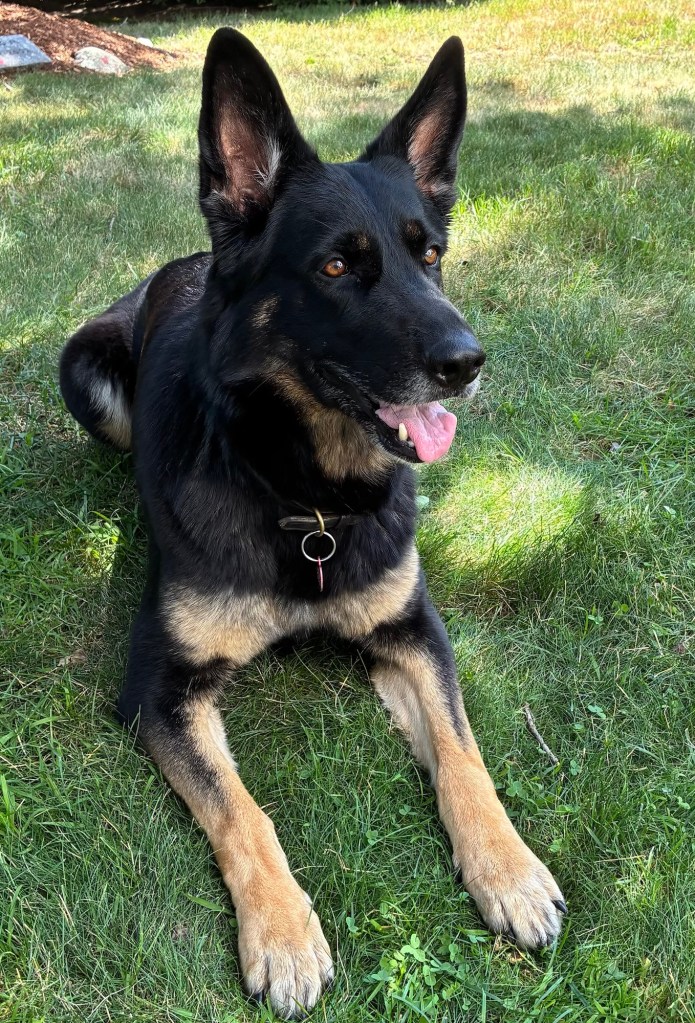
We loved you, Buffy.
Author’s Note
The Dog That Was is my 70th essay and a personal landmark. The catalyst for this literary output occurred six years ago when Covid 19 became a scourge upon this world. We are still facing the ramifications of a horrible era. An entire nation had been cut off at the knees and so many Americans were forced into isolation. I chose to retire temporarily from work. For months my circumscribed life revolved around my wife Kathy, our dog Kaiser and me. People coped with this social division in many ways. In my case, switching boredom and lethargy into something productive was easy: I returned to my writer’s garret.
Blogospheres had been mushrooming and in April, 2020 I started what would become an anthology of essays covering various contemporary topics. My earliest blogs addressed the emotional and financial impact Covid was having on us all. The essays have included human interest stories containing a sprinkling of humor. Central to my blogs was the artwork and cartoons drawn by my dear friend and optometry school classmate, Vince Giovannucci. Of course Kathy has been my mainstay. She has been my sounding board and a great editor, too. I hope you have enjoyed reading my essays as much I have writing them. Now on to No. 71.
Leo de Natale

