Caravaggio’s Son

Caravaggio’s Son

By

Leo de Natale

Illustrations by Vince Giovannucci
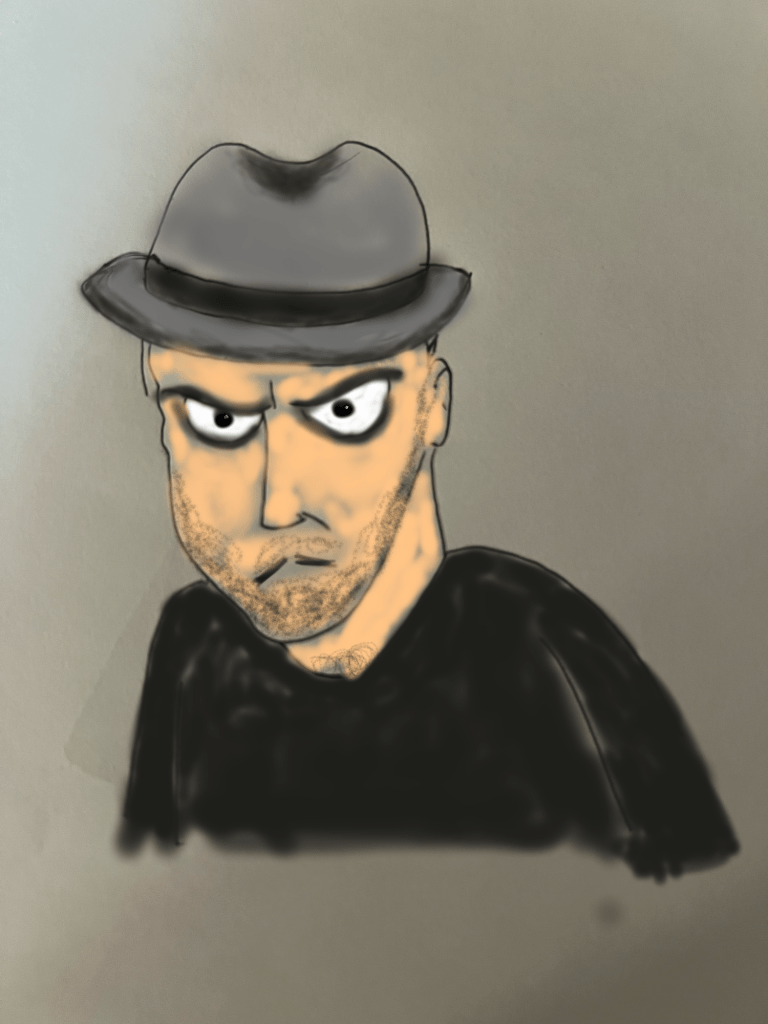
Arthur Di Nobili

          Some people have an obsession with colors.   There are many women who have a thing about purple.  They dress in purple, their homes are fifty shades of purple – sofas, wall paper, bathroom tiles.  Others prefer pink or orange.  A certain Rhode Island gentleman, however, chose a different hue.

          No one is really sure why or at what point in his life Arthur Di Nobili fell in love with the color black, especially black clothing.  His usual monochromatic attire consisted of black shoes and socks, black polyester slacks that crackled with static electricity in wintertime and black or sometime gray acetate shirts.  His left ring finger was adorned with a massive gold-and-onyx ring bearing the profile of a Roman Centurion.  Such apparel accentuated his swarthy southern Italian features that  naturally included a black mustache.

          In 1977, Arthur attended Princeton University,  on full scholarship (he  achieved three 800s on his SAT scores).   He was known at Princeton as the “Italian Johnny Cash”. He created an avalanche of sardonic laughter the day he wore to class his infamous black disco shirt festooned with hordes of scarlet parrots perched upon palm branches.

          He was  indeed a walking contradiction.  His outward appearance conveyed Providence Goombah — he was born in the Rhode Island city.  A virile six-footer, Arthur was the possessor of smooth, olive-toned skin.  His beard was so coarse, his friends teased, he could wake at 4:30 in the morning and  have five o’clock shadow thirty minutes later.  Arthur Di Nobili’s eyes were a deep penetrating umber and when, as he was so often, excited, his eyes would become bulged by the exposed white sclera as his eyelids retracted with emotion.  He also had the habit of voluntarily raising his eyebrow as a menacing emphasis.  His voice was deep and sonorous.

          Arthur was blessed with an IQ of 150 and relished such varied subjects as quantum physics, the Hegelian dialectic or Hittite pottery. He was engrossed with Baroque  art and his favorite painter from that era was Caravaggio, the master of chiaroscuro.

          His college dormitory cronies became enamored  with Arthur’s engaging personality.  He would regale them with such utterances as, “Look, all I care about is Nietzsche and getting laid.”  As the only child of divorced parents, he extolled the virtues of marriage, yet boasted of his womanizing during  visits to New York City.

          The crusty aristocrats of Princeton never knew quite what to make of this multifaceted personality.  He confounded them with his intellect (he was one of few to graduate with a straight 4.0 average). He had the uncanny ability to maximize the efficiency of his waking hours. 

For example, during his junior year Arthur was simultaneously on the dean’s list, co-captain of the varsity soccer team, president of the Dante Alighieri debating society and a member of the university’s a capella choir.

Perhaps the most unusual of Arthur’s many idiosyncracies was his obsession with the Mafia.  Although neither he nor his family had underworld ties, everyone presumed he did  because of his encyclopedic knowledge of what Arthur referred to as “America’s sub rosa General Motors”.  For years, his daily routine was to purchase four morning newspapers: the New York Times, the New York Post, Providence Journal,  and the Washington Post.  He would assiduously scan these for underworld news items- this was pre-internet.   On  his dormitory room wall he had drawn an elaborate and astonishingly detailed flow chart of the Mafia, complete with every chieftain’s name, moniker, place of birth, city of operation and the rackets therein controlled.
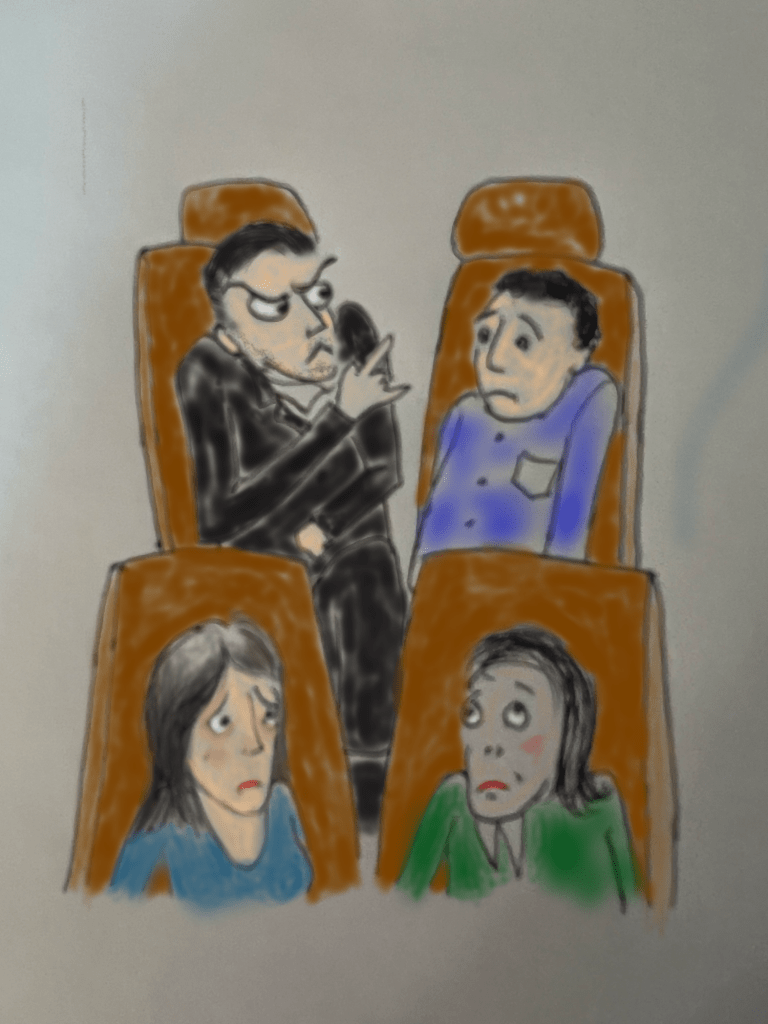
Arthur And Nick In Manhattan

Once in New York City, Arthur and his Italo-American classmate,  Nick Volterra, a Type A personality from Westchester County, spent several hours in a Manhattan South police precinct for what Volterra called a case of mistaken identity. According to Nick (whom Arthur dubbed “Travis Bickle” for his resemblance to actor Robert Di Niro’s character in the movie Taxi Drive), the two spent a winter’s weekend in New York after a Princeton-Columbia basketball game.

“Arthur would always ‘dress up’ for a trip to New York,” Nick recalled. “He had this big, gray homburg hat he’d bought at the same haberdashery where Mafia don Carlo Gambino shopped.  He was wearing  his black Chesterfield coat and carrying that damned Samsonite brief case . Sometimes it contained only a sandwich but he liked taking it along for the “effect’” and I would say,  ‘What no violin case?’”.

          “Anyway, we’re on a bus on the West Side, and Arthur’s there telling me about the latest “hits” by the New York mob,” Nick said.   “He always got excited talking about that sort of thing, and his eyes got really beady and intense.  He was talking about the demise of a minor hood named Mario “The Nose”Granito.  He’d say ‘Yeah he was horning in on the Gambino’s loan sharking.  They garroted the son-of-a-bitch and stuffed him into a pink Cadillac. A pink Caddy, that’s a sign of real disrespect.  The Nose was a fag anyways.  He had no balls.’”

          Volterra said he became uneasy as he noticed two women in front of them exchanging fearful glances.  Suddenly, one of the women (it turned out they were Bellevue Hospital outpatients) yelled hysterically, “Murderers! Murderers! We’re going to be killed.”

          The bus driver pulled to a halt and tried to calm the women while Arthur, obviously enjoying the ruse, glared with those eyes and, as an emphatic gesture, grabbed his groin and shouted, “Hey right here’s your murderers, you scumbags!!!”

Three hours later, after undergoing interrogation at Manhattan’s Precint 4, Arthur and Volterra were released.  The police had questioned Arthur but discovered his identification.  Arthur gladly opened his brief case and displayed its contents: a jar of Skippy Peanut Butter, three changes of underwear and his four newspapers.

By his senior year, Arthur had decided to pursue a career in health care.  It was a tossup between dentistry and medicine.  He opted for medical school because he told friends he didn’t care for spending eight hours a day sticking his fingers into somebody’s mouth.  At Harvard Medical School, Arthur quickly established himself as the class eccentric.  No one could prove it but he was strongly suspected as the culprit who dressed an anatomy cadaver in monk’s robes, complete with a Chianti bottle in the corpse’s right hand and a lit cigar between the teeth of the body’s grizzled, formaldehyde-awashed face.

It was also at Harvard that Arthur was “thunderstruck”, as he put it, by Lori Johannsen, a  first year classmate from Minnesota.  If Arthur was polyester, Lori was crepe de chine; he was Mediterranean terra cotta, she was Scandinavian cut glass. Their often stormy relationship became a classic example of oil and vinegar, noir et blanche.   Light and shadow, just like the chiaroscuro paintings of Caravaggio, a major proponent of this technique and most often associated with a dramatic use of lighting.
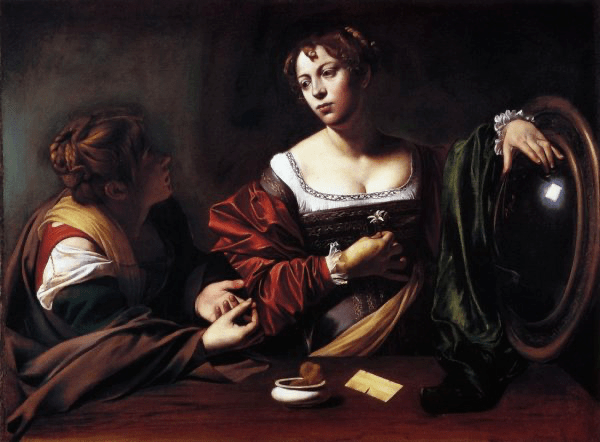
Magdalen by Caravaggio

Lori was at first glance a striking female.  She was tall, blonde, and blue-eyed.  She had an athlete’s lithe physique that developed from years as a varsity swimmer; her skin was alabaster-toned.  Arthur referred to her as his “Venus reincarnate”; others saw her as a flat-chested, weak-chinned hypochondriac who once told a fellow student she skipped classes because she thought her blood pressure would be elevated that day.  She could divine a common cold two weeks in advance.

 And for all Arthur’s sexual braggadocio, in actuality he reflected conservative attitudes of a second-generation Italo-American.  He could be and often was promiscuous with a coed here, or a comely graduate student there.  But Arthur had this Godfatheresque fantasy regarding the purity of womanhood he saw in Lori.  At times he fancied himself a latter-day Michael Corleone, the literary and intellectual Mafia character.

And so the relationship evolved, or regressed.  It was during the summer between third and fourth year of medical school that an event occurred that drastically altered Arthur’s life.  During summer break, Arthur and an old neighborhood friend, George “The Greek” Scatopolous, spent two weeks driving cross country to visit Lori and her family in rural Minnesota.    The two city slickers likened it to an urban Meriwether and Lewis expedition to the Northwest Passage.

For the first three years of medical school, the romance between Arthur and Lori ebbed and flowed.  It was a melodrama reminiscent of the old dime store novels.  She would harangue him over the rigidity with which he dearly held the Providence/Italian/Macho ethic.

“You’re as progressive as one of your grandmother’s zucchinis,” Lori yelled at him during one of their innumerable fights.

“Yeah well at least I take my clothes off at night,” he retorted, referring her distaste for nudity. “Your problem is you’ve always worn tight underwear!”

          Arthur arrived at the Johannsen home tired, hot and incredibly drunk on chianti.  A predictably ugly scene ensued at Lori’s doorstep.  Words were exchanged  with Lori’s livid father.  Arthur and “The Greek”, sped off towards Minneapolis via Interstate 84.  A thunderstorm with high winds blew out over the Minnesota flatlands.  Rain cascaded in sheets off the lightweight Chevrolet they were driving.

          Arthur could not recall precisely how it happened but a tractor-trailer containing 30 tons of feed corn jackknifed, swerved towards their car and sent it careening into a drainage ditch thirty feet away from the highway.

George was killed instantly as the car roof collapsed and crushed his cervical vertebrae.  Arthur was discovered outside the wreckage and was unconscious. 

For nearly a month he lay in coma at a Minneapolis hospital.  Lori visited once and spent the remainder of the summer horseback riding near her home.  She never saw him again.

          After Labor Day Arthur was transported to Providence and, as if by the influence of some magical elixir wafting through the city’s atmosphere, regained consciousness by September’s end.  The recovery, unfortunately, was incomplete.  Arthur was blind.  The neuro-ophthalmologist at Providence Hospital told Arthur and his anxious mother he had sustained significant trauma to the base of his skull called the occipital area, the location of visual processing.  The doctor said his sight might be restored within weeks or months but he might never again see the skyline of the Rhode Island city he called home.

          Arthur showed remarkable resilience.  “At least my world is colored black” he quipped with gallows humor.  But alone at night, and surrounded by internal and external darkness, despondency oozed through the crevices of his battered mind: “I’ll never see another Princeton-Harvard game,” he thought. “I’ll never see another St. Anthony’s feast in Little Italy…………I’ll never watch Frank Sinatra sing again.”

       Three days before his release from the hospital, a rush of noise entered his room.  He heard muffled voices and the air became heavy with the smell of sweet cologne and smoke from an expensive cigar.  As Arthur lay there, a large warm hand gripped his.  A man’s soft voice asked,

“Arthur, my son, how are you?” 

Arthur recognized the voice and immediately associated the face he’d seen at numerous Senate sub-committee hearings.  It was Raymond Patriarca, capo of the Providence mob. “Il Padrone” was a typical Mafia don: wanted and hated by state and federal law enforcement but revered by the Rhode Island Italian community.  He was, in their eyes, a modern day Robin Hood with garlic and prosciutto.
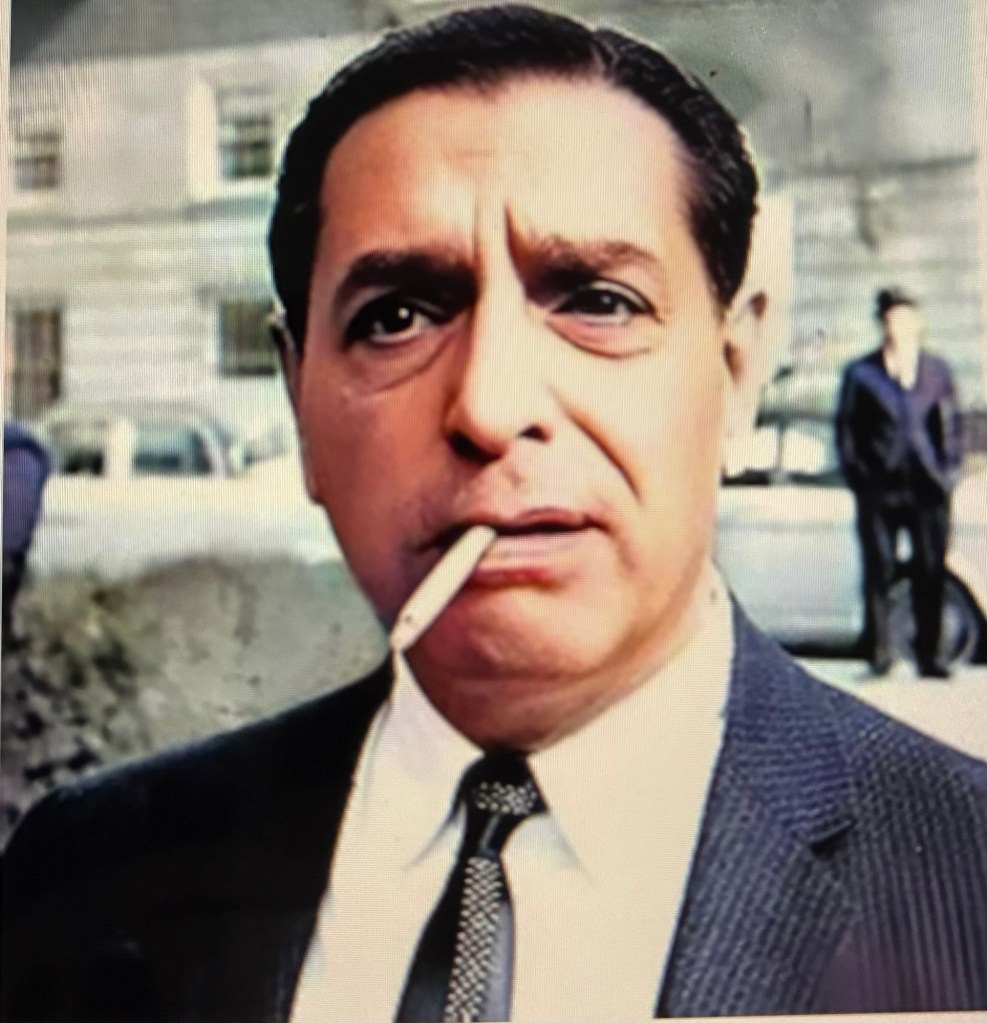
Raymond L. S. Patriarca

          “Arthur, you have made us very proud in the past,” Patriarca said in a lilting, paternal tone with an unmistakable Italian accent. “You have brought honor to this neighborhood.  You have gone to the best schools, achieved things that I hoped my own sons would achieve.  I want to help.”     

 As Arthur listened in near disbelief over the visitor now sitting beside him, Patriarca told him all his medical expenses would be paid.  Any rehabilitation or vocational training would also be subsidized.  This was the same Raymond Patriarca that two days prior had ordered an execution of Eugenio “The Tomato” Innocenti because of attempted burglary of his daughter’s summer home and the theft of three hundred pounds of provolone cheese from Patriarca’s underworld headquarters in North Providence.          

          Patriarca was good to his word.  The bills were paid. He provided Arthur  with a comfortable apartment near his mother’s home.  He paid for nursing until Arthur could fend for himself.

        It was at this juncture that Arthur experienced an artistic influence that shunted him along a different path.  As a child, his grandfather had taught him to play the mandolin, a stringed instrument that accompanies the Italian soul.  He had outgrown the interest for such an instrument but suddenly, in the dark world he existed, he took pursued even greater exponent of the heart – the violin.

          Jacob Cohen, a former virtuoso fallen on hard times, was discreetly contacted by Patriarca intermediaries.  He had once been concertmaster with the New York Philharmonic but a sour marriage, a few sex scandals  and his penchant for high living contributed to his downfall.  Cohen was now earning money by existing in a musician’s purgatory: tutoring would-be Paganinis.  Cohen admits today that mentoring Arthur was perhaps the salvation of his checkered career.  The publicity he later received, locally and internationally, catapulted him once again to prominence.

Working with Arthur was originally trying.  They traded ethnic slurs but after the initial feeling-out period, Cohen (referred to as a kosher Ichabod Crane, both in temperament and appearance) discovered the latent artist in Arthur.  Teaching a blind man to play violin, he would say, was simultaneously difficult and easy.  It was difficult because the musical notation had to be put into more abstract form; easy because the blind man’s remaining senses made Arthur more aware of  the nuances of music.

          The two men came to understand each other to such a degree they combined their talents.  They began playing duets and appeared at weddings, Bar Mitzvahs and musical events around Providence and throughout New England.

          Nearly three years to the day after that fateful evening in Minnesota, a miracle occurred.  Arthur was preparing for a concert before the Providence Jaycees when the sensation, the suggestion of light from an ancient, wooden bulkhead, appeared in the midst of his consciousness.  The light sprung forward, first slowly but then with greater rapidity, blur piled upon blur.  Gross forms were becoming discernible. Vision was coming back.  He could see!

  The news splashed onto local newspapers and television stations.  The national media learned of the blind, Princeton-educated violinist re-entering the world of light and images.  There were tears of joy.

Five years later, Arthur Di Nobili stood tall inside Providence’s Saints Peter and Paul Cathedral.  He wore black again but the black polyester was no longer an empty expression of poor taste in clothing.  It was  symbolic of the world into which he had been submerged.  Dressed in black, he played Mozart’s The Requiem at Raymond Patriarca’s funeral mass.  A thousand eyes cried.
A Petri Dish On Wings

Illustrations by Vince Giovannucci

A Petri Dish On Wings

By

Leo de Natale

Seven Hours Of Incubation

          After cruising eight days down the Danube River, Josef “Joe” and Anna Adamek were ready to go home to Boston.  Despite the unseasonably cool and rainy weather, the late September vacation did not disappoint.  From a reverential Benedictine Abbey near Linz to the cultural zenith known as Vienna, Austria the Adameks oohed and ahhed their way to Bratislava, Slovakia and the final destination, Budapest, Hungary.  The couple were humbled and awed by the region’s political and religious history.  One cathedral was more spectacular than the next.  The statuary was gigantic and majestic and paid homage to  empires  gone but not forgotten.  The Adameks loved immersing themselves in such culture but also became increasingly aware this part of Europe was a tourist trap.  Each city was filled with bars, open air restaurants, souvenir shops, ubiquitous cigarette smoking and pickpockets.  These go with the territory.

          For Joe, the vacation was a sentimental journey back to his roots.  His grandparents were Slovak and returning to the “Old Country” was incredibly nostalgic.  Growing up, Joe’s immigrant  grandmother lived with the family and she and his mother exclusively spoke Slovak.  Eastern Europeans were  hardy stock and they were infused with a work ethic shown by most immigrants during the first half of the 20th Century.

Joe had an elementary knowledge of the mother tongue and remembered many Slovak words.  He was delighted to arrive in Bratislava  and hear conversations that reminded him of yesteryear.  The cruise line provided guided tours of each city and Joe reveled with his conversations with the Slovak tour guide.  In Bratislava, he’d close his eyes and listen to familiar conversations.  He’d enjoy the aromatic smells of cooking he’d known growing up—Kasha, roast pork,  sauerkraut.   He’d tasted plum dumplings and apple strudel that were delicious – but not as good as Grandma’s.  Joe shared these remembrances with Anna although she was Irish American and couldn’t completely appreciate Josef’s nostalgia.

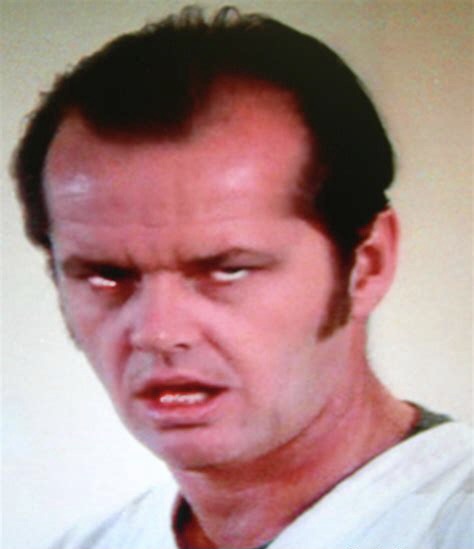
The Adamek’s had flown non-stop to Munich.  The flight wasn’t bad.  Seven hours on Lufthansa’s huge jumbo AirBus A380 (accommodation up to 853 passengers) that was only half full.  Being cautious they decided to wear masks.  Joe and Anna would later recall how Munich’s airport turned them into lab rats. The route between the gate and baggage pickup was a series of moves lasting more than fifteen minutes.  They were required to climb up and down three different long staircases and another three escalators.  Welcome to Germany.  They chose an overnight stay at the Munich Airport Hilton.   They recalled the debilitating jet lag tourists experience with time changes affecting circadian rhythms that make people look and feel like a lobotomized Jack Nicholson in the Cuckoo’s Nest film.  

Are We In Munich?

They didn’t realize their one night stay was during Oktoberfest.   They winced at their final hotel bill totaling $1,100.  Ouch!  Not much bang for the buck, especially when they left less 24 hours after their arrival.  Chalk that up to a devalued dollar compared to the Euro.  Despite the hotel gouging, the Adameks were ready for vacation.  The following day they were shuttled with other river cruise tourists to their first destination. 

The river cruise started in the Bavarian city Passau, a well preserved medieval city whose streets were primarily paved with cobblestones.

Sensible walking shoes were de rigueur.  Passau is infamously  the place where four-year-old Adolf Hitler almost drowned.  Alas, he was  rescued and the world would eventually suffer.  Most Passau residents always say ,

“If only……..” 

Drinking was a staple in Passau and most Bavarian towns where strong coffee,  local beer, reisling wine and schnapps were in ample supply.  The ship moved between cities in the evening but the twenty mile voyage between Linz and Vienna was a day cruise.  The vessel glided through the greenish river (The Danube is no longer blue).  The ship’s British program director narrated the journey and pointed out various famous castles, monasteries, and vineyards. 

Unfortunately, the day was rainy.  Low lying clouds obscured many of the famous castles.  Joe’s favorite site, however, was the gigantic 13-foot  concrete nose located along the Wachau riverbank.  The Austrians have an active and viable wine industry and the nose represented the aromas associated with blossoming grapevines and an odd sense of humor.  Of course the large human noses are well represented in Austria.  The famous Viennese organ meister and composer Anton Bruckner’s schnozz  might have been an inspiration for the concrete nose .

Organmeister Bruckner

On board, many  jokes –“Does the nose ever sneeze cement?”-were made about the Giant Proboscis and most of the laughing tourists enjoyed the view and the boat’s pleasant, almost lulling rhythm especially while consuming  regional white wine or local beers.  After all, it was Oktoberfest.

The Wauchau Valley Nose Along The Danube River

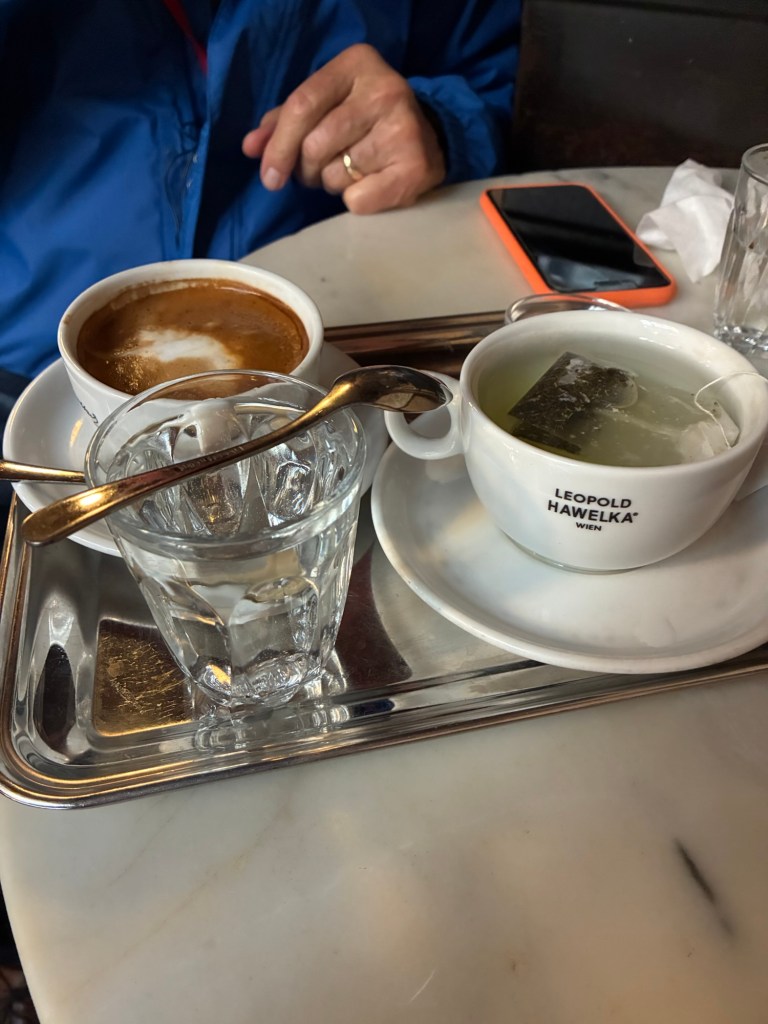
Vienna was breathtaking with its majestic buildings that harkened tourists to be overwhelmed by the long-vanished wealth and power of the Habsburg Empire.  St. Stephen’s Cathedral was immense but the bustling crowds filing in and out made it apparent the church is more of a sightseeing spot than a House of God.   Joe and Anna enjoyed sauntering through the city’s cosmopolitan streets.  And it was a must to sip  cappuccino in  one of the many Viennese coffee houses.

Espresso At The Leopold Hawelka Coffee House, Vienna

Then it was onto Bratislava, capitol of Slovakia.   This city was a thrill for Joe because his grandparents were born there and, as a child, his grandmother lived with his family.     And now he’d returned to his roots.

He couldn’t  speak  fluent Slovak but he remembered enough vocabulary to speak awkwardly with the natives.  The city was charming because it was relatively small compared to Vienna.  It was easy to meander through Bratislava’s quaint streets.    Josef thoroughly enjoyed the eight hours spent with Anna in this livable town.

The tour ended in Budapest, an amazingly schizophrenic city (Buda on one bank, Pest on the other) that boastfully spotlighted itself at night with citywide lights that included the three famous bridges – all lit like a gigantic birthday cake.  It was a helluva farewell sight.

By Day Eight, the Adameks were sated and ready to leave this fantasy world for the grueling,  multi- airport return.  They actually should have been acclimated to this by their experiences with the direct inbound flight to Munich.

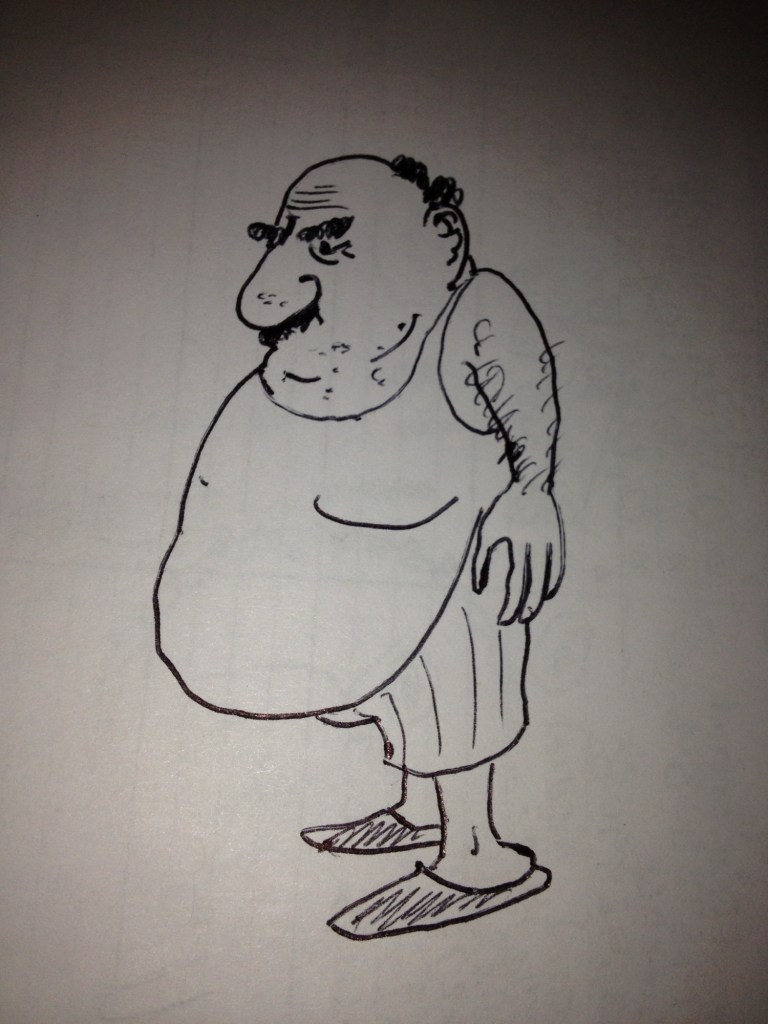
The return, however, was different.   From Budapest, they scheduled a connecting flight to Frankfort (two hours) and the final destination to  Boston (seven+ hours).  Little did the Adameks know that an obnoxious, obese  American –Joe would later refer to him as “TM” Typhoid Mary – would turn this voyage into a nightmare and a Lufthansa sanitarium.

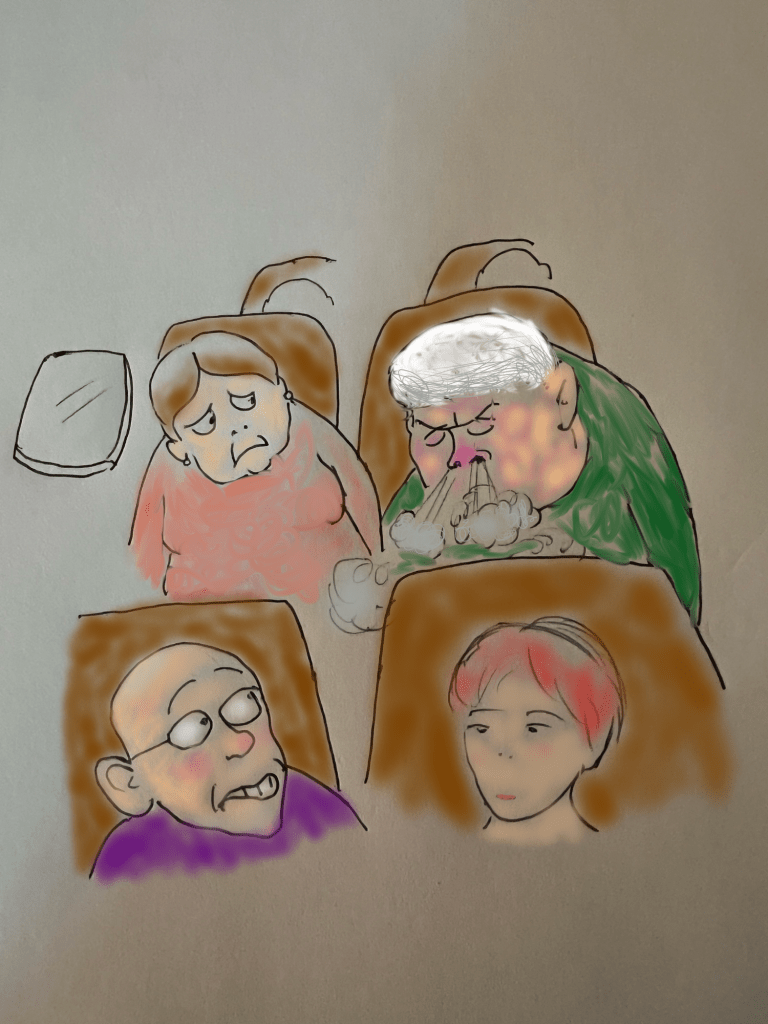
“Typhoid Mary” Sneezes, Again And Again And Again

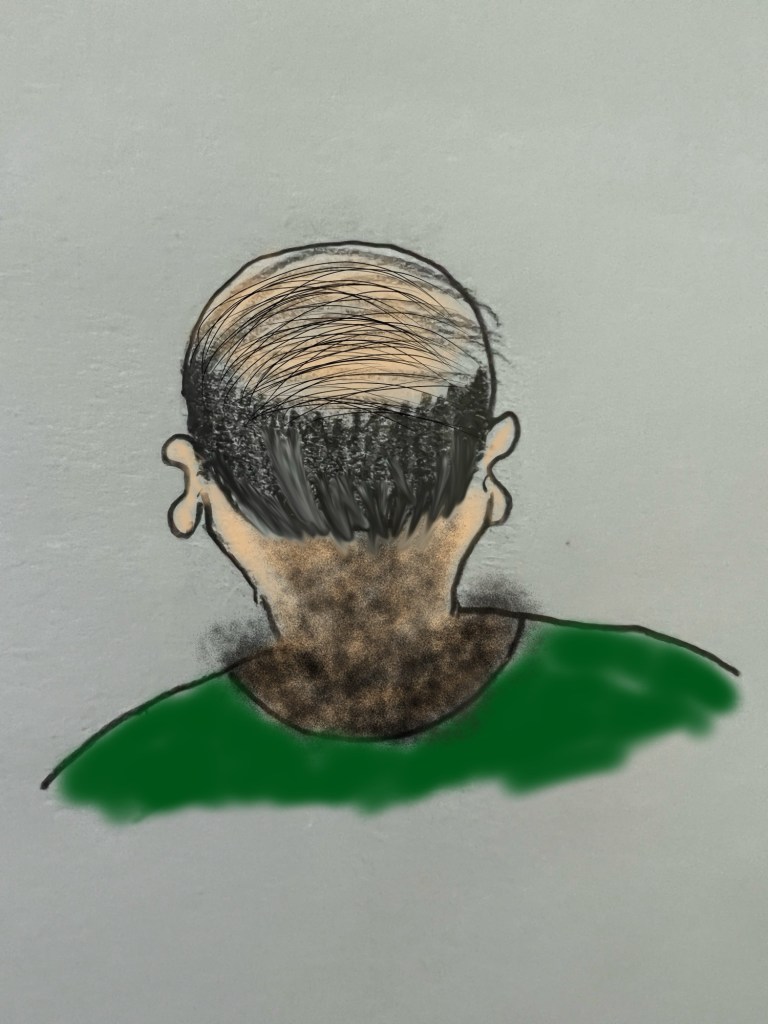
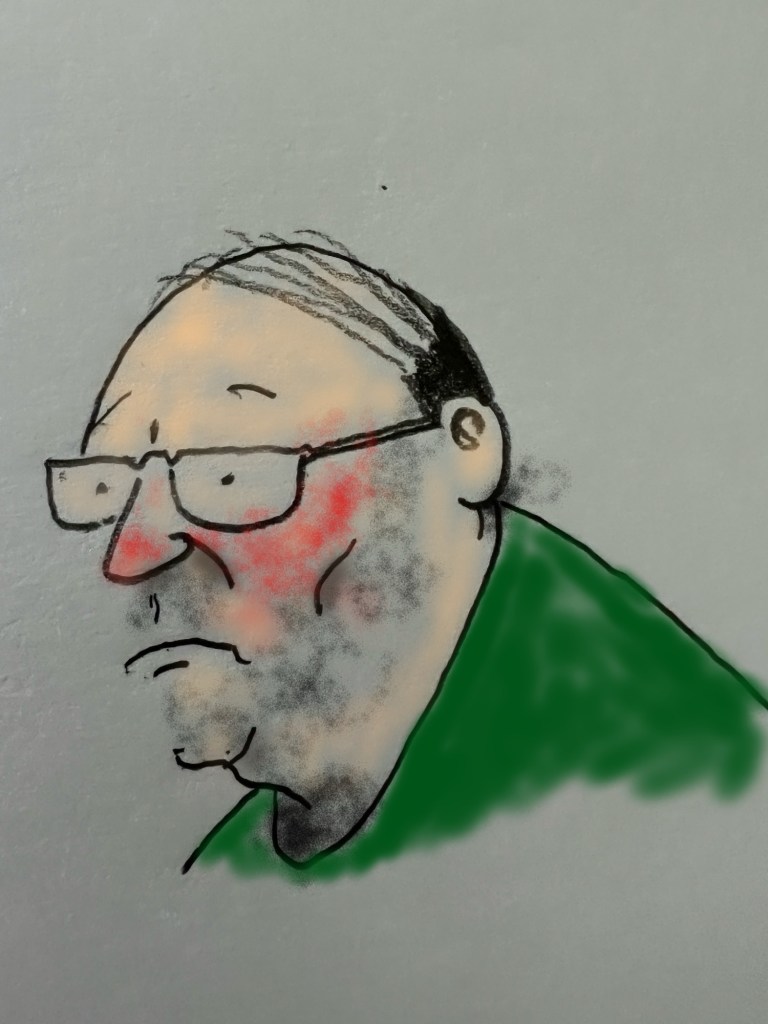
This older man was a hulking six-footer.  He had a shock of snow-white hair that was thick and full; his eyes deep-set blue.  His needle nose lay above a malevolent smirk (Joe could visualize him as a Stormtrooper goose stepping down the boulevards of Frankfort).   The average person would look at this man’s face with his bull neck and  melon-sized head  and think  “This is not a nice guy”.  The man’s head was so huge his drug store  reading glasses were ill-fitting and two small.  The side piece bows struggled to meet his ears.

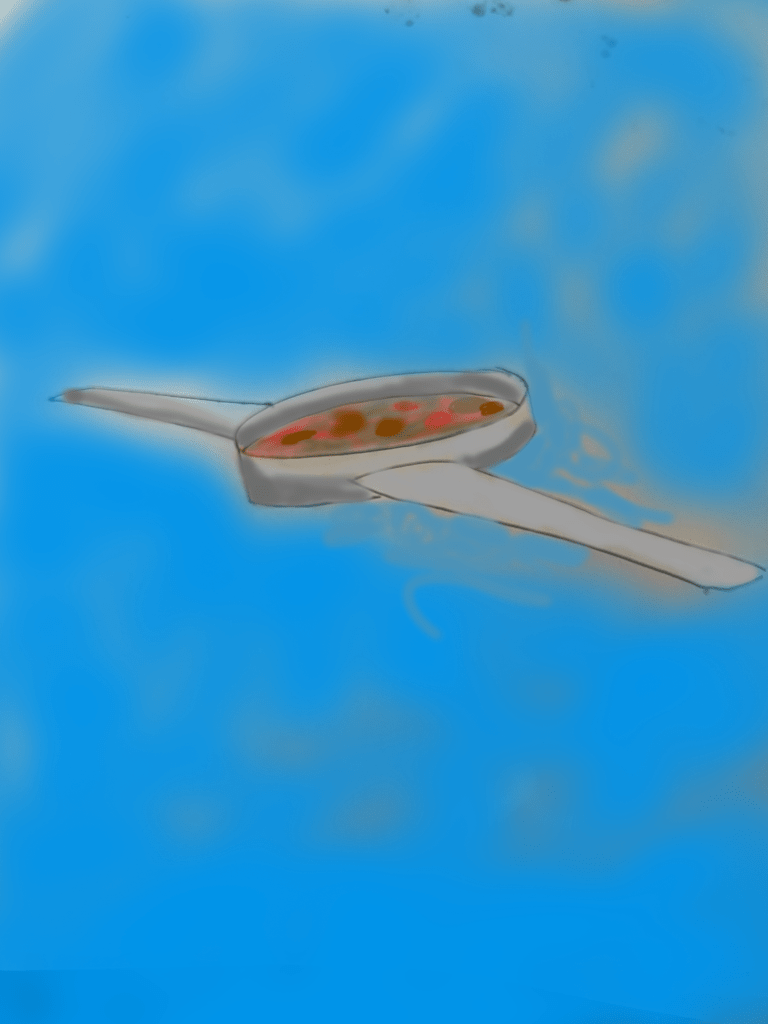
From before the plane’s doors were locked and until  arrival in Boston  seven hours later, this inconsiderate traveler would wheeze hack, cough, sneeze his way across the Atlantic Ocean and without wearing a mask.   The Adameks – and all the surrounding passengers– had been poured into a 500 ton Petri Dish and became living, breathing Agar Agar. At one point, he was sneezing into the tiny complimentary airline pillow.  Joe observed this and became nauseous. 

Things became hostile.  Midway through the flight a heavily tattooed biker four rows behind yelled “Hey asshole!! Put a fucking paper bag over your head!  You’re killing us back here!”  Nobody moved and there was concern  a  fist fight would ensue.  Violent behavior has become common on domestic and interntional flights. Fortunately, T.M. never responded.

 The Adameks thought Covid masks should have been mandatory with this human plague aboard.   After several hours of this public health onslaught,  a frustrated Joe approached an uptight, Teutonic flight attendant and complained about the public health hazard sitting in seat 15C.

“I’m sorry, sir, but there’s nothing we can do,” she curtly replied, her blonde hair in a French Twist.  “This happens all the time.” 

The attendant was not warm and fuzzy.  She unfortunately perpetuated the stereotype of frigid Germans.

“Well, gee, this passenger is really creating a stir in our area,” Joe said. “People are getting frustrated. Can’t you force him to wear a mask?”

“I’m sorry Herr Adamek but our hands are tied,” she responded in a heavy German accent.  “You can always contact the airlines when you arrive home.”

Thanks a lot, Joe said to himself.   Well, at least Anna and I have masks.  Most of their fellow travelers were not masked and as the flight ensued he became aware of the cacophony of coughing that emanated from his section of the airplane.  Typhoid Mary had company.  The Adameks became increasingly upset with  this giant tuberculosis ward flying at a 35,000 feet altitude.

After the grueling seven hours, the airplane finally, blessedly landed.  T.M. was still hacking as the boarding gate opened.  Everyone in his section glared at him and predictably he was non-plussed.  He had a me, myself and my cough attitude towards fellow travelers.  An eight foot buffer zone surrounded him as the crowd awaiting luggage delivery at the airport carousel.

Joe and Anna swiftly hauled their baggage to the nearest exit and ordered an Uber car.  Thirty five minutes later, they were mercifully  in front of their beloved home.   It had been an unusual odyssey.  They stripped off their skeevy clothes and threw them into the washing machine, showered and fell fast asleep.

The following morning they were still exhausted but over breakfast coffee savored the unusual vacation with its evanescent memories.  The history of those places, the beauty of the cities and the people they met. The culture was palpable.  They knew within several weeks the trip would become just a memory.    Both had taken hundreds of photos and videos for them to savor.  Thank God for iPhones.

The entire experience, however, wasn’t over. It was the good, the bad and the ugly.  By the next evening, Joe was coughing and wheezing.  He had night sweats and a fluctuating  temperature.  He felt crappy.  Two days later his symptoms hadn’t lessened. 

He went to a nearby doc-in-a- box  urgent care that was useless.  The “doc’s” scrubs were rumpled and   was a physically disheveled  schlemiel.  He was  a nurse practitioner, not an M.D., and had the personality of a slug.  No bedside manner.   Joe had to ask him to identify himself – “It’s John” he said.  This guy  needed a charisma transplant – and a clean set of scrubs-  Joe thought.

“Well, Joe, your heart and lungs sound fine and I’ve swabbed your nose for Covid and the flu.” he said.  “Our quick test shows neither of these.   You’re free to go and we’ll contact you if the more thorough testing is positive.  Good bye.”

During the evening, his symptoms went unabated.   He was feeling incredibly fatigued and his temperature was increasing.

“I don’t like this Joe,” Anna said. “There’s something going on here.  Let’s get you to the hospital tomorrow.”

At 9 am Joe was at a local hospital’s emergency room.  His temperature was spiking and the coughing persisted.

“I think we need an X-ray performed, Mr. Adamek,” an attending physician said. “This is suspicious, especially the sounds coming from your lungs.”

An hour ensued between the X-ray procedure and the reappearance of the M.D.

“Well, it’s just as I suspected,” he said. “You’ve contracted bacterial pneumonia.  It’s what we call walking pneumonia.  You don’t need to be hospitalized but I’m prescribing a strong oral antibiotic. Take the pills for seven days.  This should clear up by then.”

“Doctor, does this explain my increasing fatigue?” Joe asked.

“Yes,” the doctor replied. “It’s a classic symptom of pneumonia. I’m glad we picked it up this  quickly.  You’ll be fine.”

“Did the doctor think exposure to Typhoid Mary was a possible source,” Anna asked when Joe returned home.

“I didn’t ask him but I think I could have picked the bug anywhere,” he replied. “We were on a flying Petri Dish and that oik still remains the prime suspect.  But let’s put this behind us, Honey.”

It took two weeks before Joe felt better.  The fatigue was the worst of it and that lasted for more than a month.

“Well, Anna, the end of vacation  is behind us,” he said. “I’d rather accentuate the positive.  We visited a different part of the world and the memories we have made the trip, pneumonia and all,  were worth it.   But next trip let’s wear Hazmat suits on the plane.”

Bon Voyage!


Barnyard Gold

By Leo de Natale

     The ochre-colored building sits ensconced on a hilltop in rural Agawam, Massachusetts.  At first glance it could pass for a warehouse or storage area for the potatoes and broad-leaf tobacco that are grown in this western Massachusetts town.  But the pungent mixture of horseflesh, manure and winter hay reveals its true identity.  The New England Equine Auction Center is indeed a stable.  For some horses it is a way station to the next  barn or riding school where 14-year-old pre-pubescents will yank the mouth and kick the body with insensitive spurs.

           For the remainder of those soft-eyed creatures with their coats of brown, black or gray, it means the proverbial end of the line: bidders for dog food companies – in the horse world known as “The Killers”- are always well  represented at the weekly Thursday auction.

          The horses stand there, row after row, peering over their steel-piped enclosures with as many stories to tell as the two-legged man/beasts standing astride and free on the other side.  One horse, an emaciated  gray five-year-old mare has escaped the noose.  A plump middle-aged mother and her two teenaged daughters describe how they’ve scraped together $500 on this admittedly doubtful reclamation project.

The horse’s exposed rib cage and pelvic bones, thrusting through the scruffy skin of its hindquarters and the whip scars behind the neck tell the story.  New wounds from horsebites demonstrate the equine pecking order that culls the weak from the herd.

The woman tells how the family intends to sustain its new charge as her daughter applies salve to the mare’s wounds.

“She put her head on my husband’s shoulder, almost saying, ‘Please’,” the mother said of the Quixote-esque horse. “We just couldn’t let her wind up in a tin can.”

The gray horse’s roommate, an old black-and-white pinto in the adjacent stall is destined for a different fate.  It stands there, listless, while the round-wormed parasites holiday within dark, diseased intestines and have ballooned the pinto’s abdomen to twice its normal girth. The pinto just stands, lacking the energy to swat as a convention of flies swarm unmolested around a motionless tail.  Within twenty-four hours the once noble beast will droop its eyes, gasp its last breath and crash upon the ground, its face covered with sawdust and woodchips.

Pinto horse has beaten the system.  No more trailers to untold places, no electric stun gun to shock its head into oblivion.  Rather, a backhoe will unceremoniously drag its hind hooves to burial in an adjacent meadow where new, young legs will prance over the bones. 

Requiescat In Pace, sweet horse.

Deus Ex Machina

Deus Ex Machina

By

Leo de Natale

Everyone’s PIA

         Illustration by Vince Giovannucci

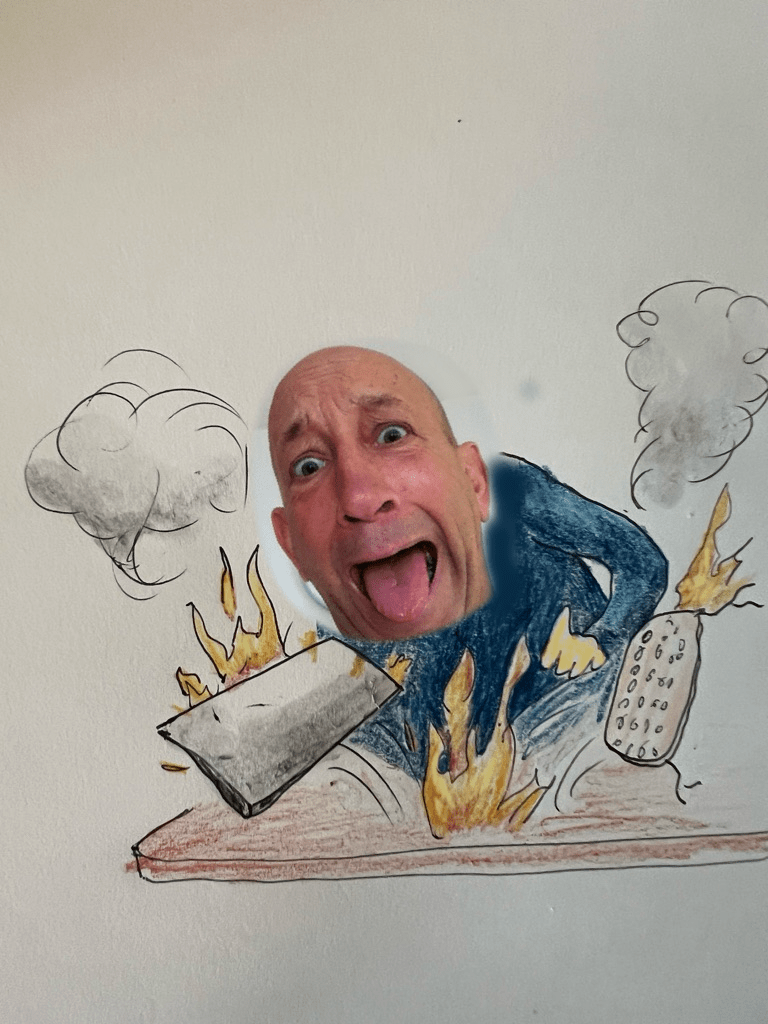
I am old and  often contemplate the dehumanization we are experiencing at the hand of modern technology, specifically the ever increasing hydra-like control  the internet, computers and cell phones have over human beings.

          I’m not completely intimidated by social media, the internet, the constantly changing computer or software technology. I can adequately navigate through cyberspace but, like so many in my aging Baby Boomer generation, there’s an intimidation factor.  With increasing frequency, we’re becoming roadkill.  There’s one basic fear:  pushing the wrong button and, poof !, there’s a figurative explosion and you lose your emails, your texts and everything. I often think of the Dirty Harry quip,”A man’s gotta know his limitations.” We live in mortal fear of losing all data while the devices turn to dreck.

          Probably one of the most annoying aspects of cyberworld is the dreaded PASSWORD!  I’ve tried to use one basic password but the websites/servers seem to be constantly and arbitrarily changing: “Your password is not recognized”, “Forgot your password?,  Click here and reset” or, my favorite, “Are you a robot?”. “No!,” I respond, “Are you?”.   A broken man, I reset the password and it works–at least once.  But on a subsequent access it’s back to ground zero.  “Password not recognized”.   MIPS.  MIPS. It is so Devo.

          Of course more companies/websites are heavily relying on the annoying QR code, a Rorschachian symbol that permits entry into connections to many websites.  And I laugh phoning Apple because the android voice sounds eerily similar to HAL, the robotic voice in the classic film 2001: A Space Odyssey:  “Just what do you think you’re doing, Dave?” The cybernet  seems to say “I am your master.  You will do as told or will be denied entry.”

          Cyberspace is totally obtrusive and the more it’s used the more you realize what a hydra it has become.  It wraps its tentacles around us.  There was a time pre-computer/cell phones when humans weren’t constantly bombarded with junk mail, scams, hustles.  No one worried about being hacked or having identity theft.  In a mere quarter century, it has become the pleasure vs. pain experience circa 2025 and counting.

          My most recent clash with this pervasive phenomenon pertained to a pedestrian event:  my wife and I needed a new refrigerator.  The old Frigidaire was leaking and we proactively decided to replace it before the deluge and a refrigerator full of spoiled food.  There was a quick trip to Home Depot where Clarice, a frumpy middle-aged woman with technicolor shoulder length hair guided us through the various models and manufacturers. Her fingernail polish was flaking; some fingers had no polish.  Not a pretty look.

          “This LG model here is the most popular French door ‘fridge,” she said with a thick Boston accent. “We sell a lot of these ones.”

She was actually very pleasant and helpful and $2,000 later we were the proud owner of a new stainless steel LG Super Freeze model made in Korea (the Koreans have usurped appliance manufacturing – LG, Samsung produce and sell most refrigerators, televisions, washing machines et al).  

“And remembah, the LG has a twelve month extended warranty but you gotta go online to registah,” she said with some forewarning.

The unit arrived and had new bells and whistles.  One notable feature was punishment for not closing the refrigerator and freezer doors.  Fifteen seconds is all I got before ear ringing beeps yelled “close the door!”.

The stainless steel unit was slick and shiny, the interior was well designed.  After delivery, I started to notice little things that slip by when selecting an appliance.  Plastic trays on the doors were thinner and chintzy.  There was no rubber padding on shelves, so bottles and containers created unanticipated noise.  Quality used to be a watchword for household items but it’s the old story you pay more for something but it’s manufactured with inferior materials.  Of course I’m talking like a grumpy old man (“I remember in my day things were different!” blah blah blah).  Each generation succumbs to curmudgeonliness.

          Once our food was placed inside the refrigerator, it was time to register the unit and apply for the warranty benefit.  There was a time you could do this by telephone and speak to a human.  Today, you’re on your own.  The first hint there’d be gnashing of teeth occurred when the owner’s manual informed my wife and me there were data on the refrigerator wall detailing the process.  On the refrigerator’s left wall there was a 3×8 sticker that contained the usual – model number, serial number etc.  Also included was the aforementioned QR code, the increasingly ubiquitous symbol used by just about anything associated with the internet.

          Placing my cell phone in front of the QR’s squares and squiggles, I focused the symbol and was immediately shunted to a LG website with further instructions.  I was told to download a corporate app called “LG ThinQ”.   Switching to my laptop, I arrived at LG’s website, the vehicle for establishing an account and services provided.  I doggedly followed the usual prompts – name, email, address, telephone number. “Are you a new account?” the prompt asked.  Yes I am.   “You must register and provide – you guessed it – a password”.  Oh no, here we go again!

I knew the routine: password must contain a minimum of 8 characters; You must use at least one capitalized letter, a numeral and a character # or !, etc.  I dutifully typed in Sarge123! (we always use this password honoring Sarge, our first German Shepherd Dog).  Of course you are required to re-type the password for “security reasons”.  I received a stern message saying “This password is weak.  You must provide a stronger combination of numerals and letters!”.

 I retyped another password and was rewarded.   Like Ali Baba, the website opened. 

I then proceeded to complete the warranty application.  A creepy,  Orwellian phenomenon appeared before my eyes.  As I typed my surname the entire field was immediately filled.   The screen automatically included my address and zip code and then incredibly showed the last four digits of my credit card.   This has occurred before and my reaction is  wow!,  how  do they harvest this information, especially from a website I’ve never before visited?  This occurrence was eery and scary. I guess it really has come to pass.  Big Brother is watching you and all I could think of was H. G. Wells’ morlocks from his novel The Time Machine.  The subterranean ghouls control the robotic earth dwellers who are comatose and walk aimlessly while staring into their cell phones. I thought of young people today who cross streets without looking up or ride bicycles and simultaneously texting.

 For example, I recently was stopped at a red light.  A pimply-faced kid was driving a Vespa motor scooter.  With the scooter’s  green light flashing, he takes a left. His girlfriend is riding behind him on the guest seat.  Instead of paying attention and perhaps enjoying the ride she was- what else?- gazing at her cell phone.  We are doomed.

The only thing worse was watching  another kid following the Vespa  riding his electric bike.  Traveling at about 20 mph, he was helmetless and, simaltaneiously, texting and pulling wheelies.  He’ll eventually become an organ donor.  His young heart, lungs, kidneys and corneas will find a healthy home.

Of course, I just received an email from LG.  A reverberating circuit  informed  me the password was not recognized and then prompted me with the question “Forgot password?  Press here.”. Start from square one.

Dammit,   getting old is not fun.   I feel like yelling, “Hey!  Get off the grass!!!”.      Computers, phones, tablets are consuming more time and energy as we slouch towards the Wasteland.

 I wish it were 1965 again!!!!

“Arrrghh!!

Les Dentes de Roi

Les Dentes de Roi

By

Leo de Natale

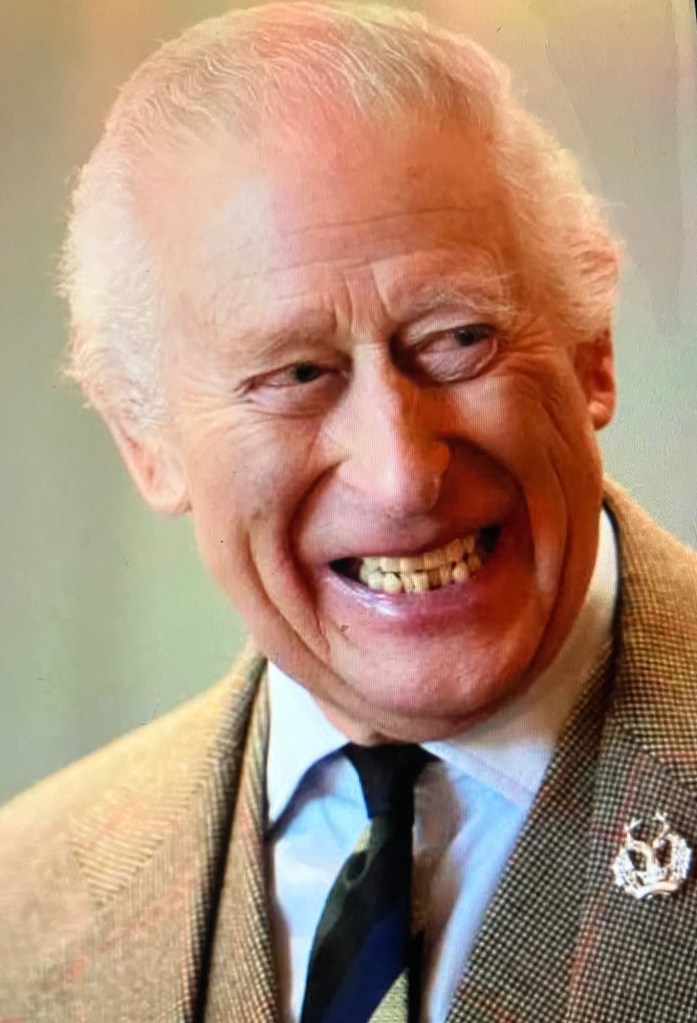
King Charles III And His Teeth

          As a child, I had a world class Bugs Bunny overbight.   Abnormal dentition ran in the family.  My mother and sister also had an array of crooked teeth.   As a rite of passage, my parents realized the social repercussions of malformed teeth and by Grade 6 I paid my first visit to  orthodontist Dr. Kaplan.   I joined the ranks of the select group of classmates who, for two to four yeas endured hardware in our mouths and wore the dreaded “night brace” that magically catapulted teeth into the desired position.

          Predictably, fellow classmates would rag on us – called us “barbed wire mouths” and made fun of us after lunch because of the food stuck in the metal jungle.  Tuna fish sandwiches were especially gross in appearance.  Foul breath was rampant.  So was the insufferable teasing.

          We all went through this orthodontic misadventure that was comparable to college fraternity hazing.  Unlike frat house initiation, there was not corporal punishment and the braces period eventually faded into oblivion.   Not so for me. During the rest of my life I nearly always observed and made mental notes about people’s teeth.  Besides the overbights, crookeds and John Kerry prognathic underbites, I’d note whether or not a person’s teeth were yellow, gray, missing/absent.

Austin Powers

          Mike Myers is a comedic genius and his spoof film, Austin Powers, International Man of Mystery, is a paean to a nation besot of bad teeth.  Myers portrays the eponymous  character  Powers “superspy” and throughout the movie wears a set of large, yellow-stained  prosthetic teeth.  After being teased by his comely co-star, he admits the obvious.

          “Ok, the English have bad teeth!” he yells as the camera focuses on his gaping mouth. “They’re not shagadelic, Baby!”

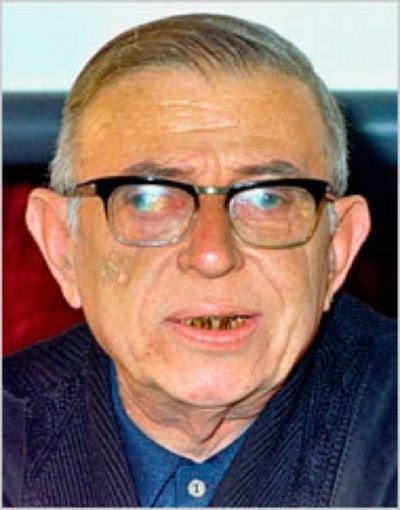
          On the continent, it isn’t much different.  The late wall-eyed French existentialist Jean Paul Sartre had egregiously brown stained teeth from a lifetime of pipe smoking.  It was not a pretty sight.

Jean Paul Sartre

          Austin Powers is considered a seminal comedic theme.  The movie is a spoof of the  1960’s James Bond movies.   The sight gags and plot lines satirized the genre to a point where the Bond movie’s producers completely changed the characterization when Daniel Craig was chosen to become the newest reincarnation in  2005.  A hairy-chested, toupeed, Sean Connery became a dinosaur.

          Segue to 2025.  My wife and I  became addicted to the British crime television series – Inspector Lewis, Midsomer Murders, Murdoch Mysteries et al. The programs are a British cottage industry and we noticed many of the character actors can be seen playing musical chairs in numerous programs.  It’s the British version of central casting.  In the English version of cinema verite, episodes would be sprinkled with a cast filled with ugly teeth. 

I began to think the producers regarded the tooth problem as a yellow badge of courage.  We’re Brits, godammit, and we’ll televise a physical trait that we gladly accept.

          American standup comedian Rodney Dangerfield had a famous joke about a man who seeks cheap dental advice:

“Hey, Doc, what should is do about my yellow teeth?” he asks his dentist.

“Wear a brown necktie!” was the response.  Badda Bing, Badda Boom!!

          My wife and I actually began playing a game.  We’d each keep a score tally of how many cast members were unabashedly demonstrating their genetic dental proclivities.  Most scores ranged between fifty and seventy five percent.  We realized there was a vast cultural divide between Americans and British.  We also noticed other countries – Ireland, Holland and Germany- were also infamous for eschewing orthodontists.

          The natural course of events led to the inevitable end stage: dentures.  The British Isles per capita consume more Poligrip, Fixodent and  the famous cleaner Efferdent than any European counterpart.

Which brings us to the title of this essay.   King Charles – boy, did he wait a lifetime to be crowned- is frequently in the news.  Everyone knows the British Royalty is a vestigial entity and purely ceremonial.  The Crown lost its governing powers after the 17th Century.  The pomp and traditions still remain, however, and the Royal Family has become  a perpetual carnival with costumes, horse-drawn carriages and all the trappings of a society that lies in fairy tales and history books.

          The English still cling to the history and the what used-to-be  British Empire.  Now the Royal Family are merely a tourist attraction that’s perpetuated by  vicarious lifestyles that remain laced with palace intrigue.

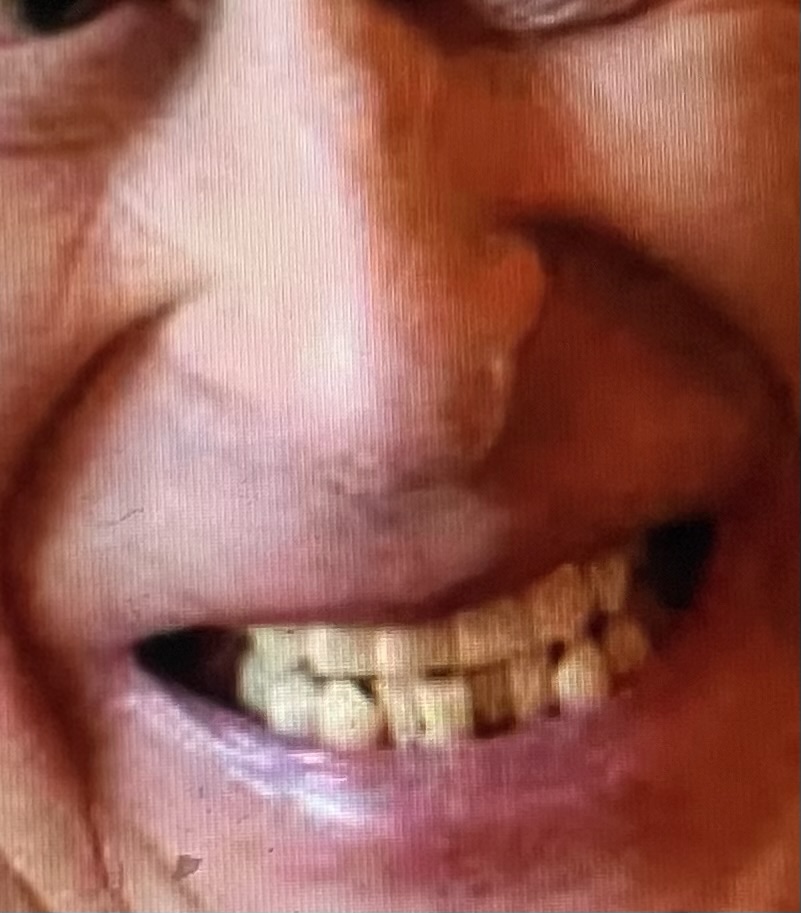
          King Charles III is often photographed and, as the fictional Austin Powers, he does have bad teeth.  His lower incisors are an assembly of frozen corn niblets- yellowed crooked and with a mind of their own.  I stared at the photo and thought here is one of the wealthiest men in the world and Good Queen Bess didn’t care enough for her oldest son to slap him into a set of braces?  To this day he remains the poster boy for a quintessential Brit: not particularly good looking and accursed with ugly teeth.

Not to be undone, Britain’s island neighbor Ireland has teeth problems of its own.  It’s not unusual to meet a strapping young Irishman whose handsomeness ends when he opens his mouth.  Yep, there they are in full display: a set of teeth that are gnarled and blackened with rot.  I once knew an English fellow who was having trouble with his teeth.  He’d been suffering from abscesses.

          “I’m sick of these goddamn dentist’s bills,” he said .  “Yeah I made an appointment with the dentist and am having all of them yanked out.  I won’t have to worry about taking care of my fuckin’ teeth, guv!”

          The Brit didn’t realize that  over time a person’s gums shrink and the choppers have to be replaced periodically.  Otherwise his speech will be accompanied by the trademark denture whistle resembling a windstorm occurring as the prosthetic loosens.  And  over time the dentures turn yellow, despite using industrial strength Efferdent.

          According to history books, George Washington lost his teeth while growing older.   Dentures in the 18th Century were primitive and made of wood – try putting those suckers in! His subordinates reportedly  referred to him as General Splinter Mouth.  Unsurpisingly,  no portraits of Washington exist with him smiling or laughing.  Just look at the $1 bill.  George doesn’t resemble a happy camper.

Perhaps the worst of it the dreaded denture breath, a rank odor that often compared to a Monday morning fish market.  As a young man famous actor Clark Gable lost his teeth due to poor dentition and prematurely needed dentures.  His breath was purportedly so foul that leading lady actresses gagged while kissing Gable.  They should have requested  hazardous duty pay.   Viven Leigh, his costar in Gone With The Wind, claimed her head snapped back during many of the movie’s romantic scenes.  She had neck  problems for the remainder of her career.

          In America we are the antithesis.  Cosmetic dentistry is a multimillion dollar industry.  It’s the Hollywood effect where movie stars historically needed/wanted pearly whites.  There’s an ever increasing influx of teeth whitening strips and tooth pastes that advertise whiter teeth.  A trip to the CVS tooth paste aisle is akin to the grocery store’s canned tomato section.  There are so many options one’s head spins: whole tomatoes, whole skinned tomatoes, tomato paste, chopped tomatoes, crushed tomatoes, stewed tomatoes, plum tomatoes diced tomatoes etc.

A Wall of Toothpaste

At CVS there’s a wall of  tooth pastes. It is a myriad of products that contain sodium bicarbonate whiteners and have proprietary names: “Sparkling White”, “Optic White”,” Baking Soda and Whitening”, “Baking Soda and Peroxide”, etc.

 All these products promise whiter teeth but skeptics abide.  Americans wanting refrigerator white teeth borrow  thousands of dollars required to obtain veneers or the more radical implant surgery.   We are, as Bruce Springsteen sings, blinded by the light. Just ask most politicians, actors or television personalities.

King Charles III, however, will carry on, fight the good fight, and not give a damn about his mouthful of chick peas.

Magnificat

Magnificat

By
Leo de Natale

          Can miracles occur?  Does a Supreme Being, aka God, exist?  Is there hope for the future?  These metaphysical questions have been posed through the millennia.  We are living in an age of cynicism, an epoch when the bad news outweighs the good.  Mankind has always considered our life on Earth as an existential experience.  To us no point in time has more relevance than the now. Wars, environmental disasters and  all life’s vicissitudes are regarded as the most important and relevant compared to any other point in history. It is the conceit of every era.

          Our history can be split between the believers and non-believers.  Religion is the opiate of the masses, Karl Marx wrote.   Atheism and agnosticism are common especially in days of worldwide annihilation.  Armageddon is always around the corner.

          But there can be hope as witnessed by two men whose friend and colleague experienced a legitimate miracle.  Here is their friend’s miraculous story:

The Alexa tunes player was blaring singer John Fogerty’s famous song, Centerfield.

          “Oh, put me in coach, I’m ready to play today,” yelled  Stratos “Stratty” Liakos as he sang along. ”Put me in coach, I’m ready to play today, Look at me, I can be centerfield.”

Stratty was in a long term care facility in Boston.  He was wearing an UnderArmor tee shirt and warmup pants.  He was smiling and laughing with his two optometry school classmates, Augustus “Gus” Bianco and Ledario “Led” Del Torto.  His friends were slack-jawed by the joyous behavior  they were witnessing.

          It was the Sunday before Thanksgiving.  Eleven months earlier, Stratty was bedridden.  The right side of his body didn’t move.  His attempt at speech was gibberish.  His friends were saddened because Stratty was, in their minds, approaching the abyss.  His brown eyes were glazed and his stubbly beard was a wizened gray.  He recognized his friends and they made him laugh from mimicking various quirky optometry school professors.  They saw a glimmer of Stratty but not much else.  They visited for about twenty minutes that day and left with nary a word between them.  Sadness enveloped them as they approached the facility’s parking lot.

          Stratty’s odyssey –  fitting because he is Greek American- actually started  the previous June.  At age 68 he had been remarkably fit and trim. He exercised at a local gym at least three times per week.   He was semi-retired and spent the majority of time working with his passion:  artisanal designer woodworking, a craft that earned him a national reputation.  He was that good.

Stratos  Liakos’ family emigrated from Greece.  He was second generation American and was steeped in the culture of his grandparents’ homeland.  As a child he attended Greek School where he learned of his heritage.  He was also taught the language and was fluent in his native tongue.  His family was middle class and lived in New York’s Astoria Queens section. The area was known as “Little Athens.”

          Stratty was also an exceptional student and through elementary and high school was the proverbial straight A student.  Learning, especially mathematics  and science, came easily to him.  He had an intense personality and often displayed a mercurial temper that vanished as quickly as it arrived.  He was smart and he knew it and many times bordered on arrogance.   His high school classmates sometimes joked about the image of him as a whacked out crazy.

          Physically, he was a wiry five foot eleven .  In high school he was superb in soccer, cross country track and tennis.  His eyes and hair were dark brown. His nose was bony, the result of many soccer balls bouncing off his face.  He was not overly handsome but many of the high school girls were attracted to his personality.  He possessed charisma.

          He received a soccer scholarship from Colgate University, a school located in upstate New York.  In college he divided his studies between classic literature and the sciences.  He was especially adept at mathematics – with pride he’d say, “That’s yet another Greek word!”.  As his college career progressed, Stratty became increasingly interested in the health sciences.  A college guidance counselor encouraged him to consider medicine or some allied health field.  By his junior year he decided to pursue a medical degree.

Initially, he was drawn to medicine because it combined mathematics, physics and biology.  He researched medical careers and discovered several glitches.  After graduating from medical school,  most physicians choose a specialty and follow the protocol of internship, then residency.  A physician amasses large financial debt and doesn’t earn a salary until his mid-thirties.  It’s a long haul for medical students and places them in a huge financial hole.  The ultimate question is it worth it?  These were considerations Stratty forced himself to ponder.

During his junior year, Stratty experienced double vision after working on homework and late night reading.  A classmate suggested an eye examination. Stratty’s eyesight had always been 20/20.  The visual problem was bothering him and  his classmate recommended a local optometrist, Dr. Hyman Klein.

“Your vision is fine, Stratty,” said the bald, avuncular Dr. Klein as he finished the examination. “It’s your eye muscles that are the problem.  They’re misaligned and that’s the reason for the double vision, clinically known as diplopia.”

Klein prescribed reading glasses containing prisms that bent the images entering the eye, a physical change of the light projections.   The prism eyeglasses allowed Stratty’s eyes to see singly.  Stratty was amazed at such a simple yet scientific solution solved an important problem.   He began to consider optometry as a professional option.  On his follow up appointment he asked about a possible career.

“Well, Stratty, optometry would be a wonderful choice, “ Dr. Klein said on a follow up appointment. “You won’t get super rich but it’s a rewarding profession.  Think of it.  You use math and physics plus observational skills to help people see better – just like I did for you.  You can even save someone’s life  when  diseases affect the eyes.  I’ve thoroughly enjoyed my career.”

Stratty’s girlfriend Ginny was accepted to a master’s program at Boston University.  The couple were romantically involved and wanted to continue their relationship.  Stratty had interviewed with several optometry schools in Manhattan, Ohio and Texas.  One school, Massachusetts College of Optometry, was located in Boston.  The decision was easy.  He followed his girlfriend there.

The love affair unfortunately didn’t last.  After one academic year Stratty and Ginny went their separate ways.  Their programs were demanding in time and homework.  They drifted apart without rancor and each crowded new romances between school classes.

There’s an old saying time accelerates exponentially.   The four years at optometry were over within the proverbial blink of an eye.   Stratty graduated second in his class and obtained a good position at Harvard University’s student/faculty health center.  He quickly became ensconced in his new position, one that would allow him to combine clinical work with visual science research.  Professionally and personally things were unfolding as if by blueprint.

His optometric career was on cruise control.  Stratty honed his clinical skills and was promoted to chief optometrist.  He wrote research  papers in various optometric and medical journals. It had become a well paying and   satisfying career.  He eventually married Angie, a computer programmer, and they were blessed with two children.  They purchased a house in suburban Boston. 

 His grandfather had been a carpenter in Greece and continued woodworking after immigrating to New York. He had loved watching Gramps working with wood.  The old man was a wunderkind at designing and building furniture.  He taught Stratty how to identify and choose various woods – maple, oak, walnut,  and pine.  Stratty loved the smell of a woodworking  shop and the feel of the materials and the tools that used in creating beautiful furniture.  He developed a reverence for wood.

After settling down in his new middle class life, he decided to revisit his past and created a basement workshop.  He purchased vast numbers of carpentry tools and eqiupment required for fine woodworking.  At home during the evening, Stratty would spend hours designing desks, chairs, side and coffee tables.  His two young sons  would watch Daddy and sometimes helped him create his next piece.  He traveled to regional shows and developed a reputation for sleek, modern furniture designs.  His hobby was turning into a profitable and satisfying avocation.

Stratty expanded his knowledge of exotic woods.  He used various  species – Brazilian rosewood, Japanese bamboo,  Bavarian oak.  He would spend hours at the computer, using the latest software to design the furniture.  He became more avant garde with his designs.  A staff member of New York’s Guggenheim Museum discovered his work and purchased several pieces including an ultra-modern coffee table.  Sratty’s reputation as an artisan continued to grow.  He had hired an agent and was now exporting his sleek masterpieces to Europe, especially Scandanavia.

On his 67th birthday, he decided to scale down his optometric career.  He would work only two days per week.  The remainder of his time would be divided between his studio and the local Planet Fitness gym.  On  a warm June day Stratty was exercising with his gym rat cronies.   He attempted to squat thrust 300 pounds.  He was successful but seconds after standing erect, he dropped the barbell with an earsplitting crash.  His eyes tilted upwards and he fell backwards, unconscious.  His friends rushed to him.  It was pandemonium with gym staff at his side after calling 911.  Twenty minutes later Stratty was in an  emergency room where hospital staff were frantically stabilizing his condition.

          His wife Annie arrived at the hospital and met with the on call neurosurgeon.

          “I’ll be completely candid with you, Ms. Liakos,” the neurosurgeon said. “Your husband has sustained a significant cerebral hemorrhage.  In fact, the fall he suffered compounded the problem because he also fractured his skull.  Unfortunately, it’s a double whammy.”

          “Oh my poor Stratty!,” a crying Annie screamed when she saw her husband in the hospital intensive care room. “I can’t believe what’s happening!”

Stratty underwent a six hour surgery.  The surgeon and his team staunched the bleeding but there was a significant amount of blood creating pressure on his brain.  The medical team was forced to perform a craniotomy to relieve this pressure.  During this procedure, the surgeon used a saw to remove the entire left side of the skull.  His head was left with a gaping grotesque depression.  He was intubated and underwent an induced coma where he would remain unconscious for more than a month.

          The surgeon was beside her and tried to comfort and reassure her.

          “Ms. Liakos, this is going to be a long and difficult period for Stratty and you,” he counseled.  “I can’t absolutely predict what’ll happen but I can reassure you we’ll be trying to save him.  Please have faith.”

          “But what about his head, Doctor,” she cried, tears streaming down her cheeks. “I’m frightened.  I don’t want him to die.”

          “We had to remove part of his skull in order to save his life,” he explained in a soothing bedside manner voice. “Once he regains consciousness and is stabilized we can talk about cosmetic surgery.  We’ll attach a prosthesis and afterwards he’ll be looking like his old self.  Please trust me.”

          Two months later Stratty’s condition had indeed improved.  He was conscious but had slurred speech.  His leg muscles had atrophied but he was able to use a walker.  Muscle wasting had rendered his legs useless.

          In October, friends Gus and Led visited him at home.  They were excited to see Stratty, his physical drawbacks notwithstanding.  He and his wife greeted them and they sat in the living room.  Stratty’s hair was beginning to regrow and helped to camouflage his concave skull.  It was difficult to avoid staring at the crater.  Despite what had happened, he appeared in good spirits and was able to give the friends a tour of his impressive workshop.  Stratty had surrounded himself with lathes, drill presses and a constellation of hand tools.  A wave of sadness enveloped him.

          “I won’t ever be able to do this again,” he slurred as tears welled up in his eyes.”I can’t tell you what the various woods are.  I don’t what all these tools do.  My memory is shot”.

          His friends left the house and felt upbeat about Stratty’s recovery.  

          “My impression is that with time and physical therapy, he’ll recover well,” Gus said as they drove away. “I remember our neuro professor Dr. Sam Marty saying the brain has ways of rewiring itself if certain regions remain in tact.”

          For his part, Led was writing email updates to  classmates.  Through the school’s alumni association, he’d been able to contact many and kept them abreast of Stratty’s condition.  Their hopes for a recovery were unfortunately dashed.

          About one month after their visit,  Annie frantically telephoned Gus.

          “Oh, Gus, Stratty’s had a relapse,” she said despondently.  “He had what they called a ‘vascular accident’.  It wasn’t another stroke but he’s in a bad way.”

          Stratty’s condition had deteriorated and Annie was forced to place him a long term rehabilitation center, The Harold House, that was located near the major Boston hospitals.  The relapse  occurred in early December.  It would not be a joyous Christmas season and the new year did not bode well because he still required the cranial surgery attaching the prosthetic skull.

          Later in January the two friends visited him at the facility.  It was officially a rehabilitation center but most of the residents on Stratty’s floor were there long term .  Some of the patients, Stratty included, were confined to wheelchairs.  Others walking about were zombies that had a faraway look in their eyes.  The facility was clean and windows provided much sunlight.  The “residents” were well cared for.

A nurse led them to Stratty’s room. He was bedridden and the friends gasped when they first saw him.  He recognized them but his speech was limited to jibberish.  The right side of his body was paralyzed, his arm and leg  limp and motionless.  He was unshaven and looked tough. The window shelf was filled with greeting cards and Stratty’s “shrine” contained photos of his wife, children and grandchildren.  The optometry school’s alumni association had recently sent him yellow roses that were prominently displayed.

          Gus and Led stayed about twenty minutes.

          “We’ll be back Stratty,” Gus said. “Just hang in there.”

          They left in silence.  The visit was perhaps the saddest experience either had known.   They were sullen and disconsolate.

          “This is unbelievable,” Led said as they drove back home. “Doesn’t look good.  He might never leave that place.  What a life, if you want call it that.”

          That evening, Led had difficulty sleeping.   He held the image of his friend lying alone in a hospital bed and contemplated the infinite number of days spent in such a depressing environment.  The smell of institutional food, the yells and screams of fellow patients, the monotony.   Led thought of waves reaching an ocean shoreline, one lapping over the others.  The boredom  and the madness of being stuck in such a place for minutes, hours, days and weeks were images that wouldn’t go away. 

Gus and Led decided to visit Stratty monthly and during the bleak winter months the meetings were usually the same.  Stratty remained verbally incoherent.  Worse, he started having difficulty swallowing and underwent another procedure where surgeons inserted a feeding tube into his stomach.  He was  incontinent and was now wearing diapers.   Stratty was in rough shape and the two friends would leave more depressed after each visit.  It was becoming more emotionally difficult for them to visit.

Stratty had been undergoing daily physical therapy.  In early spring Gus and Led were surprised to find him among the other patients in a common area with a television blaring.  He was in a wheelchair and was wearing a bicycle helmet, a routine protocol for head trauma residents.  He still had no use of his right arm and leg but there appeared a change in his cognition.  The three friends told jokes and Stratty’s speech had slightly improved.  Was this an omen?

Yes, it was.  By early summer, Stratty had made incredible strides.  His speech had definitely improved and the facility’s physical therapists were successfully reversing the arm and leg paralysis.

Vacations and the vagaries of work interrupted Gus and Led’s visits and it wasn’t until early October they returned to Harold House.

They were shocked.  Stratty was in the common room.  There was no wheelchair.  He was using a walker and shuffled to greet his friends.

“Can you believe it, guys?” he chortled. “No more fuckin’ wheelchair! I can’t believe what’s happening.”

Stratty proceeded to tell them how the physical therapists had been pushing him hard.  They were using rubber exercise bands on his right leg and it was miraculously responding.  Stratty was also using free weights and grip exercisers to strengthen his hands and forearms. 

“Watch this”, he said. “I can now walk the entire floor by myself.  They still make me use the walker but this is easy peasy.”

The friends were ecstatic over the transformation and improvement.  Most noticeable was his speech.  That, too, was improving.  Stratty was forming full sentences with no garbling.  Things would prove even better.

Gus and Led visited Stratty in mid-November.  It was approaching Thanksgiving and they didn’t know what to expect.  The miracle had occurred.

Stratty greeted them by the nurses’ station and standing tall.

“Hey guys, great to see you,” he said with perfect diction. “Come on to my room.  I want to show you something.”

He walked from one end of his room, pivoted and returned to them.  He was walking!  Gus and Led were agog, even more so when Stratty grasped a sheaf of booklets containing  color book drawings, arithmetic tablets and English grammar and spelling books.  The teaching aids were reminiscent of elementary school exercises.  Each booklet had been completed with penmanship that had been lost more than one year prior.

“I’ve done this all my myself in the past two months,” he said proudly. “I’m still not one hundred per cent but I’ve always had drive and this has been the biggest challenge in my life.”

“We were really worried about you last January, Strat,” Gus confessed. “You were a hurtin’ puppy.”

“Yeah, but you know I was so out of it I don’t remember anything,” he replied.  “I had no memory of what had happened, where or who I was.  I know you guys kept visiting me but there was no lasting memory. I can’t tell how much that meant to me.”

His voice croaked with emotion and he wept.  The friends followed suit.  Tears and laughter.

“But guys, I’ve some really great news,” Stratty said. “I’m being released the day after Thanksgiving.  Annie’ll be picking me up.  God bless.”

With that announcement, Stratty again activated Alexa and John Fogerty blared, “Put me in coach I’m ready to play ……..”

Magnificat.  A miracle did occur.

Autumn Flame

Autumn Flame

By

Leo de Natale

Red.  Or is it scarlet?  The wind blows, reveals a cascade of blinding color.  Acer rubrum is  performing its annual Show

Neighbors standing mouths agape in awe on sunny days.  It’s a thrill really.  For a week maybe two the backyard is ablaze with red maple Leaves nature in full celebration

Like a snowflake each leaf is a variation; some totally scarlet others with Black markings, faint yellow stripes

Slowly, predictably, time takes control; leaves fall to the ground and Laughing grandchildren make snow angels in a sea of red

Street maples can  muster only ho-hum yellow and orange leaves; none Compare to rubrum’s splendor

Alas in the blink of an eye the performance ends mottle leaves turning Brown/black

The naked tree thirty feet tall now laid bare; I cannot wait for spring to arrive when the Autumn Flame begins anew.

Why A Hulihee?

Why A  Hulihee?

By

Leo de Natale

Illustration by Vince Giovannucci

“To shave or not to shave. That is the question!”

A Real Hulihee

By the time a young boy morphs into a teenager, the subject of facial hair, beards, mustaches and any combination of the two have bounced around in his head.  Most sons growing up watch their fathers exercise the daily ritual of removing the five o’clock shadow and facing another day. 

          “Daddy, can I watch you shave?” a 10-year-old son will ask as he becomes fixated on this rite of passage.

          “Yes, Johnny, you can,” the father replies. “And remember some day you’ll be doing the same thing.”

The boy watches his dad wash the face, apply the shaving cream  – that’s a favorite – and slowly, methodically stroke the cheeks,  neck, chin and  upper lips.  On a rushed day, the father will yelp- ouch! too close and another razor cut.  Out comes the coagulating styptic stick  that staunches the bleeding.  An astringent after shave is then applied with an accompanying “Ahh”.  The aroma lingers and the  boy files the smell in his olfactory memory bank. 

Once in a while adult  males will sniff Old Spice, Brut, English Leather, Drakkar Noir or other popular colognes and will be catapulted back to their youth. 

Beards and facial hair have existed since the man became homo erectus and lurched out of his cave.  Across the millennia – especially dating back to the Greeks and Romans- beards have been an integral part of society.  Anthropologists claim in ancient times the hairiness  had several purposes. 

The beards created evolutionary pressures among tribes to enforce dominance hierarchies.  Beards = testosterone and they affected mating habits- the iconic Neanderthal  man dragging his female mate by the hair and grunting “Me take you to cave”.  Also, it is proposed that among warring tribes, beards were actually useful in reducing the impact of blunt force during tribal battles.  Had they lived in that era Giuseppe Garibaldi or Beat poet Allen Ginsberg would have protected themselves well.

In  appearance early humans weren’t much different from the rest of the animal kingdom.    We were all hairy beasts and evolution shows some things don’t change, especially in various places in the world.  You wouldn’t confuse Swedes with Moroccans.

Throughout modern history men’s facial hair has varied as often as hemlines (when women more commonly wore skirts and dresses).  Egyptians shaved their faces and scalps although Pharaohs were often depicted with long, well-oiled chin beards.  Along came the  Greeks where hirsutism was the accepted norm. 

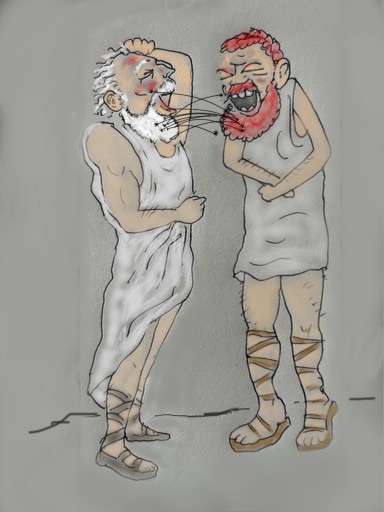
Philosopher Socrates (left) Playing Beard Games with an acolyte

In fact, Socrates and his disciples purportedly would play games and watch fleas jump from one beard to another.  Simple pleasures for not so simple philosophers.  Beards grew and predominated during the Hellenic golden era.

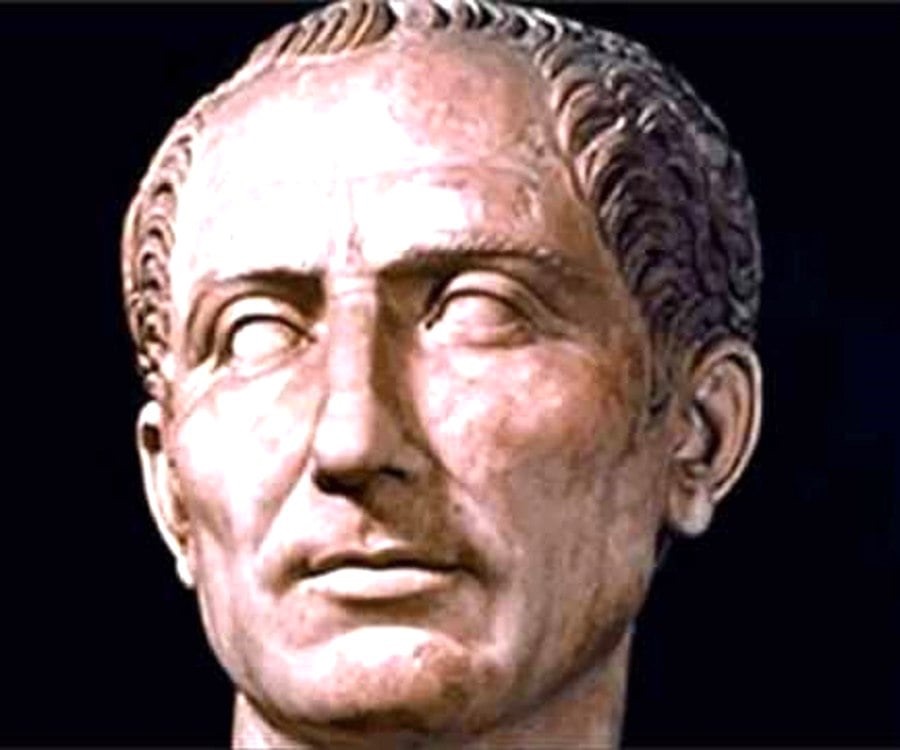
A Clean Shaven Julius Ceasar

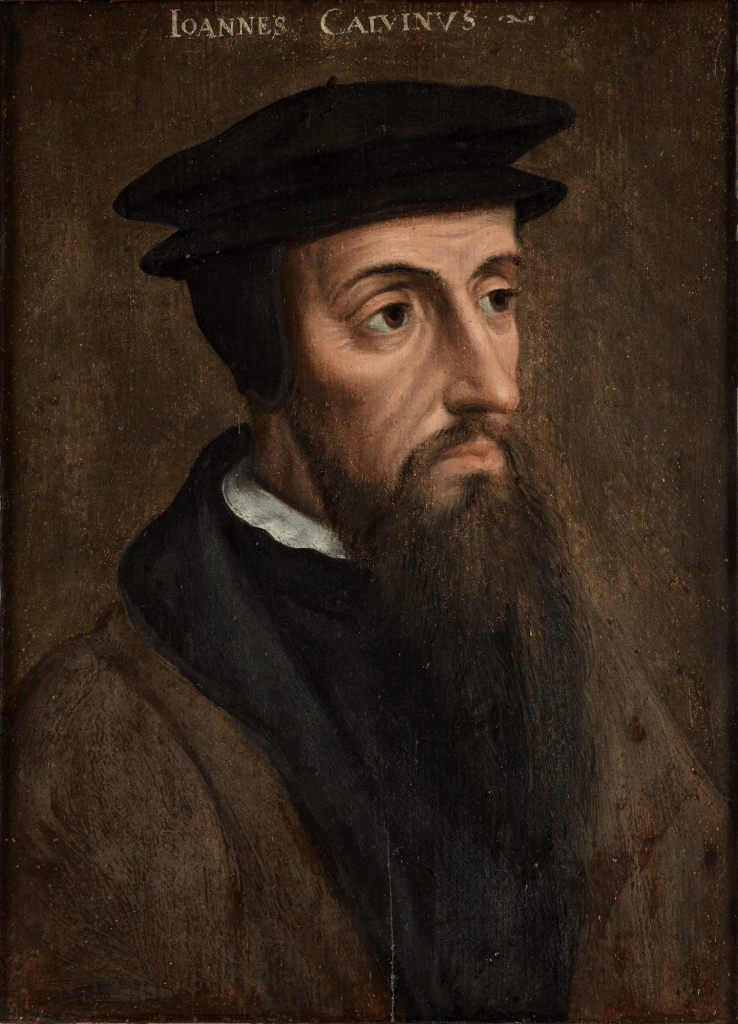
The Romans succeeded the Greeks and theirs was a distinctly anti-beard empire.  The emperors were predominantly clean-shaven from Julius Caesar, Augustus, Caligula, Tiberius et al.   It is evident in the various sculptures that have been preserved through the ages.  The invading Barbarians liquidated the Roman Empire and men’s facial appearances reflected their conquerors’ preferences.   The grandeur of Rome morphed into a region of scruffy, bearded, smelly infidels lacking in hygiene and good taste.  During the Middle Ages, hirsutism was the European norm.  Then Protestantism erupted.  There was a clean-shaven Martin Luther and bearded Henry VIII and John Calvin.  These gentlemen created a tectonic upheaval in Western history, religion and facial hair.

John Calvin, The Life of Any Party

Regarding beards, the Protestant Reformation created  the proverbial line in the sand.  During that period, Roman Catholic Church clergy were clean shaven.  As a matter of physically making an ecclesiastic statement, Protestants – with the exception of Luther- donned beards.  The religious battles with the Church were longstanding and the political positions of European states would follow a centuries-long conflict – rebellious England vs. Defender of the Faith France are a prime examples.  Both groups presumed a Michaelangelo-bearded Almighty God was on its side.

Politics and beards aside, many if not most men living between the 16th and 19th Centuries were unshaven.  A fundamental question persists regarding the decision:  to shave or not shave.  And that’s hygiene.  Men and women during those times were- shall we say- not terribly clean. European peasants reportedly bathed themselves about three times per year.   Washing and bathing were infrequent at best – remember Socrates and his flea-bitten disciples. If men weren’t washing their hair it’s safe to say the beards weren’t earning extra attention and were a safe haven for bacteria, vermin, dirt and last Thursday’s meat loaf.  During that era B.O. could mean either body or beard odor.

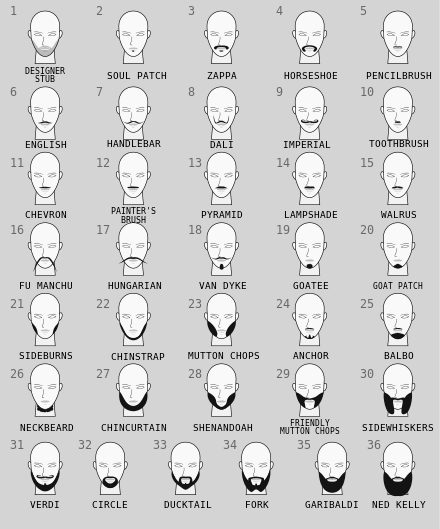
Facial hair history does have an historic timeline but today beards and mustaches provide an even more important contribution: Humor!  The laughter begins with the names.  Each style has a history and each generation seems to add various alterations.  There are more than twenty distinct beard styles with such names as The Garibaldi,  Monkey Tail,  Friendly Mutton Chops,   Verdi and, of course, the Van Dyke.

Henry David Thoreau And His Famous Neckbeard

          Many famous men have sported beards that become eponymous or create visual memory lasting a lifetime.  For example, Transcendentalist Henry David Thoreau was known for his masterpiece book “Walden” and other essays.  Thoreau was photographed with a beard style called the “neck beard”. While spending his time building a log cabin on the shore of Walden Pond, Thoreau decided the grow a beard that included only his neck.  His face was clean shaven that highlighted his crystal blue eyes.  During the 19th  Century many strange things occurred in Concord, Massachusetts and Thoreau’s facial hair was one of them.

          It’s uncertain if Thoreau was a trendsetter but it turns out New York publisher Horace Greeley also grew a neck beard.  German composer Richard “Die Meistersinger” Wagner also followed suit.  Henry David was in famous company.  Wagner’s contemporary Guiseppe Verdi sported a beard that became associated with the world’s most famous opera masterpieces.  From an historic standpoint, maverick Roman Emperor Nero purportedly wore a neck beard.

          Facial hair has always had a humorous aspect.  Beards and mustaches obviously alter a man’s physical appearance.  A white bearded Santa Claus evokes childhood memories of a fictitious character who represents mirth and holiday cheer.  Segue to a rock music Frank Zappa whose mustache/goatee combination was so well known that his style has become eponymous.  Seeing his facial hair evoke memories of Zappa’s record album Weasels Ripped My Flesh.

          One can’t help but laugh at some of the outrageous names attached to beards.  At the top of the list are the Mutton Chops and its offspring, the Hulihee and Friendly Hulihee.  Also included are the “Claus”, Shenendoah, Old Dutch, ZZ Top, Handlebar Chops, Friendly Chops, Anchor and the Full Spade. 

Andy “I Am The Walrus” Reid
A Beard/Mustache Glossary

Not to be denied, there are numerous mustache styles, some visually descriptive: Chevron, Lampshade, Painter’s Brush, Pencil – and the Parted Pencil .  Others evoke chortles: Walrus (think Kansas City Chiefs coach Andy Reid), Handlebar, English, Hungarian, Dali, Fu Manchu and the Horseshoe.  There’s the arcane Imperial Kaiser Wilhelm mustache and a hybrid called the Beardstache.

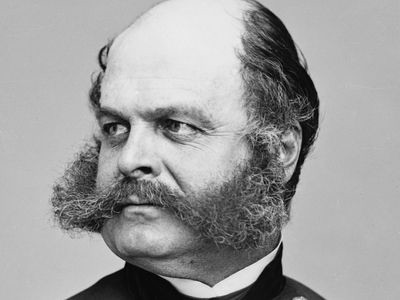
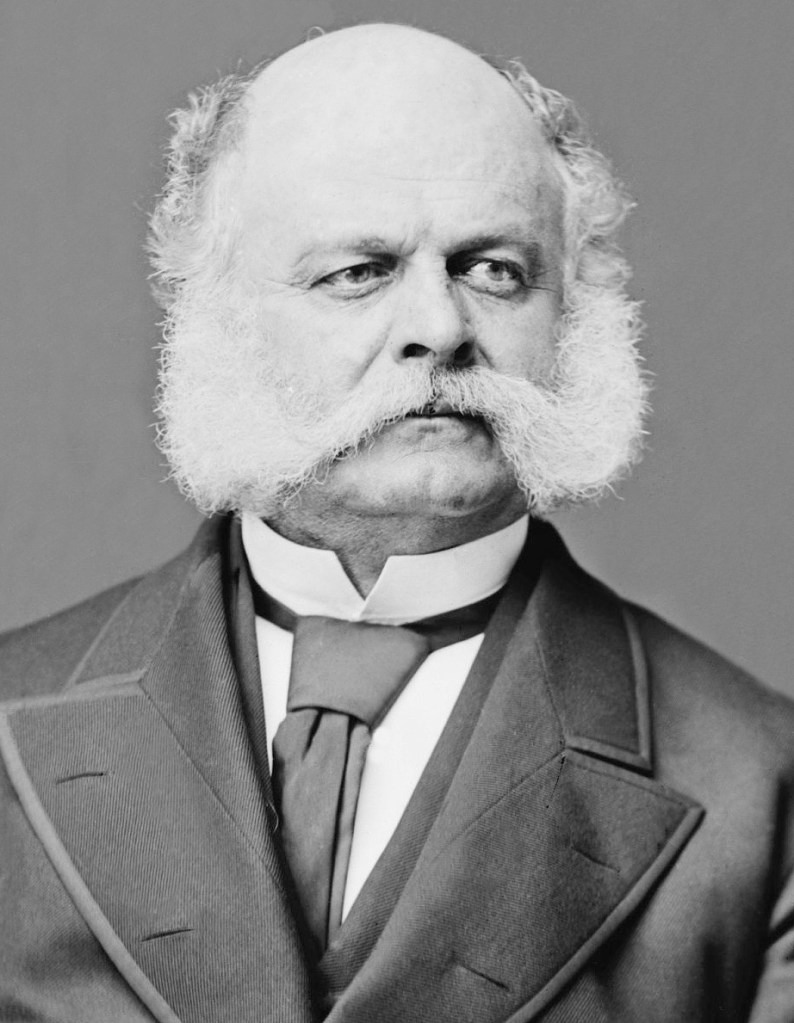
There’s plenty of history with these names.  Civil War General Ambrose Burnside – considered the worst Union commander – carved a niche in facial hair history.  Gen. Burnside started his career by growing hair adjacent to the ear.  He popularized the look that eventually was named “sideburns”, a style contemporarily popularized by Elvis Presley.  Of course Burnside wasn’t finished.  His facial hair eventually morphed into another signature style: Friendly Mutton Chops.  No one ever took Gen. Burnside or his beard seriously.

A Young Gen. Burnside With His Early Friendly Hulihee
Burnside With His Older Beard

          Noted Harvard trained paleontologist Dr. Keith Vitalis has dedicated his life to tracing the long hairy history of man’s obsession with beards and mustaches.

          “Men have a schizoid approach to mustaches and beards,” he said. “We either love them or hate them, myself included.”

          Vitalis speaks from experience.  He long ago decided to adopt a Janus-like appearance: he shaves only the right side of his face.  The left side has a bearded appearance resembling the full beard Garibaldi!

          “I do it for effect,” he said. “Some men love their facial hair; others are psychologically confused. For example, young men regard beards and mustaches as a rite of passage. Growing facial hair states ‘I am a man!’”.

          According to Vitalis, facial hair has psychological associations.  Men with weak chins or who have poor self images while shaved will hide behind a curtain of hair.  Other men try to make a social statement.  Today’s rock musicians are often bearded and express a counter-culture appearance while becoming millionaires with their musical success.

          What about old men who often sport a white mustache and/or beard?

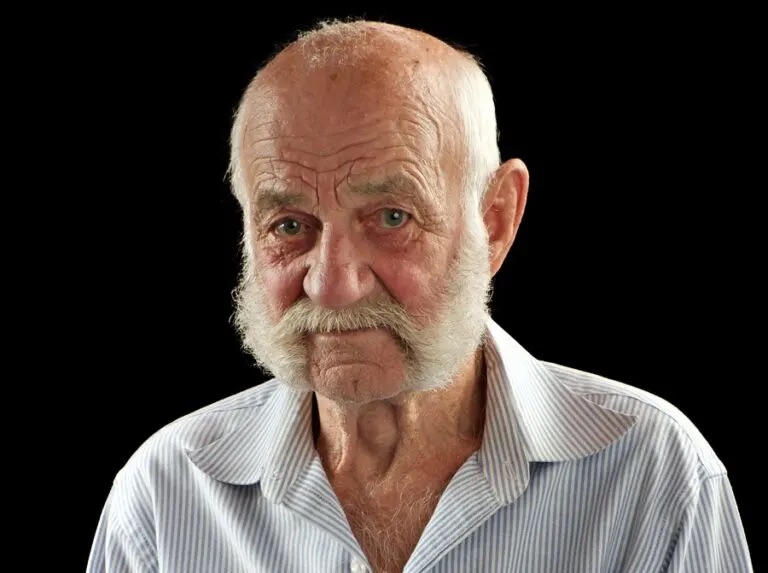
          “Some men think growing a graying mustache/beard gives them an avuncular or perhaps patriarchal appearance,” Vitalis said.  In reality many of these men are hiding behind a wizened mask. Older men with beards think the grey hair hides aging skin or a sagging gullet – the bain of all elderly men and women.  A 73-year-old man with a gray beard is simply calling attention to his chronological age.  Can you take any man seriously if he’s wearing a white Fu Manchu?, Vitalis asks.

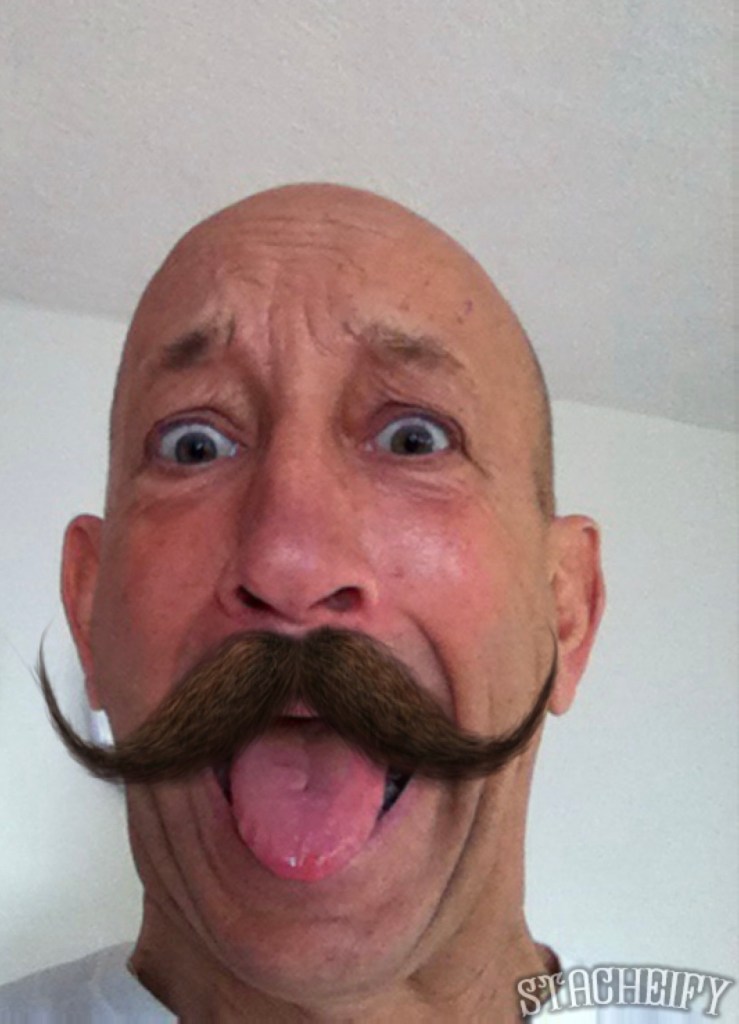
          Hairy faces have been with mankind since the dawn of time.  In  this era of computers, software and apps there is still room for fun.  Two ingenious apps, Beardify and Stachify, allow a man to create virtual and instant beards and mustaches.  One moment you’re Ulysses S. Grant at Appomattox or Moses parting the Red Sea.  All in the flick of a finger on a cell phone.  You can even transform women’s photos into a band of bearded ladies.  The laughter created by facial hair never ends.  It grows and grows and grows.

The Author Clean Shaven
The Author Beardified
The Author Stachified


****************************************************************************************

This is my blog essay number 60.  What started out four years ago as a diversion from the Covid 19 nightmare became a reinvigorated passion to write.  I’ve had fun stringing together essays and poems.  I want to thank my wife Kathy who’s been supportive in my endeavors.  She’s also my editor extraordinaire.  Thanks also to my dear close friend, optometry school classmate and colleague  Vince Giovannucci whose artwork and cartoons have  added such zest and humor to my essays.

Adonis On The Half Shell

By Leo de Natale

Adonis On The Half Shell

By

Leo de Natale

Illustrations by Vince Giovannucci

An elbow injury had forced me to alter my thrice-weekly exercise routine at the local gymnasium.  Instead of upper body weight machines that were painful, I concentrated on calisthenics and  leg exercises.  The quadriceps machine required me to push a solid angular platform with my lower legs.  I rested between reps and looked around me.  And there he was.  Directly across from me was a paunchy middle-aged man.  He had just arrived at the exercise station.  An Adonis he was not.

He was about six feet tall, probably in his mid-to-late fifties. A rumpled, faded Guinness Stout tee shirt outlined his growing pot belly.  He was lifting dumbbells while performing the aerobic step exercises, right foot, left foot, right foot, left foot.  Mr. “A.”sported a three-day-old beard that revealed graying chin whiskers. The scruffy look seems  popular these days but in “A”’s case it drew attention to his aging.  A neck gullet was forming and he was a hairy bastard. 

Mr. Adonis

As he turned his back to me I was astounded by his neck.  I’d never seen a man whose entire neck was camouflaged  by hair that belonged on his chest.  You physically could not see skin.  There was that much hair.  Very Neanderthal. I asked myself, how does his barber handle this hirsute challenge? A hedge trimmer or perhaps a Lady McCulloch mini-chainsaw?

Somewhere There’s A Hidden Neck

What was really amusing was his particularly bad “sweep over” that was making a futile attempt to hide his baldness.  Most bald men using this method have too few hairs to attempt to conceal the “curse of alopecia”.  This gentleman had allowed a three-inch wide band of side hair to grow and cover the middle portion of his bare scalp.  I was convinced he had applied mousse to prevent any movement of the “sweep”.  Those suckers were gonna stay in place, goddammnit, and be able to withstand the wind tunnel test.

Of course anyone who was on the gym’s second floor or standing 40 feet from him could easily see the fore and aft bare skin.  Sweep overs were man’s feeble attempt at deception  and the quintessential example of self delusion. 

The piece de resistance was his face.  “A” was bespectacled with Geek grade eyeglasses. They weren’t Armani’s or Ralph Laurens.  Just a cheap pair of Walmart spectacles that exposed his strong,  nearsighted prescription with thick lenses.  The most glaring issue, however, is our friend’s bad case of disfiguring acne rosacea, a skin condition that afflicts many persons of Northern Europe origins – English,Irish, German, etc. His nose, cheeks and chin were scarlet and called attention to his unattractive visage. 

Adonis Closeup

His cheeks  resembled an interstate roadmap.  He would never be considered a chick magnet.  He was wearing a grubby pair of Chuck Taylor high-cut sneakers but didn’t realize the Chucks had only recently become a faddist fashion items.  He’d worn that brand  since the 1970’s.

His  dorkiness was accentuated by a 1950’s-style wrist watch, complete with the  Speidel Twist-O-Flex expandable watch band; his timepiece was not a bespoke Rolex Oster Perpetual.  Few gym-worshipers wore watches because they were normally glued to their iPhones and constantly texting.  If wrist watches were worn they were either Apple iWatches or the black, macho, oversized G-Shocks that provided every conceivable function – day, date, moon phase, stop watch and, of course, the time of day.

“A” was among groups of older gym rats who are trying to attain physical fitness and weight loss, a process made difficult with ingrained eating habits and metabolism changes affecting body shape and change.   At the gym there are many sculpted younger men and women preening and strutting their stuff.  Young women tantalize the males with their skin tight leggings that would explode if they emitted a  combustible fart.  Adding to the titillation are the spandex v-neck jerseys that expose cleavage. 

Others wear gym tops that are basically bras-in-disguise with some extra fabric wrapping around the back.  Such displays cause much knuckle-biting among the strong, red-blooded American males!

Stretching Spandex To Its Molecular Limits

American women seem to want it both ways.  They flaunt their sexuality with provocative gym attire yet want to obliterate toxic masculinity.  Can’t have it both ways, ladies.  Blame it on the spandex.

Of course the preening men, most of whom are denizens of the weight room, display their male equivalent of such exhibitionis.  Those who are fit and muscular wear the sleeveless muscle shirts  exposing well defined biceps, triceps and pectorals.  They stare at themselves in mirror-lined gym walls.  They flex, admire their images and take occasional selfies.

          The men’s gym shirts are available online and have different styles and amazing names: Racerback, Stringer, Drop Arm Tank, Crest Tank, Sleeveless, Legacy Stringer, the one with little fabric in the back or front.  Of course, there was also the classic wife-beater undershirt that always appear in gangster movies.   

Drop Arm Tank Front

And Back
The Wife Beater T-Shirt

As an ever-increasingly added feature, many – males and females -are sporting tattoos in all shapes and sizes.  One fellow sports a black, full beard and is wearing a black sweatshirt.  I refer to him as Mr. Blackie.  Most people keep their sleeves loose at the wrist.

 Blackie, however, pulls the sweatshirt sleeves to his elbows where he exposes “sleeve” tattoos on both arms.  The tats occupy enough space to hide visible skin.  “Hey look at my ink! Ain’t it impressive?”, such an exhibitionist seems to say.  Some women display sleeve tats or something behind the neck, thigh or ankle.  Pick a body part and you’ll see ink.

Modern society has the acceptance of body tattoos and many, if not most Gen Zers  under age thirty have at least one tattoo.  Wait until they discover how unappealing these  permanent body alterations appear when they reach age 55, 60 and beyond.  Collagen loss produces flaccid skin.  The tats become an undiscernible  blob of black ink.

And then you have the geezer population.  Older men’s garb at the gym is usually comprised of baggy sweatpants and oversized sweatshirts emblazoned with a faded “Old Orchard Beach, Maine” emblem.  The really old guys eschew gym garb and wear chinos and a well worn plaid flannel shirt and/or polyester short sleeve dress shirt dating to the 1960’s.  This group is not interested in making a fashion statement.  Older women try to hide the sagging body parts with loose gym clothing.  But, hey, both the senior men and women are at least trying to remain physically active.  Points for the seniors.   It’s better exercising at a gym than morphing into a couch potato.

By the time a person reaches age 70, the body parts are wearing out.  A knee replacement here, a hip replacement there.  The human body changes appearance.  Most are moderately to severely overweight.   Everything sags.  Our faces start resembling a stone quarry.  Double chins suddenly appear; a gulletectomy is needed.  A man’s Adam’s apple disappears.  April is the cruelest month of the year, right, T.S. Eliot?

As for me, I’m included in the geezer group.  But I’ve tried to stay in shape – I’ve been regularly exercising for more than thirty years.  Although I’m happy to keep my weight down but some things change and there’s no controlling sagging, flaccid muscles, a slew of brown age spots, skin turning into crepe that create old man’s hands- just like my dad’s. 

Aging is a bitch, physically, medically and emotionally.   For such men as Mr. Adonis, the reality is premature.  I hope he turns things around.  For me and so many of my old brothers and sisters it is “One day at a time, one moment at a time, baby! Amen.

Made In China

Made In China

By

Leo de Natale

Illustration by Vince Giovannucci

Classic Opera Slippers

September, 2023

CPA Joe Di Nobili was in a foul mood. There was discord at his accounting office. Personality clashes had erupted and his job as Chief Executive Officer was to put out fires. There had been growing tension between two of his employees. It was a turf battle and he’d seen these tempests many times during his 30-year career. As in most offices, intramural friction created a lot of agita.

In his late forties, he was an attractive man. He was tall and fair skinned. His eyes were an unusual light green. His hair was brown and he had a slight cleft chin. He did not fit the description of a stereotypical Italian. He and his Irish Catholic wife Karen had two children, both of them were in college. Joe and Karen were presently empty nesters. They’d come to enjoy the quiet and solitude. They met at Tufts University. Joe received his MBA and CPA from the venerable business school, Babson College.

After the day’s squabbles at the office, he was glad to be in his suburban home in Arlington, Massachusetts where he could relax and have supper with his wife. After their meal the two sat in the living room. As a means of escaping the day’s hassles, Joe was reading another Scandinavian noir murder mystery. He rested his feet on a leather footstool and paused to admire the new tan opera slippers he’d purchased earlier that week.

       Good footwear was important to him but ever since childhood he dreaded buying new shoes, boots, sandals or slippers.  His feet were oddly shaped and sometimes difficult to fit.

       He had bought the slippers – the traditional brand L. J. Stoutfoot’s- at his favorite, longtime, old-fashioned shoe store in nearby Cambridge.  The footwear sold there were expensive but the salespeople were longtime employees who knew how to fit shoes.  Slippers and moccasins were an integral part of the inventory.  Customers knew they’d be paying top dollar but the service and customer relations were incomparable.  The slippers cost $90 and Joe didn’t mind the price although he discovered Amazon.com was selling the same shoes for $50.  No matter.  He preferred  buying something the old-fashion way.

After dinner Joe removed one slipper and admired his purchase. These slippers were incredibly comfortable and they looked good, too. But hold on, he saw something was wrong. The stitching inside the left slipper was unraveling and he discovered the lining wasn’t leather. It was vinyl-covered fabric. Fake leather. Curiously, he looked inside the slipper and suddenly it all made sense.

Underneath the manufacturer’s label was a second piece of fabric stating the country of origin. It bore all-too-familiar words: “Made In China”.

“God, everything is made in China, honey,” he bemoaned to Karen. “Look at this. I pay top dollar for a Stoutfoot slipper and it isn’t well made. It’s vinyl, not leather and is crap. That’s what it is!”

On Saturday, Joe traveled to the store and showed the defect to a salesman.

“I’m terribly sorry about this, Mr. Di Nobili,” he said. “I’ll just exchange this for a new pair.”

A new pair was inspected. There was no stitching defect. He left the shop followed by a storeful of apologies.

He returned home and went his usual weekend chores. Fall was fast approaching and he busied himself with grabbing some rakes that would be used after the leaves turned color and fell, leaving a carpet of red, yellow and orange.

He visited a local garden center and began purchasing the tulip bulbs that would be planted by mid-November. The days were still warm, the nights cool. Good planting weather, good sleeping weather.

That night, Joe opened the box containing his new slippers. He put them on but, wait a second, something felt funny in the left slipper. Removing it he was in disbelief. The insole pad covering the slipper bottom was loose and flapped open near the heel area. What is going on here? Yet another example of shoddy workmanship.

“Can you believe this, Karen?” he yelled. “These shoes are so damned comfortable but they’re merda!”

He’d been searching for good looking slippers that also provided comfort. He decided he’d give these suckers another chance and instead of returning yet another pair, he drove Monday to his cobbler John Gillooly who applied glue to the insert.

“Boy, the footwear they’re selling to us Americans is shitty,” John said. “Like they say, things ain’t the way they used to be. Don’t use the slippers until nighttime. Glue should be dry by then.”

Three months passed and Joe was indeed enjoying his slippers. They were very comfortable and he laughed because the style was very similar to the slippers old Italian men, his father included, wore around the house or working in their gardens. He remembered his paternal grandfather Joseph, “Nonnu” who’d emigrated from Messina, Sicily in the early 20th Century. Joe always joked about Nonnus being from central casting. A proud man, the father was short in stature but retained the Sicilian preoccupation with “respect”. That also accompanied the legendary Sicilian temper. Joe possessed a diluted version of Nonnu’s quick trigger. Things such as the office imbroglio would quickly summon the family trait.

Vinny De Vito, Joe’s best friend and college classmate, was a first generation American whose parents were born in Italy’s Abruzzo region. Vinny jokingly referred to the slipper style as “Scampies”, a name used by Italian men from Abruzzi. Vinny described the stereotypical appearance.

“You’d have these old Italian guys wearing their uniforms,” Vinny said. “The wife-beater t-shirts, the pot belly, the Italian cigars, and the Scampies. They’d shuffle around looking for that last glass of red wine before supper.”

An Italian and his Scampies

Vinny spoke the truth. He recalled Grampa Joe sitting in the living room and the image was a photocopy of what Vinny had just described. Of course the sofa was typical Italian: clear plastic covers and arm rests draped with white doily antimacassars. During the winter, his grandparent’s house reeked of moth balls, a common scent in immigrant homes.

The nostalgic daydream had wafted over him on a fall weekend. One day in October, Joe was noodling around the house. He was wearing the slippers and suddenly his left ankle buckled. No pain, no injury but the incident was odd. Until he inspected the slipper and gasped.

“I don’t goddamn believe this!” he bellowed.

       What Joe had observed was the left heel.  After three months it was worn down and the cheap fabric was exposed.  The heel and sole were completely worn away.  Joe was livid.  After a mere three months, the slippers were coming apart.  Jeez, you pay good money for  products that used to be made in the United States and the companies now manufacture them in some hellhole factory in China or other Asian countries.

       The following day Joe made a beeline to the shoe store and once again approached the manager.

       “I’ve had these slippers for three months and look at them,” he said while suppressing his volatile Sicilian anger. “Selling a product that is substandard and poorly made is not a good look for the business.”

The manager sheepishly looked at the disintegrating left heel and was embarrassed. His facial expression was a Jackie Gleason hamana, hamana, hamana.

“Gee I apologize again, Mr. Di Nobili,” he said. “I can give you a new pair. Is that okay?”

“No, it’s not,” De Nobili replied. “Because you know what’s going to happen? I’ll be back in another three months with the same problem. I tell you what I’ll do. I’m going back to my cobbler and, I’ll have them re-heel this poor excuse for ‘well-made’ slippers. If the work is too expensive, I’ll ask for my money back.

“Well, I got to be honest with you,” the manager replied. “All of our slippers, regardless of the company, are Chinese manufactured. My boss says there’s nothing we can do. The ones made in Europe, for example, are too expensive. Retailers are between a rock and a hard place.”

Once again, Joe returned to John the cobbler who assured he could replace the heels with rubber and the cost would be minimal. Five days and $35 later the slippers had been repaired. John was a craftsman. Hopefully, they would now last. Joe was angry. A $90 product had now cost him more than $130. What a rip off he said to himself.

That evening, he started searching the internet regarding the China/United States trade deficit. Many people talked about it but it was an exercise in frustration. The statistics were frightening. He traced the trade patterns from 1985 to 2022. In 1985 China exported goods – electronics, cell phones and clothing – totaled $3.86 billion. In 2022, the total exports were $535 billion while the United States exports to China was a measly $110 billion – a three-to-one drag on American economy. Joe’s slippers were part of that.

He grew up during the death throes of the 20th Century’s Cold War. Russia’s Soviet Union had imploded and the Western World sighed with relief. Through his education and experiences running a business, Joe realized one monster was replaced with another. From 1990 to 2000 the world had experienced a brief respite from turmoil. Then came 9/11, an event that continued to fester.

Concurrent with that event was a different Cold War and the new bogeyman, Red China. Joe long realized this. He worried over his children. What type of world will they lived through? It was a depressing question.

February, 2024

Joe and Karen decided they would approach life with the eat, drink and be merry attitude. The Serenity Prayer’s, One Day At A Time, became their mantra. Joe’s Sicilian blood made that decision easy. Italians usually find a glass half full.

As for the disintegrating Scampies, the soles began to split. He unceremoniously tossed them in the trash can. The same day he drove into Boston’s financial district and purchased a pair $400 genuine leather Bally slippers made in Switzerland. There’d be no more ersatz footwear. He smiled while driving home. Salut!