Ink

Ink

By

Leo de Natale

I was shopping at a Star Market store the other day. It was unusually hot and humid. As I exited a masked, sweaty, obese, gray-haired lady wearing thick eyeglasses was entering. She was probably in her 70’s or 80’s and dressed in a grandmotherly v-neck dress. She wouldn’t be confused with a sex symbol but there it was: in the middle of her wrinkled, senescent bosom was a new, multi-colored rose tattoo. I stopped, stared and said to myself, “What is wrong with this world?”

          Each generation has its trademark visual identity.  In the 50’s it was the greaser, doo wop look.  Cool guys wore funky suits.  Hip girls wore hoop skirts, white socks and saddle shoes.  It was the era of the malt shop and Ozzie and Harriet. Along came the 60’s and war protests, long hair, free love and lack of personal hygiene.  The 70’s witnessed the Watergate era numbskulls Gerald Ford and peanut farmer Jimmy Carter.  It was a comparatively dull decade.  The cold war, however, still existed.

Then there were the 80’s and 90’s decades. Tattooing one’s body was slowly becoming mainstream. By 2020, the act of being tattooed by “artists” has now become a rite of passage. Most adults between ages 18 and 30 undergo the painful process of social acceptance. The location of ink is literally anywhere on the human body. Today’s generation have neck tattoos, leg and ankle tattoos, hand tattoos and the physically disturbing “sleeve” tattoos where entire arms and legs have so much ink the bare skin underneath is many times invisible.

Tattoos have also migrated to the human face. As part of this bodily desecration young men and women sprinkle their faces with body piercings above the eyebrows, around the lips, along ears or nose piercings and rings. Observing this from an older generation, I ask what these people are doing to themselves? Perhaps among their contemporaries it’s considered a normal expression of what they call “body art”, expressing “how they feel” in a graphic, visible medium. To me it is anatomical graffiti and no different from the aerosol “tagging” seen on bridge overpasses, abandoned buildings, and, lately, statues and buildings that were once considered sacrosanct. The heavily tattooed are walking billboards of the grotesque.

A friend recently noted that men and women who tattoo their necks and faces should also have the word “LOSER” inked on to their foreheads.  What employer  would hire someone who will be dealing with the public?  Bodily disfigurement may have peer acceptance but many non-tattooed folk find it difficult to look at these freaks.

Like supermarket Granny, many older persons have been seduced by the alleged hipness of ink. Go to any mall or and you’ll see middle-aged men and women with freshly-inked tattoos. Most lack the slim, trim bodies of the young. There’s nothing worse than watching a woman in her 50’s with dragon tattoos located on cellulite-laden thighs or sagging biceps. And a pot-bellied man wearing knee high black support stockings with a clawing panther tattoo along a bicep. Not a sexy look.

If you delve deeper into the subject, there’s a long history of human beings covering themselves with tattoos. Egyptian archeologists have unearthed tattooed mummies. The Japanese have been tattooing for more than 5,000 years. Many of these are full body tattoos that exclude only the neck, hand, and feet from inking. The tattooing in some cultures had mystical meaning. Japan banned the practice in the 19th Century but is still exists. Other cultures in Asia and Indonesia have similarly long histories of body inking.

Certain Native American tribes also practiced tattooing.  This assault on the beauty  human bodies has occurred since we were cave dwellers.  The practice has always appealed to various segments of society, some very rich, many very poor.  British Royalty in the 19th Century sported “discreet” tattoos. Today, the fad has increased in  popularity, especially among the young.

The essential question is why inking has become incredibly popular.  According to New Age writer Sloane Solomon claims depression is a psychological component to tattooing. “Tattoos remind us of what we’ve already been through… as well as the continued strength and hope that the future brings”.

Inked magazine concurs, but a more overwhelming reason factor is fashion.  I think it is more a generation’s decision to embrace conformity– “I’ll do it because everyone else is doing it”.  Classic peer pressure.  There are examples of such behavior.

“I got my first tat when I was 18,” said Charlie “Spike” McCoy. “And that was before I joined the Angels.  “You always get a specific tat when you’re initiated.”

McCoy, now a wizened 45-year-old, is a member of the Hell’s Angels Club of New England. Spike sat with me in a Cambridge bar and chugged several beers during an interview.   The club has an infamous reputation.  It’s been known to  dabble in criminal activity and firearms sales.  Spike is heavily tattooed.  Both arms have the sleeves.  Getting inked, he said, is a tribal ritual. 

His face is craggy and it speaks to sex, drugs, and rock ‘n roll.  He has a broadly flattened nose  — he’s an ex-amateur boxer.  At 6’1” he is physically fit.  But age has caught up with him.  His fingers are gnarled from numerous fist fights.  He’s bald but vain enough to sport a gray toupee.  Given his involvement with the Angels, I was tempted to ask him if the toupee was bulletproof.  Angels need all available protection.

He said many “brothers” have daytime jobs, mostly blue collar, but once initiated these fellas have fealty to the Club. He admitted he’s done prison time in “The Big House” but wouldn’t name the crimes.

Whether or not they belong to the numerous clubs, many bikers make their annual pilgrimage to the Sturgis, South Dakota Motorcyle Rally and it is a sea of tattoos. Sturgis is considered THE event for biker enthusiasts and exhibitionists. Who has the most chrome? Who has the most bodacious paint job? Many “biker chicks” travel along, glued to the Harley-Davidson’s back seats but Sturgis wreaks of testosterone. It’s macho men on steroids.

A world away in numerous cities across America , men and women visit their local parlors and endure the  painful, expensive process of inking up.  A person can pay $50 for a small tattoo.  Having one’s entire back tattooed can cost up to $5,000.  The experience causes excruciating pain and potential infection. 

At a tattoo parlor in Boston, I spoke with a hair stylist, Renee, a buxom 25-year-old wearing a low-cut  blouse who was undergoing a right arm sleeve tattooing.   The multicolored images included a unicorn, vampire and a profile of the Blessed Virgin Mary.

“It, like, expresses my life and, like, my imagination, ya know?” she said with a voice that contained both verbal “upgliding” and “vocal fry”. “Like, every image has a meaning, ya know?”

She told me most of the co-workers in her trendy salon located in Boston’s Back Bay had similar tattoos. “It’s, like, the thing to do.” Renee also had the obligatory facial piercings and another tattoo at the base of her neck. I presumed there were other bodily locations that were inked.

Her left breast did have snake’s head tattoo peering from the blouse.

Today, body art transcends all socioeconomic lines.  I had a medical  appointment with the 30-something, Harvard Medical School  physician  who had a tat on his upper left bicep.  It was discreet but there.  Even my 59-year-old mailman has a small tattoo located on his right calf.

Body art has indeed become commonplace.  Italo-American comedian Sebastian Maniscalco has a great YouTube video where he mimics someone who has a giant serpent tattooed enveloping  his body as a testament to his late father, he says.  Sebastian apparently doesn’t like tattoos.  His punchline is “Why put a bumper sticker on a Ferrari?”  Every picture tells a story, but not necessarily on someone’s forearm or thigh.

Body tattooing is here to stay. Will it continue to remain a socially acceptable desecration or will it be a fad that loses its cachet? One thing is certain the human body’s skin changes as we age. A 20-something today will discover in his or her 40’s, 50’s and beyond that skin loses its elasticity. Humans develop collagen breakdown leading to wrinkly skin. The dyes used in tattooing diffuse beyond original borders. Eventually the images blur and devolve into colored Rorschach tests. Go to a beach and inspect some 70-year-old ex-sailor’s tats. The ink’s there but the details are unrecognizable.

Hair stylist Renee’s snake’s head will eventually resemble an old Emoji. And the supermarket Granny’s new chest tattoo won’t hide the onion skin beneath the ink.

The Love of a Horse

The Love Of A Horse

By

Leo de Natale

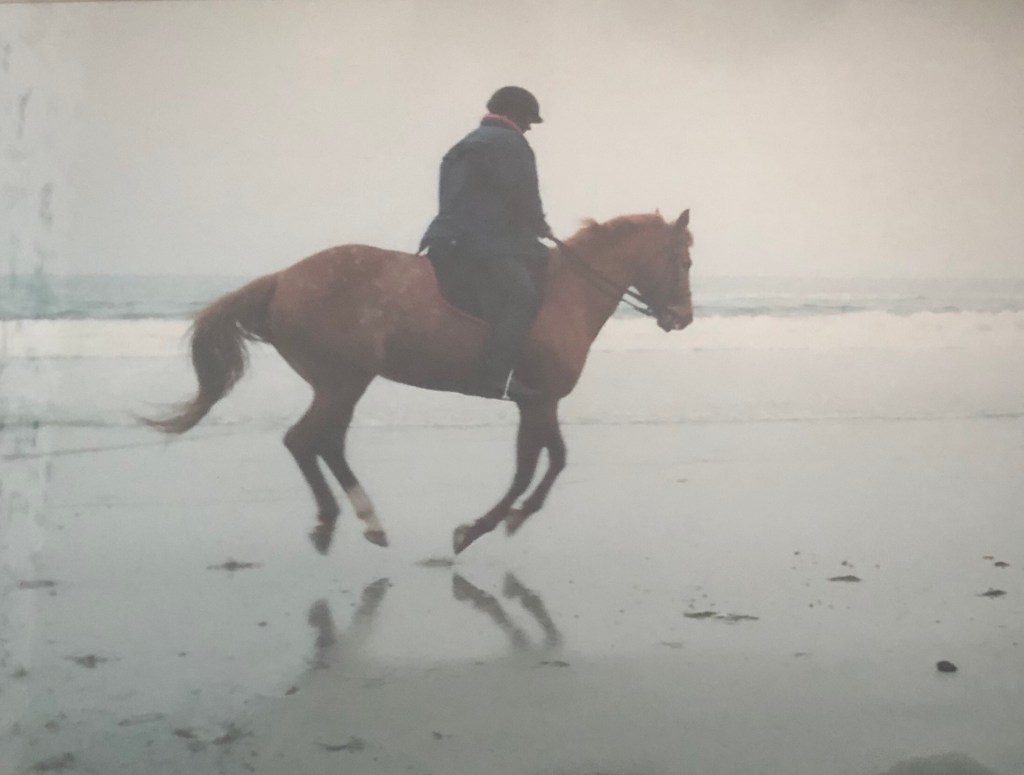
The author riding Straw’s Essie at Plymouth Beach, MA

On a crisp autumn day, riding a horse at full gallop is the greatest adrenal rush one can experience. Guiding a 1,200 lb. animal across a grassy field is exhilarating. You feel the speed, the pounding hooves, the refreshing cool of the wind in your face and the sound of staccato hoofbeats of a magnificent beast. Man and horse traverse meadows as one swiftly moving unit. The art of riding is an atavistic pleasure. When one rides, he or she is experiencing a thrill that has been occurring for millennia. We replicate what Genghis Kahn, the Greeks, Romans and all subsequent conquering nations have discovered: the bond between horses and humans is never ending . Every time a rider saddles up, the continuum is perpetuated. We are riding with Julius Ceaser, with Spanish conquistadors, Napoleon, George Custer and countless cavalry soldiers and adventurers.

Until the 20th Century, horses were indeed beasts of burden. They pulled wagons, tilled fields, changed the lives of Native Americans, transported humans in carriages and were ridden and slaughtered on such battlefields as Bull Run and Gettysburg. Most horses experienced miserable lives that ended at an abattoir. Today, horses have been primarily relegated to a pleasure activity. In certain parts of the planet they are still worked but the days of universal equine use and abuse have passed.

There is no question about the love and admiration mankind has for these noble animals.  We revere them in paintings, sculptures and statues.  In the era of war horses, soldiers literally looked up to cavalry officers.  Horses have always instilled admiration  among those on foot.  No one wants to be trampled and that inherent fear remains unchanged.  Many are fearful of riding them.  They are big and powerful.  And beautiful.

Watching horses in a pasture is pure bucolic beauty. The sight of their foraging with supple lips, racing along a fence line or resting on their sides covered with mud are simple pleasures. It is a joy to be present at feeding time and hear the rhythmic crunching as a barn full of horses consume their twice-daily ration of feed. In winter with barn doors closed, the stables are surprisingly warm from equine body heat. The accompanying aroma is a delight. When a horse whinnies and neighs under saddle, its body vibrates with equine excitement and reverie. Most riders are tickled by the sensation. They also experience the jolt when the horse – especially in springtime—bucks with gusto. Horses express their emotions in very physical terms.

In the United States, horseback riding has become a sport. For many it is a leisurely pastime where human and horse travel in primeval forests, flatlands and mountains. There still is thoroughbred racing and cowboys on horses do exist out West but the majority of horses are used for pleasure and relaxation. Owning and riding a horse does appeal to aristocrats and social climbers who engage in horse shows and competitive events. Riding became more egalitarian during the last half of the 20th Century, something middle class folk could enjoy. In the West, you often see horses in backyards. Many riders lease horses; others purchase them at prices varying from an inexpensive grade horse to jumping and eventing horses costing more than $100,000.

It is an expensive sport. Saddles and bridles from England, France and Germany sell for thousands of dollars; used or synthetic saddles are more reasonably priced. The cost of boarding a horse varies. Show barns, where horses and riders are involved in competitive events, are costly; others, where riders own or lease pleasure horses, are comparably affordable. There are also veterinary bills and horseshoeing fees.

But the magic of equine husbandry has always been there whether someone leased or owned. There’s a sensual quality of horseback riding. The sight of a grazing horse in pasture, the pungent aroma of horseflesh, the sounds horses make – whinnying, snorting, neighing and soft huzzahs—all provide delight to horsemen and women. There is the soft, velvety feel of their muzzles. In a sign of equine affection, horses will lean their shoulders against riders, especially during grooming sessions. There are the munching sounds when offered carrots or apples.

Riding can be a sociable sport with boarders discussing riding conditions or sharing barn gossip, all with the comradery that creates bonds among riders who often ride in groups. It is also can be a solitary activity where there’s only a rider, horse and nature. Many a rider suspends reality and harkens to an unspecified time and place where there’s peace and tranquility. Trailblazers, pioneers or explorers rode alone. Horses became their trusted companions. While horses don’t display the bond humans have with dogs, many a horseman will tell you his or her horse recognizes them and manifests rudimentary affection.

There are many rituals involved with riding. On a typical day, the rider strolls to a paddock or pasture where his or her horse will be grazing on field grass. The horse will be led to the barn where the clippity-clop of horseshoes on concrete is music unto itself. Riders nestle in the aromatic atmosphere barn smells of manure, hay, horse sweat and saddle leather. Then comes the husbandry that has been performed for centuries.

With horses, grooming goes from bottom to top. The riders first inspect the hooves and, with a hoof pick, remove the impacted mud and dirt. They feel the hooves and check to see if there is heat, an indicator of hoof health. They inspect the iron shoes. Is there a nail missing? Is a shoe loose? A trail ride can be canceled if any of these routine problems are discovered. From the hooves, riders glide over the four legs and make sure there is no inflammation or tenderness. They also look for deer ticks, those disgusting parasites that cause Lyme Tick Disease. Finally, the horse is ready for brushing. Most horses –especially in summer- roll in dirt or mud to protect them from ubiquitous and irritating flies. Using a variety of brushes, the dirt is removed the legs, rib cage, back and rump. The cross-tie area is awash in dust and horse hair.

Last, the mane and tail are untangled with human hair brushes.  Many riders use a detangling spray that makes the job easier.  The spray has a pleasant scent, too.

There are various levels of pre-ride preparations. Riders can be perfunctory and prepare for riding as quickly as possible; others are fastidious and want their horses properly turned out. It is now time for tacking up the horse. Most barns have tack rooms where saddles, bridles and reins and saddle pads are stored. Out they come and the horse is quickly saddled, bit inserted and reins attached. In summer, many riders use fly spray and douse the horse, especially on the neck, underbelly and tail.

Riders, especially those who ride with English-style saddles, usually grab gloves and a riding crop. The safety helmet is donned– there was a time when falls from a horse caused serious or fatal head injuries. Most barns require mandatory helmet use. Horse and rider walk towards a mounting block, riders swing the right leg over the saddle, boots are secure in the stirrups and the adventure begins.

The beauty of riding is the ability to ride year round. In springtime, the rider revels in verdant scenes. Trees are spreading their leaves, the grassy knolls and forest undergrowth are green. The smell of springtime is incomparable. Forging across racing streams and the sounds made walking through water is a joy. The view atop a horse is different and special. Summertime brings heat and flies. Nearly every rider uses a fly whisk, a shortened crop with horsehair attached and resembling a dust mop. Conservative riders won’t engage in too much galloping or cantering during midsummer. Heat stroke can occur if the riding period is too long or strenuous.

When rider and sweat-laden horse return there is the bathing ritual. A hosedown with cool water is followed by pleasantly scented horse shampoo. When thorough rinsing is complete, a squeegee-like device called a sweat scraper removes the excess water. After the bath, most riders will graze their horses until the coats are dry and gleaming.

This is done because the dry, bathed horse invariably returns to its paddock, lays down and again covers itself with dirt. All the cleaning and primping is for naught. Riders usually shake their heads and smile at their exercise in futility.

Autumn is a favorite season for riders. The temperature is cooling, the insects are disappearing. Horses are more frisky. It’s a time when when a four minute gallop becomes invigorating for horse and rider. Again, from atop a horse, the rider revels in the pastel colors of foliage – yellows, reds, oranges – that blend together and create an impressionist painting that lasts for a mere two-to-three weeks. It is also the fox hunting season. Hunt clubs are very popular in the Northeastern states. There’s a certain elitism to such events but most clubs allow day-trippers to enjoy the excitement of jumping over countless fences. That’s the adrenaline rush on steroids.

Fortunately, no real foxes are used. The hunt clubs conduct “drag” hunts where fox urine is applied along the appointed trail route. Foxhounds eagerly pick up the scent. A popular activity during these hunts occurs at resting “check points”, where the hunters stop and sip whiskey, schnapps or brandy before noon. The sweaty horses merely stand, cool off and smell the booze.

Fox hunting and fall pleasure riding occur before the ground is frozen.  Season four begins in December.  Usually the rides are limited to trots and canters.  Tundra can be harmful to horses’ legs.  During this period, horses are re-shod with winter shoes that possess iron studs allowing them to traverse slippery ice and snow.  Many horses have their woolly coats clipped.  This prevents excessive sweating but also requires horse blankets to provide warmth.  Intrepid riders love this period, too.  Unless there’s a severe snowstorm or blizzard, horse and rider can traverse trails.

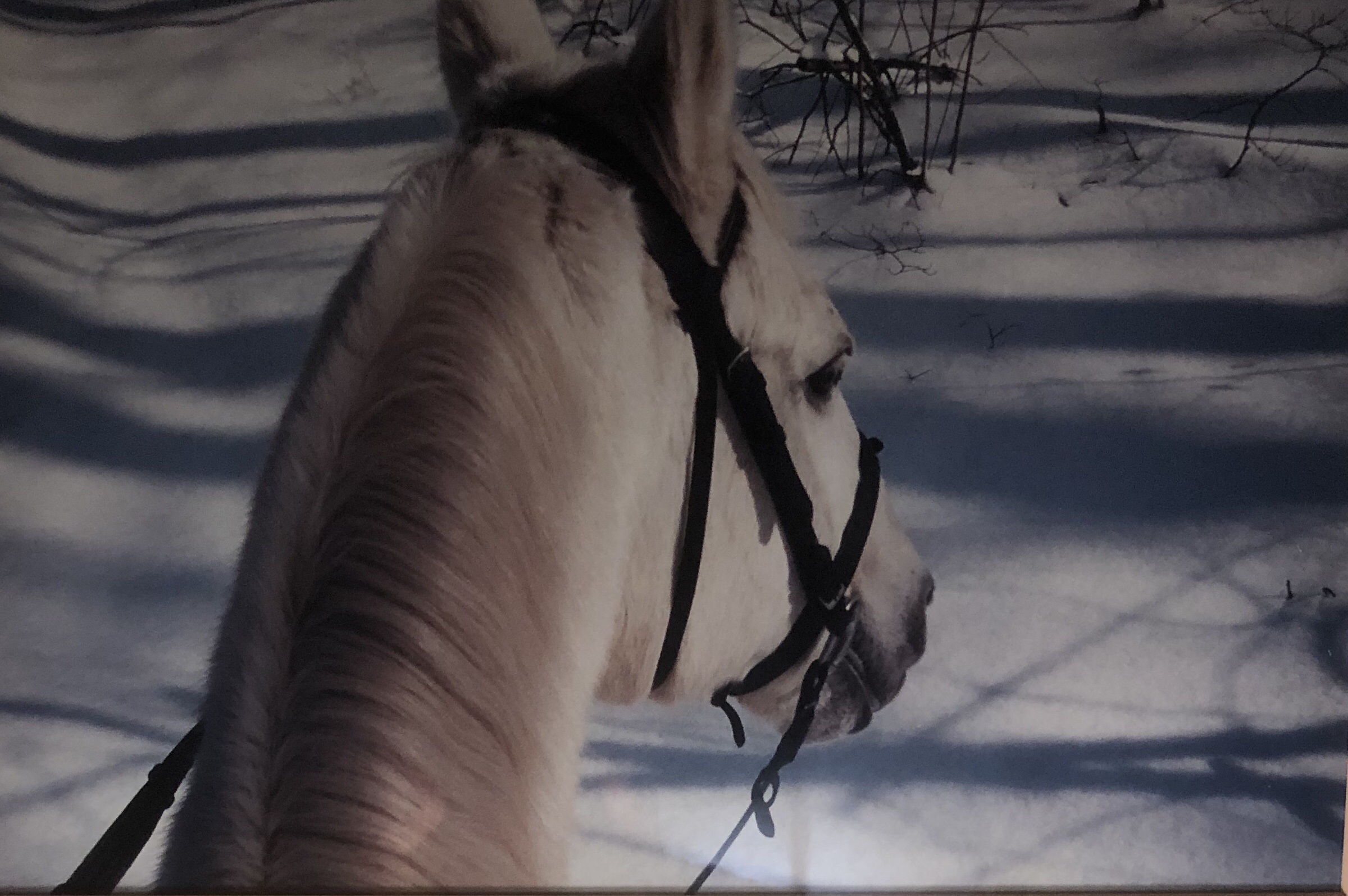
After a snow storm, the forest and trails have a magical beauty.  Tree branches are covered with snow and icicles.  There are incredible vistas in  meadows that glisten with virgin snow.  Animal tracks – fox, rabbit, coyotes – are easy to see.  The horses work harder in the snow and their noses discharge the white vapor of their breathing.  Perhaps the most enjoyable part of winter riding is the quiet.  Hoofbeats are muffled and, apart from an occasional snort, there is a calmness of the spirit.  Riding a horse in wintry solitude has that effect.

Riding “Smokey” after a Dover, MA snowfall

Unfortunately the trance is broken. After an hour, the rider’s feet and hands become so cold, it’s time to return to the barn. Thawing riders will trade stories of their specific routes. Which trails were more icy, places where the snow is too deep and difficult to traverse. Hot coffee and donuts are shared. Everyone leaves and thinks about the next ride. And the ride after that. Riding becomes an addiction. The beauty of riding horses is its longevity. With the right horse a rider can ride throughout his or her life. Some ride into their 80’s. They’re the lucky ones. They spend their leisure time with the love of nature and the love of a horse — one of God’s gift to humans.

Vitreous Humor

Vitreous Humor

By

Leo de Natale

Illustrations by Vince Giovannucci

       I graduated from optometry school in 1981.  It was a time when the profession’s tectonic plates were shifting. Theretofore it was a hybrid occupation: half optician/half eye doctor.  It was a time where at optometric conventions the audience, mostly male, was awash in white belts and shoes, toupees, and pinky rings.  At the annual New England optometric conventions, most of the exhibitors who underwrote the meeting were eyeglass frame companies, lens manufacturers and equipment salesmen.  The rooms were always filled with cigarette smoke.

       Historically, optometrists have had an inferiority complex.  Ophthalmologists were the schoolyard bullies.  They were bigger, smarter and stole patients.  Many of us were smitten by the question, “But are you a real doctor?”  Clinical psychologists and podiatrists and chiropractors encountered similar professional insults.  Here is the world according to older optometrists:

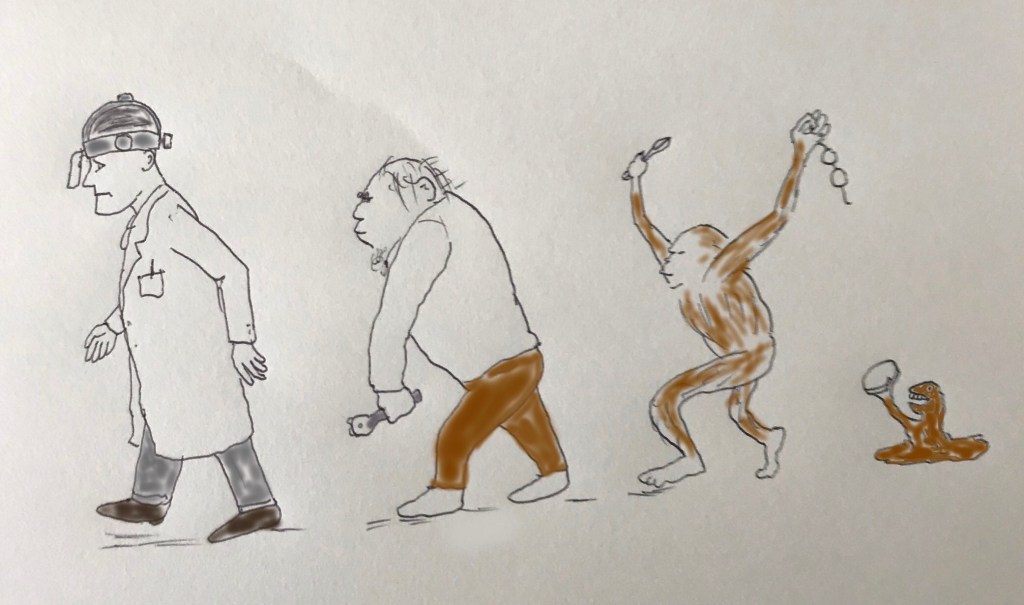
Lens grinders were the primordial slime; opticians Cro-Magnons; optometrists Neanderthals; ophthalmologists homo erectus.

Optical Evolution

My class was the first to witness the changes directing optometry towards a medically-based profession. The academic decision makers decided optometry would begin emulating ophthalmologists and de-emphasize mercantile opticianry. It was the profession pushing the envelope and transforming us into make-believe MDs. The ‘81ers, still had one foot in the optical shop and the other in the examination room but that was made the profession challenging, especially those classmates who, like myself, worked in private practice. Optometry, however, was changing. Many were finding positions in clinics and working for ophthalmologists. It was known as sleeping with the enemy.

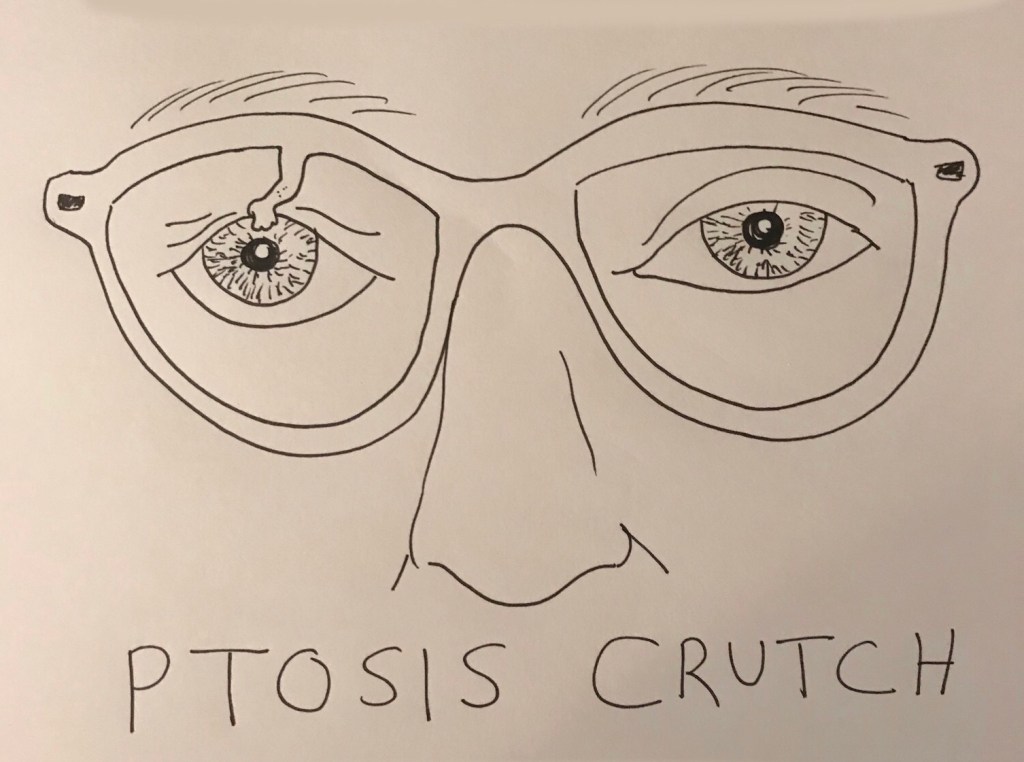
For us who wore the optician’s hat we dealt with nomenclature that pertained to making eyeglasses. Office terms were filled with double entendres. There was the “drop ball test”, a term referring to an ophthalmic lens’ breakability. Frames and lens were placed in “job trays”. I’m We were facile with pliers used for eyeglass adjustments. We were required to construct a Medieval device called the ptosis crutch that would literally elevate a patient’s droopy eyelids.

We had the task of fitting teenage girls with the teardrop-shaped plastic frames that contained sparklies.  The boys wore dull, drab plastic frames.  We knew half of the kids rarely wore their glasses.  Middle school peer pressure has that effect.

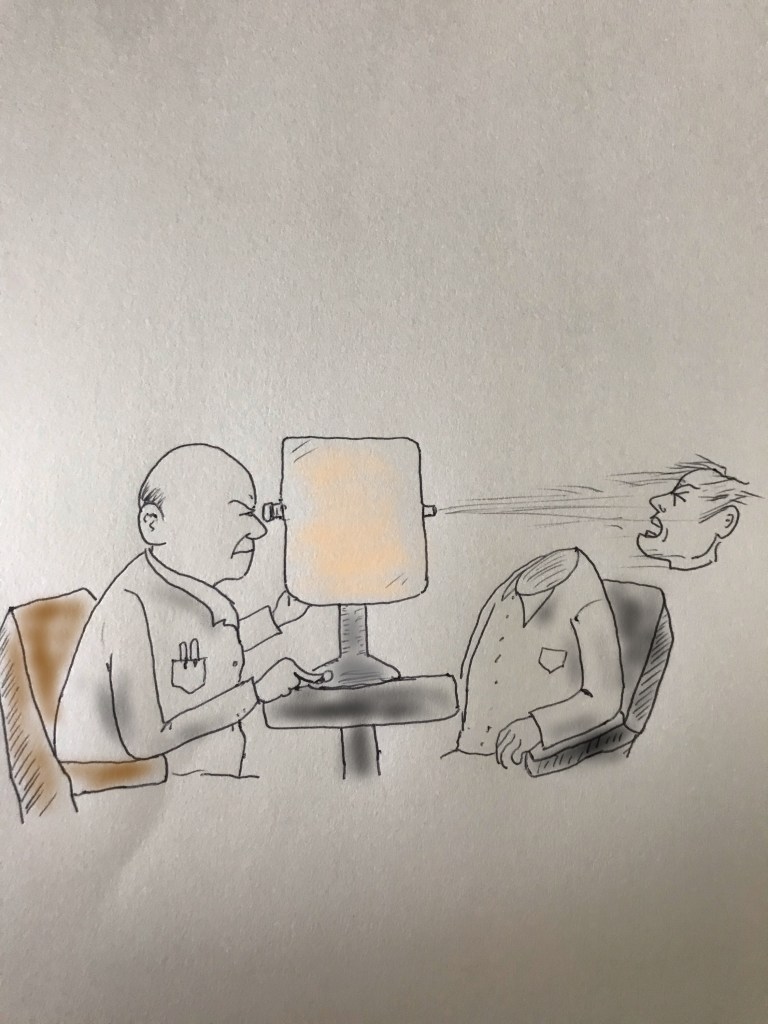
When switching to medical mode in the examination room there were other terms evoking internal laughter: the “muscle light” to diagnose eye turns, the phoropter – the device resembling a periscope – had a “near point rod” that assessed near vision. Examining the eye’s internal contents we evaluated the area of central vision, the fovea, that contained rods and cones.

Stewart’s Near Point Rod

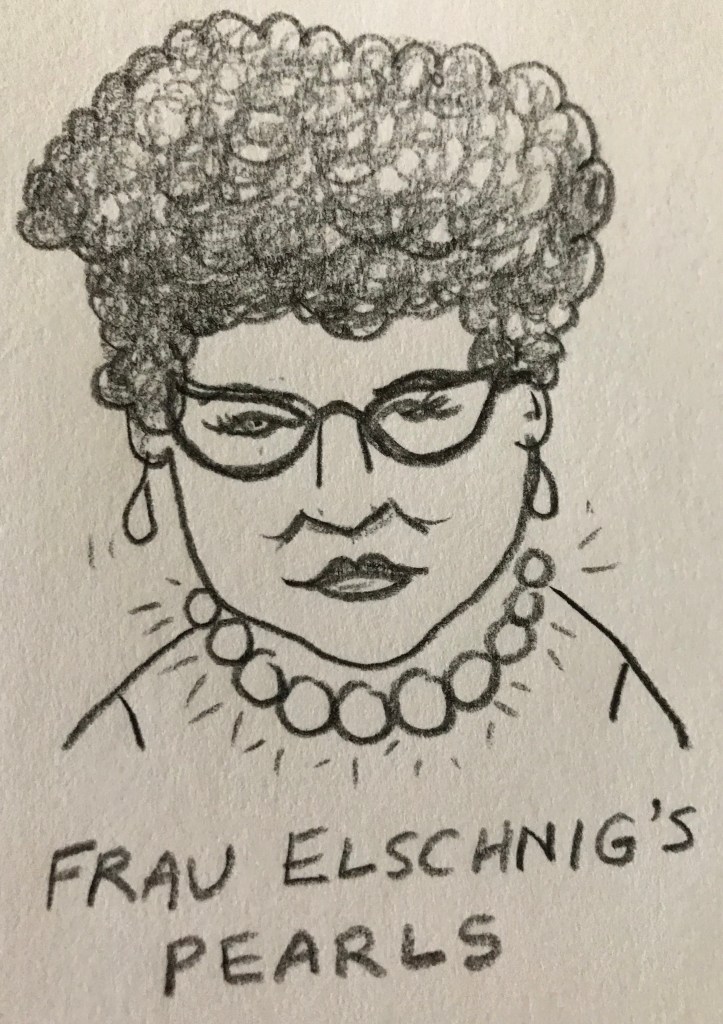
There were oddly-named medical conditions – drusen of the optic nerve head, Elschnig pearls, eyelid nodules, Hudson-Stahli lines and cutaneous horns- a dermatological condition. Iris bombe, a physical defect of the iris.  I always imagined a Punjabi pronouncing the term in high falsetto.   The oddly named vitreous humor was the gelatinous, clear fluid that filled and gave shape to the eye’s internal contents.  It was also the source of those pesky things known as “floaters”.

The real Elschnigs are in the eye

During that era, ophthalmologists contended optometrists were ill-educated and undeserving of professional recognition.  We were purportedly more interested in selling eyeglasses than assessing ocular health.  In some cases they were right.  The geezers were sometimes slipshod.

But the medical mode optometrists were busily working. One of the most essential requirements was the ability to diagnose diseases such as glaucoma. Problem was a pharmaceutical numbing drop was needed for accurate measurements. The MDs efforts had forced the optometrists to purchase the expensive and dreaded “air puff” glaucoma test. Many patients had palpitations knowing they would “get the blast.” The puff test is still used but its accuracy has always been variable.

The dreaded “Air Puff” test

       The vanguard was led by North Carolina optometrists who successfully introduced a bill allowing them to use so-called diagnostic drugs.  Included in the new law was permission to use drops that dilate the eyes.  Their argument was there were fewer ophthalmologists and more optometrists in rural areas. With such drugs they could thoroughly search for pathologies within the eye.

       Predictably, a domino effect was created.  State-by-state  similar bills were passed until 49 out of 50 states had diagnostic laws.  Which state was left?  Massachusetts, of course.   Ophthalmologists were a powerful group and annually paid lobbyists and key legislators to squelch any drug legislation.  They published a pamphlet whose motto was : “M.D., The Major Difference” that included articles where optometric incompetency supposedly had blinded patients.

       It took money and pressure but in 1987, the profession had counter-lobbied and raised campaign funds for sympathetic lawmakers.  The diagnostic drug had finally made law.  Sardonic glee raged through optometry offices across the state.  David slew Goliath.

       North Carolina and other states pushed the envelope further.  We have diagnostic drugs, now we want the right to use therapeutic drugs for red eyes and external and internal infections and pathologies.  The rationale was, unlike Massachusetts that has a plethora of ophthalmologists, many states have fewer.  Massachusetts again the last state to follow.  The therapeutic bill became law in 1997.  The irony was that many optometrists who worked in hospitals or M.D. offices had been using the various drugs before the laws were passed.  The rest of us needed the official imprimatur.

       For the private practitioners the sweeping changes were a double-edged sword.  We could use the drugs but we also were required to purchase or lease incredibly expensive diagnostic equipment.  Insurance companies had insinuated themselves in health care and required “standard levels of care”.  Translated: if you don’t use the equipment you were subject to disciplinary action.  The fearsome specter of malpractice suits was omnipresent.

On the optical front there were also winds of change.  It was a Chinese wind.  Slowly and methodically, American frame manufacturers were closing.  New England was particularly affected.  Companies such as American Optical (AO), a long-established Southbridge MA-based company, stopped making ophthalmic lenses and eventually frames.  AO was famous for the geek plastic frames – think Revenge of the Nerds- and the semi-metal frames that every male high school teacher wore. It was purchased by a conglomerate and eventually disappeared.

Rhode Island was another state that was home to famous frame manufacturers. Those companies suffered a similar fate. By the 1990’s American-made frames and lenses were endangered species and finally extinct. The predictable source of this was cheap labor.

The optical industry was flooded with frames made in Hong Kong. Today, most frames, even high-end designer frames including Ralph Lauren, Ray-Ban and Tiffany, are stamped with “Made in China”. The only competition left is in Europe – Italy, France and Austria. As with everything else, the Chinese have become the Russian trawler of the optical industry. Naturally, they have monopolized manufacturing of optical lenses, too.

Compounding the problem for private practitioners are companies that are offering online eyeglass sales. Lowball outlets – Warby Parker et al have impacted optometry.  They sell cheap Chinese frames and lenses for less than $100.  Other online retailers sell eyeglasses for less. 

And so today the predictions made in 1981 have become reality.  A typical optometrist wants nothing to do with eyeglasses.  Doesn’t know or care about fitting eyeglasses.  Dealing with “merchandise” is odious.  It’s optical leprosy.  That’s left to the technicians and opticians who work “in the store”.  Optometrists fit contact lenses, but, again the technicians perform the training and instructing.

The polyester leisure suits and alligator shoes are gone.  Soup-stained neckties are a thing of the past although halitosis continues.   In many clinics the predictable white doctors’ jackets are de rigueur.  The chief distinction is we have “O.D.” after our names; the ophthalmologists still have “M.D.”.  The major difference.  Whatever.  The medical model optometrists have achieved their goals.  The profession can treat glaucoma. The underpinning of this is economics.  Optometrists can bill insurance companies for glaucoma treatment and reimbursements are profitable.  Again, in 49 out of 50 states optometrists can diagnose and treat glaucoma.   Which state cannot?  Yup, Massachusetts today is still the holdout.  Some things don’t change.

Paper Or Plastic?

Paper or Plastic?

By

Leo de Natale

          The Covid-19 virus has upended the American economy and one medical group, plastic surgeons, is in a tizzy.  The surgery these folks perform has gone the way of all medical care.  During the past three months there have been no face lifts, no Botox injections, no laser peels.  No boob jobs, no nose jobs, no tummy tucks, no buttocks enhancements.  Life has been tough on this group.  Plastic surgery is an extremely profitable subspecialty of dermatology but here’s the hitch: it’s fee for service.  Patients pay big bucks for these procedures  but there’s no money to be made when a pandemic comes along and pulls the plug on elective surgery.  Until restrictions are lifted these vainglorious persons are wearing paper, not plastic masks.

          Poor Dolly Parton and Cher can’t have their lips reinflated.  Sandra Bullock, fresh off facial surgery, is shilling for Olay.  Dennis Quaid is hawking insurance after his face lift.  His face has an obviously different appearance.  There’s a debate over who had more plastic surgery: Wayne Newton or the late Kenny  Rogers.

           In Hollywood,   plastic surgery is a rite of passage, especially among female entertainers.  For aging actresses their careers are  hourglasses measuring the passage of time.  At around age 40, many feel compelled to  choose plastic surgeries  that will rejuvenate their physical appearance.  Some become obsessive and undergo multiple surgical procedures performed on many body parts.  It becomes a painful, masochistic addiction.  Cher is unapologetic about her war against aging.  And with lip injections, chin and facial implants they usually have the same  Barbie Doll look.

Other celebrities come to mind:  Meg Ryan, who at a comparatively young age, underwent mouth enhancement and was left with bass lips.  Actor Mickey Rourke appears embalmed, Donatella Versace is freakish and Priscilla Presley hired a K-Mart plastic surgeon who injected her cheeks with industrial strength silicone.  A once beautiful woman is disfigured and resembles a different person and Elvis checks into Heartbreak Hotel.

                    Another group affected by the plastic surgery interdict is the political class. It’s no secret Speaker of the House Nancy Pelosi has undergone facelifts.  Ditto Vice President Joe Biden.  Then we come to male hair transplants – the Land of the Plugs.  Biden and Senate Minority Lead Chuck Schumer have hair transplants.  Unfortunately they lack sufficient hair for a full procedure and waltz around with these pill box tufts atop their heads.  I’m sure neither man likes being photographed from behind because there’s a vast wasteland of barenaked scalp behind the shrubbery.

          To even things out politically it must be noted Fox News’ Dana Perino, Jeanine Pirro and Laura Ingraham have followed Hollywood protocol.  The surgical knife swings both ways.

          One can Google “Celebrities Who Have Undergone Plastic Surgery”  and view a plethora of A-list actresses and actors who’ve faced the scalpel, felt the Botox needles and suffered the burn of laser peels.  Plastic surgery inflicts pain. The procedures are extremely expensive but Hollywood denizens can afford the price.  

There was one internationally famous Brazilian plastic surgeon named Dr. Ivo Pitanguy who was so successful he purchased an island near Rio de Janeiro and built a private surgical center.  Patients traveled worldwide  and  were transported by helicopter to undergo the various surgeries.  He died an extremely wealthy man in 2016.

What most people don’t realize is the horrific origins of plastic surgery.  Ironically the story is the stuff of Hollywood.

In the late 19th Century, an Armenian immigrant named Varaztad Kazanjian escaped Turkish persecution. He is considered the godfather of a profession that is still classified as a subspecialty of dermatology. Schooled at a Jesuit academy in what was then the Ottoman Empire, he showed superior intelligence. His diaspora landed him in Worcester, Massachusetts. With humble beginnings, he first worked at a wire factory and showed remarkable artistic talent in shaping figures with this strange medium. Through many steps of good fortune, he found himself graduating from Harvard Dental School in 1905. He became a skilled dentist and had established a growing practice. He was interested in oral surgery. His life was forever changed, however, when the cataclysm known as World War I erupted.

          After the United States entered the war, Kazanjian volunteered his services and was stationed at field hospitals.  There he saw the carnage of war.  Soldiers were wheeled in with severe facial wounds.  Some had faces that were half-missing; others sustained disfiguring shrapnel wounds.  Some soldiers had severe facial burns. These unfortunate men became a hospital ward of the macabre.

Kazanjian’s career coincided with the emergence of oral surgery and he was in virgin territory while dealing with suffering soldiers who would be maimed or die without surgical intervention.  Modern plastic surgery was born in the trenches and death fields of Europe.

 Kazanjian had an incredible dexterity and a sense of aesthetics complemented his knowledge of facial anatomy.  He was at the fountainhead of creating new surgical techniques that would transform the specialty of dermatology.  His genius cast a long  shadow on  plastic surgery.

As a surgeon, Kazanjian found himself dedicated to saving lives and restoring  human faces to an acceptable appearance.  It was 20th Century alchemy.  The wounded soldiers were his guinea pigs and he  developed  the surgical techniques that have expanded during the past 100 years.  What he created out of necessity evolved into modern cosmetic surgery.

Kazanjian  returned to Massachusetts where he eventually joined the Harvard Medical School’s faculty and established and improved upon the techniques developed in field hospitals.  His son Kenneth followed him and became a pre-eminent plastic surgeon.  The father’s surgical acumen catapulted him to fame.  He was honored by numerous organizations and by his alma mater, Harvard.

Plastic surgery is an important specialty.  Soldiers burned and disfigured in the numerous wars that have been fought since 1917 and men and women injured in automobile or industrial accidents have benefitted from Kazanjian’s pioneering work.   For example, celebrity surgeon Sandra Lee (“Dr. Pimple Popper”) has demonstrated how cosmetic surgery improves patients’s physical and emotional quality of life.  

During the 1930’s, however, the mercantile aspects of Kazanjian’s success appeared. One of the first aesthetic plastic surgery procedures was rhinoplasty, aka a “nose job.”  How many of us have known teenagers or young adults with large, bulbous or aquiline noses who underwent such surgery.  It’s similar to orthodontia where crooked teeth, overbites-think Bugs Bunny – and underbites are corrected.  Middle school and high school children are familiar with that ordeal.

As the 20th Century wore on, plastic surgery exploded with new techniques for virtually any body part.  There have been advances in procedures and materials (silicone).  Lasers eventually arrived.  The instruments and chemicals used have transformed the specialty into a multi-million dollar industry.  Plastic surgeons are among the wealthiest physicians because, with few exceptions, it’s fee for service.  Patients have to pay for that facelift or boob job.  And for many,  having Botox injections, surgical facelifts and blepharoplasties have become de rigueur. 

  Celebrities, politicians, or aging wealthy Americans  are chasing their forbear, Ponce de Leon, in their search for the fountain of youth.  Do they ever reach their goal?

The pandemic has presumably caused significant revenue loss.  The surgeons will resume performing surgery as the protocol changes.  Given the universal hysteria caused by the virus,  many who were scheduled and those who want procedures are perhaps reluctant to contract the disease in an operating room.  The surgeons probably yearn for the halcyon days before the current pandemic calamity.

          The unfortunate reality is individuals undergoing cosmetic surgery have succumbed to self-delusion.  There are still many Botox addicts out there.  Their faces are visual masks.  But is it worth the money and pain in today’s world?  It is ironic in the Covid-19 pandemic era everyone is wearing anti-viral masks that transforms a person’s face into a mystery. Everybody is a stranger.   The pandemic has created an atmosphere where no one can tell if there’s a beauty or beast underneath those blue disposable paper masks. 

A Day At Market Basket

A Day At  Market Basket

By

Leo de Natale

 Market Basket, aka “The Basket”,   is one of the largest and most successful supermarket chains in New England.  The stores have become the Starbucks of supermarkets – they grow like weeds.  The success has been established by an intelligent marketing strategy:  Lower your prices and They Will Come.  Their parking lots are filled to capacity because shoppers are drawn to a place where groceries are one or two dollars cheaper than competitors.  They continually offer twofers and have their in-house brand of everything at cheaper prices.  It has been a formula for success for a business started by Greek immigrants.  Their annual sales are nearly $5 billion.

My wife and I shopped there when our staple goods were running low or we spotted an irresistible sale in their weekly flier. We typically accepted the mayhem that invariably existed there seven days per week.

          But along came Covid 19.  Until this week, I hadn’t shopped at a Market Basket – or any big box supermarket- since late February.  During those first days of pandemic panic, people became animals, especially at Market Basket.  There were fisticuffs among shoppers who were fighting over paper towels and toilet paper.  Television stations filmed police arriving at The Basket to quell continuous melees at the store’s entrance.  Store shelves were stripped bare of essential commodities.  Panic abounded. The stores resembled the former Soviet Union.  We have nothing, nyet.

As most Americans  hunkered down  and began rationing their Charmin and Bounty, fear set in.   “Do I dare venture to any supermarket and be infected?” many asked.  Buying necessities underwent a transmogrification.  First, people would find a store that offered home delivery, a solution that  sustained a quick death.  From a few days’ wait, the service was stretched to weeks.  I have one friend who waited a month for delivery.  What about food expiration dates?  Then along came curbside delivery allowing grocery pickup and avoiding the cooties inside the store.  That, too, was evanescent.  Employees quit or were laid off.  No more curbside.

Weeks turned into months and for many it was time to bite the bullet.  Armed with masks and rubber gloves,  shoppers would, with dread, venture to Market Basket.  There were news stories how isolated cases of Covid 19 virus had infected and killed employees.  Fear and panic exacerbated and was stoked by state and federal officials warnings of the dangers that lay with shopping.  Must wear masks, must observe social distancing, blah, blah, blah.

By June, people were impatient.  They wanted all businesses opened.  Supermarkets had been given special status, but thousands of men and women wanted haircuts!  There were so many long-haired ladies turning   completely gray. Men began resembling cavemen.  Open the salons and barbershops, goddammit.

With our staples running dangerously low, I took the plunge.  I drove to a Market Basket that purportedly was less busy than others.   It was about 30 minutes from home.  I arrived at 8:30 when most elderly were leaving – they were allowed special  hours to reduce virus exposure.

Equipped with disposable mask and rubber gloves, I ventured inside. All Market Baskets are similarly designed. Various groceries are located in familiar locations. The aisles had signs suspended from ceilings that demarcate where various groceries were located. The deli, meat and fish are always located at the back wall. There were, however, visible changes. The aisles had large red-arrowed floor signs designating one-way directions. I was looking for baked beans and, whoops, I was pushing my shopping cart the wrong way. I wonder if they had traffic cops railing against misguided shoppers. “Wrong way,” they’d shout. “If you want your tortilla chips and chili sauce you have loop around to Aisle 7.” I soon found myself placing the cart in reverse and walking backwards.

Traversing down the aisles I noticed there were still many elderly customers.  As I meandered down the aisles I said to myself, “Shit, this place is filled with geezers.” And then I realized I, too, was in this age category.  That’s the problem with aging.  You look around and say I’m not like “them”.  I’m in good shape for a septuagenarian.  Many times it’s difficult to identify with old, infirmed people.  In my self-deluding mind, I’m somewhere in my 50’s.  Not.

Nevertheless, I navigated through the supermarket and found most items on my shopping list – Ginger Snap cookies were sold out and my favorite marinara sauce wasn’t available. The deli counter was crowded. Little social distancing. My ticket number was 53; the frenetic meat slicer guys were waiting on number 40. A line too long. There’d be no mortadella, proscuito ( or “pros-cute-o to non-Italians) or capicola ordered today. I had to defer on my Italo-American fix this week.

Shoppers were maintaining  social distancing and I was concentrating on locating the necessary foodstuffs.   I suspended the angst so many people are experiencing in all  supermarkets or  such stores as Home Depot.  This particular store on this particular day wasn’t terribly crowded and I functioned with few distractions.  When I left the checkout counter and returned to the parking lot a revelation struck.

I’d spent 35 minutes in a place that is supposedly unsafe and potentially lethal if you contract the Covid 19 virus.  The ride home was filled with what-ifs.  Did I get too close to that old-timer in aisle 15  who was purchasing  Poligrip?   Was someone breathing on my Brussel sprouts in  the produce department?   How many  persons had pawed the egg cartons?

Perhaps the most insidious aspect of this Plague is the fear and angst  produced when you’ve been told to self-isolate.   The officials in Massachusetts have assume the role of Grim Reaper.  Live your life but at your own risk!   Ageism has been one of the most elemental fear factors stoked by these bureaucrats.   For me, it came to a point where I said, screw it, there are certain activities we humans must continue to perform.  And buying groceries is one of them.  We have to exercise a certain degree of caution but, sweet Jesus,  let us live our lives!

 After pumping myself with such positive thinking, I hopped into my car.  An onslaught of the recurring curse of this  pandemic unfortunately got the better of me.   While driving, I  experienced an unclean feeling  and rushed home.  I immediately removed my mask, disrobed in the garage, left my clothing by the washing machine and headed straight to the shower. 

This is the life we now lead where battling an omnipresent, lethal virus makes us cower daily. 

To paraphrase Hamlet, To mask, or not to mask, that is the question. Whether ‘tis nobler to stay at home and to suffer the slings and arrows of isolation, or drive to Market Basket and buy 2 for $5 Pepperidge Farm Bread loaves.  

The Toupee Store

The Toupee Store

By Leo de Natale

Illustrations by Vince Giovannucci

Francis Anthony “Frank” Capelli was one of those poor bastards who had the genetic misfortune of premature baldness. By age 22, his dark curly Italian hairline started heading northward. Each day as he peered at the face in the bathroom mirror, a few more hair follicles were Missing In Action.

By his mid-20’s he noticed a discernable change. His hairline was rapidly receding and panic began. Everyone in his Italo-American family – father, brothers, cousins—all possessed thick, full hair. Someone, he thought, in my family tree had passed this goddamned bald gene down to me! He became more self-conscious of his “curse” and began losing sleep. He often would awaken in the morning with hair follicles covering his pillow.

Naturally, the teasing began among Frank’s friends.  “Hey Franky, pretty soon you won’t need shampoo!,” said one wag.  This was Step 1.

          At the beach someone yelled, “Hey Frank, put on a hat.  Your head is blinding me. What, are you polishing that dome?”

          And on it went.  He became more self-conscious.  He did, in fact, begin the first phase of dealing with alopecia.  He started wearing baseball caps. He’d stare in the mirror and say, hey, that covers things up  “real good”.  But what to do while working in my office?  He had obtained a well paying job as a securities analyst in Manhattan and obviously couldn’t wear a hat while at work. He felt uncomfortable around the water cooler with his fellow employees.  Were they staring at his bald head?

By age 28, the receding hairline reached end stage. Terminal baldness. There I am, he said to himself, I’m the next George Costanza. Feeling depressed, Frank sought counseling. The psychologist was Dr. Bertram Holiday.

          “Doctor, this baldness thing is really affecting me,” he told Holiday.  “I feel as if everyone is looking at my shiny head.”

          Holiday, who was also bald, attempted to comfort this young man.

          “Frank, take it from someone who’s already there,” he said, patting his hairless pate. “Men and women perceive physical attraction from much different perspectives.  Women don’t find men unattractive if they’re bald. Or fat.  Not all men crave tall, curvaceous, busty women. Many men find flat chested or Rubensesque women physically appealing.  It sounds trite but beauty is indeed in the eye of the beholder.”

Despite several therapy sessions, Frank couldn’t shake the neurosis occupying more of his daily consciousness. After struggling with such mental calisthenics, he arrived at Step 2. He was given the name of an exclusive “salon” in midtown Manhattan. It was a by-appointment-only business called Louis XIII and located at a nondescript storefront just off Park Avenue.

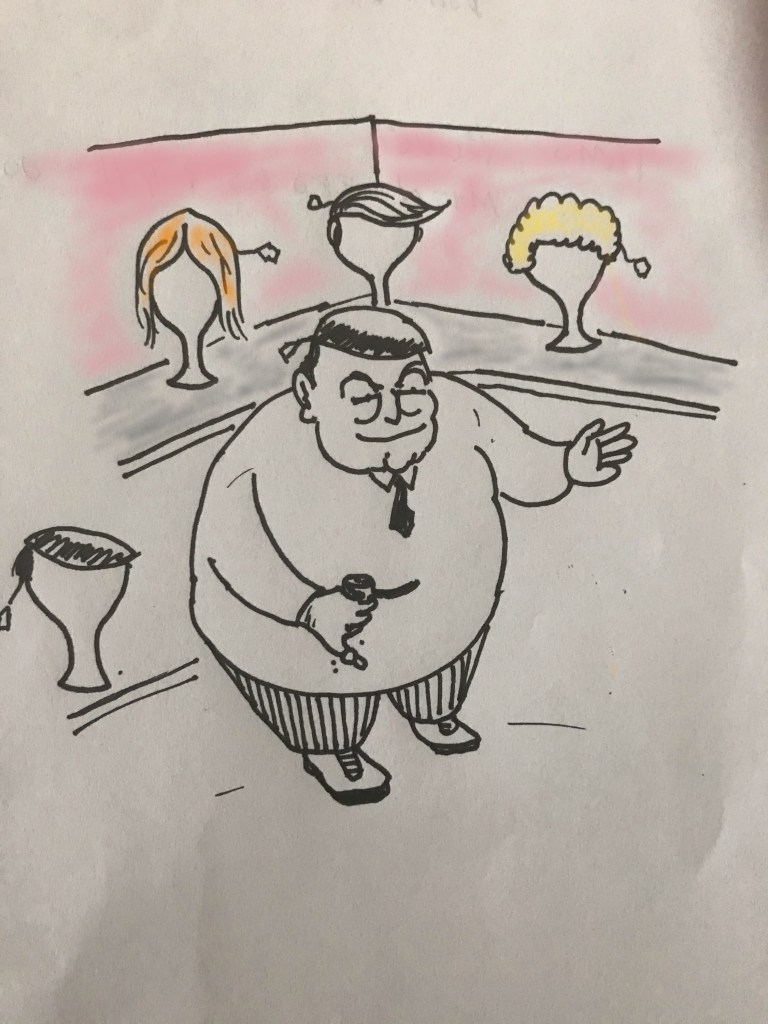
He opened the store door and was greeted by a short, elderly, well-dressed portly man named Hyman Kamens. “Call me Hy”, he said with a thick Brooklyn accent. He wore an overpowering cologne that nearly gagged Frank.

Hyman “Hy” Kamens

Hy was somewhere in his 60’s, had huge baggy eyelids and held an unlit meerschaum pipe in his left hand. His soft, pasty hands were adorned with star sapphire rings on both pinky fingers. Both hands were manicured and finished with clear nail polish. His teeth were yellowed from years of smoking but he had a friendly smile and a disarming manner. He knew why Frank was there. Frank noticed Hy was wearing a jet black toupee. To Frank’s surprise, the “piece” he was wearing still had a bobbling price tag label attached around the neckline.

“Franky boy, I know you’re looking at the tag,” he said. “I do that as a joke. Just for effect, Bubby! By the time you leave here, no one will know you’re ‘carrying’ a rug”. With that comment he dramatically pulled off the toupee revealing an very bald Hy. He tossed the toupee it against a mannequin.

          Hy asked Frank to sit in a comfortable lounge chair that faced a floor-to- ceiling mirror.  He spent 30 minutes measuring Frank’s skull and from various angles photographed Frank’s head with his iPhone.  He then uploaded the data and photos to a laptop. 

          “So Frank, let’s get down to decision time regarding the style,” Hy said.

He switched to another computer program and various celebrities’ heads popped up on the screen.                           

Frank was overwhelmed with the technology but more fundamentally aware he was potentially agreeing to a drastic lifestyle change. In his heart he knew wearing artificial hair was a Band-Aid, quick-fix solution to his problems of physical and psychological pressure young bald men endure. After all, Hy was bald and it didn’t appear to affect his outgoing nature. Salesmen usually have that ethos.

          “Gee, Hy, there are so many styles to choose from,” Frank said. “What do you think?”

          “Frank,” Hy replied, “You’re a good looking guy, a nice Italian boy.  With your hair color and complexion, I’d go with the Burt.”

Trusting Hy’s judgment, Frank opted to become the second coming of Smokey and the Bandit. Hy said fabrication would take two weeks. Frank was to return for delivery and special instructions. Step 3 was about to begin.

          Two weeks later, Frank returned to Louis XIII for the delivery.  He was still equivocating about the $6,000 expenditure.   With theatrical flair, Hy and his overpowering cologne entered the salon. He carried a blue velvet hatbox and placed the box on a table.  The coronation began.

          “Now close your eyes, Frank,” Hy said as he opened the box.  Frank complied and suddenly he felt a soft furlike object being pulled over his head.  “Open your eyes.  What do you think?”

          Frank gazed into the mirrored wall and was taken aback.  There he was, staring at a familiar face with  black 80’s style locks adorning his head.  It was certainly a different look and, from a distance, appeared natural.  He was a different man and it momentarily threw him back into the future.  So this is what I might have resembled for the past 10 years, he mused.  He had to admit  the toupee appeared natural.  At least to him.

          Frank relaxed and actually was pleased with the transformation.

“Ok, Frank, you look terrific,” Hy said. “Now, Bubby, I want to go over some rules and regulations about your new ‘unit’. Number one: on windy days make sure the unit is really secure. If it’s extremely windy – like Chicago—try to work from home. Number two: once a week, clean the unit thoroughly, especially in the summer, to avoid TO – Toupee Odor. Number three: on hot humid days always apply anti-perspirant to you entire head. Otherwise, people will notice what we call “the drip line” – you know, sweat soaking your real hair that will make the unit more noticeable. And number four, when you wear a hat, use the two-handed approach and remove the hat very, very slowly.”

          Hy gave Frank an avuncular pat on his right cheek.  “You’ll learn to love your Burt”, he said. “Go Bubby.  Live your life. Enjoy.”

          Frank left Louis XIII and felt very positive about his decision.  He noticed passersby as he walked up Park Avenue.  Heh-heh, these people will never know what’s underneath the rug.  Of course, he had already considered how he would handle reactions from his co-workers at the office.  He anticipated there would be kidding or giggling, but he was at a point where he didn’t give a fig.  Women wear makeup, dye their hair, wear uplift bras and no one criticizes.  He knew there’d be some flak, but it would subside.  He didn’t care.  His peace of mind was the number one priority, and his family was understanding and supportive.

          For one year, Frank had no regrets about his decision.   He started joining his work buddies at the countless dating bars in Manhattan.  Wearing the toupee had increased his confidence and he became less inhibited with women.  It wasn’t long before he began dating women at the clubs.  That’s when the glitches started.

It’s one thing to party with twenty-somethings but things change as intimacy grows.  He met a tall, beautiful, blonde and blue-eyed security analyst named Melanie.  Phone numbers were exchanged.  They began having frequent luncheon dates. Beside stimulating conversations, both felt a physical attraction. Soon, Frank had replaced his original “unit” for a new, odor-free model.  Step 4 was beginning.

Frank’s job responsibility was increasing along with his salary. He was quite good at financial analysis. Finally, he called Melanie and invited her to dinner at New York’s posh Village Green restaurant. He preened in front of his bathroom mirror and made sure the unit was securely in place. He splashed on a subdued cologne – even spritzed some on his piece. Frank regularly went to the gym. Physically he was in very good shape. He still had an athlete’s body. Decked out in an Armani suit, but tieless with a designer shirt, Frank arrived at Melanie’s Upper West Side apartment and taxied to the restaurant. Melanie was dressed in a stunning spaghetti -strap dinner dress and stiletto high heels. She was rapturous and her Chanel No. 5 smelled wonderful.

          The dinner was elegant, the wine delicious.  Coffee and dessert followed. 

Clearly there was animal magnetism between the two.   They returned to Melanie’s townhouse for a nightcap……. or maybe more.  The apartment’s design was contemporary. They quaffed brandy and sat on Melanie’s  leather Scandanavian sofa.  The more they talked, the more they liked each other.  She was of part Swedish, part German ancestry and grew up in Minnesota.  She seemed oblivious to the thing that was parked atop Frank’s head.  They sat closer together and lovingly stared into each other’s eyes.  And then, boom, Step 5 surfaced with a vengeance.

          They began kissing and when Melanie went to caress Frank’s hair he bolted upright and moved away from her. 

          “What’s wrong, Frank?” said a startled Melanie.  And then she stared closely at his head.  It was an Aha! moment.  

          “Frank, that’s not your real hair, is it?” she queried.  “Oh my god, you poor thing.  You’re living a make-believe life.  Why can’t you be yourself and avoid such a charade?  You’re being dishonest with yourself and me.”

          Recoiling in egregious embarrassment,  Frank began revealing what an irrelevant condition, baldness, had done to his psyche and his life.

          “I’m sorry, Melanie,” he said. “I feel like such a phony.  I don’t like pretending to be someone I’m not.  This makes me feel crappy.”

          Slowly, Frank stood up, grabbed his jacket and left.   All the depression and insecurities that had washed over his youth reappeared.  He called himself a fraud and the fairy tale The Emperor’s Clothes popped into his head.

          In reality, Frank knew a day of reckoning would arrive.  He knew deep down his fake hair would eventually cause more heartache and depression, Hy Kamens be damned.

          He texted Melanie an apology and regretted he didn’t possess enough self-assuredness to appeal to someone who was clearly an honest and forthright person.

That night, he grabbed the toupee, kicked it across his living room floor and tossed the “piece” into a trash can.  Step 6 had arrived.

          Interestingly, between the onset of Frank’s baldness and his jolting experience with Melanie, norms had changed.  Male baldness was becoming cool and acceptable.  Professional athletes were going with the Michael Jordan look. Baldness went mainstream.  Even Bruce Willis embraced his natural physical appearance.  Yeah, baldness, that’s the ticket.

          The following day, Frank went to his favorite barber who had been cutting his real hair very, very carefully.

          “Ok, Vito,” Frank said.  “Let’s do it.  I want a buzz cut, right down to the skin!”

Fifteen minutes later and after looking into the mirror, Frank left the shop with nary a hair on his head. This is the new and real me and he thought to himself, to paraphrase James Brown, say it loud, I’m bald and I’m proud!

          And he texted Melanie.  Again. 

Il Doppio Standard

Il Doppio Standard

By

Leo de Natale

The epigram “Life is unfair” is usually attributed to Robert F. Kennedy, the most pugnacious of the three Kennedy boys. He had an intimidating personality and, because he was the scion of a ruthless, calculating father, he usually found himself beneficiary of a deep scoop of “fairness”- at someone else’s expense.

       The Kennedy family and its prodigious wealth is symbolic of how those from the middle class are raised and educated with the notion that personal or financial success is attainable. However, many people’s dreams are never realized and they often find themselves falling short of their dreams.

       In America today, our social fabric is threadbare.  Yesteryear concepts such as etiquette, politeness, humanism and kindness towards our fellow man and woman are disintegrating before our  eyes.  Gone are the days when holding open a door for a stranger was routine. That simple, polite gesture today is the exception, not the norm.   The wealthy, the elite, the educated, ivory-towered academics hold themselves to different and better, standards.  Added to this mix is the snotty, entitled generation known as millennials.  This group is one of the major reasons why we’re becoming a nation of boors.

This is not a class warfare rant, but an examination of who we are as a nation today.  As the country grew during the 19th Century into a world power via the industrial revolution, vast numbers of the wealthy emerged in major Northeast cities, the Midwest, especially Chicago and California.  Many of that era dreamed of being the next Rockefeller, Carnegie, Wrigley or Huntington.   A growing middle class which would eventually include European immigrants were included in the pursuit of happiness.  Unfortunately the rise of African Americans, many of whose ancestors have lived here since Revolutionary times, has routinely been truncated.  This condition still exists.  Life continues to be unfair.

The beauty of this country, however, is there’s still opportunity for the dreamers who have sufficient intelligence and drive to succeed.  Of course, luck is always an ever-important ingredient.  Being at the proverbial right place at the right time.

There are several groups who are the contemporary robber barons.  Included are the superannuated Yankees and WASPS whose fortunes are old and well protected and who live off the estate’s interest.

  There are many images of this group:  the Ivy League educations, “cottages” in Newport, Rhode Island or Bar Harbor, Maine, debutante balls, yacht clubs and exclusive country clubs.  That was yesterday.

Today the millionaires still reside in Manhattan where stock brokers and financial money market traders are Wall Street denizens.

However, with the creation of the computer and internet, a new group emerged: Silicon Valley, home of software and hardware multi-millionaires.  Another group includes the most venal of the groups:  career politicians.  They are the parasitic hookworms of society.  Governance has devolved.  A common adage is a Congressman or Senator never leaves office impoverished.  Featherbedding has been a historically common habit among this group.

The changes have changed personal behavior.  Elitism is running rampant with these groups.  The Kennedy family fortune, for example, was based on Papa Joe’s bootlegging days and manipulating Wall Street to his advantage before the 1929 crash.  Kennedy established and improved  his wealth during the middle third of the 20th Century.  He crushed and ruined many in his ascension to success.  He purportedly coined the phrase “Do you know who I am” and his progeny have embraced it ever since.

The country has been balkanized.  There will always be the haves and have-nots.   The good old middle class has been a stabilizing force throughout the country’s magic carpet ride.   Citizens have been chugging along between and among the various Presidents who come and go. 

Unfortunately, we have undergone during the past five months  a seismic change in society and lifestyle.  The class distinctions among the elite has never been more blatant after the introduction of a bioterror virus made in, where else?, China.

The current pandemic has served to accentuate the differences between the publicans and Pharisees.  In this current situation, the governing class –local, state or federal – has assumed the mantle of de facto dictators.  They invoke arbitrary interdicts that have affected Americans financially, physically and emotionally.  It’s all in the name of protecting public health, they say.  Masks, social distancing, self-enforced isolation have been imposed.  Any yet many of these buffoons are card-carrying members of Il Doppio Standard, the Double Standard.

In Massachusetts, for example, Republican Gov. Charlie Baker and his sidekick, Lt. Gov. Karyn Polito have heightened fear by requiring the ubiquitous face mask be worn. While some states are relaxing various interdicts, the pandemic is real but the feeling here is statistics have been massaged. Meanwhile, thousands of workers have lost jobs, many businesses will likely close. All of this leads to financial pandemonium.

People cannot resume their lives.  Except, perhaps, if your last name is Polito.  In a highly publicized internet gotcha, Polito was caught at a large gathering at her family’s ritzy “compound” on Memorial Day, a holiday where parades and group festivities were canceled or outlawed.  Polito, known for hustling campaign funds to the highest bidder, was interviewed and so flummoxed she mimicked comedian Jackie Gleason’s “hamana, hamana, hamana” stammer.

Across the country politicians were also caught breaking the rules by engaging in activities that contradicted their draconian rules and regulations.  To wit, harridan Nancy Pelosi posing with her designer $12 ice cream located in a $25,000 Sub Zero freezer.

Hence, Il Doppio Standard.  Do as I say but not as I do. Both political parties engage in such arrogance.   Many Americans are becoming intolerant of such obnoxious elitist behavior as “Do you know who I am?”. 

Remember, as Bobby K said, life is unfair.

My, How Neighborhoods Change

My, How Neighborhoods  Change

By

Leo de Natale

In the winter of 1978 an infamously historic blizzard swept through New England and crippled the region, especially Boston, for weeks. The killer storm arrived swiftly and deposited nearly 30 inches of snow. Cars were stranded on highways. About 100 persons died and another 4,500 were injured. It wreaked havoc and caused approximately $520 million in damages.

       Anyone who experienced that cataclysmic event has a story and remembers where he or she was during the mega-blizzard.  Its impact has been seared into the memories of all who survived.  For seven days residents experienced back-breaking work of removing monumental snowdrifts.  All businesses were closed.  Only essential occupations, specifically hospitals and emergency health facilities were allowed freedom of movement.

Most people stayed at home and waited until an all clear announcement.  They were isolated and many experienced cabin fever.  An unusual phenomenon occurred.  Neighbors found themselves helping each other.  People who’d never acknowledged neighborhood residents said hello.  It was a strange silver lining to a frightening natural disaster.  After about one week conditions were improving.

       Of course comradery evaporated once the crisis had subsided.  Everything gradually returned to normal.  That evanescent period of neighborliness vanished.  No more hail fellow, well met.

Until this day, however, the mere mention of the word blizzard precipitates panic that is manifested by people elbowing each other at crowded supermarkets and grocery stores. Milk, bread, water, toilet paper, shovels, paper towels are usually sold out. No winter storm has dumped such gargantuan amounts of snow but the reaction is always the same: survival.

Fast forward 42 years. We are five months into the year 2020 and a different form of apocalypse has arrived. It is one that arrived in late January/early February. It is a far more ominous apocalypse and has instilled greater fear than an isolated blizzard. It is known as Covid-19, a virus exported from Communist China. Its origin is unknown but bioterrorism seems to be the most likely cause. The virus has infected the entire planet and has been labelled a pandemic.

       During winter 2020, countless died, jobs were lost, the nation’s economy suffered and Americans were forced into self-incarceration.  Panic arose, and, just like the Great Blizzard, people began raiding grocery and big box stores for, you guessed it, toilet paper, milk, bread, etc.  Oh, but throw in hand sanitizer and rubbing alcohol.  In the Northeast, the weather was unusual.  Significant snowfall and/or blizzards did not occur but the weather was miserably cold and extended into May.  It was easy to stay indoors. 

Homes with parents and children became trying because school systems – elementary, middle and high schools were closed. Higher educational institutions also furloughed students. It was a year where students were home-schooled and relied upon online education. College students were paying $50,000 tuitions for a University of Phoenix education. No one knows if this will be tenable. America has too many colleges and universities. Perhaps second and third tier institutions will suffer the same economic fate as many Roman Catholic churches were forced to close following the pederasty sex scandals.

It’s also unknown how long wearing masks and rubber gloves will continue.  Ditto for “social distancing”.  In the meantime, however, history is repeating itself.  We’ve reverted to 1978.  In neighborhoods in New England and presumably across the entire country, neighborliness has returned.  More people are walking in the ‘hoods.  Behind the masks, pedestrians will stare at strangers and offer a friendly wave or a muffled “hello”.  It’s a “We’re all in this together” subliminal message.

Behind the various colored and patterned masks are eyes of strangers who are yearning for human contact.  Walking and running are the most common forms of exercise.  All gyms and fitness clubs are closed.  Most folks don’t own indoor treadmills or similar exercising equipment.  For most of us it’s been walking, walking, walking.

This fraternal experience, however, does have limitations. Yes, the walkers are there but there has been an explosion of dog walking, too, and that’s the difference between 1978 and 2020. During the blizzard, walking the family dog was quick and dirty. Out for pee and poop, then back inside. It was cold and all were snowbound. Most dog owners didn’t have the inclination to walk Fido any longer than necessary. But now, the canine factor has raised ire among persons living in towns and cities. The problem? Some dog owners lack manners and etiquette. You’ll see them walking their dogs, using the “Flexi-lead”, a spring-loaded leash that allows dogs to walk farther distances from a typical six-foot leash. These owners are multi-tasking. Many walk their dogs while gazing hypnotically at cell phones. They are oblivious to their locations or their dogs. To varying degrees, we’ve all become “blast victims”.

What happens?  The dogs wander from a grassy sidewalk strip on to manicured lawns.  These semi-untethered dogs  urinate on front lawns; some defecate, too.  Owners  haven’t a clue it’s uncool for your dogs soil on private property.  There’s a sub-group called the “Night Walkers” who walk the dogs in the dark.  These sneaky people allow their pets to defecate on lawns and don’t collect the mess.  Night walkers have unfortunately always existed, pandemic or not.  Some things never change.

When the pandemic eventually is conquered, human beings will predictably return to normal habits.  Neighbors strolling  and dogs walking will vanish.  People will resume driving off to the supermarkets or big box stores.  Traffic jams and road rage will reappear.  We’ll soon forget the moment in time when empathy for fellow men and women rose, when we appreciated the frontliners – hospital staff, mail delivery workers, trash collectors, supermarket employees, police and firefighters and all the good people who survived an evil Plague and remain imbued with the kindness that is often unappreciated or ignored. The blizzard of ’78 and the 2020 pandemic are touchstones of survival.  Never forget them.  Catastrophes always recur.

“Where Is Everybody Redux?”

“Where Is Everbody Redux?”

By

The world, spring 2020

Leo de Natale

I was parked in downtown Boston on a beautiful May afternoon. My wife had an ophthalmology appointment. I drove to the office near the city’s Government Center. Our dog, Kaiser, an aging German Shepherd Dog, came along for the ride.

       In the midst of this Covid-19 crisis, I sat in the car, windows open, but not wearing the ubiquitous mask (I wear it when walking).  Kaiser and I sat and waited.  It was a 1 pm appointment but office visits usually last about two hours, most of which is spent in a waiting room.

With the windows down I observed a significantly reduced number of pedestrians. Two panhandlers walked near my car. “Can you spare some change?” asked an obese, unmasked street person. Shook my head, sorry, not today was my terse response. Nearly all passersby were wearing masks of various design and fabric. It was a scene that had become the norm after nine weeks of worldwide panic and shutdown.

City traffic was lessened, too. I rarely find a parking spot on this busy thoroughfare. Fewer people, fewer cars. A palpable tension could be seen in body language and in people’s eyes. Kaiser, of course, merely stuck his snout out a window and enjoyed the sights and scents. Unaware of the pandemic, he was very relaxed.

I was reading a Scandanavian noir thriller and suddenly my mind began wandering. The isolation and fear that had swept across the United States reminded me of The Twilight Zone, an iconic, classic sci/fi, paranormal show televised during the late 1950’s and early 60’s. In fact, it was the program’s first episode that came to mind. It was entitled “Where Is Everybody?” and starred actor Earl Holliman. I remember watching the program. I was a young teenager who was completely enthralled. The entire Twilight Zone series, filmed in black and white, left an indelible impression on me and millions of others.

       Holliman portrays Mike Ferris, a military man, who agrees to an experimental hypnotic assignment.  When he awakes, he finds himself in an apple-pie town of Oakwood, USA.  The day is similar to the one I was experiencing: warm, a slight wind, and blinding sunlight.

Earl Holliman: “Where is everybody?”

Holliman is bewildered. The town is similar to his hometown with a main drag, shops, parked cars and a diner. What bothers him is the absence of people, no human beings anywhere. He enters the Main Street diner. A juke box is blaring music, the grille is hot and a burger is on its way to being overcooked. The music is the only sounds he hears. He yells to see if any employees are present. No one. Just the blaring music.

Throughout the 30 minute program, Holliman becomes increasingly frantic.  He wanders through the city.  Not a soul in sight.  The show ends with Holliman in a telephone booth (they existed back then) punching the keys, trying to call someone.

       The climax immediately occurs. He is awakened by military hospital personnel.  They explain he’d been subjected to a drug causing sensory deprivation.  He certainly had experienced the phenomenon.

We have no knowledge of when our “normal” lives will return, when we can appreciate the interaction between and among human beings. Who knew 60-plus years ago Rod Serling would write a teleplay that in so many ways depicts what is happening to our country and the world? We all wander through this strange time asking “Where is everybody?”.

So here we are today, millions of Mike Ferris’s wandering around cities and towns. We are surrounded by other humans but for many of us the effect is eerily similar to the program. We maintain our six-foot personal space and we wear masks that hide the identity of those wearing them. People are, in a modified way, non-existent. Instead of wandering through Oakwood, many of us are in voluntary isolation. We stay home, talk to only spouses, children or roommates. We are told to avoid crowds, shopping centers and, like Mike Ferris, diners. We are all dealing with self-imposed isolation. Human interaction has been reduced to computer teleconferences.

“Submitted for your approval”

A Modest proposal

A Modest Proposal

By

Leo de Natale

Albany, NY — Boisterous Gov. Andrew Cuomo, intrepid in his fight against the Covid-19 Plague, has just announced yet another ban. From May 4, 2020 forward, all males living in the state will be forced to eliminate facial hair – beards, mustaches, goatees and sideburns.

“According to the CDC (Center for Disease Control), facial hair among males can represent a serious threat to the general public,” Cuomo declared in his usual screaming, bellicose voice. “This form of male/macho expression represents a legitimate threat to the spreading of Covid.”

          Cuomo elaborated that facial hair of all shapes and styles are “petri dishes” filled with bacteria, lice and, yes, the dreaded virus.  He said the full beards, whether a Garibaldi, Pavarotti,  Gabby Hayes or Hell’s Angels style must be removed.  He also insisted beard styles known as the Zappa (after the late rock star) and the Col. Sanders goatee  will also be outlawed.  Mustaches, whether they be filmaker John Waters’ pencil or an actor Sam Elliot’s soup strainer, must also be removed.  Cuomo, expecting some blowback, also included Orthodox Jewish beards and sideburns known as “peyos”.  They  must be shorn.

          “I know I’m gonna get a lot of heat for this,” Cuomo said. “But it’s more important to eliminate any public health hazards.”

          There have been immediate protests and condemnations for what many bearded men called Cuomo’s Covid 19 pronouncement unilateral and biased.

          “He’s gonna be paid a ‘visit’ by many of our members,” decried  Mike “The Anvil” Brockton, president of the Greater New York Hell’s Angels. “Cuomo better watch out.  He’ll get one of our club tattoos, free of charge, and it won’t be pretty.”

          Legal experts question the constitutionality of what many critics says is an infringement on their physical appearance.  Many men prefer the bearded look.  Like the Hell’s Angels, the Amish and Mennonite religions require a hirsute appearance.  Growing a beard is a rite of passage, an Amish spokesman from Lancaster, PA said.

          Rabbi Hyman Goldberg of Brooklyn, is from Temple Mishkan  Shalom. He decried Cuomo’s decision.  “This is an anti-semitic act,” he boomed in front a crowd of cheering, bearded Orthodox Jews. “Our beards are a God-given right!”

          Some gentlemen from Harlem refused the swab test and stated this was merely a racist attack against black men, many of whom sport facial hair.  What Cuomo didn’t realize from this overreach, was the effect it has had on men across New York State.  Men of different races, religions and socioeconomic backgrounds have united in the protests at the Albany State House.

          Cuomo was justifying the decision based upon tests performed by New York’s regional (CDC) office in Manhattan.  According to the governor, CDC workers randomly stopped bearded men and requested a swab test.  The beards were of varying lengths from three day’s growth beards popular  among the city’s gay population to Grizzly Adams-type full length beards. The report showed a minute percentage of men’s beards tested positive for the virus but they also found mites and  dried beer and wine deposits.  A few men had remnants from various meals eaten prior to the swab test.

          “We’re here!  We’ve  got hair! We are manly men, Cuomo!” they repeatedly shouted at a state house protest.

          A curious aspect to this event was the disclosure that Cuomo and his family own considerable stock in Proctor and Gamble’s Gillette Shaving Division.  State Republicans are calling for a complete investigation into what appears to be a conflict of interest.  Cuomo, who was filmed shaving,  has declined comment.